
ACC vs PCC Coaching: The Difference Between ACC and PCC, From a Mentor Coach’s Chair
What is the difference between ACC and PCC coaching?
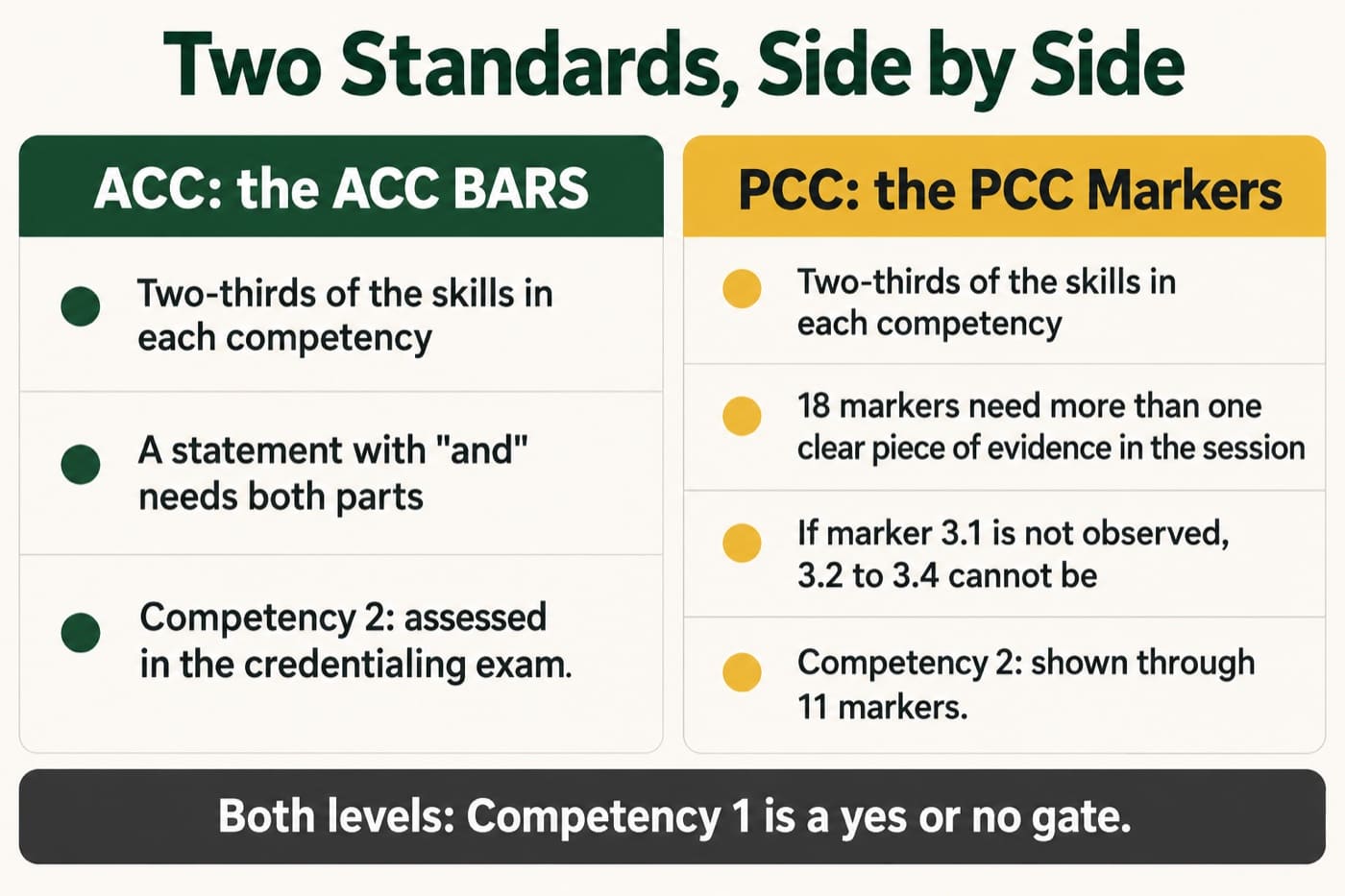
ACC and PCC coaching are judged against two different ICF standards: the ACC BARS and the PCC Markers. Both levels require two-thirds of the skills in each competency, but the counts and the evidence rules differ. From a mentor coach's chair, PCC coaching usually goes deeper, with more exploration and more focus on the person.
I'm Cherie Silas, a Master Certified Coach (MCC) with the International Coaching Federation (ICF), and I train mentor coaches at Tandem Coaching Academy, the coach education side of our company. We sell that training, which you should know before you read on.
When I review a recording, the difference between Associate Certified Coach (ACC) and Professional Certified Coach (PCC) coaching comes down to the document I'm listening against. How I listen is in the ACC BARS (Behaviorally Anchored Rating Scales) or the PCC Markers. That's what I'm listening for, and that is the distinction.
So that's where I'll start: what each of the two ICF coaching credentials asks for in a session, what I hear when a coach is working toward ACC or PCC, and the two misjudgments I see from the mentor's chair. One belongs to mentors, and one belongs to the coaches they mentor.
Key Takeaways
- ACC coaching is heard against the ACC BARS and PCC coaching against the PCC Markers: two documents, with different counts per competency.
- Both levels need at least two-thirds of the skills in each competency, shown in at least one observed session. At PCC, 18 markers need more than one clear piece of evidence within a single session.
- Competency 1, ethics, is a yes or no gate at both levels, and Competency 2 is never tallied by a mentor coach.
- Mentors who coach at PCC level can hear PCC-level misses in an ACC session, so each missed opportunity has to be checked against the ACC BARS.
- In my experience, coaches usually think they did worse than the recording shows; the competency is much wider than asking questions.
ACC and PCC Coaching Answer to Two Different Standards
ACC and PCC coaching are heard against two different documents: ACC coaching against the ACC BARS, PCC coaching against the PCC Markers. PCC is a whole different set of requirements. What demonstrates PCC is meeting those markers and the competencies, and that's very different from ACC. It's a different standard.
Some things are shared. At both levels, ICF asks for at least two-thirds (67%) of the skills in each competency to be demonstrated at a competent level. The line is drawn per competency, so a strong competency can't make up for a weak one. A skill counts as demonstrated when it shows up at a competent level in at least one observed coaching session. ICF credentialing treats ACC and PCC as two professional standards, each with its own statements and its own Competency Review Form, and that is how a mentor coach has to hear them.
I also explain the depth through experience. Look at the hours: the ICF ACC credential requires 100 hours of coaching experience, and the PCC credential requires 500 hours. That's five times more experience than an ACC coach, and five times more experience should translate into a deeper level of coaching. When a coach moves from ACC to PCC, the hours go up and the standard changes with them. The inference from hours to depth is my own reading.
Everything else about ICF coach certification lives in other posts on our site. The ICF ACC requirements and ICF PCC requirements posts walk through the ICF certification process. The hours are there: coach training hours and the hours of coaching education, then mentor coaching hours and the 500 coaching hours, with how many of them must be paid. So are the steps of an ACC application or PCC application. If you already hold a credential, see how ACC and PCC renewal differ. Here I stay with the coaching itself.
What the ACC BARS and the PCC Markers Ask For at Each Level
The ACC BARS and the PCC Markers both sit on the eight ICF Core Competencies, and both look for the ability to apply the ICF Core Competencies in a recorded coaching session. They part ways in the statements under each of the coaching competencies, in how many of those statements a coach needs, and in the evidence rules. Here is the count for each competency, from ICF's Competency Review Forms, with the two levels kept apart.
| ICF Core Competency | ACC BARS: statements needed | PCC Markers: markers needed |
|---|---|---|
| 3. Establishes and Maintains Agreements | 3 of 4 | 3 of 4 |
| 4. Cultivates Trust and Safety | 2 of 3 | 3 of 4 |
| 5. Maintains Presence | 3 of 4 | 4 of 5 |
| 6. Listens Actively | 2 of 3 | 5 of 7 |
| 7. Evokes Awareness | 2 of 3 | 6 of 8 |
| 8. Facilitates Client Growth | 2 of 3 | 6 of 9 |
Read down the two columns and the shape changes. At ACC, four of the six competencies need two statements out of three. At PCC, Listens Actively, Evokes Awareness and Facilitates Client Growth each carry seven to nine markers, and a coach needs five or six of them. Competencies 1 and 2 aren't in the table, because neither is counted this way.
Then come the evidence rules. At PCC, 18 markers need more than one clear piece of evidence before they can be marked, including all eight markers in Evokes Awareness. That evidence has to come from inside one session: ICF has said evidence for a marker can't be added up across sessions. The ACC BARS have no equivalent rule. The PCC Markers also chain Competency 3 together. If marker 3.1, which establishes the session goal, isn't observed, markers 3.2, 3.3 and 3.4 can't be observed either. The ACC BARS have a rule of their own: if a statement includes “and,” both parts must be present to meet the standard.
Ethics works the same way at both levels. Competency 1, Demonstrates Ethical Practice, is a yes or no gate, and strength elsewhere can't offset it. Competency 2, Embodies a Coaching Mindset, isn't rated from the session at ACC; the written ICF credentialing exam evaluates it. At PCC it shows up through 11 markers borrowed from other competencies, and ICF has said Competency 2 is not scored. Either way, a mentor coach has nothing to tally for it.
MCC is a third standard, with its own BARS and its own count per competency. At MCC level, an MCC coach is heard against that third document. Mentoring toward the MCC credential is a different conversation, and I'm leaving it for another article.
What I Listen For: Surface and Problem, or Depth and Person
If you ask me what the difference sounds like, the only thing I could say is that ACC could be more at a surface level, more focused on the problem. Could be. PCC is going to go deeper, and it's going to focus more on exploration and more on the person, not the problem they're trying to solve.
I hold that loosely. It describes where a session's attention tends to sit, and the standard itself is in the documents above.
Our own course data shows how differently people learning this work hear the same recording. In the feedback on submissions to Tandem's Mentor Coaching Foundations course (161 students in the English course, May to October 2026), every student analyzes the same 25-minute recording, which the course presents as a PCC-level demonstration, and names the competencies they heard as strengths and as gaps. Across 132 first attempts, Establishes and Maintains Agreements was named as a strength 119 times (90%) and as a gap 19 times. Evokes Awareness was named as a strength 113 times (86%) and as a gap 78 times (59%), more often than any other competency.
The story behind those readings is in how students heard one 25-minute recording.
If you're reviewing your own recording, try one question at the moments where you followed the client's problem closely: would exploring the person have changed what the session shows?
One Behavior That Can Clear Eight Misses
When I go through a recording with a coach, a lot of times it's this: if you just focus on the person, it's going to clear up these eight things you missed in this recording. It's one behavior: focus on the person.
You don't have to say something to meet this, this and this. That's why the conversation around behaviors is important.
Picture a coach reading feedback with eight separate gaps on it. “Focus on the person” is one thing to carry into the next recording, and the next review shows whether those gaps closed.
When Mentors Who Coach at PCC Level Review an ACC Session
The gap between the two standards shows up on the mentor's side too. In the Mentor Coach Specialization (MCS) training I teach, I find mentors in training are often citing missed opportunities on ACC recordings, but the missed opportunity they're describing is at the PCC level, not the ACC level. They're having a hard time separating the way they coach, at the level they coach at, from the expectation of ACC.
Calibrate on Both Standards
Our Mentor Coach Specialization training works through recordings against the ACC BARS and the PCC Markers, so you review at the level the coach is working toward.
They're looking at an ACC session and basing it on what they know PCC to be, even though they may not know the markers yet, because they coach at a PCC level. So their expectations may be higher than the level they're reviewing. That's something else we have to calibrate on.
These are experienced coaches, and that is why it happens: they hear the session through their own coaching. The missed opportunity they name may be real at their own level and still be no gap against the ACC BARS. So before a moment goes on the Session Observation Form as a missed opportunity, check it against the ACC BARS.
Their expectations may be higher than the level they’re reviewing.
Familiarity plays a part too. The participants who had mentored before knew the PCC Markers, because that was the standard they had mentored against, and they actually had more trouble assessing against the ACC BARS than against the PCC Markers.
Almost all of the participants in my first cohort had never seen the ACC BARS, which I wrote about in my piece on what makes a good mentor coach.
A mentor coach reviews against the standard for the level the coach is working toward, whatever level the mentor coaches at, PCC or MCC. The ICF rules behind that are in what ICF requires of mentor coaching. That's why calibrating on both documents is part of how we train mentor coaches.
Why Coaches Often Think They Coached Worse Than They Did
The opposite mismatch happens on the coach's side. Coaches often think, “I can't do anything but ask questions,” or “I did too much,” or “I was leading.” And really, they're showing a higher level of skill than they think.
It's natural. But they've locked themselves into “I'm a coach, I can only ask questions,” and they don't realize that the competency is much wider than that. That's usually where the mismatch comes in. They usually think they're doing much worse than they are.
They usually think they’re doing much worse than they are.
Say a professional coach finishes a session and thinks, “I did too much.” The recording shows whether they did too much, or whether they used the wider range the competency allows. Your coaching skills may be wider than the picture you're holding of them, and the recording, heard against the right standard, settles it.
So when you debrief your own session, ask where “I did too much” comes from. Did you hear it on the recording, or did you expect more from yourself? And which standard are you reading your own coaching against? If you're an ICF coach working toward ACC or PCC and want someone else to hear it, that's what our mentor coaching for ICF credentials is for.
Mentored at One Level, Applying at Another
The two standards also matter when the level of the mentoring and the level of the application differ. ICF has said, in a live call with ICF Credentials and Standards staff in August 2026, that a coach may be mentored above the level they are applying for. The mentor coach has to hold the MCS at the level being delivered, and the two-thirds line has to be met at that level. A PCC-level MCS holder can't complete ACC-level forms without also holding the ACC MCS.
If the evidence isn't there at the higher level, ICF has said the evaluation is redone at the lower level, and the same recordings can be reused. Each evaluation uses its own standard and that level's Session Observation Form and Competency Review Form. The post on the ICF portfolio path covers what this means before a credential application goes in.
So on the way to earning an ICF credential, ask your mentor coach which levels they hold the MCS at. Alex Kudinov and I hold the MCS at all three levels, and every mentor coach on our team holds it at the level they mentor.
If mentoring is the next step in your coaching career, hearing each level against its own standard is a trained skill. Tandem's Mentor Coach Specialization training program trains mentor coaches on both the ACC BARS and the PCC Markers, and it is accredited under ICF's Advanced Accreditation in Mentor Coaching. For what the specialization asks at each level, start with the ICF Mentor Coach Specialization.
Questions About ACC and PCC Coaching
Is PCC coaching just ACC coaching with more hours?
PCC asks for more hours, and it is also a different standard. ACC coaching is heard against the ACC BARS and PCC coaching against the PCC Markers, with different counts per competency and evidence rules that apply only at PCC, such as the 18 markers that need more than one clear piece of evidence in a single session.
Do ACC and PCC use the same two-thirds rule?
At both levels, at least two-thirds of the skills in each competency must be demonstrated, and a skill counts when it shows up at a competent level in at least one of the observed coaching sessions. The number of skills in each competency is set separately at ACC, PCC or MCC: Listens Actively, for example, needs 2 of 3 at ACC and 5 of 7 at PCC.
Can I be mentored at PCC level and still apply for ACC?
ICF has said yes. A coach may be mentored above the level they apply for, as long as the mentor coach holds the MCS at that level. If there isn't enough evidence at PCC level, the evaluation is redone at ACC level with the same recordings.
Why does my recording sound weaker to me than to my mentor coach?
In my experience, coaches usually think they're doing much worse than they are. They lock themselves into “I can only ask questions,” when the competency is much wider than that. The recording, heard against the standard for your level, shows what was there.
Mentor Coaches Who Can Hear the Difference
Train with Cherie Silas, MCC, to review ACC and PCC recordings against the right standard and give feedback a coach can use. Accredited under ICF’s Advanced Accreditation in Mentor Coaching.
See Cohorts & Pricing →