ICF Continuing Coach Education (CCE) courses, MCC-led for credentialed coaches.
Skill depth you can use Monday - without the $1,500 ticket.
Tandem Coaching Academy is the coach-training DBA of Tandem Coaching Partners, LLC.
The Academy delivers coach education and continuing development; Tandem Coaching Partners delivers coaching engagements and leadership development.
All-Access — $597/year. Start free for 3 days.
Eight live courses, written by two working MCCs. Seven have standalone enrollment from $79; the new Executive Coaching in Context course is included in All-Access. Six courses are ICF CCE-Approved Programs - 150 accredited hours between them, 77 of them Core Competency.
Self-paced
3-day free trial
ICF CCE-approved: 150 hours
By working MCCs
Tandem operates ICF-accredited programs at Level 1, Level 2, ACTC, and the Mentor Coach Specialization. All six Continuing Coach Education courses in the Practitioner Series are ICF CCE-Approved Programs — 150 accredited hours between them, 77 of them Core Competency.
A sequenced pathway of eight courses for trained and credentialed coaches. Authored end to end by two MCC founders. Six are ICF CCE-Approved Programs; Executive Coaching in Context has been submitted to ICF and is awaiting approval.
MCCs authoring the curriculum (Cherie Silas, Alex Kudinov)
$597
a year for All-Access (all eight live courses)
ICF CCE Renewal Planner
Know what still counts before you buy another hour.
Enter the CCE hours you have already earned. The planner separates Core Competency, ethics, Resource Development, ACC mentor coaching, and ACTC requirements before it shows a valid way to close the remaining gap.
Uses the current 40 / 24 / 3 / 16 ICF renewal structure
Prevents excess Resource Development hours from being counted twice
Creates a local renewal note you can download without giving us your email
Planning aid only. Confirm your entered credits and final application in your ICF profile.
40Total CCE credits every three years for ACC, PCC, and MCC
24Minimum Core Competency credits
3Core Competency credits in coaching ethics
16Maximum Resource Development credits that apply
The Coaching Room
What do you notice first?
Four realistic coaching moments reveal the lens you reach for first – and the one that may stretch your range.
This is not a personality quiz.
Every answer is defensible. The useful question is which part of the room you attend to first: the coaching move, the client, the system, the practice container, or the technology around the work.
Your strongest instinct and the risk of overusing it
One experiment to try in your next coaching session
Two learning routes: deepen your instinct or stretch your range
About three minutes. No email required to see or save your result.
Your practitioner range
CraftClient complexitySystemPracticeTechnology
Your learning pathway
Eight courses, one continuing-development pathway
All eight courses are live. Start any of them free for 3 days, or buy outright: seven sell on their own from $79, and Executive Coaching in Context comes with All-Access.
The Coach as Founder course: the legal, tax, insurance, financial, and operational layer every coaching practice runs on, taught generically so you can apply it in any US state. Built for year one through your first tax filing.
The Coach as Operator framework: the build sequence that takes a coaching practice from pre-revenue, early-revenue, or plateaued to running. Discovery as coaching, three-party contracting, ethics of practice, plus the operator backbone.
The Right Tool, Right Mind framework: a five-move discipline for choosing, sequencing, and using coaching tools without diluting presence. Practiced on ten client cases, with a 352-tool library to choose from.
Where AI belongs in your practice, your room, your client work, and your profession. Eight modules covering ethics, augmentation, disclosure, and the line presence should not cross.
Coaching clients through the five most common transitions - layoffs, pivots, the stuck mid-career, returns after caregiving, and the late-career encore - without drifting into consulting.
ADHD-Informed Coaching across three lenses - life, executive, and entrepreneur - with disciplined boundaries against clinical scope. The only multi-lens course in the Series.
Coach the system in the room, not the personalities. Read the structural collision under executive-team friction and metabolize it - the formation-literate, ACTC-adjacent course, kept inside coaching scope.
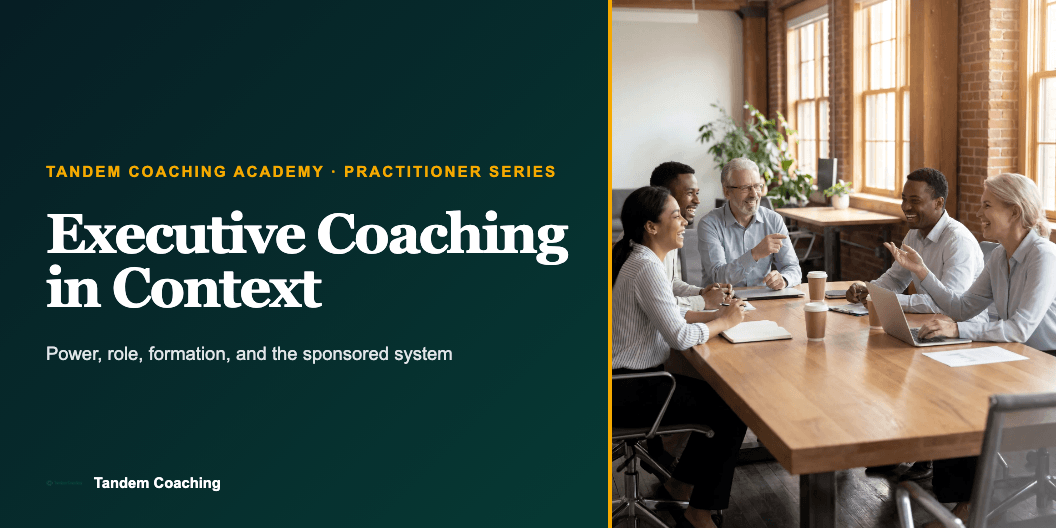
Design the sponsored one-to-one engagement from contract through close. Read formation, power, role, organization, evidence, and boundaries as context for better coaching questions rather than labels for the client.
A 16-page catalog: the renewal arithmetic, the pathway and its four stops, a page on each course with its modules and capstone, and two worked ways to cover a full 40-hour renewal.
What Continuing Coach Education (CCE) is - and why you need it
If you hold an ICF credential, the International Coaching Federation requires you to renew it every three years - and that renewal takes 40 hours of Continuing Coach Education (CCE), the credits ICF once called CCEUs. CCE is the professional development tier of coaching education: the practical, deepening work between credentials. Coaches come to it under renewal-deadline pressure, while building toward PCC or MCC, or to specialize - ADHD, career, team systems, AI in the room.
What are the requirements for ICF CCE credits at credential renewal
The requirement is 40 CCE hours every three years, the same for an ACC, PCC, or MCC coaching credential. At least 24 have to be in Core Competency coaching education - the eight ICF Core Competencies, including three mandatory coaching ethics hours. Up to 16 can be in Resource Development, anything that falls outside the Core Competencies. These CCE requirements are how you maintain your ICF credential at each renewal.
What types of activities count toward ICF CCE credits
ICF recognizes two categories of CCE units. Core Competency (CC) CCE directly relates to or expands upon the ICF Core Competencies. Resource Development CCE - the RD hours - covers everything that falls outside the ICF Core Competencies: business building, coaching tools or assessments, capped at 16 of the 40. Accredited courses and workshops, up to 10 hours of mentor coaching, coach-specific group coaching, and learning in coaching techniques or best practices in coaching all count toward your hours. Real-world coaching with your own clients does not count on its own - the hours have to come from education and training a provider designed and verifies.
How ICF CCE accreditation works
Async courses count. ICF's 50%-synchronous requirement applies only to entry-level credentialing (Level 1, Level 2), not to CCE renewal. CCE designation and ICF accreditation are determined by curriculum focus and verification-of-learning - not by delivery mode. ICF-accredited programs align with ICF's standards: the programs are designed against the Core Competencies and reviewed before a provider can offer continuing education for CCE. These ICF accredited CCE courses - the CCE-accredited programs you will see listed - give ICF coaching professionals dependable hours and continuing education opportunities with ICF-recognized providers that advance your coaching and keep your skills current with continuing coach education.
What are the benefits of ICF CCE accreditation
Once a course earns ICF CCE accreditation, the hours count toward renewal of ICF credentials without you having to justify them, they are recognized across the coaching industry, and accredited continuing coach education can support a Portfolio Path application toward your next coaching credential. Accreditation also signals a program is designed around the ICF Core Competencies rather than assembled as generic content.
Continuing coaching education units, CCE hours, CCEUs - which term is current
Coaches searching for continuing coaching education units and coaches searching for continuing coach education hours are asking about the same requirement. ICF issued the credits as CCEUs - Continuing Coach Education Units - before retiring that label, and the current renewal policy states the requirement in CCE hours. Whichever term you learned it under, the number at renewal is the same: 40 hours every three years, at least 24 of them Core Competency. A provider quoting "units" and a provider quoting "hours" are describing one requirement, not two - so you can compare their listings directly.
Where to find ICF-accredited CCE courses and programs
ICF runs an education search service where you can filter accredited CCE programs and coaching education programs by competency, format, and hours; some coaches also earn hours through a local ICF chapter. All six CCE courses in the Practitioner Series are ICF CCE-Approved Programs, with 150 accredited hours between them. Setting Up Your Coaching Practice is the seventh course in the Series and is deliberately outside the CCE track.
Why a pathway
A coaching education pathway, not a CCE shopping cart
Other providers stack unrelated webinars and call it a catalog. Each course here is one stop on a deliberately sequenced pathway built around your practice - so the hours add up to a coherent skillset, not a transcript of one-offs.
01
The courses are sequenced to build on each other
The pathway starts with the foundation any coaching practice needs - setting it up legally, financially, and operationally - then moves into the operating discipline of running it, then layers in the craft work: tools, AI, niches like career, ADHD, and systemic. Each course assumes you can lean on the ones before it, so the depth compounds.
You can also enter at any stop. Already running a practice? Skip the founder course. Already past the operator stage? Go straight to a niche. The sequence is there if you want it - not a prerequisite chain.
02
Two MCCs wrote it - the same two, end to end
In most CCE catalogs, a named MCC shows up for one webinar - the marketing photo, not the curriculum. Here, Cherie Silas (MCC) and Alex Kudinov (MCC) wrote the lessons, designed the slides, recorded the narration, and built the assessment for the courses they teach. Voice and standard hold across the whole pathway because the same hands made all of it.
03
Every course is mapped to specific ICF Core Competencies
CCE marketplaces report total hours and a CC/RD split. Here, each course names which of the eight ICF Core Competencies it deepens, with a per-module map you can take to a PCC or MCC assessor. If you are assembling a Portfolio Path application or preparing for credential evaluation, you can point at exactly where each hour lands.
04
The courses you take are yours - for life
CCE webinars and subscriptions expire. The courses here don't. Enroll once, keep it. Re-watch a module the week before a difficult client session. Reference the workbooks two credentials later.
And every course starts with a 3-day free trial, so you can look inside before you pay.
Your instructors
Two MCCs. The whole pathway.
Cherie and Alex wrote, recorded, and assessed every course themselves.
ICF MCCICF MCSICF CSSSA CECCPCCEMCC ESIA
Cherie Silas, MCC
CEO & Managing Partner, Tandem Coaching
Cherie is a co-founder and CEO of Tandem Coaching with over 20 years of experience as a corporate leader turned professional coach. She ranks in the top 3.7% of over 56,000 credentialed coaches worldwide and was named the #16 most influential coach by Global Gurus. Her background in executive, leadership, and agile coaching – combined with deep organizational design expertise – gives students a rare blend of real-world leadership and coaching mastery. Cherie is also a co-author of the Enterprise Agile Coaching book and one of only 215 Accredited Coaching Supervisors worldwide with EMCC. She also holds ICF’s Coaching Supervisor Specialization (CSS).
ICF MCCICF MCS
Alex Kudinov, MCC
Enterprise Coach & Managing Director, Tandem Coaching
Alex is a technology leader turned professional coach with over 20 years of experience spanning software development, product leadership, and consulting across industries including Oil & Gas, Investment Banking, and Commodities Trading. He brings a unique perspective that bridges human, business, and technology dimensions, making him especially effective for coaches working in corporate and tech environments. Alex holds an MBA from the University of Texas at Austin, is a co-author of the Enterprise Agile Coaching book, and is a Scrum Alliance Certified Enterprise Coach and Professional Scrum Trainer.
Tandem's wider faculty teaches our ICF Level 1 and Level 2 programs. Meet the full team ›
How it works
From enrolling to claiming ICF CCE credits at credential renewal
Five steps, end to end - what to expect from the moment you enroll through the moment your hours land at credential renewal.
1
Enroll in any live course - or start a free trial
Take a single course on its own, or start All-Access with a 3-day free trial. A minute at checkout and you are inside, all modules unlocked, ready to start. Single courses include Lifetime Access as defined in our Additional Terms.
2
Work through it at your pace
Each course is roughly 20 hours of structured material: video lessons, downloadable worksheets, an assessment per module. Pause for a quarter, return when you have time. Re-watch a module the week you have a difficult client session.
3
Complete the assessment
Verification of learning is what ICF requires for async CCE designation. Each course ends with a competency-aligned quiz or scenario task (per course identity). Pass it and your completion record locks in.
4
Receive your certificate
On completion, your certificate issues automatically - shareable to LinkedIn and suitable for L&D reimbursement. It carries the ICF CCE-Approved Program badge, the accredited hour count, and the Core Competency / Resource Development split.
5
Claim your CCE hours and maintain your ICF credential at renewal
The hours are accredited the day you finish - nothing to wait for. Your certificate states the approved hour count and the Core Competency / Resource Development split, which is what ICF asks for at renewal. Keep it with your renewal records and report the hours in your application.
Choose by the job
Four ways to buy what you actually need
Start with one specialty, close one verified renewal gap, use all eight live courses for a year, or own the original seven-course library outright. Executive Coaching in Context is live in All-Access while its standalone offer is finalized and ICF reviews it for CCE hours.
One specialty, forever
Choose one CCE specialization
$149–499
One approved CCE course · lifetime access
Six ICF CCE-Approved Programs from $149
20–40 approved hours per course, with the exact CC/RD split shown
Ethics status stated before purchase
Completion certificate after the course requirements are met
Buying for someone else, or skipping the trial?Buy now and pay $597 today.
Best when you want breadth now and whatever Tandem publishes during your paid year.
Own the original library
Lifetime bundle
$949
Start free for 3 days · original seven-course library · yours forever
Original seven-course library, including six CCE-approved programs
150 approved CCE hours across the current portfolio
Lifetime access to the courses in this frozen bundle
Skipping the trial?Buy now and pay $949 today. The $949 payment is not refundable once charged.
Executive Coaching in Context is a later release and is not silently added to this frozen bundle.
What you can show before asking an employer to pay
Use the course page together with this summary. For organization-specific invoicing or procurement paperwork, contact Tandem before purchase.
Approval: exact total CCE hours and CC/RD split for each approved course
Ethics: documented three-hour status, or an explicit note when ethics is not included
Learning proof: syllabus, outcomes, instructor, capstone, and completion requirements
Commercial proof: current price, access duration, refund terms, and checkout destination
After completion: completion certificate with the applicable ICF CCE-Approved Program identification
Renewal boundary: your ICF profile and ICF make the final credit and renewal determination
The practical questions coaches usually ask before signing up - pricing and the free trial, CCE accreditation timing, employer reimbursement, and what happens if you don't finish.
What is The Practitioner Series?
A sequenced pathway of eight courses for trained and credentialed coaches, authored end to end by Tandem's two MCC founders (Cherie Silas and Alex Kudinov). All are async and self-paced; access duration depends on the offer you choose.
The eight topics: setting up your coaching practice, running a coaching business, coaching tools, AI for coaches, career and career-transition coaching, ADHD coaching, systemic coaching for executive teams, and sponsored one-to-one executive coaching.
Are these courses ICF-accredited for CCE?
All six are ICF CCE-Approved Programs: Coaching Tools Mastery (20.0 hours, 13 CC + 7 RD), Running a Coaching Business (40.0 hours, 9 CC + 31 RD), AI for Coaches (20.0 hours, 6 CC + 14 RD), Career & Transition Coaching (20.0 hours, 14 CC + 6 RD), ADHD Coaching (20.0 hours, 13 CC + 7 RD), and Systemic Coaching for Executive Teams (30.0 hours, 22 CC + 8 RD) - 150 accredited hours in total. Setting Up Your Coaching Practice is a practice-building course and is deliberately outside the CCE track.
Each approved course page shows its awarded hour count and Core Competency / Resource Development split. Setting Up Your Coaching Practice is outside the CCE track by design. Executive Coaching in Context is live and has been submitted to ICF for 30 CCE hours; it awards no CCE hours until ICF approves it.
How many ICF CCE credits do I need, and what counts?
ICF credential-holders must earn 40 CCE credits every three years to renew - at least 24 in Core Competency coaching education (including three coaching ethics hours) and up to 16 in Resource Development.
The type of CCE that counts is any continuing coach education that directly relates to or expands upon the ICF Core Competencies, plus professional development - business building, coaching tools, or assessments - that falls outside the core. See the full ICF credential renewal breakdown for ACC, PCC, and MCC.
What is the difference between CCE, CCEUs, and ICF accreditation?
They describe the same thing from different angles. CCE (Continuing Coach Education) is the category of learning; CCEUs (CCE Units) is the older name ICF used for the same continuing education credits; ICF accreditation is the designation a course earns once the International Coaching Federation reviews it and approves it to award CCE.
An accredited continuing coach education course displays its approved CCE hour count and CC/RD split - AI for Coaches, for instance, shows 20.0 hours, 6 CC and 14 RD. Executive Coaching in Context is still in that review and therefore makes no awarded-hours claim.
Will these CCE hours help me maintain and advance my ICF credential?
Yes. CCE hours are how you maintain your ICF credential - certified coaches earn ICF CCE hours at every level to meet renewal. Beyond the minimum number of CCE hours, these courses support advancing your coaching: advanced coaching education in a niche, plus deeper coaching knowledge and core coaching skills.
ICF frames continuing education as advancing the coaching profession and keeping coaches current as the coaching industry and the future of coaching evolve. You also join a coaching community of credentialed practitioners working from the same standards.
What does it cost, and can I try it first?
Seven established standalone courses run $79 to $499. All-Access is $597 a year and unlocks all eight live courses plus every new one we add while you remain subscribed; it starts with a 3-day free trial. The $949 lifetime bundle is the original frozen seven-course library and does not silently gain later releases.
Every standalone course and the bundle start with a 3-day free trial: cancel before it ends and you pay nothing. A payment is not refundable once charged, so the trial is the way to look inside first. The certificate states the hour count ICF approved for that course.
Which of the four purchase paths should I choose?
Buy one CCE course if you want one specialization with Lifetime Access as defined in our Additional Terms. If you need a complete 40-hour renewal path, use the planner first: Coaching Tools Mastery and Career & Transition Coaching together are 27 Core Competency and 13 Resource Development hours - the whole 40, ethics included - for the current separate-course total of $548.
Take All-Access ($597 a year) if you want all eight live courses, including Executive Coaching in Context, and everything we publish while you are a member. Access ends when the membership does.
Buy the bundle ($949) if you want Lifetime Access to the original seven-course library, as defined in our Additional Terms, with no subscription renewal. Later courses, including Executive Coaching in Context, are not silently added.
Who is this for?
Trained and ICF-credentialed coaches (ACC, PCC, MCC) and ACTC holders who want to deepen practitioner skill in tools, AI, business, career, ADHD, systemic work, or sponsored executive coaching.
How are these courses different from a 90-minute CCE webinar?
Each course is approximately 20 hours of structured material: video lessons, module-level syllabus, downloadable worksheets, ICF Core Competency mapping, verification-of-learning assessment, and a certificate of completion.
Webinars are short, single-topic, and time-bounded. The Practitioner Series is the depth tier - the work you would do in a 12-week mentorship cohort - structured for the way working coaches actually have time to learn.
Do the hours count toward PCC or MCC application?
The accredited hours may count toward Portfolio Path application requirements (60 hours for ACC, 125 hours for PCC) for coaches assembling a credential from multiple providers. Each course page publishes its hour count and competency mapping.
If you are pursuing a direct accredited pathway, Tandem also offers ICF Level 1 (ACC) and Level 2 (PCC) accredited programs - the Practitioner Series sits on top of, not instead of, those.
Can my employer reimburse this?
Yes. An invoice and a certificate of completion are issued on completion, both suitable for L&D documentation. Many L&D teams reimburse CCE coursework directly - contact us if you need it before you enroll.
If your employer requires a W-9 or specific invoice format, contact us before you enroll - we will accommodate.
What happens if I do not complete a course in time?
There is no current completion deadline while the course remains available. Lifetime Access covers the course’s commercial life, including platform migrations and the retirement notice described in the Additional Terms.
CCE credits issue only on completion of all course requirements (including the verification-of-learning assessment), but you can complete a course years after enrolling. Once you enroll, the course is yours.
What does "MCC-authored end to end" actually mean?
In a lot of CCE catalogs, a named MCC shows up for one webinar - the marketing photo, not the curriculum. Here, the same two MCCs write the lesson content, design the slide decks, record the narration, and build the assessment for the courses they teach.
Cherie Silas teaches: Coaching Tools Mastery, ADHD Coaching, and Systemic Coaching for Executive Teams. Alex Kudinov teaches: Setting Up Your Coaching Practice, Running a Coaching Business, AI for Coaches, and Career & Transition Coaching.
I am not yet ICF-credentialed. Can I still enroll?
Yes - nothing stops you. The series is designed for credentialed coaches and assumes coaching foundations, so some lessons will land more deeply once you have your own client work to reference. But the content is rigorous and the lifetime access means you can return to it as your practice grows.
Eight MCC-led courses are live. Choose your next edge.
Seven courses have standalone enrollment from $79. All-Access now includes all eight, including Executive Coaching in Context. Six are ICF CCE-Approved Programs - 150 accredited hours between them.
Step into the room and notice what pulls your attention.
You will meet four situations that working coaches recognize. Choose the response you would be most inclined to make first – not the answer you think an assessor wants. Your result maps the lenses present in those choices and gives you one experiment for your next session.
Your result is a reflection, not a grade. It does not claim to measure competence or assign you a fixed coaching type.
Moment 1 – The request for a tool
What would you attend to first?
A client says, "We have talked about this for weeks. Can you just give me something to use?"
Choose the move you would be most likely to make first.
Moment 2 – The sponsor's diagnosis
Where would you put the first boundary?
A sponsor says, "The VP is the problem. Please make them more accountable and tell me whether they are improving."
Each response protects something different. Choose your first move.
Moment 3 – The practice underneath the practice
What would you rebuild first?
Your client calendar is full, but Sunday disappears into unpaid admin, inconsistent proposals, and work you never priced.
Choose the layer that feels most causally important.
Moment 4 – The missed commitments
What hypothesis would you test first?
A capable client repeatedly misses commitments, apologizes, and asks you to hold them more strictly accountable.
Choose the hypothesis you would explore before agreeing to "more accountability."
Your context
Now place those instincts inside your real practice.
These answers do not change your range pattern. They change the learning and CCE context we place around it.
Where are you on the ICF path?
What makes development useful now? Choose all that apply.
ICF CCE Renewal Planner
Coming to the series
Notify me when this course is available
This course is coming soon. One shared notify list covers all upcoming Practitioner Series courses - we'll email you the moment any new one is available, and we'll prioritize production based on which topics get the most interest.
We'll email you when this course goes live and when other Practitioner Series courses launch. Unsubscribe any time.
You're on the list
We'll let you know when standalone enrollment changes. In the meantime, all eight courses are live through their current offers — six are ICF CCE-Approved Programs, with 150 accredited hours between them.
One step before checkout
Where should we send your enrollment details? You’ll continue to secure checkout next.
We use this to set up your access and follow up if you don’t finish. Unsubscribe anytime.
All-Access — $597/yrEvery course, every renewal · start free for 3 days