ICF Certification: The Complete Guide to Coaching Credentials
How do I get ICF coaching certification?
ICF certification follows six steps: complete coach-specific education, log your coaching hours, finish 10 hours of mentor coaching, complete a performance evaluation, submit your application, then pass the ICF exam (the ACC Exam for ACC, the ICF Credentialing Exam for PCC). ACC requires 60 training hours and 100 coaching hours. PCC requires 125 and 500.
Key Takeaways
- ICF certification is a competency demonstration, not an educational degree. The credential confirms you can coach at a specific level, as evaluated by experienced practitioners
- Three individual credentials (ACC, PCC, MCC) and one team coaching specialization (ACTC) form two parallel tracks with a shared competency foundation
- Level 1 and Level 2 are program designations, not credential levels. A Level 1 program prepares you for ACC, a Level 2 program prepares you for PCC
- The six-step certification process connects training, coaching hours, mentor coaching, a performance evaluation, your application, and the ICF exam, which comes last
- All-inclusive programs handle the complexity for you: training, mentor coaching, exam prep, and application support under one roof
You decided to explore coaching certification. You went to the ICF website. And you found a maze of acronyms: ACC, PCC, MCC, ACTC, Level 1, Level 2. No clear starting point. No map.
You are not the only one. Having trained and mentored hundreds of coaches through the life coach certification process, we see this pattern constantly: motivated professionals who know they want ICF credentialing but cannot figure out where the pieces fit. The ICF website is organized for existing members, not for people standing at the entrance trying to find the door.
This guide is the map. It covers the full ICF credential system: which credentials exist, how the certification process works step by step, what it costs, and how to evaluate programs. Written by MCCs who have earned every credential level personally and now train coaches through the same process. We have been on both sides of the table: as candidates earning our own credentials, and as mentor coaches, instructors, and program designers preparing others to earn theirs. By the end, the acronyms will make sense and you will know exactly which path fits where you want to go.
What ICF Is (and Why It Matters)
The International Coaching Federation is the largest global professional organization for coaches, with nearly 59,000 members and, as of early 2025, members in 157 countries and territories. Founded in 1995, ICF established the credentialing standards that define what professional coaching looks like worldwide.
That distinction matters because coaching is unregulated in the United States and most other countries, a dynamic explained in our guide to what an executive coach is. Anyone can call themselves a coach tomorrow. Print business cards, set up a website, start charging clients. There is no licensing board, no state exam, no required degree. ICF credentialing fills that regulatory gap. It is the profession’s self-regulatory mechanism: a voluntary standard that signals a coach has met specific competency benchmarks, evaluated by experienced practitioners using a defined competency framework.
The “voluntary” part is important. No law requires ICF credentialing. But the professional market increasingly treats it as a baseline. Corporate coaching contracts specify ICF credentials. Coaching platforms require them for listing. Internal coaching programs at Fortune 500 companies reference ICF competencies in their job descriptions. The credential is voluntary in theory and expected in practice for coaches who work beyond their personal networks.
ICF operates on three pillars. First, individual credentials (ACC, PCC, and MCC) that recognize demonstrated coaching competency at progressively higher levels. Second, a code of ethics that all credentialed coaches commit to upholding, enforced through an independent ethics process. Third, program accreditation: ICF reviews and accredits training programs at Level 1, Level 2, and Level 3, ensuring the education meets specific curriculum and instructor standards. For a deeper look at the ethical framework, see the ICF Code of Ethics overview.
ICF is not the only coaching credentialing body. The European Mentoring and Coaching Council (EMCC) and the Center for Credentialing & Education (CCE) also offer credentials, as does the Scrum Alliance for agile coaches. But ICF remains the most widely recognized globally, particularly in organizational and executive coaching where buyers use credentialing as a quality signal when hiring coaches. That global recognition is why most coaches pursuing professional credentialing start here, and why leadership development programs use ICF-credentialed coaches as their quality standard.
Your training program teaches you to coach. ICF evaluates whether you can demonstrate coaching competency at a specific level. Two related but separate systems.
One critical distinction that trips people up early: ICF does not train coaches. ICF accredits training programs and credentials individual coaches. Your training program teaches you to coach. ICF evaluates whether you can demonstrate coaching competency at a specific level. The program gives you the education. The credential confirms you can do the work. These are related but separate systems, and understanding that separation is the first step to understanding the system clearly.
Whether you are exploring coaching as a career change, considering different types of coaching for leaders, or looking to formalize an existing practice, the ICF credential system provides the recognized standard that the profession and its buyers rely on, including the best executive coaches in the field. If you are making that transition from military service, our guide to careers after the military through ICF coaching adds the funding and career-fit context this overview cannot cover.
The ICF Credential Map
ICF’s credential system runs on two parallel tracks: three credentials for individual coaching and a team coaching specialization that builds on them. Understanding the structure saves you from the most common source of confusion: conflating program levels with credential levels.
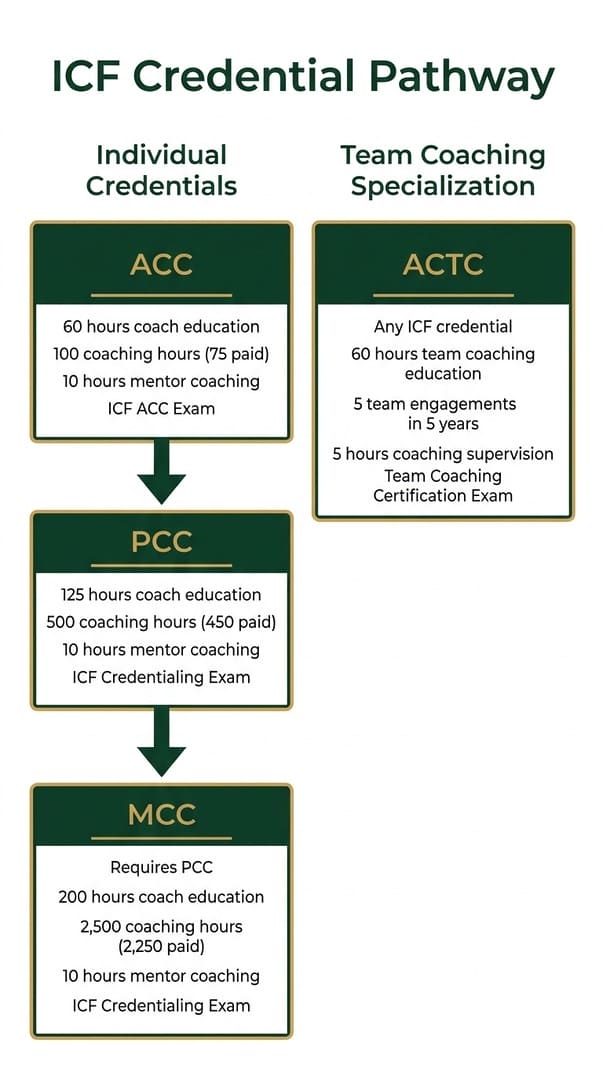
Individual Coaching Credentials
The individual track has three tiers, each representing a higher level of demonstrated competency:
Associate Certified Coach (ACC) is the entry-level credential. It signals that you have completed foundational training, logged at least 100 hours of coaching experience (75 of them paid), passed the ICF ACC Exam, and demonstrated competency in the ICF core competencies. ACC is not a lesser credential. It is the entry point to the profession. Most practicing credentialed coaches hold ACC, and the skills you develop earning it form the foundation everything else builds on. The full requirements are detailed in our ICF ACC requirements guide.
What ACC actually demonstrates, from the assessor’s perspective: you can hold a coaching conversation that stays on the client’s agenda, you can listen at a level beyond the words being said, and you can ask questions that move thinking forward rather than gathering information. Those three competencies sound simple until you try to do them consistently in live sessions with real clients who have real problems.
Professional Certified Coach (PCC) represents deeper competency. Beyond the expanded training hours and 500 coaching hours (450 of them paid), Portfolio-path PCC candidates submit two recorded coaching sessions evaluated against the PCC Markers, specific behavioral indicators that assessors use to distinguish PCC-level coaching from ACC-level coaching; on the Level 2 path, the accredited program covers that evaluation. The gap is not just more hours; it is a qualitative shift in how you coach. At PCC level, the coach trusts the coaching process more deeply. The questions are fewer and land harder. The silences are longer and more productive, a mark of deeper coaching presence. See the full ICF PCC requirements breakdown.
Master Certified Coach (MCC) is the highest individual credential, requiring a current or past PCC credential, 200 hours of education, 2,500 coaching hours (2,250 of them paid), and a performance evaluation at the mastery level. The MCC pathway represents a commitment to the profession that extends well beyond any single training program. At MCC, the coaching looks deceptively simple: shorter sessions, fewer interventions, greater impact. The mastery is in what the coach does not do.
Team Coaching Credential
The Advanced Certification in Team Coaching (ACTC) is an ICF specialization that sits alongside the individual track, not above it. It is open to any ICF credential holder (ACC, PCC, or MCC) and requires at least 60 hours of team coaching education, five team coaching engagements over the last five years, five hours of coaching supervision, and a passing score on the ICF Team Coaching Certification Exam. It recognizes competency in coaching a team as a system: working with the dynamics, patterns, and collective behaviors that make a team function or fail as a unit, rather than coaching individuals who happen to work together.
The market demand for team coaching is growing as organizations shift from developing individual leaders to developing leadership teams. If your coaching practice involves working with intact teams, cross-functional groups, or organizational leadership systems, ACTC adds a certification that no individual coaching credential covers. See our full breakdown of the ACTC team coaching credential and its competency framework.
Credential Comparison
| Requirement | ACC | PCC | MCC | ACTC |
|---|---|---|---|---|
| Coach education | 60+ hours | 125+ hours | 200+ hours | 60+ hours of team coaching education |
| Coaching experience | 100+ hours (75 paid) | 500+ hours (450 paid) | 2,500+ hours (2,250 paid) | 5 team coaching engagements in the last 5 years |
| Mentor coaching | 10 hours | 10 hours | 10 hours | 5 hours of coaching supervision |
| ICF exam | ICF ACC Exam | ICF Credentialing Exam | ICF Credentialing Exam | ICF Team Coaching Certification Exam |
| Performance evaluation | Level path: in the program; Portfolio: 1 recording (through Mar 31, 2027) | Level 2 path: in the program; Portfolio: 2 recordings (through Mar 31, 2027) | 2 recordings on every path | Not in ICF’s listed requirements |
| Prerequisite credential | None | None | PCC (current or past) | Any ICF credential |
| Renewal cycle | 3 years | 3 years | 3 years | 3 years |
Level 1, Level 2, and Level 3: Program Designations, Not Credentials
The most common confusion we encounter, by a significant margin, is candidates who think Level 1 and Level 2 are credential levels. They are not. Level 1 and Level 2 are program accreditation designations. A Level 1 program is accredited to train coaches toward ACC. A Level 2 program trains toward PCC. Level 3 (rare) aligns with MCC preparation.
This confusion costs candidates real time and money when they choose a program without understanding what credential level it prepares them for. When you hear “Level 1,” think training. When you hear “ACC,” think credential. Once you hold that distinction, the entire system becomes navigable.
Program Levels vs. Credential Levels
Level 1 and Level 2 describe your training program. ACC and PCC describe you. You can complete a Level 1 program and never apply for ACC if you choose not to. The program gives you the education. The credential confirms you can demonstrate competency. Two parallel systems that connect but do not overlap.
ACC vs. PCC vs. MCC: How the Credential Levels Compare
The three credential levels differ less in paperwork than in what assessors expect to hear in your coaching. The numbers explain the effort each level takes; they do not explain the difference an assessor hears.
In our experience, ACC is the basics: candidates at this level still lean on what they have learned, and their knowledge does a lot of the work. By PCC, after the better part of 500 hours, most coaches have stopped hunting for the next best question and stopped worrying about how they come across, and their attention has moved to the client. MCC goes further in the same direction, with fewer interventions and more of the session left to the client, as the credential map above describes.
The table sets out ICF’s published requirements for each level, as listed on ICF’s credential pages in October 2026.
| Requirement | ACC | PCC | MCC |
|---|---|---|---|
| Coach-specific education | 60+ hours | 125+ hours | 200+ hours |
| Coaching experience | 100+ hours, at least 75 paid, 8+ clients | 500+ hours, at least 450 paid, 25+ clients | 2,500+ hours, at least 2,250 paid, 35+ clients |
| Recent hours | 25 hours within 18 months of applying | 50 hours within 18 months of applying | Not listed by ICF |
| Mentor coaching | 10 hours over 3+ months | 10 hours over 3+ months | 10 hours over 3+ months |
| Performance evaluation | Level path: in the program; Portfolio: 1 recording | Level 2 path: in the program; Portfolio: 2 recordings | 2 recordings on both paths |
| Exam | ICF ACC Exam | ICF Credentialing Exam | ICF Credentialing Exam |
| Prerequisite | None | None | PCC, current or past |
| Application fee (ICF member / non-member) | $175 / $325 Level path; $475 / $625 Portfolio | $375 / $525 Level 2 path; $750 / $900 Portfolio | $675 / $825 on both paths |
| Typical ICF review time | About 4 weeks (Level path), 14 weeks (Portfolio) | About 4 weeks (Level 2 path), 18 weeks (Portfolio) | About 18 weeks |
| Renewal | Every 3 years: 40 continuing education credits, including 10 hours of mentor coaching | Every 3 years: 40 continuing education credits | Every 3 years: 40 continuing education credits |
Which level should come first? Most of our students earn ACC first and add PCC as their 500 hours accumulate. Some train straight through to PCC, starting a Level 2 program right after their first program, because the binding constraint at PCC is coaching hours, not training.
Skipping the ACC application makes sense mainly when nobody needs you to be credentialed soon: an employer is funding your training without requiring a credential, for example, and holding ACC would not change anything for you professionally.
Team coaches add the ACTC on top of any of the three credentials, so it does not change this sequence. Details are in our post on ACTC requirements.
The Certification Process
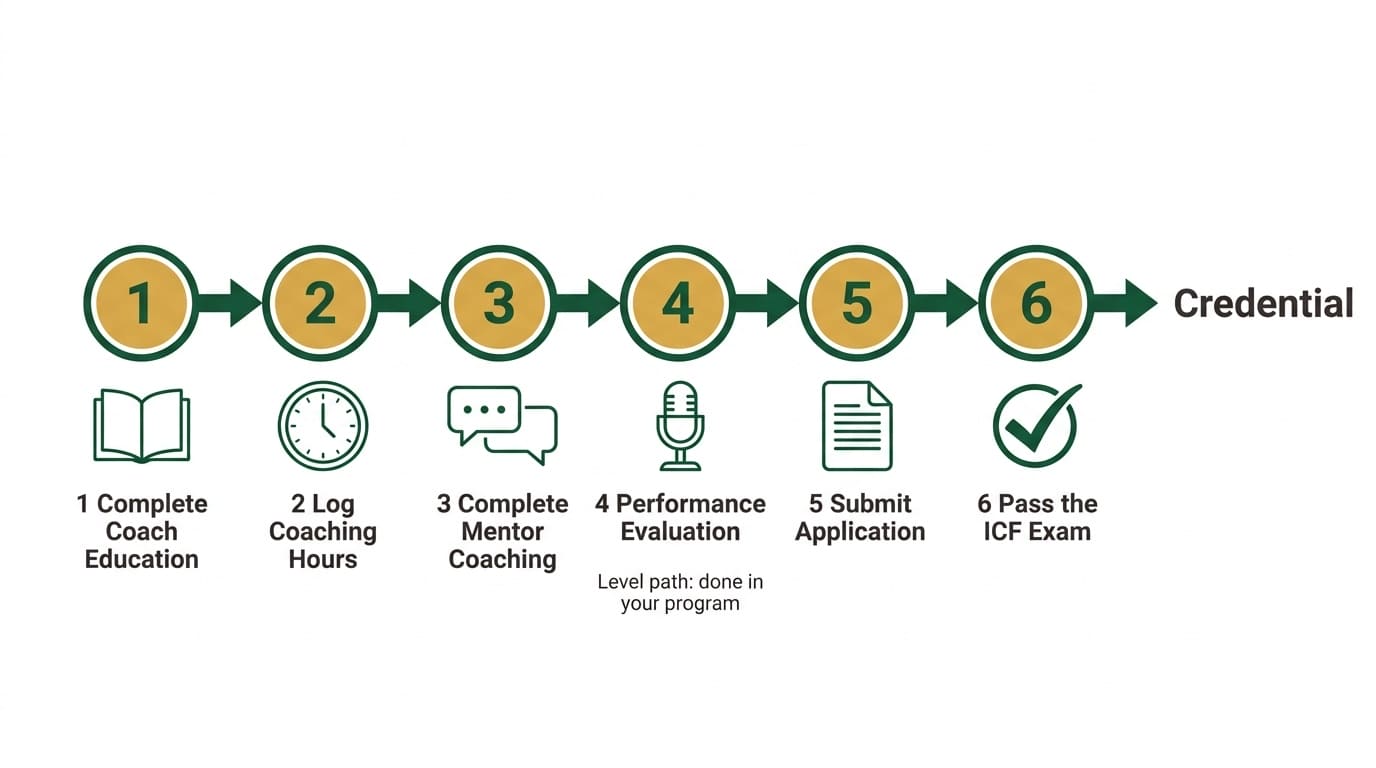
ICF certification follows a six-step process that connects training, practice, mentorship, performance evaluation, documentation, and examination. Since November 3, 2025, each credential has two application paths, and the path decides who handles the evaluation: on the Level path, your accredited program covers it; on the Portfolio path, you submit recordings to ICF. All-inclusive programs handle much of the coordination for you.
Step 1: Complete an ICF-Accredited Training Program
Your training program is where you learn coaching competencies, practice coaching skills, and begin developing your coaching identity. On the Level path, ACC requires a complete Level 1 or Level 2 accredited program (at least 60 hours) and PCC a complete Level 2 program (at least 125 hours). On the Portfolio path, ICF accepts the same number of hours of coach-specific education from accredited or non-accredited sources, which you document yourself.
Not all programs labeled “coach training” meet ICF standards. Only programs with ICF Level 1, Level 2, or Level 3 accreditation qualify you for the Level path, where the program certificate is the main document ICF reads. Non-accredited coach training can still count on the Portfolio path, but you carry the burden of documenting it, and ICF’s review takes longer. Accreditation level matters more than program length.
Step 2: Log Your Coaching Hours
ACC requires 100 documented coaching hours with at least 8 clients; at least 75 of those hours must be paid, and at least 25 must fall within the 18 months before you apply. PCC requires 500 hours with at least 25 clients, 450 of them paid and 50 within the last 18 months. These hours must be real coaching sessions, not training exercises, not practice rounds within your program (unless specifically designated), not peer coaching with fellow students. Paid and pro bono sessions both count toward the total, but the paid minimum is fixed. The documentation requirements are specific: client name, date, duration, whether paid or unpaid.
This is the step with the most variable timeline. Some candidates accumulate 100 hours within six months of starting their practice. Others take 18 months or longer. The constraint is rarely skill; it is access to clients and the discipline to document every single session. Candidates who start building their coaching practice during training (rather than waiting until training ends) typically complete this requirement faster. Pro bono coaching with nonprofits, fellow professionals, or community organizations counts toward the total (though not toward the paid minimum) and gives you experience across different client contexts.
Step 3: Complete Mentor Coaching
ACC, PCC, and MCC each require 10 hours of mentor coaching over at least three months. On the Level path it is part of your accredited program; on the Portfolio path you arrange it with a qualified mentor coach. This is where the “both sides of the table” perspective matters most.
From the candidate’s side, mentor coaching feels like it should be a feedback session: here is what I did well, here is what to improve. From the mentor’s side, we are facilitating guided self-examination.
A good mentor does not tell you what to fix. They help you see the gap between what you think you are doing in a session and what you are actually doing. That gap, between intent and impact, is where the real development happens.
Most candidates underestimate this step. Not the hours. The depth of reflection it requires. You bring a recorded session. Your mentor asks what you heard in the client’s language that you did not follow. You realize you were hearing what you expected instead of what was actually said. That realization, repeated across 10 hours of mentor coaching, changes how you listen in every session that follows. It is the most impactful part of the credentialing process, and it is also the most uncomfortable because you are confronting your own patterns rather than absorbing new content.
Step 4: Complete the Performance Evaluation
Every credential level includes a performance evaluation of recorded coaching, but your path decides who runs it. On the Level 1/Level 2 path for ACC and the Level 2 path for PCC, ICF treats the requirement as covered by your accredited program, and you submit no recordings. On the Portfolio path, you submit full, unedited recordings of 20 to 60 minutes with transcripts: one for ACC and two for PCC, where trained assessors score them against the PCC Markers. MCC candidates submit two recordings on either path. ICF removes the Portfolio evaluation for ACC and PCC in 2027, as the step-by-step paths below explain.
For a PCC submission, this is not a pass/fail gate on a single coaching skill; it is a full-spectrum evaluation of whether your coaching consistently demonstrates PCC-level competency across the full marker set. From the assessor’s perspective, the pattern that separates passing submissions from failing ones is not technique. It is the coach’s ability to stay with the client’s agenda rather than subtly directing the conversation.
The credential does not make you a coach. It confirms that you can demonstrate coaching competency at a specific level, as evaluated by people who have been doing this work for decades.
Step 5: Submit Your ICF Application
The application documents everything: your program certificate or education records, your coaching hours log, your mentor coaching hours and, on the Portfolio path, your recordings. ICF reviews the application against their requirements and may audit your documentation, requesting additional verification for coaching hours or program credentials. Fees depend on the credential, the path, and ICF membership: $175 for members or $325 for non-members on the ACC Level 1/Level 2 path and $475 or $625 on the ACC Portfolio path; $375 or $525 on the PCC Level 2 path and $750 or $900 on the PCC Portfolio path; $675 or $825 for MCC. ICF estimates about 4 weeks of review on the Level paths, 14 weeks on the ACC Portfolio path, and 18 weeks for the PCC Portfolio path and MCC. ICF members pay a lower application fee, which is one reason many candidates join ICF before applying.
All-inclusive programs typically support you through this step: reviewing your documentation before submission, ensuring your coaching hours log meets ICF standards, and helping you handle any audit requests. Candidates going through piecemeal training often find the application process unexpectedly complex.
Step 6: Pass the ICF Exam
ICF sends your exam invitation after it accepts your application, and you have 60 days to schedule and complete the exam at a Pearson VUE testing center or online. ACC candidates take the ICF ACC Exam: 60 multiple-choice knowledge questions in 90 minutes. PCC and MCC candidates take the ICF Credentialing Exam: 78 situational-judgment items in 180 minutes, or, from November 10, 2026, ICF’s new PCC-MCC Exam with 80 items in 150 minutes. Both exams test your understanding of the ICF core competencies, the coaching process, and ethical standards.
The PCC and MCC exam is not a memorization test, and that catches candidates off guard. Its questions present coaching scenarios and ask you to choose the most and least effective responses. Two or three answer choices may look reasonable. The question is which one aligns most closely with how the ICF competency framework defines effective coaching. The ACC Exam is more direct: one correct answer from four options, drawn from what ICF says about the competencies, its Code of Ethics, and the definition of coaching.
Candidates who try to study by memorizing definitions struggle with the scenarios. Candidates who have been coaching regularly, receiving mentor coaching feedback, and reflecting on their practice tend to find the exam an accurate reflection of what they already know. The best exam preparation is coaching practice, not flashcards. That said, practice exam questions can help you calibrate your readiness and get comfortable with the format. ACTC candidates can work through free team coaching exam questions the same way.
Credential renewal occurs every three years: 40 credits of continuing coach education (CCE), including 3 in coaching ethics, and for ACC holders 10 hours of mentor coaching.
How to Get ICF Certified: Step-by-Step Paths for ACC, PCC and MCC
The six steps are the same for everyone. What changes is who carries the paperwork, and that depends on your application path. ICF restructured the paths on November 3, 2025: each credential now has one path for graduates of a complete accredited program and a Portfolio path for everyone else. The figures below are ICF’s, checked in October 2026; ICF updates them, so confirm on ICF’s credential pages before you apply.
Level Path or Portfolio Path?
The Level path (Level 1/Level 2 for ACC, Level 2 for PCC, Level 3 for MCC) is for coaches who completed an entire ICF-accredited program. The program certificate is the main education document, mentor coaching is included in the program, and for ACC and PCC the performance evaluation is covered too. Applications cost less and ICF estimates about four weeks of review for ACC and PCC.
The Portfolio path is for coaches whose education comes from several sources, accredited or not, including continuing education courses. You document how that education meets ICF standards, arrange your own mentor coaching with a qualified mentor coach, prepare scorable recordings, and pay a higher fee. ICF estimates about 14 weeks of review for an ACC Portfolio application and 18 weeks for PCC.
If you already hold most of the education hours, the Portfolio path can save you from repeating a full program. It also moves the work to you: assembling the education records, finding a mentor coach who meets ICF’s criteria, recording sessions that meet the 20 to 60 minute rule, and waiting longer for a decision. Our PCC guide puts it this way for the Level 2 decision: the single-program route suits candidates who want one curriculum that handles the documentation, while the Portfolio route suits experienced coaches with substantial, varied training who can track requirements across several providers. If you are still choosing a program, our guide on how to compare ICF-accredited programs covers what to check.
ACC, Step by Step
- Education: 60+ hours of coach-specific education, either a complete Level 1 or Level 2 program (Level path) or documented hours from mixed sources (Portfolio path).
- Coaching hours: 100+ hours with at least 8 clients; at least 75 hours paid and at least 25 hours within the 18 months before you apply.
- Mentor coaching: 10 hours over at least three months, included in an accredited program or, on the Portfolio path, with a PCC or MCC (or an ACC who has renewed at least once).
- Performance evaluation: covered by the program on the Level path; on the Portfolio path, one recorded session with a transcript (through March 31, 2027).
- Application: $175 for ICF members or $325 for non-members on the Level path, $475 or $625 on the Portfolio path.
- Exam: the ICF ACC Exam, within 60 days of ICF’s invitation.
The education is the predictable part; Level 1 programs usually spread it over three to six months. The coaching hours set the pace, and candidates who start logging client sessions during training finish sooner. The most common setback is counting work that ICF does not treat as coaching, such as teaching, training, mentoring, or supervising, which then has to be replaced with real client sessions. The ACC credential requirements guide covers each item in more detail.
The education is the predictable part. The coaching hours set the pace.
PCC, Step by Step
- Education: 125+ hours, either a complete Level 2 program (Level 2 path) or documented hours from mixed sources, which can include a Level 1 program (Portfolio path).
- Coaching hours: 500+ hours with at least 25 clients; at least 450 paid and at least 50 within the 18 months before you apply.
- Mentor coaching: 10 hours over at least three months, included in a Level 2 program or, on the Portfolio path, with a PCC or MCC and including at least 3 hours one-on-one.
- Performance evaluation: covered by the program on the Level 2 path; on the Portfolio path, two recorded sessions with transcripts, scored against the PCC Markers (through March 31, 2027).
- Application: $375 or $525 on the Level 2 path, $750 or $900 on the Portfolio path.
- Exam: the ICF Credentialing Exam (see the 2026 change below).
PCC has no credential prerequisite, so the real gate is the 450 paid hours, not the training. Our guide to PCC certification requirements walks through the markers and the recording in detail.
MCC, Step by Step
- Prerequisite: you hold, or have held, the PCC.
- Education: 200+ hours, either a complete Level 3 program (Level 3 path) or documented hours (Portfolio path).
- Coaching hours: 2,500+ hours with at least 35 clients, at least 2,250 of them paid.
- Mentor coaching: 10 hours, included in a Level 3 program or, on the Portfolio path, with an MCC over at least three months and including at least 3 hours one-on-one.
- Performance evaluation: two recorded sessions with transcripts on either path.
- Application and exam: $675 for ICF members or $825 for non-members (about 18 weeks of review), then the ICF Credentialing Exam.
Our MCC certification requirements guide puts the realistic timeline at five to ten years of active coaching after PCC, because 2,500 hours take that long to build alongside a practice.
What Changes in 2026 and 2027
A new PCC and MCC exam. From November 10, 2026, ICF offers a new PCC-MCC Exam: 80 items (44 situational-judgment questions and 36 knowledge-based multiple-choice questions) in 150 minutes, covering the same four competency domains as the current ICF Credentialing Exam, which has 78 situational-judgment items in 180 minutes. From November 10, 2026 through March 31, 2027, candidates may take either version; anyone testing or retesting on or after April 1, 2027 takes the new one. ICF’s guide to the new exam does not recommend one version over the other. The trade-offs are factual: the current exam is all scenarios and runs longer, the new one adds direct knowledge questions and is shorter, and a retake after March 31, 2027 will be on the new format.
A new route for Portfolio candidates. Beginning January 1, 2027, ACC and PCC candidates on the Portfolio path complete their mentor coaching with a mentor coach who holds ICF’s Mentor Coach Specialization (MCS), and they include the Competency Review Form completed by that mentor in the application, keeping a Session Observation Form on file for each session the mentor reviewed. From April 1, 2027, the Portfolio performance evaluation is gone for ACC and PCC. Level path applicants change nothing. MCC keeps the performance evaluation, and any new MCC mentor coaching hours must be with a Mentor Coach Specialization holder.
ICF’s announcement does not tell candidates who are partway through a Portfolio application which side of these dates to apply on, so here are the facts to weigh. An application under the current rules still needs the recording. An application under the new rules needs no recording, but it does need mentor coaching from a Mentor Coach Specialization holder and the Competency Review Form. If your mentor coaching hours straddle January 1, 2027, check ICF’s current transition guidance before you decide, and if you are looking for a qualified mentor, see our mentor coaching for ACC, PCC and MCC candidates.
How Much It Costs
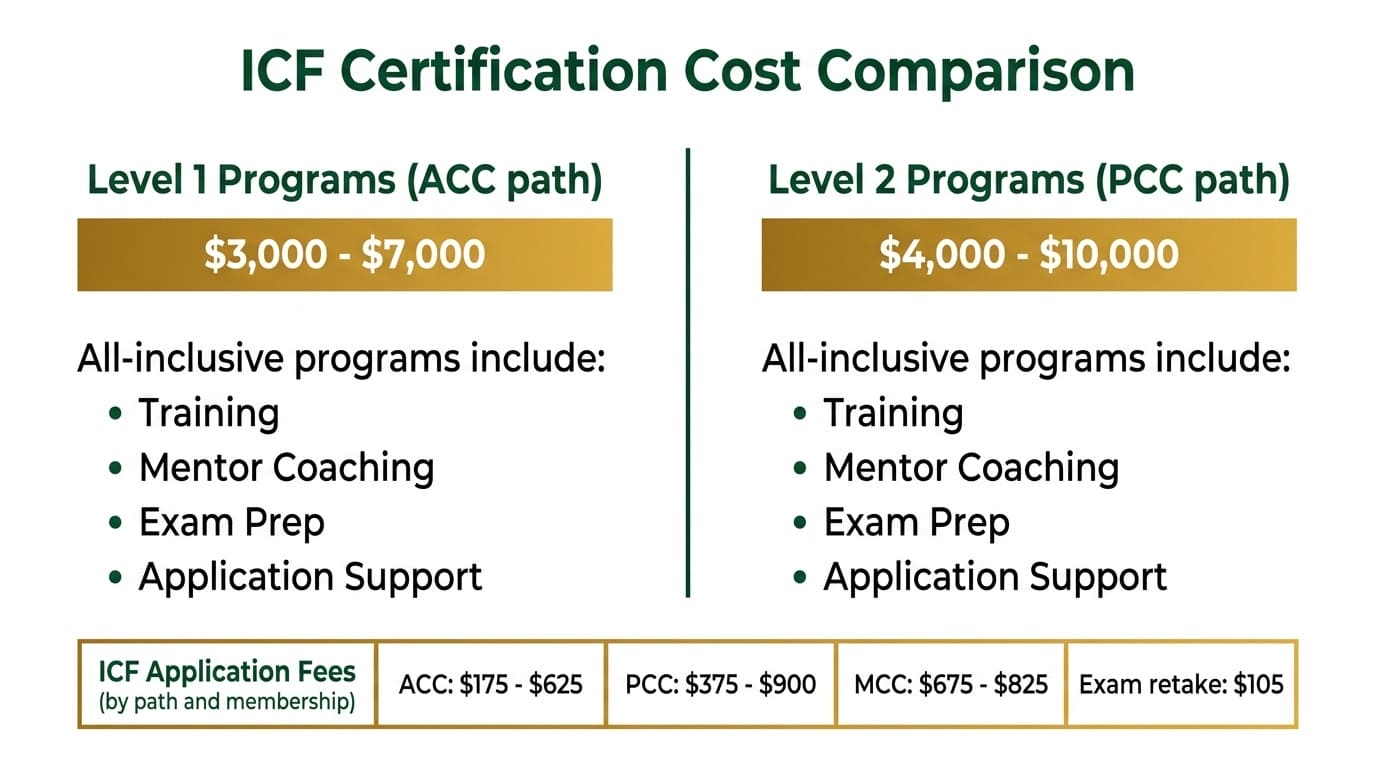
ICF certification costs vary significantly depending on your path, your program, and what is included. Understanding the full cost picture before you commit prevents the most expensive mistake candidates make: paying for training, then discovering they need to purchase mentor coaching, exam prep, and application support separately.
Level 1 (ACC path) programs typically range from $3,000 to $7,000. Level 2 (PCC path) programs run $4,000 to $10,000. These ranges reflect the market as of 2026 and vary substantially by provider, format (in-person vs. virtual), cohort size, and what the program includes. Programs at the lower end of the range tend to cover training only. Programs at the higher end tend to be all-inclusive, bundling everything you need through credential completion.
All-inclusive programs bundle training, mentor coaching, exam preparation, and application support into a single fee. A-la-carte programs cover training only. You source and pay for mentor coaching, exam prep, and credentialing support separately. The sticker price of an all-inclusive program is higher, but the total cost of ownership is often lower once you add the components individually.
ICF direct fees sit on top of your program cost: the credential application fee ($175 to $625 for ACC and $375 to $900 for PCC, depending on your path and ICF membership) and $105 for each exam retake. The application fee is unavoidable regardless of which program you choose.
For the full cost breakdown including hidden costs, payment options, and ROI framing, see our detailed ICF certification cost analysis.
Choosing an ICF-Accredited Program
Choosing an ICF-accredited program is the single decision with the most downstream consequences. The program shapes your training experience, your mentor coaching quality, your exam readiness, and your support through the credentialing application. Getting this wrong means paying twice.
Everything ICF Requires for ACC
60+ training hours, 10 hours of mentor coaching, exam preparation, and full application support. Led by two MCC-credentialed instructors who hold every credential level.
What to Verify First
ICF accreditation status. Verify directly on the ICF website that the program holds current Level 1 or Level 2 accreditation. Programs can lose accreditation. Marketing materials may be outdated. The ICF-accredited coaching programs directory can help you start your search.
Instructor credentials. Who is teaching? Coaches credentialed at MCC level have demonstrated the highest standard of competency. Programs led by MCC-level instructors expose you to coaching at the mastery level during your foundational training, a qualitative difference you feel in every practice session.
What is included. Does the program cover mentor coaching, exam preparation, and application support? Or is it training-only? An all-inclusive program means you do not have to piece together four or five different providers to complete the credentialing process.
Red Flags
Be cautious of programs claiming “ICF-equivalent” or “ICF-aligned” training without holding actual ICF accreditation. Watch for proprietary frameworks substituted for ICF competencies rather than built on top of them. Programs that train but explicitly disclaim any support for the credentialing process. Programs where the instructors hold ACC or no ICF credential at all. Your training experience is shaped by the competency level of the people teaching you, and there is a meaningful difference between learning coaching from someone who demonstrates it at the ACC level versus someone who demonstrates it at PCC or MCC level.
The Most Expensive Mistake
Choosing a program that trains but does not support you through credentialing. You complete training, then discover you need separate mentor coaching ($800–$2,000), separate exam prep ($200–$500), and work through the ICF application alone. The piecemeal path costs more, takes longer, and has a lower completion rate.
Tandem Coaching offers ICF-accredited programs at both Level 1 and Level 2, led by two MCC-level instructors who have personally earned every credential level. Both programs are all-inclusive: training, mentor coaching, exam preparation, and full application support in one program. Coaches who want to earn ACC, PCC, and ACTC together can pursue the Professional Coach Program ($7,499), which delivers all three credentials through a single integrated pathway. Explore the ICF Level 1 (ACC) program or how to become a certified coach for a broader view of the path from interest to credentialing.
Is ICF Certification Worth It?
The answer depends on why you are pursuing it and what you expect it to deliver. We address this question in depth in our dedicated analysis of whether ICF certification is worth the time and investment, but the short version matters here.
ICF certification is worth it for professional development: the training and mentoring process genuinely develops coaching skill. It is worth it for belonging to the profession: credentialing connects you to an ethical framework, a peer community, and ongoing development standards. And it is worth it as a credibility signal: organizational buyers, HR departments, and coaching firms increasingly use ICF credentials as a baseline when hiring or referring coaches. When a buyer is comparing two otherwise-similar coaches, the credential is often the tiebreaker. Those ongoing development standards are what the renewal cycle enforces: every three years you log 40 CCE units to keep the credential active, and our ICF CCE courses are built specifically to fill that requirement.
ICF certification is not worth it as a magic business transformation. The credential does not guarantee clients, income, or a viable coaching practice. It does not replace the work of building a coaching business: finding clients, articulating your value, developing referral relationships, marketing your practice. What you do with the credential depends on your business development, your niche, and your ability to deliver results, not on the letters after your name. Anyone telling you otherwise is selling something.
For coaches working in organizational settings or aspiring to executive coaching, the credential carries particular weight. Corporate buyers default to credentialed coaches when selecting external coaching partners. Coaching platforms require credentials for listing eligibility. Internal coaching programs at major companies reference ICF competency standards in their job descriptions and performance reviews. The credential does not create demand for your coaching, but it removes friction at the point of purchase for buyers who are already looking. If anything, that pull has strengthened heading into 2026: as AI tools flood the “coaching” label with chatbots and self-guided apps, an ICF credential is one of the clearest signals a buyer has to separate a trained human coach from software wearing the same word.
The credential does not create demand for your coaching, but it removes friction at the point of purchase for buyers who are already looking.
ICF certification has value. What matters is whether the value it provides aligns with the investment you are making and the career you are building. If you are coaching inside organizations or building a practice that serves corporate clients, the return is direct and measurable. If you are coaching individuals informally within your community, the credential may matter less than your reputation and referral network.
Frequently Asked Questions
How long does ICF certification take?
Timeline varies by credential level and how quickly you accumulate coaching hours. Most candidates complete ACC in 6–12 months through a structured program. PCC typically takes 12–24 months because of the 500 coaching hours requirement. The training itself is the shorter part; logging sufficient coaching hours is what determines your timeline.
Can I get ICF certified online?
Yes. Many ICF-accredited programs deliver their full curriculum virtually, including live instruction, practice coaching, mentor coaching sessions, and exam preparation. The ICF does not require in-person attendance for any credential level. Virtual programs have become the standard since 2020, with no quality difference in credential outcomes.
What is the difference between Level 1 and Level 2?
Level 1 and Level 2 are program accreditation designations, not credential levels. A Level 1 program trains you toward ACC. A Level 2 program trains you toward PCC. You earn the credential (ACC or PCC) separately through ICF after meeting all requirements. The program gives you the education; ICF evaluates whether you can demonstrate competency.
Do I need ICF certification to be a coach?
Legally, no. Coaching is unregulated in most jurisdictions, and no license is required. Professionally, it depends on your market. If you coach individuals privately, you can practice without credentials. If you want to work with organizations, join coaching platforms, or build credibility in the professional coaching space, ICF certification is the recognized standard that buyers and referral sources rely on.
The complexity you felt when you first visited the ICF website was real, but it was not because the system is broken. It was because you were seeing pieces without the structure. Two tracks of credentials (individual and team). Two tracks of programs (Level 1 and Level 2). A six-step process that connects them. Now you have the structure.
Your next step depends on where you are. If you are exploring whether coaching certification makes sense for your career, start with the ICF credential paths page to see the official requirements firsthand. If you are ready to evaluate programs, look at what is included beyond training (mentor coaching, exam prep, application support) and who is teaching. If you already know you want ACC, review the ACC requirements in detail so you can plan your timeline. And if you are weighing the investment against the return, read our analysis of whether ICF certification is worth it for your specific situation.
The path is clearer than it looked from the outside. The acronyms have structure. The process has steps. And the credential, for all the complexity of getting there, represents something straightforward: demonstrated coaching competency, evaluated by practitioners who have spent careers doing this work.
Ready to Choose Your Credential Path?
Explore ICF-accredited programs at Level 1 and Level 2. Everything you need through credential completion: training, mentor coaching, exam prep, and application support, all in one program.
See All ICF Programs →