

ICF PCC Certification Requirements Explained
What are ICF PCC requirements?
ICF PCC requirements are 125 hours of coach-specific education, 500 hours of coaching experience (450 paid) with at least 25 clients, 10 hours of mentor coaching over three or more months, a performance evaluation, and a passing score on ICF’s written exam: the ICF Credentialing Exam or, from November 10, 2026, the new PCC-MCC Exam.
Five hundred coaching hours. That is the number that makes many coaches pause before pursuing PCC certification, and the number that separates professional-level coaches from those still building their foundation.
The ICF Professional Certified Coach (PCC) credential represents the middle tier in the ICF credential levels overview, above ACC and below MCC. It signals that a coach has moved beyond foundational competence into demonstrated professional practice. The requirements are specific, the bar is measurable, and the path is navigable once you understand what each component actually involves.
This guide covers every PCC requirement with the numbers, timelines, and preparation insights that come from training coaches through this process. It was updated in October 2026 for ICF’s new PCC-MCC Exam and the 2027 changes to mentor coaching and the performance evaluation.
Key Takeaways
- PCC certification requires 125 hours of coach-specific education, 500 coaching hours (450 paid), 10 hours of mentor coaching, a performance evaluation, and a passing score on the ICF credentialing exam.
- From November 10, 2026, PCC candidates can take either the current exam or the new 80-item PCC-MCC Exam on ICF’s 2025 standards. From April 1, 2027, only the PCC-MCC Exam is offered.
- For Portfolio applications submitted on or after April 1, 2027, an enhanced mentor coaching requirement with a Mentor Coach Specialization (MCS) holder replaces the performance evaluation. Level 2 path applicants see no change.
- The 500-hour requirement is achievable in two to four years when coaches build multiple streams: paid clients, exchange-of-value arrangements, organizational coaching, and pro-bono work.
- PCC is not ACC with more hours. The competency bar shifts from demonstrating presence to holding presence under pressure, from prepared questions to responsive attunement.
PCC Requirements at a Glance
PCC certification requires five components. Each has a specific minimum and a documentation standard that ICF verifies during the application review.
| Requirement | Minimum | Notes |
|---|---|---|
| Coach-Specific Training | 125 hours | Level 2 path: a complete ICF Level 2 program. Portfolio path: 125+ hours of coach education, accredited or not |
| Coaching Experience | 500 hours total (450 paid) | Minimum 25 clients; paid = remunerated or exchange-of-value |
| Mentor Coaching | 10 hours over 3+ months | At least 3 hours one-on-one with a PCC or MCC mentor, who from January 1, 2027 must also hold the MCS; built into Level 2 programs |
| Performance Evaluation | Level 2 path: completed in your program. Portfolio path: 2 recorded sessions with transcripts | Scored against the PCC Markers. Portfolio applications submitted from April 1, 2027 replace it with enhanced mentor coaching. See ICF PCC credential requirements |
| ICF Exam | Pass | ICF Credentialing Exam (78 items, 180 minutes) until March 31, 2027, or the PCC-MCC Exam (80 items, 150 minutes) from November 10, 2026 |
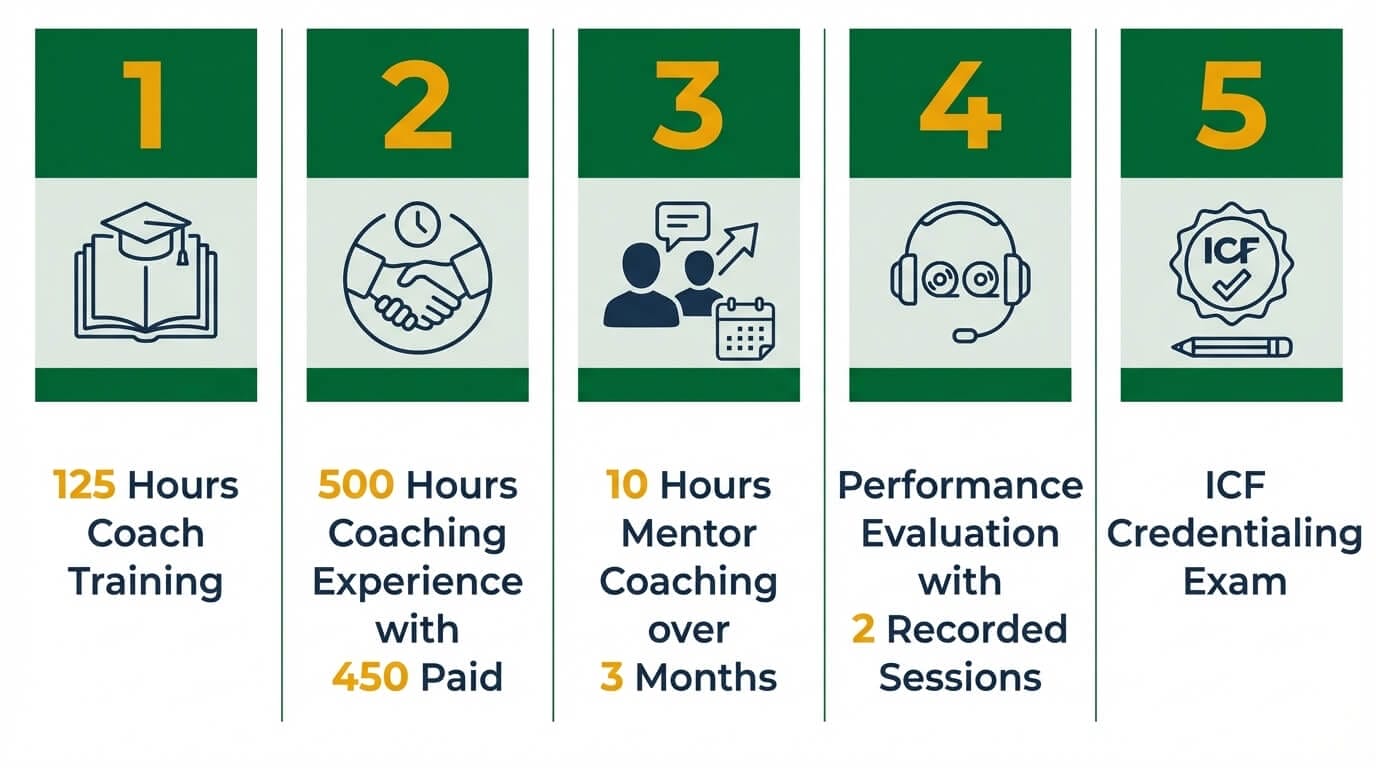
These are the official minimums from ICF. Meeting them is necessary. What determines whether a candidate actually earns the credential is how they demonstrate competency depth across each component, particularly in the performance evaluation, where coaching presence and session structure carry significant weight.
The 500-Hour Coaching Requirement
Five hundred hours is the primary barrier for PCC candidates. The number itself is real, but the assumption that all 500 must be traditional paid sessions is not.
ICF defines “remunerated” broadly. Of the 500 total hours, 450 must involve remuneration, but remuneration includes exchange-of-value arrangements, not only direct payment. A coach who provides sessions in exchange for services, mentoring, or other agreed-upon value meets the standard. The remaining 50 hours may be pro-bono.
What Counts
Paid client sessions, organizational coaching within an employer, exchange-of-value agreements with documented terms, and pro-bono work with formal coaching agreements all qualify. ICF requires session logs with dates, duration, and client identifiers for each hour claimed.
Building Hours Strategically
Coaches who reach 500 hours in a reasonable timeframe typically do three things. They start logging from the beginning of their coaching practice, not from when they decide to pursue PCC. They build multiple coaching streams: paid clients alongside pro-bono community coaching and internal organizational coaching work. And they set a weekly rhythm. Five hundred hours over three years is roughly three to four sessions per week. Making it a practice discipline rather than a distant milestone changes the psychology entirely.
The realistic timeline is two to four years for coaches working part-time alongside other professional commitments. Coaches embedded in organizations (internal coaching roles, HR leaders who coach as part of their function) accumulate faster. The hours are a byproduct of building a real coaching practice, not a separate task to complete alongside it.
Documentation matters from day one. ICF requires session logs with dates, session duration, and client identifiers. Coaches who wait two years to start logging discover they cannot reconstruct early sessions with the precision ICF expects. A simple spreadsheet updated after each session eliminates this problem entirely.
That coaching experience also has a direct market connection: PCC-credentialed coaches command higher rates, with what executive coaching clients pay reflecting the credential difference. The 500 hours is not just a requirement to endure; it is the foundation of the professional practice that the credential validates.
PCC vs ACC: What Changes
PCC is not ACC with more hours. The competency bar shifts from demonstration to embodiment, a difference that shows up in specific coaching behaviors assessed against the ICF ACC requirements for comparison.
| Requirement | ACC | PCC |
|---|---|---|
| Training Hours | 60 hours | 125 hours |
| Coaching Experience | 100 hours | 500 hours |
| Paid Hours Required | 75 hours | 450 hours |
| Mentor Coaching | 10 hours | 10 hours |
| Performance Evaluation | Level 1 or Level 2 path: completed in the program. Portfolio path: 1 recording with transcript | Level 2 path: completed in the program. Portfolio path: 2 recordings with transcripts |
| Credentialing Exam | ACC Exam: 60 knowledge-based questions, 90 minutes | ICF Credentialing Exam until March 31, 2027, or PCC-MCC Exam from November 10, 2026 |
For ACC and PCC Portfolio applications submitted on or after April 1, 2027, an enhanced mentor coaching requirement replaces the performance evaluation. The performance evaluation section below covers what that involves.
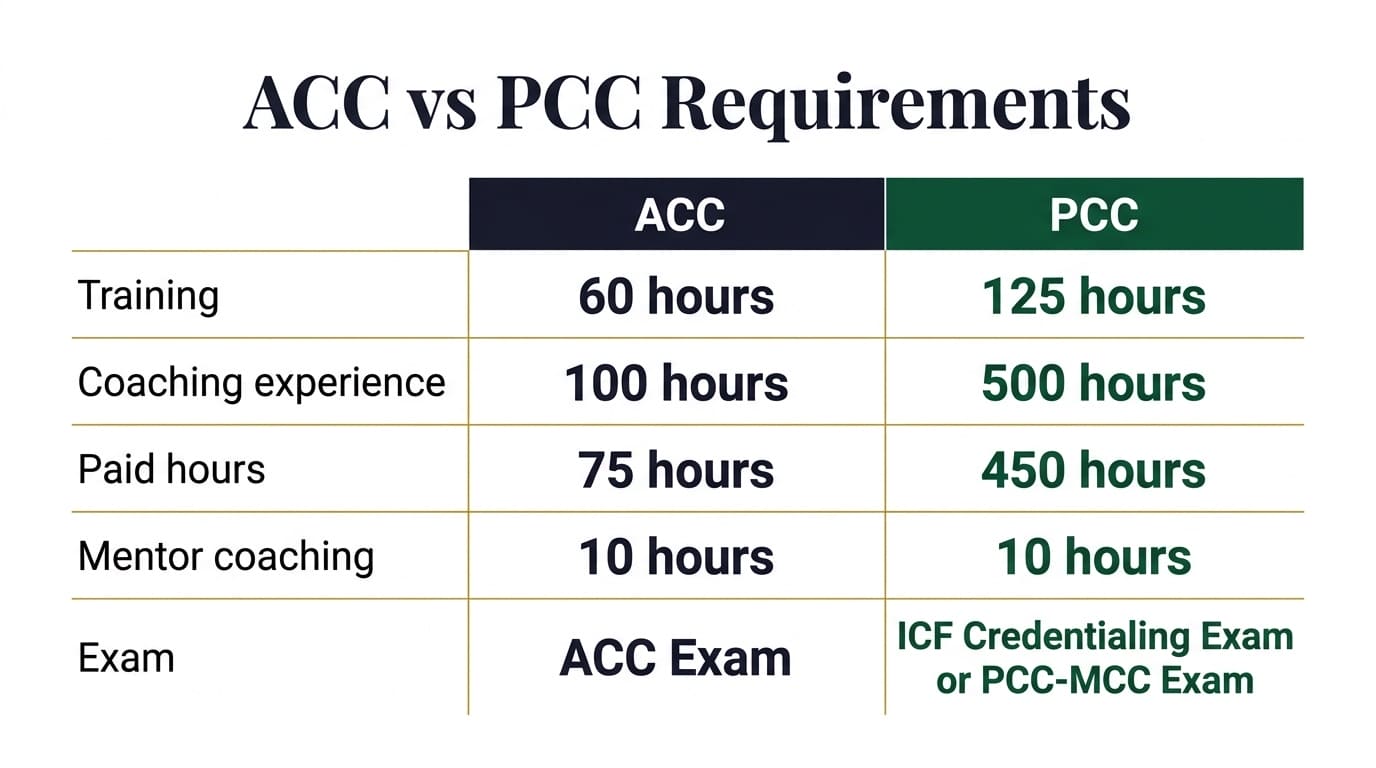
The numbers tell part of the story. The behavioral differences tell the rest.
Coaching presence. ACC coaches can demonstrate presence. They listen, they reflect. PCC coaches hold presence under pressure. When a client shifts to something unexpected, when silence gets uncomfortable, when the coach has no framework for what just emerged, PCC-level presence means staying with the person without retreating to technique.
Session structure. At ACC level, coaches often treat the coaching agreement and closing as administrative bookends surrounding the “real” coaching. At PCC level, the agreement IS the coaching. Discovery, goal clarity, and accountability happen in those phases. Missing this misses the coaching itself.
Evoking awareness. ACC coaches ask strong questions. PCC coaches ask questions that emerge from what the client just said, not from a prepared list. The shift is from technique to attunement, and it distinguishes coaches who apply coaching strategies grounded in ICF competencies from those still following scripts.
The credential arc does not stop here. For coaches considering the full trajectory, ICF MCC requirements for advanced certification build on the PCC foundation with 2,500 hours and demonstrated mastery-level coaching.
Coach-Specific Training (125 Hours)
PCC requires 125 hours of coach-specific training: a complete ICF-accredited Level 2 program on the Level 2 path, or any mix of accredited and non-accredited coach education on the Portfolio path. The training must be structured around the ICF core competencies, the eight behavioral areas that define professional coaching practice.
Get Your 125 Training Hours—All in One Place
Tandem’s PCC program delivers every required training hour through live, ICF-accredited sessions led by MCC-credentialed instructors.
Not all training is equivalent. ICF accredits programs at two levels: Level 1 (ACC path) and Level 2 (PCC path). A Level 2 program goes deeper into competency application, includes PCC-specific preparation, and typically integrates mentor coaching and performance evaluation readiness into the curriculum.
What to Look For in a Program
Three factors matter more than marketing:
ICF accreditation level. Confirm the program is accredited specifically at Level 2. Some programs advertise “ICF-approved” without the formal accreditation that the Level 2 path requires. For a full breakdown of what Level 1 and Level 2 accreditation mean—and how to evaluate programs beyond the badge—see our guide to ICF-accredited coaching programs.
Instructor credentials. Programs led by MCC-credentialed instructors operate at a different standard than those led by PCC coaches. The teaching depth reflects the instructor’s own credential level.
What is included. The ICF PCC certification cost varies substantially based on what the program bundles. An all-inclusive program that covers training, mentor coaching, exam preparation, and PCC markers coaching removes the complexity of assembling these components independently.
PCC markers preparation. The most overlooked factor in program selection. PCC candidates must eventually demonstrate coaching against the PCC markers rubric in their performance evaluation. Programs that integrate markers-based feedback throughout the curriculum give candidates months of practice under that lens. Programs that address PCC markers only at the end leave candidates scrambling to adjust ingrained habits.
The gap between what candidates expect from a mentor session and what their mentor is actually evaluating is where the real development happens. Mentor coaching surfaces where you are coaching differently than you think.
Tandem’s ICF PCC Coach Training (Level 2 bridge) is an ICF-accredited Level 2 program led by MCC instructors. The curriculum integrates all PCC requirements into a single program structure, including mentor coaching hours and performance evaluation preparation with PCC markers coaching built into every practice session. Coaches who also want ACTC (Advanced Certification in Team Coaching) can pursue the Professional Coach Program, which combines ACC, PCC, and ACTC into a single integrated pathway at $7,499.
Mentor Coaching (10 Hours)
Mentor coaching is where PCC candidates close the gap between their current coaching and PCC-level performance. ICF requires 10 hours over a minimum of three months. At least three of those hours must be one-on-one, and the other seven can be one-on-one or in a group of no more than 10 people. Your mentor must hold a current PCC or MCC credential. On the Level 2 path, your program provides the mentor coaching. On the Portfolio path, you arrange it yourself and list your mentor’s details in your application.
Mentor Coaching Built Into Your Path
One-on-one mentor coaching with MCC mentors who also hold the ICF Mentor Coach Specialization, which ICF requires for new mentor coaching hours from January 1, 2027. Observed sessions and competency feedback for your PCC application.
ICF is changing two things in 2027. From January 1, 2027, any new mentor coaching hours for ACC, PCC and MCC candidates must be with a mentor coach who also holds the ICF Mentor Coach Specialization (MCS). For Portfolio applications submitted on or after April 1, 2027, mentor coaching also takes over the job of the performance evaluation, as the next section explains. Tandem’s mentor coaching for ICF credentials is led by Cherie Silas and Alex Kudinov, who both hold the MCC and the MCS. Coaches who later want to mentor others can train in Tandem’s Mentor Coaching Specialization practicum, which holds ICF’s Advanced Accreditation in Mentor Coaching.
What actually happens in mentor coaching is less standardized than the requirement suggests. The mentor observes the candidate’s coaching (sometimes live, sometimes via recording) and provides feedback specifically tied to ICF competency demonstration. The focus is not on coaching technique in general but on the specific behavioral markers that PCC assessors evaluate.
From the mentor’s perspective, the patterns that separate candidates who are ready for the performance evaluation from those who are not show up in three areas: depth of contracting (is the candidate genuinely co-creating the session with the client?), quality of presence when the session goes somewhere unexpected, and willingness to let the client lead rather than steer toward a predetermined outcome.
Candidates who treat mentor coaching as a requirement to complete miss the point. Mentor coaching is the primary mechanism for developing PCC-level behaviors: the sessions where an experienced coach helps you see the gaps between where you are and where the credential asks you to be.
The PCC Performance Evaluation
How the performance evaluation works depends on your application path. On the Level 2 path, it is part of your accredited program, so you do not submit a separate evaluation to ICF. On the Portfolio path, you submit two recorded coaching sessions with written transcripts, and ICF assessors score them against the PCC Markers performance criteria, a rubric of specific coaching behaviors expected at the professional level.
Each recording must be a complete, unedited session of 20 to 60 minutes with a real client who has given written permission to record. The transcript must be verbatim, with each speaker on a separate line and a timestamp at every change of speaker. Assessors are not evaluating whether the coach follows a competency checklist. They are evaluating whether the coach demonstrates depth of presence, creates genuine shifts in client awareness, and facilitates accountability that the client owns.
What Changes for Applications From April 1, 2027
ICF is replacing the performance evaluation on the ACC and PCC Portfolio paths with an enhanced mentor coaching requirement. It applies to applications submitted on or after April 1, 2027, and the current requirements stay in effect until then. Under the new requirement, which ICF announced in April 2026, Portfolio applicants complete:
- Mentor coaching over at least three months with a mentor coach who holds the MCS
- At least three hours of individual mentor coaching
- At least three of their own coaching sessions observed and reviewed by the mentor
- A Competency Review Form, completed by the mentor and included in the application, in place of recordings and transcripts
Applicants also keep a Session Observation Form on file for each reviewed session, in case ICF audits the application. Level 2 path applicants do not need to do anything differently: ICF says accredited programs will build the new mentor coaching requirement in. MCC candidates keep the performance evaluation.
Common Mistakes
Candidates who fail the performance evaluation often share the same patterns. They rush through the opening agreement, treating it as setup rather than coaching. They revert to safe, formulaic questions (“What else? Tell me more.”) when the recording is running instead of responding to what the client actually said. They collapse the closing into a summary rather than letting the client articulate their own takeaways.
The most subtle mistake: performing coaching rather than coaching. Candidates who have practiced extensively with frameworks sometimes deliver technically correct sessions that lack genuine relational engagement. The mechanics are right. The connection is absent. Assessors notice the difference. Strong technique without authentic coaching presence scores lower than genuine presence with developing technique.
Many candidates who fail their first performance evaluation did not fail because they lacked coaching skill. They failed because they were performing for an evaluator rather than coaching a client.
How to Prepare
Mentor coaching is the primary preparation. Recording practice sessions and reviewing them with your mentor builds awareness of habits that are invisible in the moment. Record and review several sessions, and name the specific patterns you want to adjust, before you choose the ones you submit. The preparation is not about manufacturing a perfect session. It is about developing enough awareness of your own coaching habits that you can coach authentically while demonstrating competency depth under observation. That holds whether an ICF assessor scores your recordings or, under the 2027 Portfolio requirement, your mentor observes your sessions.
The ICF Credentialing Exam
PCC candidates must pass a written ICF exam, separate from the ACC Exam. Until March 31, 2027, that can be the current ICF Credentialing Exam. From November 10, 2026, you can instead take the new PCC-MCC Exam, and from April 1, 2027, it is the only option. Both lead to the same PCC credential.
Both exams test how you apply the ICF Core Competencies and the ICF Code of Ethics to coaching situations, across the same four domains of the ICF competency model: Foundation, Co-Creating the Relationship, Communicating Effectively, and Cultivating Learning and Growth. They differ in format and in which version of those standards they test.
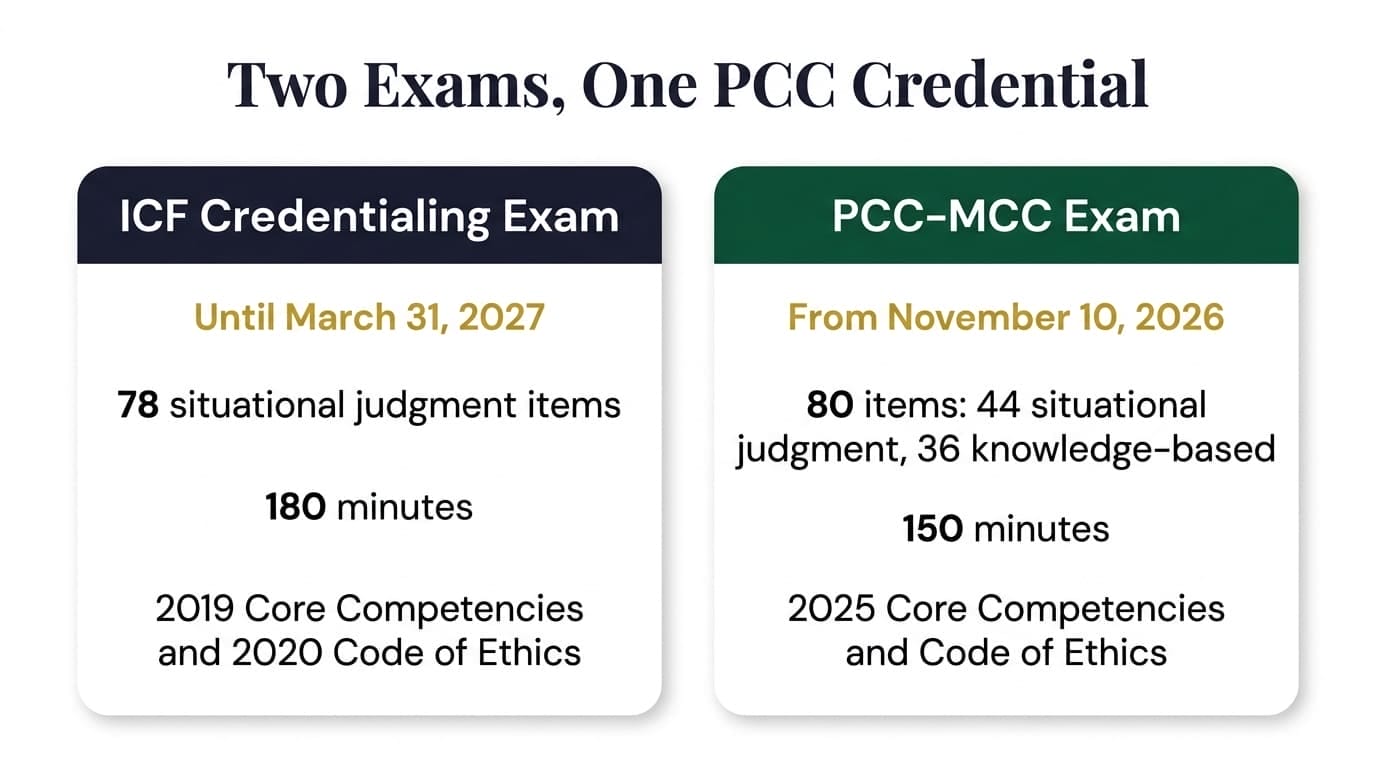
| Feature | Current ICF Credentialing Exam | New PCC-MCC Exam |
|---|---|---|
| Available | Until March 31, 2027 | From November 10, 2026 |
| Items | 78 situational judgment items | 80 items: 44 situational judgment and 36 knowledge-based |
| Question format | Choose the best and the worst of four actions | Situational judgment: choose the most and least effective response. Knowledge-based: multiple choice with one correct answer |
| Time | 180 minutes, including an optional 10-minute break | 150 minutes, including an optional 10-minute break |
| Structure | Two sections of 39 items | Four sections: 18 knowledge-based, 22 situational judgment, optional break, 18 knowledge-based, 22 situational judgment |
| Standards tested | 2019 Core Competencies and 2020 Code of Ethics | 2025 Core Competencies and Code of Ethics |
| Scoring | Scaled from 200 to 600; 460 to pass | ICF says the difficulty and expected passing standard match the current exam; scoring details not yet published |
The Current ICF Credentialing Exam
The exam you can sit today has 78 situational judgment items. Each presents a coaching scenario and four possible actions, and you choose the best and the worst. You get 180 minutes, including an optional 10-minute break, at a Pearson VUE test center or online through Pearson’s OnVUE platform. Scores are scaled from 200 to 600, and 460 passes. Once ICF invites you to schedule, you have 60 days to book and complete the exam. ICF reports that of the 9,795 candidates who took it in 2023, 75% passed on the first attempt and 87% passed overall.
The New PCC-MCC Exam
ICF’s PCC-MCC Exam replaces the current exam after the transition. It has 80 items in four sections: 44 situational judgment items, where you choose the most and least effective response to a coaching scenario, and 36 knowledge-based multiple-choice items with one correct answer, a format ICF already uses on the ACC Exam. It takes 150 minutes, including an optional 10-minute break, and tests ICF’s 2025 updates to the Core Competencies and Code of Ethics. The knowledge-based items cover core coaching concepts, principles, and professional standards. ICF has not published a topic outline for them. Because those items are more direct, ICF says the exam involves less reading overall.
ICF says the difficulty and expected pass rate match the current exam. It has not yet published the scoring details for the new exam. A free ICF tutorial on the new question formats is due shortly before launch. ICF will send candidates a form to request the PCC-MCC Exam, and if you are already in “ready for exam” status, you can contact ICF support for it. ICF published these details in July 2026 in its candidate guide to the updated credentialing exam.
Which Exam Should You Take?
Both exams lead to the same credential, and ICF says they are equally demanding, so choose by timeline and by the standards you have been studying. This is our guidance, not ICF policy:
- Testing before November 10, 2026: only the current exam is available.
- Ready to test before March 31, 2027, and prepared on the 2019 competencies and 2020 Code of Ethics: the current exam is a sound choice. Leave room for a retake inside the window, because any attempt on or after April 1, 2027 is the PCC-MCC Exam, with a different format and the 2025 standards. Do not plan a first attempt for the last days of March 2027.
- Starting preparation now, or expecting to test in 2027: prepare for the PCC-MCC Exam on the 2025 standards. Those are the standards ICF now uses, and a retake after March 2027 would be the new exam anyway.
- Choosing the new exam early: practice both question formats, because the knowledge-based items are new for PCC candidates. Few practice materials exist yet for those items, and ICF’s tutorial arrives only shortly before launch. The exam is 30 minutes shorter and involves less reading.
Both exams lead to the same PCC credential. Choose the one that fits your test date and the standards you have studied, and if you pick the current exam, leave room for a retake before March 31, 2027.
For PCC candidates who have completed their training and logged real coaching hours, the exam tests knowledge they have been applying in practice. ICF says no major changes to preparation are needed for the new exam and that most existing preparation resources remain relevant. Our guide to the ICF credentialing exam covers preparation in detail, and you can get used to the situational judgment format with PCC exam sample questions.
Two Application Paths
ICF offers two routes to PCC certification: the Level 2 Path (completing a single accredited program) and the Portfolio Path (assembling training from multiple sources). The right choice depends on where a candidate stands in their coaching career and how much training they already have.
Level 2 Path. Complete a 125+ hour ICF-accredited Level 2 program that covers all training requirements in a single curriculum. The program typically includes mentor coaching, competency assessment preparation, and PCC eligibility and application process guidance. Best for coaches who want a structured, comprehensive development experience.
Portfolio Path. Assemble 125+ hours of coach education from multiple sources, accredited or not. The candidate independently tracks training hours, sources mentor coaching, and manages their own application documentation. Best for experienced coaches who already have substantial training and need to fill specific gaps rather than repeat foundational content.
For coaches pursuing PCC within a few years of beginning their coaching career, the Level 2 path is more efficient. The structured program ensures nothing falls through the cracks and handles ICF documentation requirements on the candidate’s behalf. The Portfolio path makes sense for coaches with five or more years of diverse training who know exactly what they need and have the administrative discipline to track requirements across multiple providers. Both paths lead to the same credential. The difference is in how the preparation is organized, not in what the credential represents. Military and veteran readers weighing that progression should also see our guide to building a coaching career after military service for status-specific context before choosing a path.
If you have already finished an ICF Level 1 program, the Level 2 path does not mean starting over. Tandem’s ICF PCC training for Level 1 graduates is a bridge that completes ICF Level 2 (162 approved hours in total). It admits coaches with 60 or more hours of ICF-accredited training, from Tandem’s Level 1 or from another accredited provider. ICF, not Tandem, awards the PCC credential once you meet the experience, mentor coaching, performance evaluation and exam requirements.
How Long PCC Takes
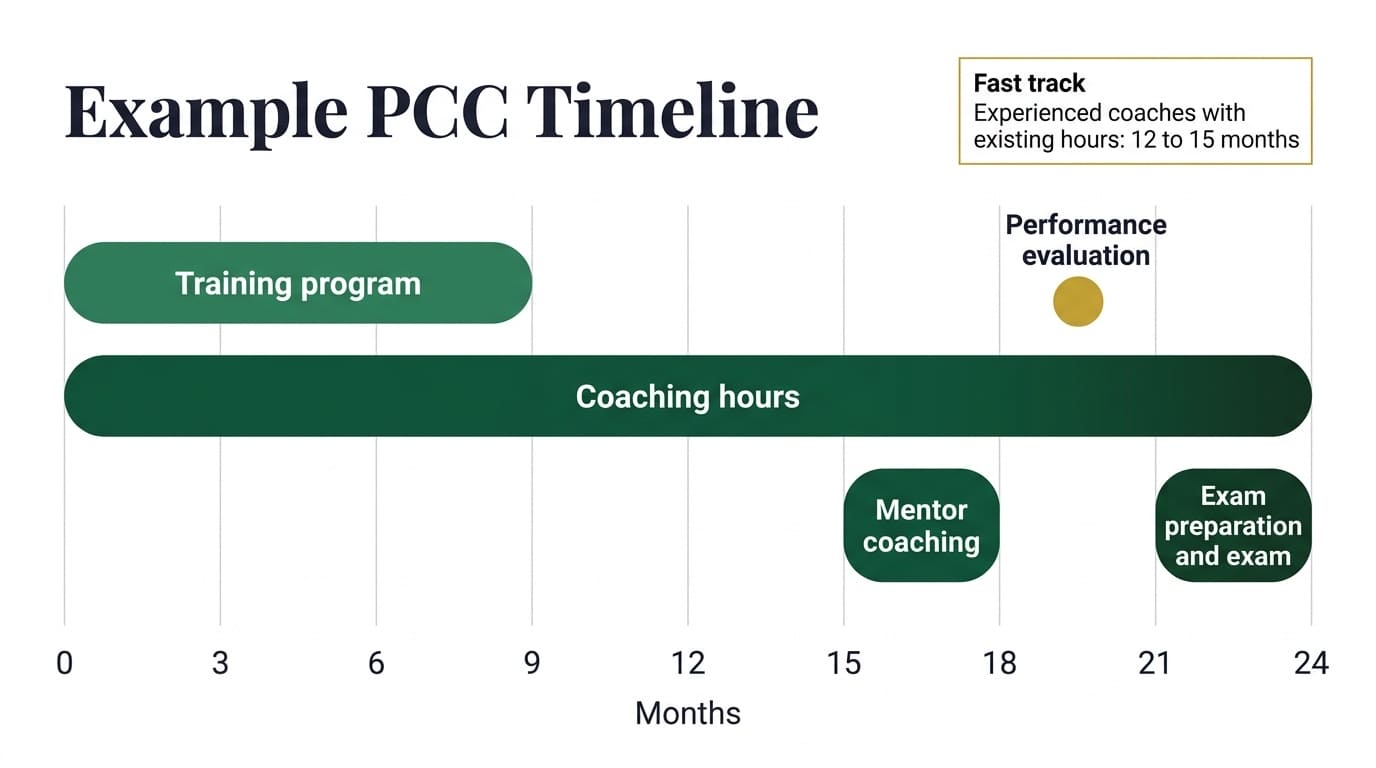
How long PCC takes depends mostly on how quickly your coaching hours accumulate. Experienced coaches who enter with existing coaching hours can finish in 12 to 15 months. A coach starting from zero should plan on two to three years, because the 500 hours set the pace, not the training. The other factors are the training program schedule and the candidate’s readiness for the performance evaluation.
The activities overlap. Training and coaching hour accumulation happen in parallel. Coaches build hours during and after their training program, not sequentially. Mentor coaching typically begins in the second half of the process, once the candidate has enough coaching experience to benefit from targeted feedback. The performance evaluation and the exam fall in the final months. ICF’s application review takes 4 to 18 weeks depending on the path, and once ICF invites you to schedule the current exam, you have 60 days to book and complete it.
If your exam could fall near the end of March 2027, plan around the transition. Anyone who tests or retests on or after April 1, 2027 takes the PCC-MCC Exam, and Portfolio applications submitted on or after that date follow the new mentor coaching requirement instead of the performance evaluation.
The variable that matters most is coaching volume. A coach averaging four sessions per week accumulates 500 hours in about three years. A coach with an organizational coaching role or multiple clients may reach the threshold in half that time.
A fast-track scenario: an experienced internal coach with 200 existing hours enters a Level 2 program, continues coaching during the 6–9 month training period, and reaches 500 hours within 12–15 months of starting. A more typical path: a coach starting from zero builds hours over two to three years while completing training in the first six to nine months. Both are viable. Planning the coaching hour accumulation early, ideally before beginning the training program, is the single most impactful decision a PCC candidate makes.
The hours are a byproduct of building a real coaching practice, not a separate task to complete alongside it. Making that shift in framing changes the psychology entirely.
Frequently Asked Questions
What is ICF PCC?
ICF PCC (Professional Certified Coach) is the mid-tier credential awarded by the International Coaching Federation, above ACC and below MCC. It requires 125 hours of coach-specific education, 500 coaching hours (450 paid) with at least 25 clients, 10 mentor coaching hours over at least three months, a performance evaluation, and a passing score on ICF’s PCC exam: the ICF Credentialing Exam, or the PCC-MCC Exam from November 10, 2026.
Do I need ACC before pursuing PCC?
No. Coaches can apply directly for PCC if they meet all the requirements (125 hours of training, 500 hours of experience, mentor coaching, the performance evaluation, and the exam). ACC is not a prerequisite for PCC. Many coaches choose to pursue ACC first because the hour requirements are lower, but others enter directly at the PCC level.
Can I count pro-bono coaching hours toward PCC?
Yes, up to 50 hours. Of the 500 total hours required, a minimum of 450 must be remunerated, meaning the client provides payment or a genuine exchange of value. The remaining 50 hours may be pro-bono coaching with documented agreements.
What happens if I fail the performance evaluation?
On the Portfolio path, ICF lets you submit a new recording and transcript within six months of your results notice, at $150 per recording. You can instead request a rescore within the same six months, also $150 per recording and refunded if the rescore passes, with one rescore allowed per recording. Work through the results with your mentor coach before you record again. On the Level 2 path, the evaluation sits inside your program, so ask your program about its reassessment process. For Portfolio applications submitted on or after April 1, 2027, there is no performance evaluation: your mentor observes your sessions and completes a Competency Review Form instead.
How hard is the ICF PCC exam?
ICF reports that of the 9,795 candidates who took the ICF Credentialing Exam in 2023, 75% passed on the first attempt and 87% passed overall. The exam has 78 situational judgment items in 180 minutes, scored from 200 to 600 with 460 needed to pass. ICF says the new PCC-MCC Exam, available from November 10, 2026, keeps the same difficulty and expected passing standard. It has not yet published the scoring details for the new exam. Both exams test how you apply the ICF Core Competencies and Code of Ethics, not rote memorization. See our ICF credentialing exam preparation guide.
Is the ICF PCC exam the same as the ACC exam?
No. Since November 2024, ACC candidates take their own ACC Exam: 60 knowledge-based multiple-choice questions with one correct answer, in 90 minutes. PCC and MCC candidates take the ICF Credentialing Exam (78 situational judgment items, 180 minutes) until March 31, 2027, or the new PCC-MCC Exam (80 items, 150 minutes) from November 10, 2026. From April 1, 2027, only the PCC-MCC Exam is offered. Its 36 knowledge-based items use the same format as the ACC Exam, and its 44 situational judgment items ask for the most and least effective response. The experience and evaluation requirements differ too: see the ICF ACC requirements.
How long is PCC certification valid?
PCC is valid for three years. Renewal requires 40 hours of continuing coach education (CCE) and payment of the renewal fee. Details on the renewal process and CCE requirements are covered in renewing your PCC credential.
How much does PCC certification cost in total?
Training tuition is the largest cost and varies widely by program. ICF’s PCC application fee is $375 for ICF members on the Level 2 path and $750 on the Portfolio path ($525 and $900 for non-members). On the Portfolio path, mentor coaching is a separate cost. All-inclusive programs that bundle training, mentor coaching, and exam preparation cost more up front but remove the work of sourcing components separately. Explore ICF-accredited training programs to compare options.
Ready to Start Your PCC Journey?
Tandem’s ICF-accredited PCC program covers all training, mentor coaching, and exam preparation. Two MCC-level instructors guide you from enrollment to credential.
See PCC Program Details →