
ICF MCC Mentor Coaching: Why I Plan for a Year, One-on-One
How Is MCC Mentor Coaching Different From PCC Mentor Coaching?
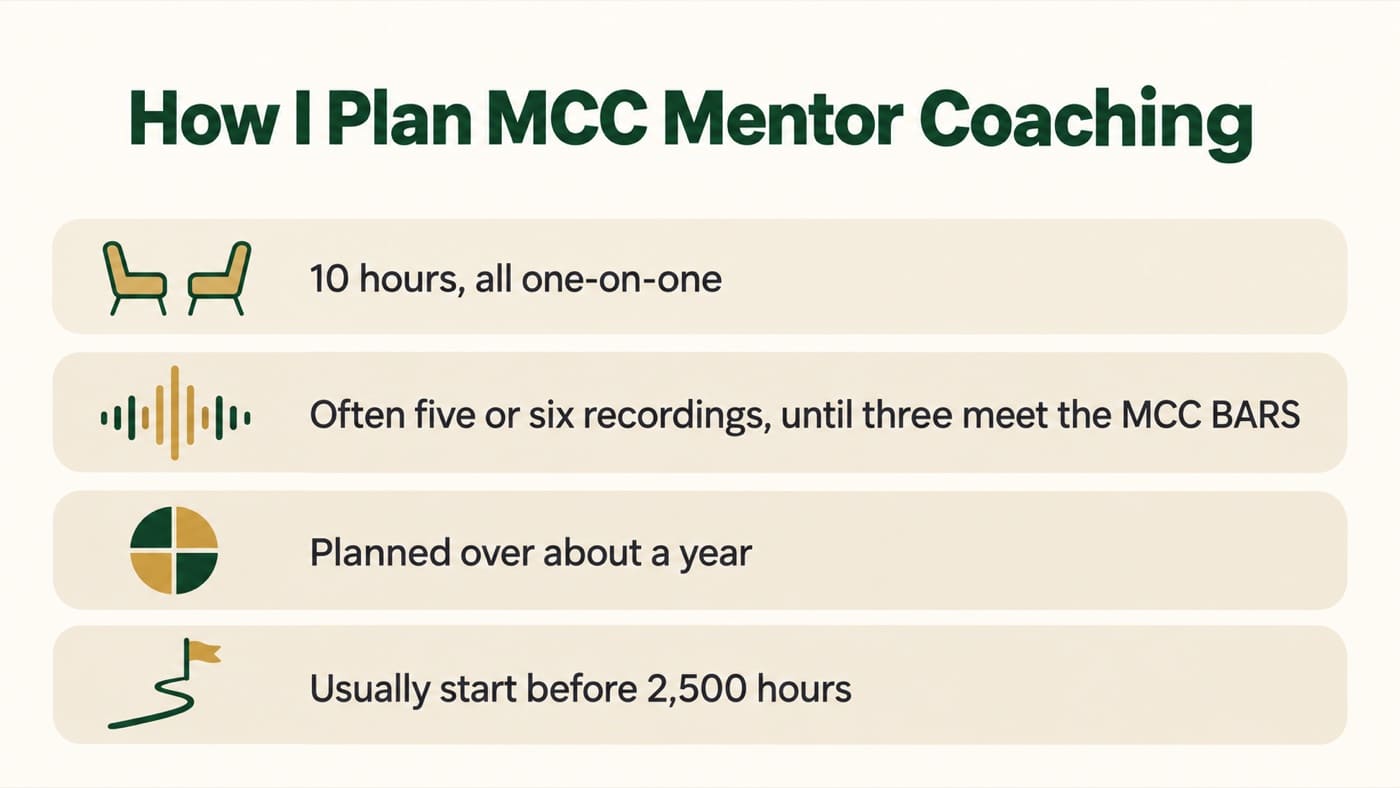
In my practice, MCC mentor coaching is 10 hours, all one-on-one, because the differences between PCC and MCC are too fine for a group. I often review five or six recordings until three meet the MCC BARS (Behaviorally Anchored Rating Scales), and we plan about a year, usually starting before the coach reaches 2,500 hours.
I'm Cherie Silas. I hold the Master Certified Coach (MCC) credential awarded by the International Coaching Federation (ICF), and I mentor coaches toward it. Tandem sells MCC mentor coaching, so you should know that as you read.
This article is for a credentialed coach who has earned an ICF credential as an ICF Professional Certified Coach (PCC) and wants the ICF Master Certified Coach credential next. The way I look at it, MCC is 2,500 hours of coaching experience, five times more experience than PCC, so the level of coaching is much higher than PCC level. The ICF requirements for the MCC credential itself are in our guide to ICF MCC requirements. Here I'll stay with the mentoring.
Mentor coaching toward MCC runs differently in my practice. It's all one-on-one, it takes more recordings and we plan it over about a year.
Key Takeaways
- In my practice, MCC mentor coaching is all one-on-one. The differences between PCC and MCC are too fine to get to in a group.
- Plan for more recordings than the three-form minimum. I often review five or six before three meet the MCC BARS.
- Plan for about a year, and start before you reach 2,500 hours.
- Needing more mentoring, or waiting, is one of the ordinary ways MCC mentoring goes.
- ICF has said that from January 1, 2027, new MCC mentor coaching must come from a mentor coach who holds the Mentor Coach Specialization at MCC level.
Why My MCC Mentor Coaching Is All One-on-One
At the Associate Certified Coach (ACC) level and at PCC, the coaches I mentor get individual and group mentor coaching. That changes at MCC. It's all one-on-one mentor coaching, because you're not going to get to the differences between PCC and MCC in a group mentoring session.
They deserve one-on-one feedback, because the things that make MCC can be so minute. You're working at a skill level where it's hard to describe what it is, because it's so integrated. So we need to look at multiple recordings, basically line by line.
That's my mentor coaching practice, and it's the way Tandem's MCC package runs. ICF sets its own mentor coaching requirements for how the hours are delivered. One-on-one is my choice, and for what ICF requires, read the ICF mentor coaching hour rules in our guide.
10 Hours of Mentor Coaching, Planned Over About a Year
I only do MCC as 10 hours of one-on-one mentor coaching, and I give feedback on several recorded coaching sessions. ICF's Accreditation Alignment and Compliance Guide sets a minimum of three Session Observation Forms and one Competency Review Form for each mentoring client, and at MCC I plan for more recordings than that. (At MCC, ICF has said those forms aren't required for submission.)
Start Before You Reach 2,500 Hours
Our MCC mentor coaching runs the way this article describes: 10 hours, all one-on-one, with a mentor coach who holds the MCS at MCC level.
It generally takes people more than three recordings to get to MCC. I might do five or six recordings until we get three that meet the MCC BARS (Behaviorally Anchored Rating Scales) and show that they're successful.
A lot of times they won't be successful, and they'll either need more mentoring or they'll wait. Needing additional mentor coaching, or waiting, is one of the ordinary ways this goes at MCC.
That's why, when people sign up for MCC mentoring, we generally talk about taking the next year to do this. They usually sign up before they get to their 2,500 hours, so the year of mentoring runs alongside their last hours of coaching.
We've got a year to grow and develop those skills, rather than trying to do this in three months.
Say you hold the PCC and you're still some way short of 2,500 hours. When you sign up for MCC mentoring, we talk about the next year: time to work on your coaching skills between recordings, so each new recording shows what you've been learning. I treat the year as time for professional development.
What the MCC Level Asks of a Whole Coaching Session
What I'll say about MCC-level coaching is short. At MCC there's a higher level of listening, a higher level of attention to detail, a higher level of curiosity. And it's meeting the MCC BARS, the bars that describe the coaching competencies at the MCC level.
I'm not going to describe a moment that showed MCC-level coaching. That's not really a thing.
The whole coaching shows MCC or it doesn't.
The question is whether there was a moment that met a bar or didn't meet a bar, and that's no different from the other levels. It's just at the MCC level. ICF uses BARS at the ACC and MCC levels and the ICF PCC Markers at PCC, so the bar changes with the level. My written feedback stays aligned with the ICF Core Competencies, the same eight competencies behind every ICF level.
If you use the forms at MCC, the MCC Competency Review Form carries the same rule as the other levels: at least two-thirds (67%) of the skills in each competency must be demonstrated, and a skill counts when it's rated Meets or Exceeds Standard in at least one observed coaching session. At MCC, the counts per competency are:
| ICF Core Competency | MCC: at least |
|---|---|
| 3. Establishes and Maintains Agreements | 3 of 4 statements |
| 4. Cultivates Trust and Safety | 3 of 4 statements |
| 5. Maintains Presence | 3 of 4 statements |
| 6. Listens Actively | 2 of 3 statements |
| 7. Evokes Awareness | 2 of 3 statements |
| 8. Facilitates Client Growth | 2 of 3 statements |
Competency 2 isn't rated from the session at MCC; in ICF credentialing it's evaluated through the written exam. The PCC rule that some markers need more than one piece of evidence within a session has no MCC equivalent. And at every level, evidence for one statement can't be added up across sessions, so a single recording has to show it.
Choosing an ICF Mentor Coach for MCC From 2027
ICF has said the MCC performance evaluation stays. The 2027 change to the portfolio pathway covers ACC and PCC only. ICF has also said that new mentor coaching at MCC after January 1, 2027 must be with a mentor coach who holds the ICF Mentor Coach Specialization (MCS) at MCC level, and that the Session Observation Forms and Competency Review Form aren't required for MCC submission. ICF strongly encourages them as preparation for the performance evaluation.
The broader rule, as ICF has said it: from January 1, 2027, all new mentor coaching must be by an MCS holder at that level or above, renewals included, for any ICF coaching credential. ICF has said listings without the MCS come off its mentor coach registry at the end of 2026. There's more on what ICF has said about MCC from 2027 in my article on the portfolio path.
If you need mentor coaching toward MCC, the MCS is the mentor coach qualification to check. ICF has said your mentor coach must hold the MCS at MCC level. A mentor coach holding the ICF MCS only at PCC level can't take on your new MCC mentor coaching, and experienced mentor coaches who don't hold it at all can't either. Ask about your mentor coach's MCS level before you sign up.
Alex Kudinov and I hold the MCS at all three levels, and every mentor coach on our team holds it at the level they mentor. Wherever you look to find a qualified mentor coach, check that the mentor coach holds the MCS at the level you're working toward.
Where to Start If You're Working Toward MCC
Start before you have your 2,500 hours, and give it the year. Our MCC package runs the way I've described here: 10 hours of mentor coaching for ICF credentialing, all one-on-one, with a mentor coach who holds the MCS at MCC level. If you compare it with another mentor coaching program, ask the same questions about format, recordings and the mentor's MCS level.
If you mentor ACC and PCC coaches yourself, our mentor coach training program prepares mentor coaches for that work.
Frequently Asked Questions
Can MCC mentor coaching be done in a group?
Not in my practice. At MCC I do all 10 hours one-on-one, because you're not going to get to the differences between PCC and MCC in a group mentoring session. ICF sets its own rules for how mentor coaching hours are delivered; the one-on-one format is my choice.
How many recordings does MCC mentor coaching take?
In my practice it generally takes more than three. I might review five or six recordings of your coaching conversations until three meet the MCC BARS.
When should I start MCC mentor coaching?
Coaches usually sign up with me before they reach 2,500 hours, and we plan the mentoring over about a year.
Who can mentor me toward MCC after January 1, 2027?
ICF has said new mentor coaching toward PCC or MCC must come from an MCS holder at that level or above. For MCC, that means a mentor coach who holds the MCS at MCC level.
Do I need the Session Observation Forms for my ICF application at MCC?
ICF has said the Session Observation Forms and Competency Review Form aren't required for MCC submission. It strongly encourages them as preparation for the performance evaluation.
Plan Your Year Toward MCC
10 hours of one-on-one mentor coaching with an MCS-MCC mentor coach, feedback on your recordings against the MCC BARS, and time to grow before you apply.
See MCC Credential Mentoring →