
What Makes a Good Mentor Coach: What Two Cohorts Taught Me
What makes a good mentor coach?
A good mentor coach can review a recording of a coach's session and see accurately whether the coach did what ICF's standard for that credential level says. They ask “did they,” not “would I have,” describe the behavior under the words, give feedback from a coaching stance, and have the patience for hours of detailed review before every session.
By the second class of our first Mentor Coach Specialization (MCS) cohort, I knew the course I had built was not going to work, and I had to start over.
That cohort, and the one after it, changed my answer to a question I thought I already knew: what makes a good mentor coach? Search for it and you'll mostly find advice about workplace mentoring. Mentor coaching in the International Coaching Federation (ICF) sense is narrower and more demanding. A coach working toward an ICF credential at the Associate Certified Coach (ACC), Professional Certified Coach (PCC) or Master Certified Coach (MCC) level brings recordings of real sessions, and the mentor coach gives feedback against ICF's standard for that level, such as the ACC Behaviorally Anchored Rating Scales (BARS) or the PCC Markers. Two cohorts in, my answer looks different from the one I would have given before the first class.
Key Takeaways
- The core skill is looking at a recording, seeing accurately what the coach did, and matching it to the ACC BARS or PCC Markers by reading every word of the marker.
- The rating question is “did they”: did the coach do what the marker says? How they did it belongs in the mentoring conversation.
- Useful feedback names the behavior under the words, and it comes from a coaching stance: “How could you rephrase this?”
- The work is detailed. For a one-hour mentor coaching session, I spend two hours reviewing the recording and writing up feedback first.
- From January 1, 2027, new mentor coaching has to come from someone who holds the MCS at that level or above.
What a Good Mentor Does, and What a Mentor Coach Adds
A workplace mentor shares career advice based on their personal experience and builds a mentee's confidence toward a goal. A mentor coach in the ICF sense adds a narrower skill: reviewing recordings of a coach's real sessions, seeing accurately what the coach did, and giving feedback against ICF's standard for that credential level.
The search results describe workplace mentorship with familiar lists. A great mentor shows empathy, has honesty and integrity, and is a good communicator. They help with problem-solving and professional development and talk frankly about strengths and weaknesses. They support a mentee's leadership growth and career goals, share their network and resources, guide the next steps, encourage progress, and build a relationship of mutual respect. An effective mentor in a company mentoring program does all of that well.
ICF mentor coaching asks for something more specific. The mentee is a coach preparing for an ICF credential. The mentor coach reviews recordings of the mentee's actual coaching sessions and gives feedback against the standard for the level the coach is working toward, such as the ACC BARS or the PCC Markers. That is what ICF requires of mentor coaching: observation of real coaching, and feedback tied to the standard.
So the mentor-mentee relationship is built around recordings. The mentoring relationship still needs warmth, honesty and good communication between mentor and mentee, the same things any relationship between a mentor and a mentee needs. The workplace lists leave out the review skill, and it's the one that separates a strong mentor coach from a weak one. If you're choosing mentor coaching for an ACC, PCC or MCC application, that's the skill to look for. It's also where my first cohort surprised me.
What I Assumed When the First Cohort Started
When our first cohort opened, I assumed the participants would be highly competent coaches, coaching at least at a high PCC level, who could tell from their own experience what was good coaching and what wasn't. I also assumed I knew what it would take to teach them. The first wasn't necessarily true. The second was the bigger mistake.
I came to mentor coaching as an instructor in a coach training program, and I took ICF's training on the ACC BARS and the PCC Markers to qualify. So I thought I knew who would join and what they would need.
The mix was wider than I expected. Some participants had never mentored anyone. Some were mentoring, but only coaches renewing their ACC. Some were running or working in a coach training organization that now needed certified mentor coaches. And some saw an opportunity for a new product. Each group came with its own experience and its own motivation, in one class.
I had also assumed everyone would be a PCC- or MCC-level coach, and a few were ACC-level coaches who had renewed. Some heard of the PCC Markers for the first time in our course. Almost all of them had never heard of the ACC BARS.
I think I made more of an assumption about what it would take to teach them, and that was the incorrect assumption more than who would be in the class.
Why I Threw Out the Plan at the Second Class
I threw out the plan at the second class because I could see the participants needed calibration: practice matching what a coach does in a recording to the ACC BARS and PCC Markers. I had built the live classes in more of a teaching format, because it was a class, and that wasn't going to work.
When we got into the second class, I knew I had to throw everything out the window and start over.
I very, very quickly realized that what they needed was calibration.
The participants were supposed to have done ICF's ACC BARS and PCC Markers training before the course started, and not all of them had. Once class began, they were drowning, because they couldn't keep up with the course work and the BARS and Markers training at the same time.
Then they reviewed their first recording. I was shocked at how far off things were, between what they assumed met the BARS and Markers and what actually did, and at how often they put evidence in completely unrelated places.
What does it look like when a mentor coach isn't calibrated yet? They can't find the evidence in a recording and align it with the PCC Markers or the ACC BARS. Some don't yet have a working understanding of the BARS and Markers at all. When they say something met a marker, it often didn't, or they miss things that did. More often, they file a behavior under the wrong competency, or credit the coach with something that never showed up in the session, because they aren't reading all of the words of the marker. Each word matters, and what the coach did has to match it.
The hardest part of this work is reviewing the recordings and matching them to the ACC BARS or the PCC Markers. The amount of calibration my participants needed was extreme, so I redesigned the course to give that work much more room.
Did They or Did They Not: The Rule Good Mentors Follow
The rule is one question for every piece of evidence: did the coach do what the marker says? Whether the coach did it the way you would have is a separate question, and its place is the mentoring conversation, after the rating. A style unlike yours can still show the competency.
Style is where my participants struggled. Someone would watch a recording and think, that's not how you do that, you're supposed to do it like this. I kept bringing them back to the same questions. What does the marker say? Did they do what the marker says, or did they not? Not how they did it. Did they?
How they did it still matters. Maybe the coach did it super skillfully, maybe not, maybe in a coaching style you would never use. In the mentoring conversation you can say: consider how it would look if you did this, or what was the value of that? If they did it in a way you wouldn't, they still showed the competency. They showed it differently than you would.
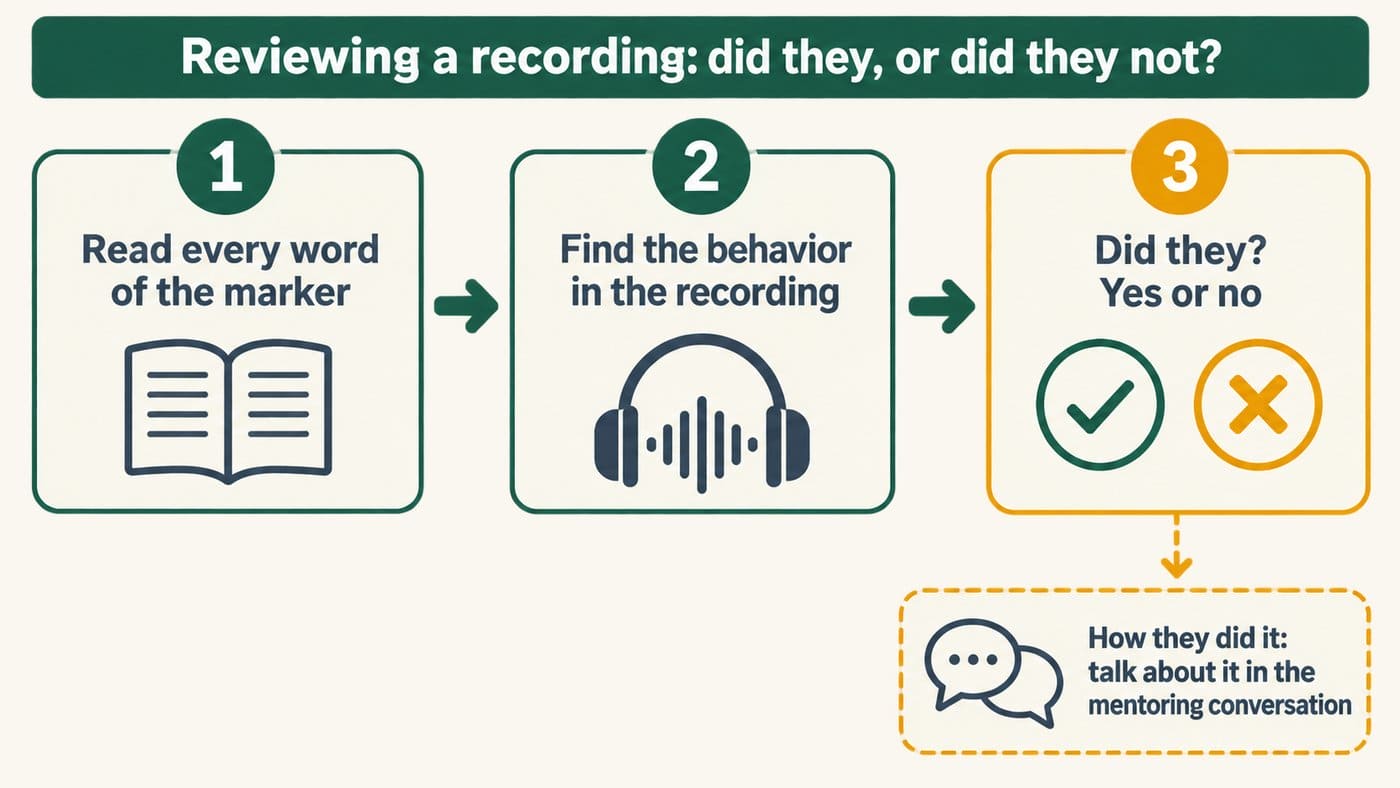
Keep in mind how ICF itself counts. A skill counts as demonstrated when the coach shows it at a competent level in at least one observed session, and a competency passes when at least two-thirds (67%) of its skills are demonstrated. Rating a coach by how you would have done it is a bias, and staying open-minded about style is how you keep it out of the review. The rest of what each credential asks is in our guides to the ICF ACC requirements and the ICF PCC requirements.
When you read a transcript, which question are you asking: did they, or would I have?
Feedback That Names the Behavior Under the Words
Constructive feedback in mentor coaching names the behavior. A quote from the transcript and a timestamp show where to look. The feedback also has to say what the mentee was actually doing in the session that makes those words meet the competency marker.
Practice This Feedback on Real Recordings
In our mentor coach training cohort you mentor a peer on their coaching recording each week, then debrief the session live in class with Cherie Silas, MCC.
That's a change from how I used to mentor. Before, I was assessing: this piece of your recording matched this, and this part didn't. Now, in my own mentoring and when I teach mentor coaches, the feedback talks about behavior. The mentee's attention moves from the words they used to what they were doing underneath them, and I think that's better for them. It's a more effective way to help the mentee see their own competence.
Participants who had mentored before did better in the course than coaches new to mentoring. Their big gap was describing the behavior. They could point to the quote; saying what the coach did there was the learning curve. They also knew the PCC Markers, because when they had mentored before, it was against the PCC Markers. The ACC BARS were new to almost all of them, so they had more trouble assessing against the ACC BARS than the PCC Markers.
ICF never really required behavior descriptions before, and there's probably still some question about whether it requires them now. I think it's the best thing for the mentee, and I find a lot of value in it. So do the participants, once they've mentored this way.
The structure around that feedback comes from ICF. A mentee needs at least three Session Observation Forms, each from a different session, and one Competency Review Form. We built free online mentor coaching forms for both. A form is a tool for recording the judgment; the mentor coach still has to make it.
Mentoring From a Coaching Stance
Mentoring from a coaching stance means you use all of your coaching skills on the feedback itself. You say what you noticed, then let the mentee react and work out how they would change it. A consulting stance tells them what they got wrong and how to fix it.
The consulting version sounds like this: you got this wrong, fix it like this, go do this. The coaching version sounds like this: here's what I noticed. These are closed questions. How could you change this into an open-ended question? The whole difference fits in one line: “You should rephrase this like this,” versus “How could you rephrase this?”
In the past, as mentors, we weren't using coaching skills to mentor. At least I wasn't. I can't speak for the rest of the world.
It's development through coaching. What you already do with a client, to build trust, listen and ask a good question, is what you use here. The mentor's role is to help your mentee refine their own coaching, so the mentee must do the deciding: which question to rephrase, and how. You can co-create what they'll try in the next recording, and the change stays theirs. That keeps the conversation two-way and close to the coaching relationship you already know, and it lets the mentee develop as a coach. Good communication is the part you bring with you. A coaching supervisor works on something different again, and our piece on how mentoring differs from supervision draws that line.
Why a Good Coach Can Struggle as a Mentor Coach
A good coach can struggle as a mentor coach because it's a completely different thing. Mentor coaching is extremely detailed and takes a different skill set: watching, listening and reading a recording for what is said, what behaviors the coach is doing, and how those match the competencies. That takes far longer than the session.
In coaching, you walk in and you're in the moment, without any of that prep work. If you're not an extremely detailed person who wants to spend a lot of time down in the weeds, you're going to hate mentor coaching. If I have a one-hour session with someone, I've already spent two hours reviewing the recording and writing up feedback before I ever talk to them.
Picture a mentor coach whose first meeting with a new mentee is on the calendar. The two hours of review come before it, and before every session after it. That review is the part of the coaching process that takes the time.
In our first cohort, the coaches who struggled more were the ones new to mentoring. Some had joined because they saw a new product to offer. With no mentoring behind them, they didn't really understand what was involved. One person dropped out and said, this is too much work, I don't want to do this, this is not fun at all. Which is valid. It was way more work than they thought it would be.
The Graduation Gate Every Participant Has to Pass
The gate is a calibration exercise every participant has to pass to graduate: each one reviews the same recording against the ACC BARS and PCC Markers. I put it in about halfway through the first cohort, replacing the original capstone, and I've kept it since.
I changed it because I was very concerned about releasing people to go get certified as mentor coaches when they weren't capable of doing the evaluation properly. My original capstone didn't cover that. It was a personal ethics question for me, and one I struggled with.
How do I make sure that I'm not releasing people who can't do this?
Making the calibration the gate gave me the comfort that I wouldn't have to graduate somebody I didn't think was qualified. The capstone is our course design, a standard we chose to ensure every graduate can evaluate a recording before they mentor anyone. ICF doesn't set it.
What a Mentor Coach Who Is Ready Can Do
A mentor coach who is ready can understand, point out and describe what is happening in a coaching session, and match it to the ACC BARS and PCC Markers: how the competencies are showing up in what the coach does. Then they can write that up as feedback the mentee can use.
Participants also self-reported that their own coaching got tremendously better, because learning to mentor others meant understanding the BARS and Markers, and the competencies they needed to bring more of into their own coaching.
The easiest part of mentor coaching is the conversation with the mentee. You're a coach; you know how to have these conversations. The hardest part is the preparation and writing up the feedback. My participants learned the structure of a mentor coaching conversation, but they were already capable of the conversation itself. What they needed was the underlying knowledge to bring to it, and the skills needed to find it in someone else's recording and help a mentee grow from it. That's the quality I'd look for in any mentor coach, whether you're choosing one or becoming one.
In 2027 that quality matters to more coaches: from January 1, new mentor coaching has to come from someone who holds the MCS at that level or above, and from April 1, ICF stops taking new ACC and PCC portfolio applications that use its performance evaluation. Alex Kudinov and I hold the MCS at all three levels, and every mentor coach on our team holds it at the level they mentor. Our overview of the Mentor Coach Specialization sets out what it requires at each level, and whether the specialization is worth it for your practice is a question to answer before you enroll. If you want to learn to do this work, Tandem's mentor coach training cohort is where we teach it.
Questions About Mentor Coaching
What is the difference between a mentor and a mentor coach?
A workplace mentor guides someone's career with advice based on their own experience. An ICF mentor coach reviews recordings of a coach's real sessions and gives feedback against ICF's standard for the credential level, such as the ACC BARS or the PCC Markers, from a coaching stance.
How long does a mentor coach prepare for a session?
Longer than the session itself. For a one-hour mentor coaching session, I spend two hours reviewing the recording and writing up feedback before I talk with the mentee. Matching what the coach said and did to each marker is detailed work.
Does learning to mentor coach improve your own coaching?
Participants in our cohorts self-reported that it did, tremendously. Reviewing other coaches' recordings against the ACC BARS and PCC Markers showed them which competencies they needed to bring more of into their own coaching.
Can a coach show a competency in a different style and still meet it?
Yes. The question is whether the coach did what the marker says. Style is a topic for the mentoring conversation, where you can explore how another approach would look.
Train as a Mentor Coach With Cherie Silas, MCC
Twelve weeks of live classes, ending in the calibration gate every participant passes to graduate. $2,997, or from $999 on a payment plan, with cohorts through 2027.
See Cohorts & Pricing →