
Mentor Coaching Mistakes: Four Habits Behind the Mistakes Coaches Make With a Mentee
What are the most common mentor coaching mistakes?
The most common mentor coaching mistakes are four habits experienced coaches bring into the mentor coach role: directing instead of developing, rating the person instead of the skill, skipping the check on your own lens, and answers without the reasoning. Each grows out of a coaching instinct that works with clients, and each changes fast once named.
Key Takeaways
- On one recording presented as PCC level, 37 of 120 level calls (31%) placed it below PCC.
- Directing instead of developing is the most common habit: 85% offered example questions or wording on their first try.
- Rating the person instead of the skill scores humor, pace or warmth as if it were competency evidence.
- Knowing your own lens means naming your pulls before you listen and checking them against evidence.
- Answers without the reasoning hide what the coach could borrow: show the evidence, the competency and the call you rejected.
One Recording, 132 Verdicts
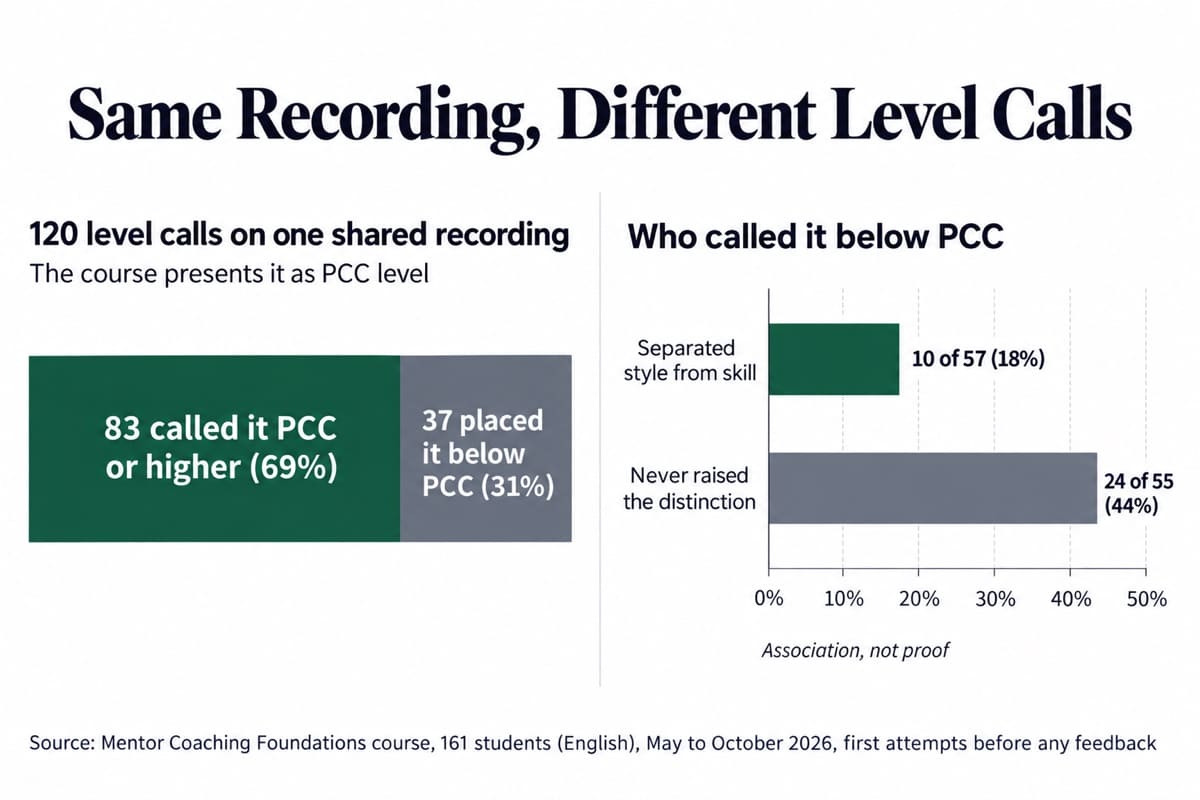
Give experienced coaches the same 25-minute coaching session recording, presented as Professional Certified Coach (PCC) level, and their level calls spread wide. Of 132 first attempts in our course, 120 gave an overall level: 83 (69%) called it PCC or higher, and 37 (31%) placed it below PCC.
Every number in this article comes from Tandem Coaching Academy's own Mentor Coaching Foundations course: 161 students in the English course, May to October 2026, counting first attempts only, before any feedback. Every student analyzes the same recording, so whatever spreads the calls sits with the listeners.
The International Coaching Federation (ICF) publishes the ICF PCC Markers, the behaviors an assessor listens for in a PCC-level session, and a level call means matching what the coach on the recording does to them. The course adds a proficiency threshold for turning that evidence into a call. The threshold is our teaching framework, not ICF scoring. Of the 98 students who reasoned explicitly with it, 29 (30%) still landed below PCC.
Many coaches in that 31% had the rule in front of them and still placed the session below PCC. One caveat before going further: the course labels this recording a PCC demonstration, so this is not a blind test. The next section deals with what that changes.
Much of the spread comes from four habits experienced coaches bring into the mentor coach role. They are the mistakes coaches make when they start mentoring: directing instead of developing, rating the person instead of the skill, skipping the check on their own lens, and giving answers without the reasoning.
What These Numbers Do and Don't Show
These numbers show how coaches learning mentor coaching judge one recording on their first try. The recording is labeled, so this is not a blind test: 32 students mention the PCC label. Among the 88 who never mention it, 32 (36%) still called the session below PCC, and that is the cleaner figure.
The comparisons in this article are associations, not proof of cause. The data is the course's own, not an ICF assessment, and ICF does not publish its internal scoring. Nor do these numbers say whether the students demonstrate PCC-level skill in their own sessions.
Everything here is an aggregate. No student, submission or piece of feedback is quoted. And these are Mentor Coaching Foundations students, not Mentor Coach Specialization cohort members.
Directing Instead of Developing
Directing instead of developing is the most common mentor coaching mistake in our course: the mentor slips from opening a direction to supplying the answer. On their first try, 104 of 123 students (85%) offered the coach example questions or wording. Only 10 (8%) slipped a level or verdict into developmental feedback.
What it looks like when a coach or mentor gives feedback
The slip comes in three sizes: a word-for-word question for the coach to use, an assigned technique, or a reworded example offered before the coach has tried. All three start from a common coaching reflex. Experienced coaches have spent years practicing powerful questions in coaching, so the better question is the first thing they hear in someone else's session, and handing it over feels like the obvious help.
Why experienced coaches fall into it in the mentor relationship
The better question, handed over word for word, is the most generous-feeling move a mentor coach can make. It is also the move our feedback corrects most often, including on work that passes.
The cost lands on the mentee. When the mentor supplies the answer, the mentor starts to take responsibility for the coach's next attempt and to set its agenda. If I hand over the question, the coach learns to trust my ear over their own, and a ready-made question can undermine the very skill the feedback is meant to build: the coach never has to formulate one.
This is where mentoring and coaching part ways. In workplace mentorship, “here's what I'd do” is the job. A mentor coach asks “what did you notice?” Supervision draws a different line again, which our piece on how mentoring differs from supervision covers.
What to do instead of giving advice: ask questions that hand back the next attempt
Name a direction and let the coach find the mechanism. Here is one moment written two ways, an illustration written for this article. “Wait three more seconds after the client answers” does the thinking for the coach. “Explore what it would look like to leave more room after the client answers” keeps the coach thinking.
An example question can still help. Offered after the coach has tried, and framed as one possibility among several, it gives the coach something to compare with their own attempt. Feedback can be accurate, constructive and kind and still take that attempt away, so I ask what the coach noticed and stay willing to listen to an answer that differs from mine. The test is who owns the next attempt. The same feedback craft sits at the center of what makes a good mentor coach.
Rating the Person Instead of the Skill
Rating the person instead of the skill means scoring a coach’s style, such as humor, pace and warmth, as if it were competency evidence. Style is how a coach delivers; skill is what the delivery does for the client. When a reviewer misses that difference, the feedback turns into a request to coach the way the reviewer coaches.
Practice Rating the Skill, Not the Person
Our mentor coach training cohort, led by Cherie Silas, MCC, practices this on real coaching recordings, with five observed mentor coaching sessions and written feedback on each.
What it looks like: humor, pace and warmth scored as skill
The coach on our shared recording is playful and informal, and humor is the trait students named most. Students who clearly separated style from skill called the session below PCC in 10 of 57 cases (18%). Students who never raised the distinction did so in 24 of 55 (44%). That is an association, not proof of cause.
Session analysis is the hardest assignment in the course: 48% of first attempts (63 of 132) were sent back. The missing style/skill distinction was cited in 54 of 65 first-attempt resubmissions on that assignment (83%), and in 30 of them it was the only thing standing between the student and a pass.
One question settles it: did this stylistic choice serve the client's awareness or fill the client's space? Humor can help the client see something new. The same joke a minute later can get in the way of a silence the client needed.
Why experienced coaches fall into it: your own delivery as the yardstick
The preference that does the most damage is the one that feels like good coaching to the reviewer. A mentor coach who values spaciousness hears a quick, playful coach and files the fast rhythm as missing presence and the humor as a lack of depth. That is a preference scored as a skill.
The course names five places style lives: pace, language register, emotional range, session structure and the coach's relationship to silence. Every mentor coach has a home position on each, and the strongest one is the one to watch.
The level depends on consistency across opportunities, not on whether a competency appears at all. Students show the right instinct here: 62 named Evokes Awareness as both a strength and a gap in the same session, which is what uneven consistency looks like from the outside. The ICF's published competencies define it by what the coach does.
What to do instead: find the skill in the client's response
Write each piece of feedback as skill, evidence and alternative. Name the skill, find its evidence in what the client says or does next, and name a different delivery that could produce the same shift. Pace is style. Asking one question at a time and leaving room for the answer is skill, and a fast coach can do both. The evidence sits in the client: what the client wants by the end that they could not name at the start, and what changes in how they talk about it. Those in-session client outcomes are what a level call rests on.
How a reviewer works shows up too. Students who worked only from the Associate Certified Coach (ACC) Session Observation Form placed the recording below PCC in 7 of 11 calls, against 19 of 76 (25%) for students writing their own narrative. Those are small numbers, so treat them as a hint.
Honor the style, evaluate the skill. The coach should come out of mentor coaching a more competent version of themselves, not a copy of me.
Knowing Your Own Lens
Knowing your own lens is the habit to build, and its absence is the mistake: noticing your own pulls, such as familiarity with someone in a recording, a love of silence or a preference for emotional depth, and checking them against evidence before acting. On the first try, 106 of 123 students (86%) wrote a genuine bias self-check.
What it looks like: preferences, familiar faces and confidentiality
The weaker checks skip the step or keep it generic. Then both development areas in the feedback happen to point toward the reviewer's own preferred style.
Recognizing someone in a recording is the same check under pressure. In the ethics assignment, that scenario drew 37% of first-attempt resubmissions. Students reach for a fix (a new recording, or recusal) before checking whether they can still listen actively and fairly. Confidentiality and conflicts of interest are real stakes here, which is why the check comes first and the decision second.
Why experienced coaches fall into it: a filter you stop noticing
A trained, comfortable lens feels like neutrality. The better the listener, the more objective their hearing feels, and the less they notice the filter it runs through. Years of good results with your own style make that style sound like the standard.
What to do instead: name the pull before you press play
Name what is likely to pull you before you listen: a coach you know, a style close to yours, a style far from yours, a topic you hold opinions about. The check we teach then asks for three things.
- A specific name. “I tried to be fair” names nothing. A generic check is a box ticked, not a lens checked.
- A qualified coach. Start from the assumption that the coach on the recording is a qualified coach, so the first job is finding what they do well.
- An evidence audit. After the draft, check that every development area cites a moment in the session, and ask whether both point toward the way you coach. If they do, go back to the recording before you send anything.
The blind spots that remain shrink only when someone else reviews your feedback. Handing it over calls for humility, and it is reflective practice in coaching applied to your own mentoring.
Answers Without the Reasoning
Answers without the reasoning is the habit of giving the right conclusion while leaving out the thinking a coach could borrow: the competing ethical obligations, the evidence behind a level call, the competency behind a design choice. Mentor coaching is teaching, and mentor coaches teach by making their thinking visible.
What it looks like: the right call with nothing to borrow
It shows up across the assignments that ask for judgment. In the ethics assignment, 80% of first-attempt resubmissions were answers that were too short or reached a conclusion without the reasoning behind it. An ethics case asks the reviewer to weigh obligations under the ICF Code of Ethics against each other, and the weighing is the part a coach can learn from.
Group session design shows the same pattern: 78% of first-attempt resubmissions could not tie design choices to mentor coaching competencies, and cited the ICF Core Competencies a participant in the group would observe instead. In the development plan, Kolb learning cycle mapping was the leading issue in 59% of first-attempt resubmissions: students listed the whole cycle in every session instead of choosing the one phase a session is built around.
Why experienced coaches fall into it: expert clarity hides the steps
Fast pattern recognition is part of what makes an experienced coach good, and it hides the reasoning, even from the expert. The call arrives whole. The coach on the other end needs the steps. A verdict gives them a number to chase; the evidence gives them a way to hear the session themselves. With the evidence, the coach can check the call against their own memory of the session, push back where they hear it differently, and listen for it on the next recording.
A bare “this is PCC” has to be taken on trust. A reasoned call shows the coach how to think, and showing the thinking is half of what a mentor coach teaches.
A verdict gives them a number to chase.
What to do instead: show the evidence, the competency and the call you rejected
Show your work. Name which markers were present and which were missing, and explain why the moments exceed the lower level instead of asserting the higher one. Hold a design choice or an intervention in a group session to the same standard: the mentor coaching competency it serves, and the option you passed over.
How New Mentor Coaches Build the Opposite Habits
New mentor coaches build the opposite habits by practicing on shared recordings and getting feedback on their feedback. Once a habit is named, it changes fast: in our course, the median time from a resubmission request to the new submission is under one day in every module.
The table sets out the four habits coaches should avoid when they start mentoring. Each pitfall has a question that catches it and a practice that replaces it, so coaches and mentors can check their own feedback before sending it.
| Habit | The test question | The opposite practice |
|---|---|---|
| Directing instead of developing | Who owns the next attempt? | Develop: name a direction and let the coach find the words |
| Rating the person instead of the skill | Did this stylistic choice serve the client's awareness or fill the client's space? | Rate the skill: find its evidence in the client's response |
| Skipping the check on your own lens | Do both development areas point toward the way I coach? | Check your lens: name the pull before you press play |
| Answers without the reasoning | Could the coach check this call against the session? | Show your reasoning: the evidence, the competency and the call you rejected |
A shared recording builds the opposite habit because each student sees their own level call next to everyone else's, and the spread becomes their evidence. Treating a call that sits far from the group as data about one's own ear takes some openness. The limits are real: one recording is a snapshot, the coach on it is not in the room, and knowing how a recording is labeled shapes what a reviewer hears.
Of 161 students, 116 passed all six written assignments, and only 31 of those 116 (27%) did it without a single resubmission. The first attempt is where the habit shows; feedback is where it changes. The question of whether the Mentor Coach Specialization is worth it for a given practice turns on what comes after shared recordings.
Shared recordings are where the habit starts; mentoring real coaches across an engagement, with someone reviewing your feedback, is where it sets. Our 71-hour live mentor coach training cohort, accredited under the ICF Advanced Accreditation in Mentor Coaching and matching the Standard Path to the Mentor Coach Specialization, practices this on real coaching recordings with feedback from a Master Certified Coach (MCC).
Questions About Mentor Coaching Mistakes
What is the most common mistake new mentor coaches make?
Directing instead of developing: supplying the coach's next question or wording instead of naming a direction for the coach to explore. In our Mentor Coaching Foundations course, 104 of 123 students (85%) offered example questions or wording on their first try. An example helps once the coach has tried; before that, it does the coach's thinking.
Is a good coach automatically a good mentor coach?
No. The four habits grow out of coaching instincts that work well with clients. A credential measures how someone coaches; ICF mentor coaching asks them to judge how someone else coaches. An Associate Certified Coach, Professional Certified Coach or Master Certified Coach still has to learn that review skill, which is why the Mentor Coach Specialization asks a professional coach to train for it.
What is the difference between coaching style and coaching skill?
Style is how a coach delivers: pace, language, emotional range, structure and silence. Skill is what the delivery does for the client. The test is whether a stylistic choice served the client's awareness or filled the client's space. In our course, students who separated the two called a PCC-level recording below PCC 18% of the time, against 44% for those who never raised it. That is an association, not proof.
How long does it take to fix these habits?
Once a habit is named, it changes fast. In our course, the median time from a resubmission request to the new submission was under one day in every module. A quick fix on one assignment shows the habit moved. Skill on real recordings takes longer, through mentoring real coaches with someone reviewing the feedback.
Does this data come from ICF?
No. It comes from Tandem Coaching Academy's own Mentor Coaching Foundations course: 161 students in the English course, May to October 2026. ICF does not publish its internal scoring, and the course's proficiency threshold is our teaching framework. ICF's own rules are in our guide to mentor coaching for ICF credentials.
Build the Opposite Habits on Real Recordings
Twelve live classes with Cherie Silas, MCC, and five observed mentor coaching sessions with written feedback. $2,997, or from $999 with a payment plan.
See Cohorts & Pricing →