
Powerful Questions in Coaching: Why Timing Beats Technique
What are transformational coaching questions?
Transformational coaching questions are open-ended questions that create productive disequilibrium: a moment when the client's current thinking runs out and they begin exploring beyond it. What makes a question transformational isn't clever phrasing but timing. Asked too early it interrupts; asked once the client's own explanation is exhausted, it opens genuinely new thinking.
Most coaches learn that questions are their primary tool. Then they study lists of powerful questions. Then they go into a session and deploy them. The sessions feel like they should work, but something is off. The questions are good. They're just landing wrong.
The skill isn't in the questions. It's in when they arrive.
Every article on powerful coaching questions gives you a list. Forty-two questions for managers. Seven questions that change everything. The lists aren't bad. But they skip the part that actually determines whether a question opens something or bounces off the surface: the coach's capacity to read the moment, listen past what's being said, and ask from a place of genuine curiosity rather than technique. Building that capacity for reading the moment, instead of just collecting more questions, is what our coaching tools course is built to develop.
That capacity sits at the center of any serious coaching skills development framework. And it cannot be built by memorizing better questions.
Key Takeaways
- Powerful coaching questions are not a category to memorize - they are outputs of deep listening, precise timing, and genuine curiosity about the coachee's process.
- Timing determines whether a question opens new thinking or bounces off the surface. The signal to track is when the coachee's current framework reveals its own limit.
- Planning your next question and listening to the coachee compete for the same cognitive bandwidth - you have to choose one.
- Five question types (goal-clarifying, reality-exploring, assumption-surfacing, perspective-shifting, forward-motion) serve different functions depending on where the coachee is in their exploration.
- Questioning skill develops not by studying lists but by tracking what happens after you ask - which questions shifted energy and which ones fell flat.
What Makes a Question Powerful
A powerful coaching question disrupts the coachee's existing framework and creates a cognitive state where their current way of thinking is temporarily insufficient. This state - productive disequilibrium - is what separates coaching-level questions from good interview questions or Socratic prompts. The coachee's settled explanation no longer holds, and they begin exploring rather than reporting.
Productive disequilibrium is not confusion. Confusion produces withdrawal - the coachee looks away, asks for clarification, gives a vague answer to get past the discomfort. Productive disequilibrium produces engagement. The coachee pauses, but their energy moves forward. They might say "I don't know" while leaning in, visibly working through something they hadn't considered. The difference is the direction of energy: confusion pulls inward, disequilibrium pushes toward exploration.
The same question creates different states at different moments. "What do you really want?" asked at minute ten of a session - before the coachee has fully described their situation - typically produces a surface answer. The coachee is still inside their existing explanation. They report what they already know they want. The question confirms rather than disrupts.
A question that arrives before the coachee has exhausted their own explanation is just a more polite interruption.
That same question at minute forty, after the coachee has talked through their situation and started noticing contradictions in their own narrative, produces something different entirely. The earlier framework has run out. The question now has space to land in, and the answer surprises even the person giving it.
This is the mechanism behind ICF Core Competencies - specifically Competency 7 (Evokes Awareness), which asks coaches to pose questions that "help the client explore beyond current thinking." The competency doesn't say ask better questions. It says help the client get past what they already think. That's productive disequilibrium at work.
Ordinary Questions vs Powerful Questions
Form is the entry requirement, not the finish line. A question that carries the coach’s solution, a buried judgment, or a yes/no exit creates no disequilibrium no matter how well it is timed. Before timing can do anything, the question has to be open, short, and free of the answer. The swaps below show that mechanical floor - what changes when you strip the coach’s agenda out of a question.
| Ordinary question | Powerful version | What changes |
|---|---|---|
| Have you tried talking to your manager? | What conversations would move this forward? | Removes the coach’s solution; opens options |
| Don’t you think you should delegate more? | What are you holding onto that someone else could carry? | Drops the leading judgment; invites honesty |
| Why didn’t the project work? | What did that project teach you? | Shifts from blame to learning |
| Are you happy in this role? | What would “a good year” look like from here? | Replaces a yes/no with a reflective opening |
None of the powerful versions are harder to ask, and none are more clever. They simply refuse to carry the coach’s conclusion. That is the floor every question has to clear. What clearing it does not guarantee is that the question lands - a perfectly formed question dropped at the wrong moment still bounces, which is exactly where timing comes in.
Why Timing Changes Everything
Timing determines whether a question opens something or interrupts something. The most common failure pattern in coaching is asking a well-formed question while the coachee is still building their own explanation. The coachee is making sense of the situation on their own terms - they haven't reached the edge of what they already understand - and the question arrives as an interruption, not an invitation.
What this looks like from the outside: the coachee pauses politely, gives an answer, but doesn't go anywhere new. The question bounced. The coach, sensing something didn't land, tries another question. Then another. The session becomes rapid-fire questioning - technically open-ended, functionally an interrogation.
Timing is not about waiting for silence. Silence after a statement might mean the coachee is done thinking. It might also mean they're taking a breath before continuing. The signal to track is not silence but the moment when the coachee's current framework reveals its own limit. They repeat a phrase they've already used. They trail off mid-sentence. They contradict something they said five minutes ago without noticing. These are the moments when a question has space to land.
A coachee has spent twelve minutes describing a conflict with a direct report. She's articulate and organized. She reaches the end and says, "So, yeah, I just need to figure out how to get through to him." She's looped back to the opening frame without adding anything new. Her existing explanation has offered everything it can.
"What would it mean if getting through to him isn't actually the problem?" asked here, after the framework ran out, creates productive disequilibrium. Asked at minute three, it would have felt premature and abstract.
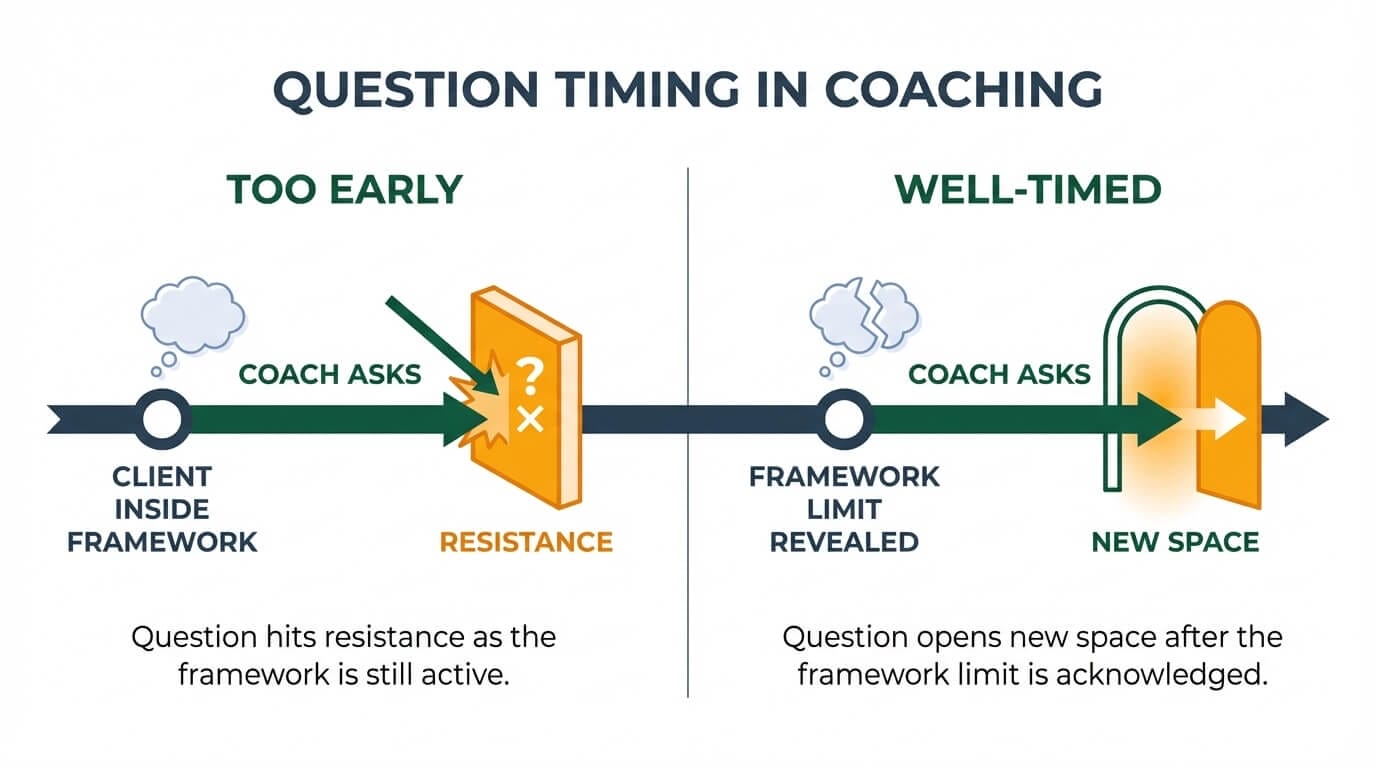
The practice implication: stop tracking what question to ask next and start tracking where the coachee is in their own process. Are they still building their explanation? Let them build. Have they reached the limit of their current framework? Now ask.
Listening Before Questioning
A powerful question cannot arrive before the coach has listened. Not listened in the casual sense - heard the words, understood the content, nodded at appropriate moments. Listened in the coaching sense: tracked what was said, what was avoided, what shifted in tone, and what the coachee doesn't seem to know they communicated.
The coach who is planning the next question while the coachee speaks has not listened yet. They've catalogued. They heard enough content to generate a relevant question, and now they're waiting for an opening to deploy it. This is competent conversation management. It is not coaching-level listening, and it doesn't produce coaching-level questions.
When active listening creates the space for questions to land, the question grows from what the coach noticed - not from what the coach planned. A coachee mentions three priorities, but their voice lifts on only one of them. A coachee describes a decision as "obvious" while their body language says anything but. A coachee uses the word "should" four times in ninety seconds without once saying "want."
These are the raw materials of powerful questions. "What's behind the word 'should' in everything you just described?" isn't something a coach plans. It becomes available when the coach is listening for more than content - and it's the kind of question that produces the pause, the lean-in, the shift that signals productive disequilibrium.
Planning and listening compete for the same cognitive bandwidth. Choose.
Types of Coaching Questions
Coaching questions serve different functions depending on where the coachee is in their exploration. Five categories cover the full range, from clarifying what the coachee wants to moving toward action. Each type does something specific. The categories aren't a sequence - a single coaching session might use all five or stay in one for forty minutes. If you want a stage-based sequence instead of a functional grouping, the GROW model walks a conversation through goal, reality, options, and will.
Goal-clarifying questions test whether the coachee's stated goal is the real one. Reality-exploring questions expand the coachee's view of what's actually happening. Assumption-surfacing questions make visible the beliefs the coachee is building on without examining. Perspective-shifting questions change the angle from which the coachee is looking. Forward-motion questions translate new awareness into commitment and action. Turning that commitment into a tracked, client-owned plan is the work of goal setting in coaching.
| Category | Question | When to Use |
|---|---|---|
| Goal-Clarifying | What would be different if you solved this? | When the coachee describes the problem but hasn't named the desired outcome |
| If you had that, what would it give you? | When the goal seems like a means to something deeper | |
| What does success look like in your own terms? | When the coachee is using borrowed language | |
| What would you stop doing if you achieved this? | When the coachee hasn't considered the trade-offs | |
| Reality-Exploring | What else is true about this situation? | When the coachee has given a tidy, complete-sounding account |
| Who else is affected that you haven't mentioned? | When the narrative focuses on two people but the system is larger | |
| What's the part you haven't said out loud yet? | When the coachee is circling something without landing on it | |
| How would someone who disagrees describe this? | When the coachee's account is one-sided | |
| Assumption-Surfacing | What would need to be true for you to believe that? | After three statements built on the same unexamined assumption |
| Where did that belief come from? | When the coachee states an interpretation as fact | |
| What if that weren't true? | When the coachee has identified a self-imposed constraint | |
| What are you assuming about them that you haven't verified? | When the narrative depends on unconfirmed motives | |
| What's the rule you're following here? | When behavior reveals an unspoken obligation | |
| Perspective-Shifting | If you were advising someone else, what would you say? | When self-awareness is blocked by proximity to the problem |
| What would the version of you who's solved this think? | When the coachee is stuck in present-tense thinking | |
| How would you describe this if you weren't frustrated? | When emotion is coloring the read of the facts | |
| What would you do if you knew it would work? | When fear of failure prevents naming what they want | |
| Forward-Motion | What's one thing you could do this week? | When clarity has been reached but not translated to action |
| What would you need to give up to make that happen? | When the coachee wants to add without subtracting | |
| On a scale of 1-10, how committed are you? | When stated commitment doesn't match energy | |
| What might get in the way, and what will you do? | When the plan hasn't been stress-tested |
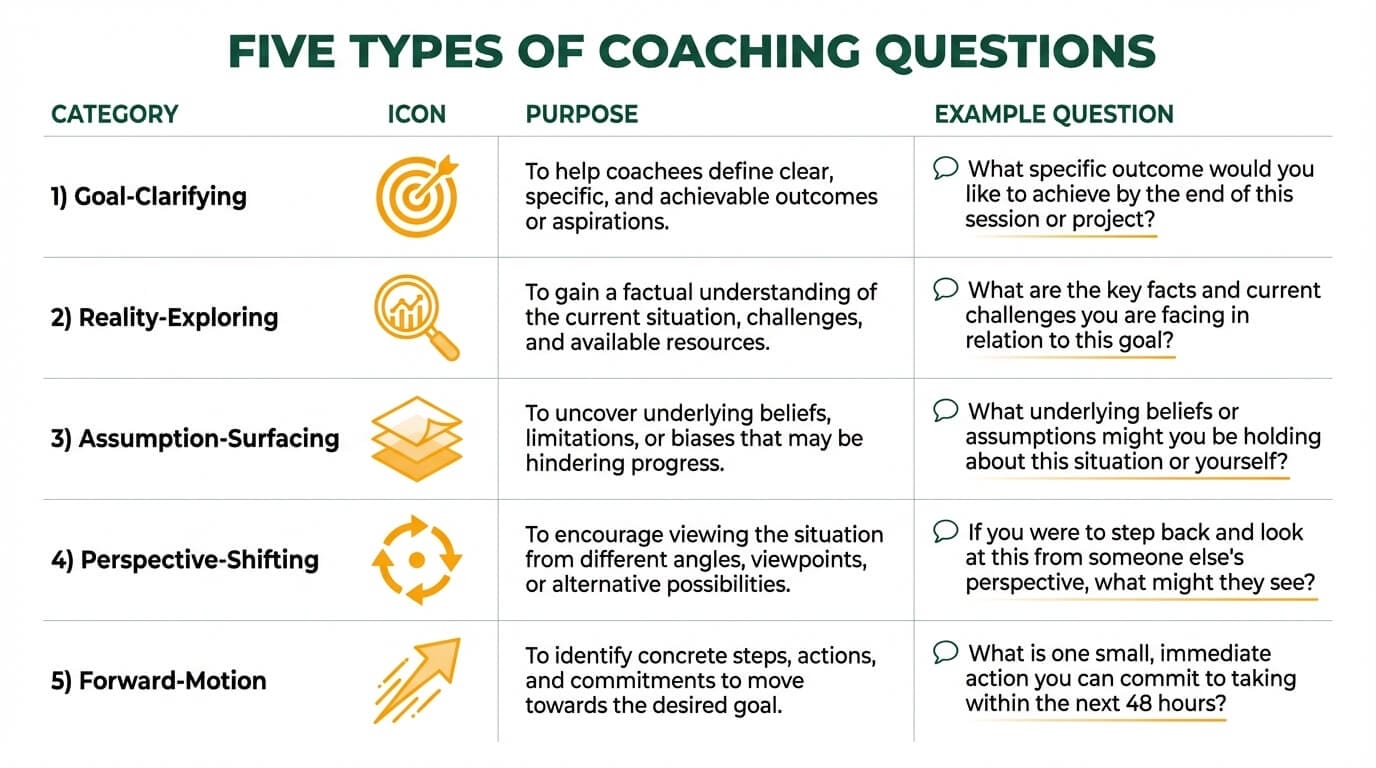
The value of these categories is not in the questions themselves - you can find question lists anywhere. The value is in knowing which category to reach for based on where the coachee is in their own process. A forward-motion question asked before the coachee has explored reality produces surface-level commitments. An assumption-surfacing question asked before the coachee has fully described the situation feels like a trap.
What Coaching Questions Are Not
Three patterns masquerade as coaching questions. Each one feels like a question to the coach. None of them function as questions for the coachee.
Interrogation
Rapid-fire questions with no space between them. The coach asks, the coachee answers, the coach immediately asks again. Each question is individually fine. The pattern is the problem. After four questions in two minutes, the coachee stops exploring and starts performing - giving short, safe answers to manage the pace. Understanding why the best coaches never ask randomly is what separates a coaching conversation from a cross-examination.
Leading Questions
"Have you considered that maybe you're being too hard on yourself?" This is not a question. It's an opinion with a question mark attached. The coachee hears the opinion and either agrees (to be agreeable) or resists (because they feel managed). Either way, the coach's agenda is now the center of the conversation rather than the coachee's exploration.
Leading questions often start with "Don't you think," "Isn't it true that," or "Have you considered that." The grammatical test: if you can remove the question framing and you're left with a statement, it was a leading question.
The moment a coach has a preferred answer in mind, the question stops being a question - regardless of its grammar.
Advice in Question Form
"What if you talked to your manager about this?" sounds like a question. But the coach is not genuinely curious about the answer. The coach has already decided that talking to the manager is the right move and is wrapping the recommendation in question syntax. The coachee senses this - they can hear the suggestion underneath the question mark - and now they're responding to advice, not exploring their own thinking.
When engaged neutrality keeps questions from becoming interrogations, the coach maintains genuine curiosity about the coachee's answer. The moment the coach has a preferred answer in mind, the question stops being a question regardless of its grammatical form.
Each of these failure modes shares a root cause: the coach is working from their own framework rather than the coachee's. Interrogation serves the coach's need for information. Leading questions serve the coach's interpretation. Advice-questions serve the coach's solution. The coachee's own exploration gets displaced.
Questions Across Credential Levels
How coaches use questions changes predictably across ICF credential levels. The progression is not about learning fancier questions. It's about developing the capacity underneath the questions - the listening, timing, and self-management that determine whether any question lands.
See How Questioning Develops Across Credential Levels
ACC training builds the foundation: open questions, comfort with silence, genuine curiosity. The program includes observed sessions where questioning patterns become visible.
| Credential Level | Question Focus | What Changes | Key Marker |
|---|---|---|---|
| ACC | Open vs. closed questions | The coach shifts from yes/no questions to questions that require exploration. "Did you talk to your manager?" becomes "What happened when you talked to your manager?" Comfort with silence after asking begins to develop. | ICF Competency 7: Evokes Awareness |
| PCC | Content to perspective | The coach stops asking about what happened and starts asking about what the coachee believes about what happened. Questions probe thinking, assumptions, beliefs, and values rather than facts and events. | PCC Marker 6.2: Asks questions about the client's way of thinking, assumptions, beliefs, values |
| MCC | Question as extension | The question feels like what the coachee was about to say next. The coach's listening is so attuned to the coachee's process that the question is almost invisible - it continues the coachee's own exploration rather than redirecting it. | Presence, listening, and questioning become one act |
The first shift - closed to open questions - happens in the first weeks of ACC training. The deeper shift takes longer. The ACC coach asks what happened. The PCC coach asks what the coachee believes about what happened, what assumptions shaped their interpretation. And the last thing to change is comfort with silence. ACC coaches rush to fill the gap after asking. PCC coaches learn that the coachee's processing time is productive time, and cutting it short with another question kills whatever the first question opened.
Tandem's ICF certification programs build this questioning capacity level by level, matching the ACC-to-MCC arc above. For coaches ready to start, the ICF ACC program develops it through observed practice sessions where these progressions become visible in real time.
Coaching Questions for Leaders
Managers and senior leaders increasingly want to coach their people rather than direct them, and the same questions work in one-on-ones and team conversations. The mechanics are identical. The caution is not. A leader asking a coaching question still holds positional power, and a direct report can hear “What do you think you should do?” as a test with a known right answer rather than a genuine invitation.
Coaching questions for leaders only function when the leader actually means them - when they can live with an answer they did not expect and are not using the question to route someone toward a decision already made. The moment a question is in service of the leader’s preferred outcome, the team learns to read it that way, and it stops opening anything. A few that travel well in a leadership setting:
- What does success look like to you on this, separate from what you think I want?
- What would you do if this were entirely your call?
- What is getting in your way that I could help remove?
- What is the conversation we are not having?
- Where do you want more responsibility, and where do you want more support?
The harder skill for a leader is knowing when to stop asking and simply decide. Coaching is one mode among several, and using it well means recognizing when a moment calls for a direction rather than a question. The same timing judgment that governs a coaching session - reading whether the person is still working the problem or waiting to be told - is what tells a leader when to switch modes.
Developing the Capacity
Questioning skill is not developed by studying question lists. It's developed by coaching with attention to what happens after you ask. The feedback loop is immediate and observable if you know where to look.
Try this after your next five sessions: notice which questions produced an energy shift in the coachee - a visible change in engagement, pace, or depth - and which ones produced a flat response. Don't evaluate the questions yet. Just track. You're building a data set about your own questioning patterns.
After five sessions, look at the questions that landed. What did you notice about the coachee just before you asked them? Were you planning the question, or did it arrive from something you observed? Were you listening for content, or were you listening for what the coachee wasn't saying?
You do not develop questioning skill by collecting better questions. You develop it by paying attention to what happens after you ask.
That trace - from observation to question - is the capacity you're developing. Understanding how questioning fits the session arc gives it structure, but the capacity itself comes from paying attention to your own coaching process with the same curiosity you bring to your coachee's.
Frequently Asked Questions
What are powerful questions in coaching?
Powerful questions in coaching are open-ended questions that create productive disequilibrium - a cognitive state where the coachee's existing framework is temporarily insufficient and they begin exploring beyond their current thinking. They differ from good conversational questions in their effect: a powerful question doesn't just gather information, it changes how the coachee sees their situation. The power is not in the phrasing but in the timing, the coach's listening, and the coachee's readiness to be disrupted.
How do you ask powerful questions in a coaching session?
Powerful questions are not deployed - they emerge from deep listening. The coach tracks what the coachee says, avoids, and repeats, then asks from genuine curiosity rather than technique. The practical discipline is to stop planning your next question while the coachee is speaking. Listen fully, notice what strikes you, and let the question form from that noticing. If you planned the question before the coachee finished speaking, it's probably a good question. But it's not a powerful one.
What is the difference between a powerful question and a leading question?
A powerful question opens the coachee's thinking without directing it toward a specific answer. A leading question contains the coach's opinion or preferred outcome in question form - "Don't you think you should talk to your manager?" tests whether the coachee agrees with the coach, not whether the coachee has explored their own options. The test: if you can remove the question framing and you're left with a statement you believe, it was a leading question.
What are examples of open-ended coaching questions?
Open-ended coaching questions include "What else is true about this situation?", "What would need to be true for you to believe that?", "What's the part of this you haven't said out loud yet?", and "What would you do if you knew it would work?" Each serves a different purpose: reality-exploring, assumption-surfacing, depth-seeking, and fear-bypassing respectively. The value is in choosing the right type for the moment, not in memorizing the list.
Are there coaching questions for leaders and managers?
Yes, and they follow the same rules as any coaching question: open, short, and free of a preferred answer. The difference is power. A manager asking “What would you do if this were entirely your call?” only works if they can genuinely accept the response. If the question is steering someone toward a decision already made, it stops being coaching and the team reads it as a test. The leadership skill is meaning the question - and knowing when to stop asking and simply decide.
Is there a powerful coaching questions PDF or list to download?
The categorized examples on this page are built to be bookmarked and copied, which is what most downloadable lists provide. A printed list is a memory aid, not a method - the skill that makes any question powerful is the timing and listening a PDF cannot teach. If you want to build that skill deliberately, Tandem’s free coaching competency resources pair practice prompts with the reasoning behind them.
After your next coaching session, identify one question that landed - one that visibly shifted how the coachee was thinking. What was the coachee saying just before you asked it? What did you notice that produced the question? That trace - from observation to question to shift - is the skill underneath every question list, every framework, every competency marker. The question was already there in what the coachee said. You heard it first.
Develop Questioning Capacity Through Practice
The ACC program builds the listening, timing, and self-management that make questions land. 60+ training hours with observed coaching sessions where you see your questioning patterns in real time.
See ACC Program Details →