Trigger and Response Options
Map situations that precede a strong response and choose safe response options to test without diagnosing a trigger.
Get This Tool
Free, print-ready PDF.
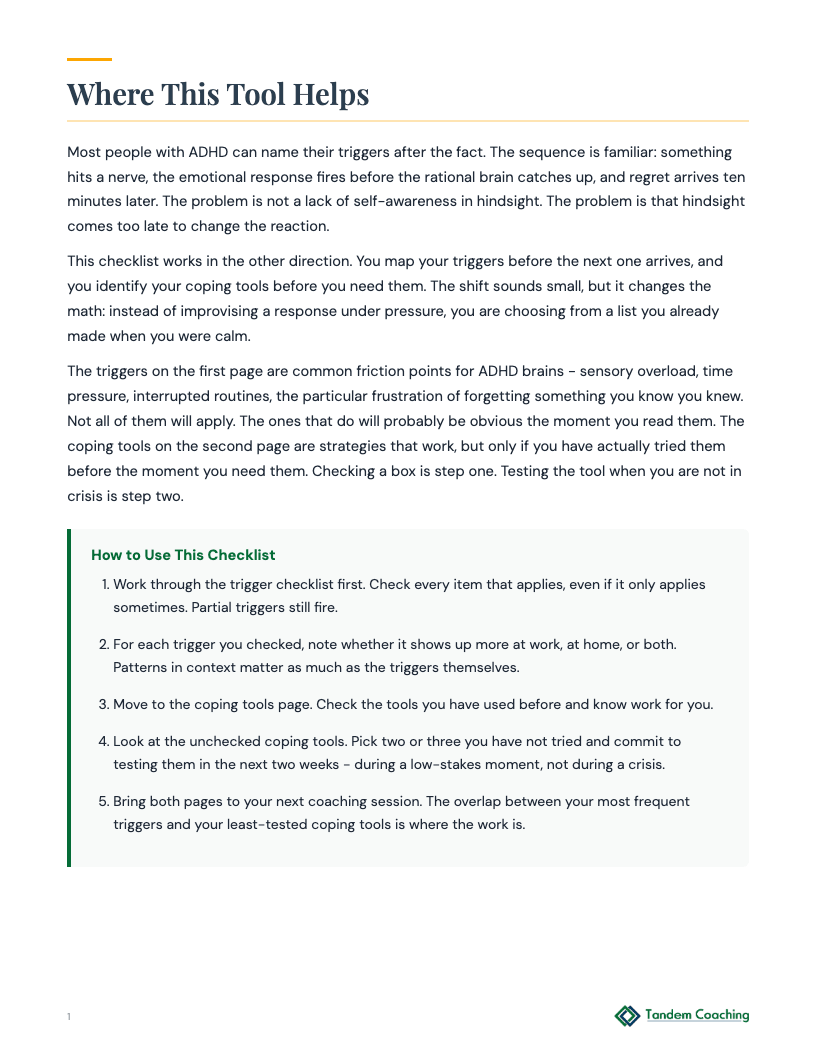
When to Use This Tool
A client is not clear on what specifically triggers their emotional reactivity
A client wants to build a personal toolkit of coping strategies they can access quickly
A client needs to audit which triggers are present and which response options they already have
How to Introduce This Tool Plus
Which situation tends to precede a strong response for you, and which safe response option would you like to test?
Coaching Tool Disclaimer
This tool is designed for coaching contexts, not clinical use. If you or your client is in crisis, contact the 988 Suicide and Crisis Lifeline (call or text 988) or Crisis Text Line (text HOME to 741741).
Browse All Pages
Tool Classification
Domain
ADHD
Type
Checklist
Phase
Discovery
Action
Details
15 min
Between sessions
Topics
Emotions
Habits
Identity
For the Coaching Practitioner
Plus
Coaching Scenarios
Plus
1 Senior developer promoted to team lead experiencing daily emotional outbursts ▶
Context
A senior software developer recently promoted to team lead is having emotional reactions to interruptions, meeting changes, and code review conflicts. They're worried about losing credibility with their former peers and think they need anger management training.
How to Introduce
Frame this as operational preparation, not emotional regulation. 'Before we work on leadership presence, let's map what's actually happening in your stress response during a typical day. You're dealing with more interruptions and context-switching than ever - that hits some people differently.' Expect resistance to the trigger list - they may see it as making excuses.
What to Watch For
Notice if they check triggers but resist the context notes about work vs home. Many new managers don't realize their trigger load has fundamentally changed with the role. If they check fewer than 5 triggers total, they're minimizing. If they check 12+ triggers, they're overwhelmed and need triage first.
Debrief
Start with the work-specific triggers they checked. 'Which of these showed up this week?' Then move to response options: 'When you got interrupted during deep work, what did you actually do?' The gap between their current improvised responses and tested tools is the development plan.
Flags
Coaching scope: do not diagnose, interpret symptoms, or recommend treatment. Adapt or stop for distress and use licensed health or emergency support when appropriate.
2 Marketing director avoiding team conflicts by working around difficult personalities ▶
Context
A marketing director keeps rearranging meetings and projects to avoid confrontation with two challenging team members. They think they're being diplomatic, but their team is starting to notice the accommodation patterns and losing respect for their leadership.
How to Introduce
Position this as a conflict audit, not a personal assessment. 'You're managing around certain people instead of managing them directly. Let's see what's actually triggering the avoidance.' Many conflict-avoidant leaders don't recognize that their triggers are driving business decisions. Name that pattern upfront.
What to Watch For
Watch for heavy checking in 'Criticism,' 'Misunderstandings,' and 'Perceived Injustice' but light checking in response options. They may intellectualize triggers - writing paragraphs in the notes instead of simple pattern recognition. Speed through response options suggests they haven't actually tested any.
Debrief
Don't start with the triggers - start with the response options they checked. 'Walk me through the last time you used one of these.' Most conflict avoiders have theoretical coping strategies but no muscle memory. Then connect back: 'When [difficult team member] pushes back in meetings, which trigger fires first?'
Flags
Coaching scope: do not diagnose, interpret symptoms, or recommend treatment. Adapt or stop for distress and use licensed health or emergency support when appropriate.
3 Operations manager whose ADHD medication stopped working during company reorganization ▶
Context
An operations manager's ADHD medication became less effective during a major company reorganization. They're making more mistakes, missing deadlines, and their usual coping strategies aren't working. They're considering asking for a demotion before they get fired.
How to Introduce
Frame this as recalibration, not failure. 'Your brain chemistry changed, your role demands changed, and your environment changed all at once. We need to rebuild your trigger management system from scratch.' Normalize that medication effectiveness can shift during high-stress periods. This isn't about willpower.
What to Watch For
Expect them to check almost everything on the triggers list - when medication efficacy drops, trigger sensitivity spikes. More reflective is the response options page. If they check tools they used to rely on but add notes like 'doesn't work anymore,' their entire system needs rebuilding, not tweaking.
Debrief
Start with what's different now versus six months ago. 'Which triggers used to be manageable that aren't anymore?' Then focus on untested response options: 'Your old system was built around medication doing more of the work. What haven't you tried that might work with your current brain chemistry?'
Flags
Coaching scope: do not diagnose, interpret symptoms, or recommend treatment. Adapt or stop for distress and use licensed health or emergency support when appropriate.
4 Project manager who thinks their triggers are just part of having high standards ▶
Context
A project manager gets frustrated when team members miss deadlines, submit incomplete work, or don't follow established processes. They see their reactions as appropriate responses to poor performance and think the team needs to step up, not that they need to manage their triggers.
How to Introduce
Frame this as leadership effectiveness, not personal change. 'Your standards aren't the problem - how your reactions land with the team is affecting your ability to maintain those standards.' Position triggers as information about what derails their leadership presence, not character flaws to fix.
What to Watch For
They'll likely check 'Perfectionism,' 'Mistakes,' and 'Lack of Focus' but frame them as reasonable responses. Look for defensive language in the notes section. If they check few response options or dismiss them as 'soft skills,' they're protecting their identity as a high performer.
Debrief
Start with impact, not triggers. 'When you react to missed deadlines, what do you notice about how your team responds?' Then connect to triggers: 'That reaction you just described - what sets it off?' The goal is helping them see that managing triggers improves their ability to maintain standards, not lower them.
Flags
Coaching scope: do not diagnose, interpret symptoms, or recommend treatment. Adapt or stop for distress and use licensed health or emergency support when appropriate.
Tool Flow
Plus
Requires
- None - standalone tool
→
Produces
- personal trigger checklist with work vs. home context notes
- audited response optionkit with tested vs. untested split
- one trigger-tool practice pairing for the week
Pairs Well With
ADHD
Opposite Actions Worksheet
A client's emotional reactions are driving behaviors that make the situation worse
Why it pairsOnce a client has named their triggers and tested response options, this worksheet converts that list into pre-decided behavioral alternatives they can reach for before the emotion peaks.
ADHDAnger Context and Safety Reflection
Use this worksheet to explore emotions and identity and turn the client’s observations into one optional next step.
Why it pairsWhen a client's trigger checklist flags anger as a recurring pattern, this worksheet maps the body signals and episode anatomy behind it - moving from category to lived detail.
ADHDDaily Mental Health Tracker
A client has no consistent picture of their daily mental health patterns
Why it pairsThe trigger-tool practice pairing from the checklist stays hypothetical without follow-through, so this tracker gives a client a daily log to record whether the pairing held up in real conditions.
Related Articles


ADHD & Emotional Intelligence in Leadership
Read article →
Adaptive ADHD Leadership: 7 Strategies That Work
Read article →
Executive Function Strategies for ADHD Leaders: Working Memory, Impulse Control & Flexibility
Read article →
Leading With ADHD: Executive Leadership Strategies That Work
Read article →