Daily Mental Health Tracker
Track ADHD mood, energy, focus, and triggers daily to reveal patterns you can act on. Structured prompts create consistent, coach-ready data.
Get This Tool
Free, print-ready PDF.
When to Use This Tool
A client has no consistent picture of their daily mental health patterns
A client wants one page per day that captures sleep, mood, intention, and reflection
A client needs data from daily life to bring to coaching sessions rather than relying on memory
How to Introduce This Tool Plus
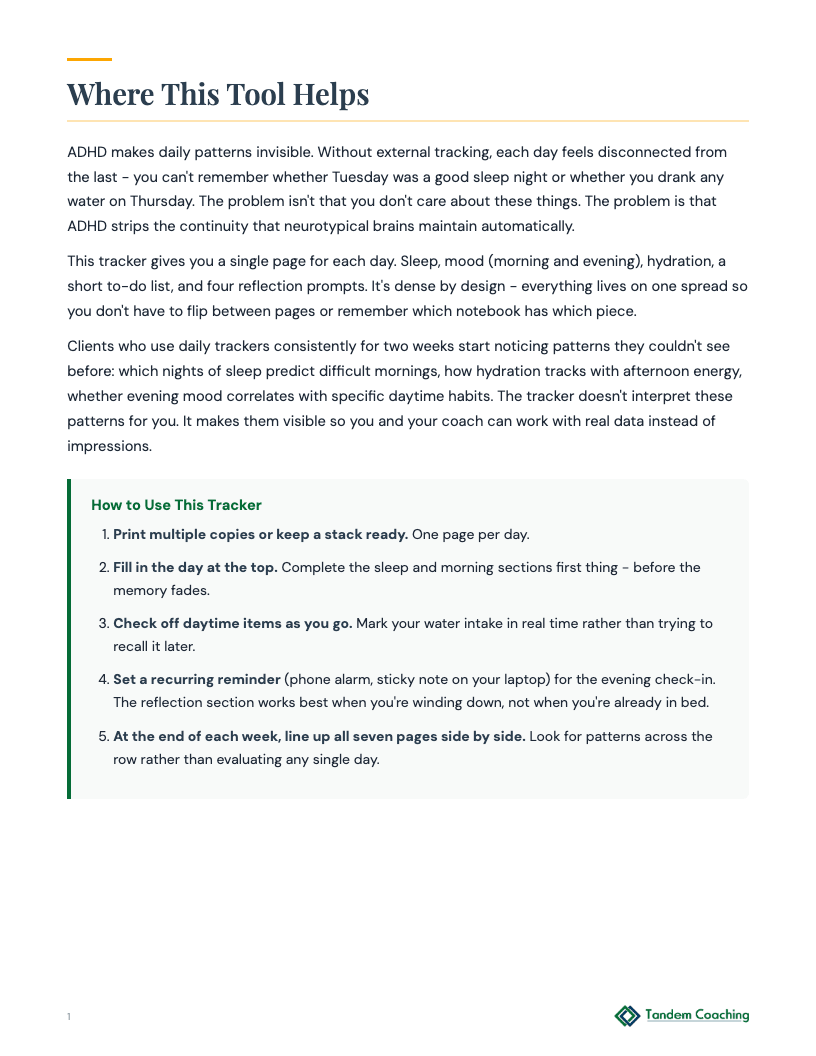
ADHD makes daily patterns invisible - you can't remember what Tuesday looked like. This tracker gives you one page per day covering sleep, morning and evening mood, intention, hydration, and four reflection prompts.
Coaching Tool Disclaimer
This tool is designed for coaching contexts, not clinical use. If you or your client is in crisis, contact the 988 Suicide and Crisis Lifeline (call or text 988) or Crisis Text Line (text HOME to 741741).
Browse All Pages
Tool Classification
Domain
ADHD
Type
Tracker
Phase
Reflection
Review
Details
15 min
Between sessions
As-needed
Topics
Emotions
Habits
Identity
For the Coaching Practitioner
Plus
Coaching Scenarios
Plus
1 Marketing director with ADHD can't connect daily habits to work performance ▶
Context
A marketing director diagnosed with ADHD six months ago struggles to understand why some days feel productive and others feel chaotic. She's tried multiple productivity systems but can't identify what makes the difference between good and bad work days.
How to Introduce
Frame this as data collection for pattern recognition, not self-improvement tracking. 'We're going to gather two weeks of daily data so we can see what your brain actually needs to perform well.' ADHD clients often resist tracking because previous attempts felt like surveillance. Emphasize that this captures what works, not what's broken.
What to Watch For
ADHD clients typically fill out morning sections inconsistently and evening sections with guilt-driven responses. Watch for perfectionist completion - if every section is filled with detailed responses, they're performing compliance. Genuine engagement shows up as uneven completion with specific, concrete entries.
Debrief
Start with the hydration tracking - it's concrete and non-judgmental. 'What do you notice about your water intake on days you rated as 4 or 5 satisfaction?' Then connect to the morning mood patterns. The question that opens this up: 'Which evening reflection surprised you the most when you wrote it?'
Flags
If the client rates satisfaction as 1-2 for more than half the tracked days, explore whether depression is present alongside ADHD. Severity: moderate. If evening reflections consistently focus on what didn't get done rather than what did, the tracking may be reinforcing negative self-talk. Response: adjust the tool or explore underlying shame patterns.
2 Operations manager returns from medical leave, needs baseline for energy patterns ▶
Context
An operations manager returning from three-month medical leave for anxiety and burnout wants to establish sustainable work habits. She's cleared to return full-time but worried about recognizing early warning signs of overwhelm before they escalate.
How to Introduce
Position this as a baseline establishment tool, not a wellness tracker. 'Before we build your re-entry strategy, let's capture two weeks of data about your current energy and mood patterns. This gives us a reference point for what sustainable looks like.' Expect resistance to the evening satisfaction rating - clients returning from leave often judge their capacity harshly.
What to Watch For
Clients post-medical leave often under-report positive experiences and over-report fatigue. Look for consistent low ratings across all categories - this suggests the client is still in recovery mode. If morning and evening moods show large gaps consistently, the workday itself may be depleting beyond normal levels.
Debrief
Start with sleep patterns and their connection to morning mood. 'Your sleep hours vary by three hours across the week. What's driving that variation?' Then examine the gap between morning and evening mood ratings. The key question: 'On days when your evening mood matched your morning mood, what was different about that day?'
Flags
If sleep hours are consistently under six or morning mood is rated as low/difficult more than three days per week, the client may not be ready for full work demands. Severity: high. If evening reflections repeatedly mention physical symptoms (headaches, stomach issues, muscle tension), consider whether medical follow-up is needed. Response: pause coaching and encourage medical consultation.
3 Sales VP tracks daily patterns but avoids the emotional aspiration section entirely ▶
Context
A sales VP uses productivity tracking extensively but struggles with team leadership challenges. He completes most sections thoroughly but consistently skips the emotional aspiration section, claiming it's 'too touchy-feely' for his management style.
How to Introduce
Frame emotional aspiration as performance optimization, not feelings work. 'The emotional aspiration section predicts your leadership presence the next day. Skip it if you want, but track whether the days you fill it out correlate with better team interactions.' Don't force engagement - let the data convince him.
What to Watch For
High-performing clients often treat this tool like a productivity audit, focusing on task completion over mood tracking. Watch for detailed daytime checklists but sparse reflection sections. If he's filling in emotional aspirations with performance words (focused, efficient, productive) rather than feeling words, he's translating the tool into familiar territory.
Debrief
Start with the checklist completion patterns. 'Your daytime completion rate is 85%, but your evening completion is 60%. What happens between afternoon and evening?' Then connect task completion to satisfaction ratings. The breakthrough question: 'On your highest satisfaction days, which emotional aspiration did you circle the night before?'
Flags
If the client consistently rates day satisfaction as 4-5 but describes ongoing team conflicts in coaching sessions, the tracker may be capturing task completion rather than actual satisfaction. Severity: low. If he completes all task-oriented sections but avoids all reflection sections for more than a week, he may be using productivity as emotional avoidance. Response: continue coaching but name the pattern directly.
4 Project manager discovers her mood crashes correlate with specific meeting types ▶
Context
A project manager tracking daily patterns for three weeks notices her evening mood consistently drops on days with executive stakeholder meetings. She's surprised by this correlation and wants to understand whether it's the meetings themselves or her preparation anxiety.
How to Introduce
Frame this as hypothesis testing rather than problem-solving. 'You've identified a pattern. Now we use the tracker to test what specifically drives the mood drop - is it the meetings, the preparation, the aftermath, or something else entirely?' Add a custom tracking element for meeting types if needed.
What to Watch For
Clients who discover unexpected patterns often want to immediately fix them rather than understand them first. Watch for changes in tracking behavior - if she starts preparing differently for stakeholder meetings, the tracking data becomes less reliable. Genuine investigation shows up as consistent tracking despite the discomfort of the pattern.
Debrief
Start with the timeline. 'Walk me through a stakeholder meeting day from morning intention to evening reflection. Where in that sequence does your mood shift?' Then examine what's different about stakeholder meetings versus other meeting types. The key question: 'What would need to be different about these meetings for your evening mood to stay stable?'
Flags
If mood drops are severe (good/great morning to difficult evening) and happen consistently with specific people or meeting types, explore whether workplace dynamics are affecting mental health beyond normal stress. Severity: moderate. If the client starts avoiding stakeholder meetings or changing her tracking behavior to hide the pattern, the avoidance may be protective. Response: explore what makes these interactions feel unsafe.
Tool Flow
Plus
Requires
- None - standalone tool
→
Produces
- daily sleep, mood, and hydration log
- week's worth of pattern data for coaching
- written daily intention and evening reflection
- emotional aspiration record for tomorrow
Pairs Well With
ADHD
Opposite Actions Worksheet
A client's emotional reactions are driving behaviors that make the situation worse
Why it pairsOnce the tracker surfaces which emotions reliably precede self-defeating habits, use this to pre-load a specific alternative response before that emotion arrives again.
ADHDTrigger and Response Options
A client is not clear on what specifically triggers their emotional reactivity
Why it pairsA week of mood logs gives you specific data points to bring into this checklist, so the client identifies triggers from real entries rather than guessing in the abstract.
ADHDAnger Context and Safety Reflection
Use this worksheet to explore emotions and identity and turn the client’s observations into one optional next step.
Why it pairsWhen the tracker flags repeated low-mood or high-stress days tied to anger episodes, this worksheet maps the anatomy of one specific episode using body signals the client has already started noticing.
Related Articles


Coaching Session Blueprints: What ADHD-Informed Executive Coaching Really Looks Like
Read article →
Adaptive ADHD Leadership: 7 Strategies That Work
Read article →
ADHD Coaching Certification: Which Path Actually Counts
Read article →
ADHD Executive Coaching: What It Is and How It Works
Read article →