Opposite Actions Worksheet
A practical ADHD coaching worksheet to replace emotion-driven reactions with opposite actions that reduce conflict and improve outcomes.
Get This Tool
Free, print-ready PDF.
When to Use This Tool
A client's emotional reactions are driving behaviors that make the situation worse
A client wants concrete strategies for responding differently when a difficult emotion arises
A client is working on breaking the link between feeling and automatic reaction
How to Introduce This Tool Plus
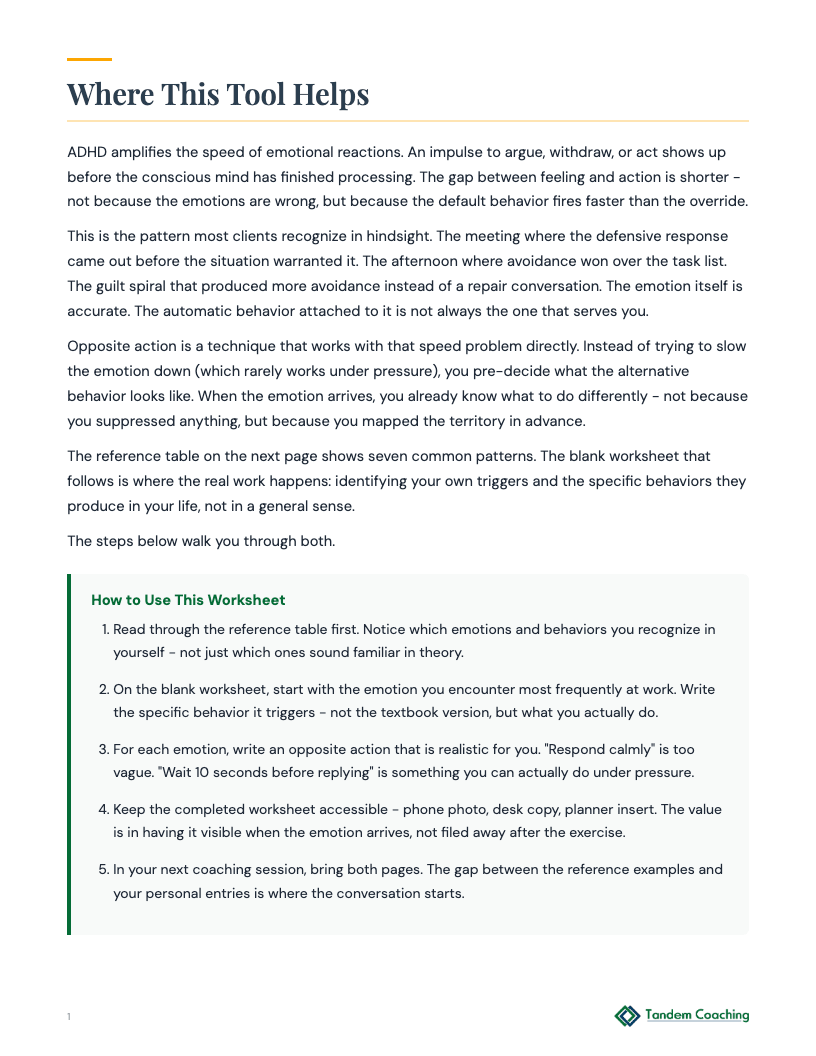
There's a pattern where the way you respond to a feeling tends to strengthen it. This worksheet - adapted from DBT - maps which response would actually move you toward what you want instead.
Coaching Tool Disclaimer
This tool is designed for coaching contexts, not clinical use. If you or your client is in crisis, contact the 988 Suicide and Crisis Lifeline (call or text 988) or Crisis Text Line (text HOME to 741741).
Browse All Pages
Tool Classification
Domain
ADHD
Type
Worksheet
Phase
Action
Reflection
Details
15 min
Between sessions
As-needed
Topics
Emotions
Habits
Identity
For the Coaching Practitioner
Plus
Coaching Scenarios
Plus
1 Shame-Driven Withdrawal After a Public Mistake ▶
Context
A client with ADHD made a significant error in a team presentation - missed data, incorrect figures - and has been withdrawing since. They have avoided scheduling the follow-up meeting, responded minimally to colleagues, and have been working from home more than usual. They know withdrawal is not helping but cannot generate the motivation to re-engage. Coaching focus is on self-regulation and professional functioning.
How to Introduce
Name the emotion-action link before introducing the tool: 'Right now shame is driving your behavior, and the behaviors it drives - withdrawal, avoidance, isolation - are making the situation worse. This worksheet maps that link and asks you to identify what would happen if you did the opposite.' Because this tool is therapy-adjacent, maintain clear scope boundaries: the worksheet is being used to map a specific behavioral pattern in a professional context, not to process the shame itself. If the client moves toward processing the underlying shame, redirect: 'That exploration is valuable and might be worth doing with a therapist. Right now let's stay with the specific behaviors you want to change this week.' Watch for the distinction between using the worksheet for behavioral planning versus emotional processing - the former is coaching scope; the latter is not.
What to Watch For
Watch for the client's 'opposite action' entries being too large to execute given their current emotional state - 'schedule a call with every person who was in the meeting' when they cannot currently send a single email. The opposite action needs to be calibrated to what is executable at the client's current activation level, not to what would fully repair the situation. Also watch for the client identifying the correct opposite action intellectually while expressing no intention to take it - 'I know I should reach out to my manager but I won't.' The gap between knowing and doing is where the coaching conversation belongs.
Debrief
Start with the behavior column, not the emotion column: 'What specific behaviors have you been doing in the last week?' Once those are named concretely, move to the opposite column: 'If you did the opposite of each one, what would that look like?' Stay at the behavioral level. Then move to commitment: 'Which of these opposite actions could you take this week? Not should - could.' The worksheet succeeds when the client leaves with one to two specific behaviors they have committed to, not with a full emotional resolution.
Flags
- Moderate
The client describes shame and withdrawal that has extended beyond the workplace into home life - not engaging with family, stopping activities they previously enjoyed, sleep disturbance
Response: Shame that extends across life domains and persists more than two weeks warrants clinical attention. Name what you are seeing: 'The pattern you're describing has moved beyond the work situation. That breadth and duration is worth talking with a therapist about.' Continue coaching on the professional behaviors while making the referral suggestion.
- Low
Client uses the worksheet to identify opposite actions but the behaviors they are opposing are highly adaptive - preparing carefully, asking for help, taking time to think before responding
Response: The opposite-action framework assumes the emotion is driving disproportionate behavior. If the behaviors are actually reasonable, the worksheet question is not 'what is the opposite' but 'what is the calibrated version.' Redirect the coaching conversation accordingly - not all withdrawal is avoidance, and not all caution is fear.
2 Anger-Driven Escalation in Team Conflict ▶
Context
A client with ADHD who is a project manager has been in a recurring conflict with a peer across teams. When frustrated, their response pattern is to escalate - more insistent emails, direct confrontations, copying leadership. They have received feedback that their escalation style is damaging their professional reputation. They acknowledge the feedback but report that in the moment, the escalation feels completely justified. Coaching goal is to build a response repertoire between silent tolerance and escalation.
How to Introduce
Frame this as building range, not eliminating justified responses: 'The goal is not to stop expressing frustration. It's to give you more than one option in those moments.' Because this tool is therapy-adjacent, establish scope: you are working with the behavioral pattern in a specific professional context, not with anger management as a therapeutic goal. If the client's anger pattern is pervasive across life domains or involves aggression, that requires clinical support. Keep the worksheet anchored to specific incidents: 'Let's map this to what happened in Tuesday's meeting specifically, not anger in general.'
What to Watch For
Watch for the client's opposite-action column being populated with complete opposite behaviors that are also maladaptive - 'say nothing and let them keep doing it.' The opposite of escalation is not silence; it is assertion or strategic delay. The coaching conversation needs to help the client identify the middle range, not just the behavioral inverse. Also watch for the client agreeing with the tool in session while having no actual plan for the next time the trigger occurs. Build the specific protocol in the session: 'The next time you get an email like that one, what specifically will you do before you respond?'
Debrief
Start with a specific incident, not a general pattern: 'Walk me through the last time this happened, step by step, from when you first felt the frustration.' Use the worksheet to map that specific episode: what was the feeling, what was the action, what would the opposite action have been. Then ask: 'If you had done the opposite action in that moment, what do you think would have happened?' This counterfactual question often reveals that the client already knows a better response exists - they need to build the gap between trigger and action, not discover better options. Build the gap through a specific protocol rather than general intention.
Flags
- High
Client describes anger responses that have frightened colleagues or that have resulted in formal HR conversations, and the pattern extends beyond work to other relationships
Response: Anger that has produced fear in others or formal HR involvement, combined with a pervasive pattern across life domains, is outside coaching scope. Be direct: 'The pattern you're describing needs more than behavioral coaching. I want to be straightforward with you about that.' If the client has a therapist, encourage them to bring this pattern into therapy. If not, recommend they find one. Do not continue using this tool as the primary intervention for this severity of anger pattern.
3 Anxiety-Driven Perfectionism Blocking Task Completion ▶
Context
A client with ADHD who is a senior writer cannot submit work they deem unfinished, which means they regularly miss deadlines while continuing to revise. The emotion driving the behavior is anxiety about the work being inadequate. They have identified this pattern themselves but cannot interrupt it. Their manager has begun raising concerns about delivery reliability.
How to Introduce
Name the function of the behavior before introducing the opposite: 'The continued revision feels like it is serving quality control, but what it's actually doing is managing your anxiety about inadequacy. The opposite action is not 'submit bad work' - it's 'submit work at the agreed standard and tolerate the discomfort of not knowing how it will land.' That is a different frame than perfection vs. mediocrity.' The therapy-adjacent risk here is around perfectionism as a clinical symptom of anxiety or OCD. Keep the worksheet anchored to work behavior and delivery timelines. If the client's perfectionism extends to their personal life with significant functional impairment, consider whether a clinical referral is warranted.
What to Watch For
Watch for the client's 'opposite action' entry being 'submit work that I don't think is good enough' - which is accurate but not executable as stated. Work with the client to define what 'good enough' means in their specific context: not a feeling state, but an objective criterion (all requirements met, review cycle complete, factual accuracy confirmed). The opposite of 'continue revising beyond objective completion' is 'stop at objective completion standards.' Make that concrete before the session ends. Also watch for the perfectionism being selective - if it is happening only on projects where their manager is the reviewer, the trigger is not quality anxiety but evaluation anxiety. Those require different opposite actions.
Debrief
Start with the most recent deadline miss: 'Walk me through where the work was when the deadline passed.' Establish what was actually incomplete versus what the client was still improving. If the work was functionally complete at the deadline, the opposite action is about the moment of stopping, not the quality of the work. Build a specific stopping protocol: what criteria will the client use to decide the work is done, and what will they do immediately after meeting those criteria (not 'decide to submit' - submit, close the file, move to the next task). The protocol needs to be more specific than the client's general intention.
Flags
- Moderate
Client describes perfectionism extending to personal life - repeatedly redoing household tasks, difficulty discarding anything, spending hours on decisions that others make in minutes
Response: Pervasive perfectionism across life domains may indicate OCD-spectrum symptoms that sit outside coaching scope. Name the pattern across domains and ask if the client has explored this with a therapist. Continue coaching on the work-specific behavioral patterns while being explicit about the limits of the coaching focus.
Tool Flow
Plus
Requires
- named recurring emotional triggers in own life
- awareness of automatic behaviors under emotional load
→
Produces
- personal emotion-to-behavior pattern map
- pre-decided opposite action for each trigger emotion
- reference card for use when emotion arrives
Pairs Well With
ADHD
Trigger and Response Options
A client is not clear on what specifically triggers their emotional reactivity
Why it pairsUse this before the worksheet so clients arrive with named triggers and tested coping options, giving the opposite-action planning something concrete to work against.
ADHDDaily Mental Health Tracker
A client has no consistent picture of their daily mental health patterns
Why it pairsOnce opposite actions are pre-decided, daily tracking shows whether clients are actually deploying them when the trigger emotion arrives.
ADHDAnger Context and Safety Reflection
Use this worksheet to explore emotions and identity and turn the client’s observations into one optional next step.
Why it pairsWhen anger is the dominant trigger on the worksheet, this adds body-signal early-warning data so the client can intervene before the automatic behavior takes over.
This tool is part of a coaching pathway
Step 6 of 6 in A client acts on digital impulses before they've had a chance to notice and choose
Use after Check the Facts Worksheet.
Explore all pathways →Related Articles


ADHD Coaching Certification: Which Path Actually Counts
Read article →
ADHD & Emotional Intelligence in Leadership
Read article →
Adaptive ADHD Leadership: 7 Strategies That Work
Read article →
Leading With ADHD: Executive Leadership Strategies That Work
Read article →