
ADHD Coaching Certification: Which Path Actually Counts
What is ADHD coaching certification?
ADHD coaching certification covers three different things: a training school’s certificate of completion, an independently assessed credential from ICF or PAAC, and CCE top-up hours for coaches who already hold one. No law protects the title. ICF issues no ADHD credential; PAAC issues the only ADHD-specific one.
Eight pages rank for this search and every one of them is selling something. That would be fine if they were selling the same thing. One is selling a training course, one a credential, one twenty hours of continuing education, and all three print the word “certification” on the box. If you have been comparing programs and cannot work out why the prices run from eighty-seven dollars to fifteen thousand, that is why. Three different products, one name. Here is what each one is, who issues it, what it costs end to end, and which you need - which turns almost entirely on whether you already hold a coaching credential.
Key Takeaways
- “Certified ADHD coach” is not a protected title. No law restricts who uses it, and programs from $87 to $15,353 all produce someone entitled to it.
- ICF issues no ADHD credential at all. PAAC’s CACP and PCAC are the only ADHD-specific credentials currently issued by anyone.
- A CCE course is continuing education, not a credential. It counts toward renewal, and toward an initial ACC only through the Portfolio route.
- Renewing an ICF credential takes at least 40 CCE credits every three years, at least 24 of them in Core Competencies, and at least 3 of those in ethics.
- Organisations screen for ICF. Adults paying privately read for presence in the ADHD space rather than for credentials they have never heard of.
“Certified ADHD Coach” Is Not a Protected Title
No law restricts who may call themselves a certified ADHD coach. No license, no register, nothing stopping anyone from using the title tomorrow. That single fact is why the distinction below matters: when a title is unprotected, the word on the certificate means whatever the seller decided it means.
| Layer | What it is | Who issues it | Proves competence to a buyer? |
|---|---|---|---|
| 1. Training | A school’s course, ending in a certificate of completion | ADDCA, MentorCoach, ADHD Works and dozens of smaller providers | Only as far as that school’s reputation carries |
| 2. Credential | Independent assessment of your coaching against a published standard | ICF (ACC / PCC / MCC) or PAAC (CACP / PCAC) | Yes. This is the portable one |
| 3. CCE | Top-up education for coaches who already hold layer 1 or 2 | Any ICF CCE-accredited provider | No. It grants no credential |
A school certificate and a CCE certificate are both marketed with the word “certified.” An independent credential is a different category of thing. Every page competing for this search sells one layer and calls it certification, which is how you end up weighing a twenty-hour course against a two-hundred-hour one as though they were rival versions of the same purchase. Attention deficit hyperactivity disorder is a domain you can go deep in, and neurodiversity is the context all of this operates in. Neither makes a certified coach. Only layer 2 does.
The cost of an unprotected title is visible in the search results themselves. The Institute for the Advancement of ADHD Coaching closed in 2013, and one of the highest-ranking pages on this query still lists it as a current certifying body. Its post-nominals - ACAC, CAC, SCAC - still trail the names of working coaches thirteen years on. Nobody is doing anything wrong by keeping them. There is no mechanism to retire a credential issued by a body that no longer exists.
So the phrase adhd certification tells a prospective client nothing on its own. It cannot separate twenty hours from two hundred and twenty-eight, or a live certifying body from a defunct one. That leaves the disambiguating to you, which is the practical reason to know which layer you are buying. This article covers the credentialing underneath the adhd coaching profession; for the client-facing work itself, our guide to being an ADHD executive coach covers coaching individuals with ADHD in practice.
The Two Questions That Decide Your Path
Do you already hold a coaching credential? If you have an ACC or a PCC you are in a different market from someone starting out, and most of what ranks here is written as though you do not exist. If you have no coach training yet, you need a foundational program before any ADHD specialisation will do you much good.
Who is your buyer? An organisation buying coaching for its staff screens differently from an adult paying out of pocket. That difference decides which credential earns its cost, and it gets its own section below.
The already-credentialed reader is mis-sold consistently, in four ways. They shop for a second foundational program while already holding the credential organisational buyers ask for. They assume any ADHD course’s hours advance their credential, when those hours serve renewal and reach an initial credential through one route only. They treat PAAC and ICF as competing choices. And they compare on hours and price rather than on whether the training adds something usable with adults with ADHD on Monday. If you want to become an adhd coach and you are already trained as one, I would argue you need far less than you are being sold. Adult ADHD is a domain to go deep in, not a reason to start over.
The ICF Route: What It Requires, What It Costs, What It Proves
The International Coaching Federation is the body most organisational buyers mean when they ask whether a coach is certified. Its entry credential is the ACC, and the requirements are published: 60 hours of coach specific training, 100 or more client hours with at least eight clients, 10 hours of mentor coaching with a qualified mentor coach over at least three months, one recorded coaching session submitted with a transcript, and a pass on the credentialing exam. Our breakdown of how ICF certification levels work covers the ACC, PCC and MCC tiers.
There is no ADHD credential at ICF to grant. Anything sold as one is training or continuing education wearing a better word.
The fees are public too, which is worth noting because not every body here publishes its own. An ACC application through a Level 1 or Level 2 program costs $175 for members and $325 for non-members; through the Portfolio route, $475 and $625. A failed exam costs $105 to retake. Renewal runs $175 or $275 every three years. Membership earns the discount but is not required. Most people take this through ICF ACC certification or the longer professional coach certification program route.
Here is the part that decides the rest of this article. ICF does not issue an ADHD credential. CHADD, the leading national ADHD nonprofit, says so on its own coaching page: ICF recognises ADHD coaching as a special area of expertise but does not provide specialised ADHD certification. What ICF assesses is your coaching skills. The domain is not assessed at all. So anything sold as an ICF-aligned ADHD certification is layer 1 training or layer 3 education and training - never a credential, because there is no ADHD credential at ICF to grant.
The PAAC Route: The Only ADHD-Specific Credential That Still Exists
The Professional Association of ADHD Coaches issues the one credential specific to this domain. Its entry level is the CACP; its advanced level, the PCAC, is the professional certified adhd coach designation. Requirements are assessed-hours based: a CACP takes 60 ADHD coaching hours with 90 percent of them paid, a PCAC takes 250 on the same rule. Three routes exist - $250 accredited school, $450 cohort, $650 portfolio - each with a six-month window and three PAAC-approved sponsors who assess recorded or live sessions and nominate you.
Two things about PAAC are widely misreported. It publishes no minimum ADHD-specific training-hour requirement; the frequently-quoted 35-hour figure belongs to the ADHD Coaches Organization, which uses it as an inclusion criterion for its directory of coach training programs. And graduating from a PAAC-accredited school is not required. The professional association says so in its own FAQ: you can earn the credential without attending one. That matters, because PAAC has accredited exactly two schools - The ADD Coach Academy and MentorCoach - and both rank on this search without mentioning that the accredited list is two names long.
PAAC does not train anyone; it credentials coaches already in practice, which makes a paac credentialed coach a layer 2 outcome by definition. The professional association for adhd coaches renews on a three-year cycle, matching ICF. You can read PAAC’s published credentialing requirements in full.
ICF or PAAC? They Answer Different Questions
Neither body compares itself to the other, so this table exists nowhere else on this search.
| Requirement | ICF route | PAAC route |
|---|---|---|
| Scope | Generalist. No ADHD specialty credential exists | ADHD-specific, exclusively |
| Entry credential | ACC | CACP |
| Education | 60 hours coach-specific | Required, but no published hour minimum. Accredited school is one route of three |
| Client hours | 100+, 75 paid, 8+ clients | 60 ADHD hours, 90% paid |
| Assessment | 10 hours mentor coaching, recorded session with transcript, exam | 3 sponsors assessing sessions, plus knowledge modules |
| Application fee | $175 / $325; $475 / $625 portfolio | $250 / $450 / $650 by route |
| Next level | PCC, then MCC | PCAC, at 250 hours |
| Recognition | What organisational and EAP buyers ask for by name | Known inside the ADHD niche, largely unknown outside it |
They are complementary. The evidence sits on PAAC’s own board roster, where members list stacked post-nominals like “PCC, PCAC” and “MCC, PCAC” - the coaches closest to that credential hold the other one too. PAAC never draws the conclusion out loud. For the wider picture, see how ICF certification compares to other coaching credentials.
The decision rule turns on your buyer rather than on either credential’s merits. Organisations screen for ICF and then look for evidence of ADHD work alongside it: ICF is the gate, the ADHD experience differentiates you once through it. Adults paying for their own coaching are not credential-shopping at all. They are reading for presence in the ADHD space - whether you visibly and consistently work here. PAAC helps that reader mainly through the visibility of its directory, because they have generally never heard of it. So my read is that the credential is not what wins the private client. Sustained presence is. The credential is what gets an organisation to consider you at all.
What ADHD Coach Training Actually Costs, and How Long It Takes
Prices here span two orders of magnitude and nobody totals the real bill. ADDCA, the add coach academy, runs about 116 hours at roughly $7,781 for Level 1 and about 228 hours at roughly $14,583 for Level 2. MentorCoach publishes a comparable breakdown. At the other end sit self-paced options around $87. ADHD Works sits between. The ACO directory sets its bar at full ICF accreditation plus at least 35 hours of adhd-specific training, a useful filter precisely because it is published.
An adhd coach training program fee is the first line of the bill, not the total. The ICF route adds the application, 10 hours of mentor coaching bought separately, the exam and renewal every three years. The PAAC route adds its fee and the sponsor process. Dues belong in the total too, though PAAC publishes none publicly - a fair contrast with ICF, whose whole schedule is open.
Apply one filter before comparing any two prices. Some providers advertise accreditation from bodies such as ICAHP, IPHM, CMA or NCCAP; those hours do not transfer toward an ICF or PAAC credential. That is a statement about where hours count, not a judgement of the teaching. If a program is fully accredited by the icf its hours travel. If it is fully accredited by a body neither credentialing organisation recognises, they stop there. Many coaches arrive from life coach training and are surprised that a general life coach qualification and ADHD specific training sit in different columns. Ask any training program which body will accredit these hours, and toward what. The answer sorts the market fast. Strong adhd coaching skills for work with people with adhd can come from either side of that line; only one side counts toward a credential.
What a CCE Specialization Does, and What It Does Not Do
Continuing Coach Education is the third layer and the one most often mistaken for the second. ICF is unambiguous in its own accreditation guidance: CCE focuses on additional learning, not initial training, and providers offering foundational education are told to seek Level 1 or Level 2 accreditation instead. A CCE course is professional development for someone who already coaches.
| A CCE course does | A CCE course does not |
|---|---|
| Count toward the credits required to renew an ICF credential you already hold | Grant any credential. It yields a certificate of completion |
| Count toward an initial ACC through the Portfolio route only | Count on the Level 1 or Level 2 routes |
| Deliver real domain knowledge, the actual reason to take one | Substitute for foundational coach training |
| Carry hours in two categories: Core Competencies and Resource Development | Make anyone ADHD-certified in ICF’s or PAAC’s eyes |
Two sets of numbers govern this and they answer different questions. Keep them apart.
To renew a credential you hold: at least 40 CCE credits every three years. At least 24 must be Core Competencies, and at least 3 of those 24 must be coaching ethics. The remaining 16 may be either category. ACC holders also complete 10 hours of mentor coaching each cycle, which count toward the 24.
To earn an initial ACC through the Portfolio route: 60 hours of coach-specific education, of which at least 48 must cover the ICF Core Competencies and at least 30 must be synchronous. Those are education requirements for a first credential, not renewal credits. Carry a number from one paragraph to the other and you will have both wrong.
The Portfolio route also carries a cost the accredited routes do not. Alongside the higher application fee, a Portfolio review that has to be resubmitted costs $150 each time; Level 1 and Level 2 show no such fee, because there is no separate review to fail. That is the practical price of assembling a credential from CCE hours rather than an accredited program. ICF publishes its education and training requirements and its CCE accreditation guidance in full.
Where ADHD Coaching Stops and Clinical Work Begins
ADHD is not a special case here. There is no ADHD-specific boundary to learn. There is the coaching and therapy boundary every credentialed coach already works under, applied to a population where the pull to cross it is stronger because a diagnosis is attached.
The competency requires the referral. The code requires the disclosure. Neither one is optional.
Coaches do not diagnose, treat, or assign clinical labels. A coaching approach works with what the client wants to build; assessment and treatment belong to a mental health professional. Structured clinical modalities such as cognitive behavioral therapy sit on the far side of that line no matter how much adhd knowledge a coach has accumulated.
The obligation to refer is worth stating precisely, because it is routinely attributed to the wrong document. It lives in the ICF Core Competencies, under Demonstrates Ethical Practice, which requires that a coach refers clients to other support professionals as appropriate - what demonstrating ethical practice requires covers that competency in depth. The ICF Code of Ethics contributes two adjacent obligations rather than the referral itself. Standard 3.7 requires you to disclose when you are acting in a role other than that of an ICF professional, aimed squarely at coaches who also hold a clinical licence. Standard 4.2 requires you to recognise your own limitations, and says plainly that doing so may mean suspending or ending the coaching relationship. The competency requires the referral; the code requires the disclosure.
None of this requires a clinical background. You do not need a psychology degree to coach adhd clients well. You need enough knowledge of adhd - how executive function demands land in a working week, how impulsivity and emotional regulation show up in the room, what a crash looks like after a stretch of hyperfocus - to coach the person in front of you and to recognise when another professional is the right room. Executive functions and emotional self-regulation are things a coach holds knowledge about without practising on. That knowledge shapes your coaching process and coaching techniques; it does not extend your scope, in individual coaching or in groups. Helping neurodivergent clients build systems is well inside scope. Reaching toward diagnosis or treatment is not, and mental health belongs to the professionals trained for it. Learning to support adhd clients well starts with knowing which room you are in. Our comparison of individual or group ADHD coaching formats and our guide to professional coaching for executive-function challenges cover where each fits.
Choosing Your Path: A Checklist
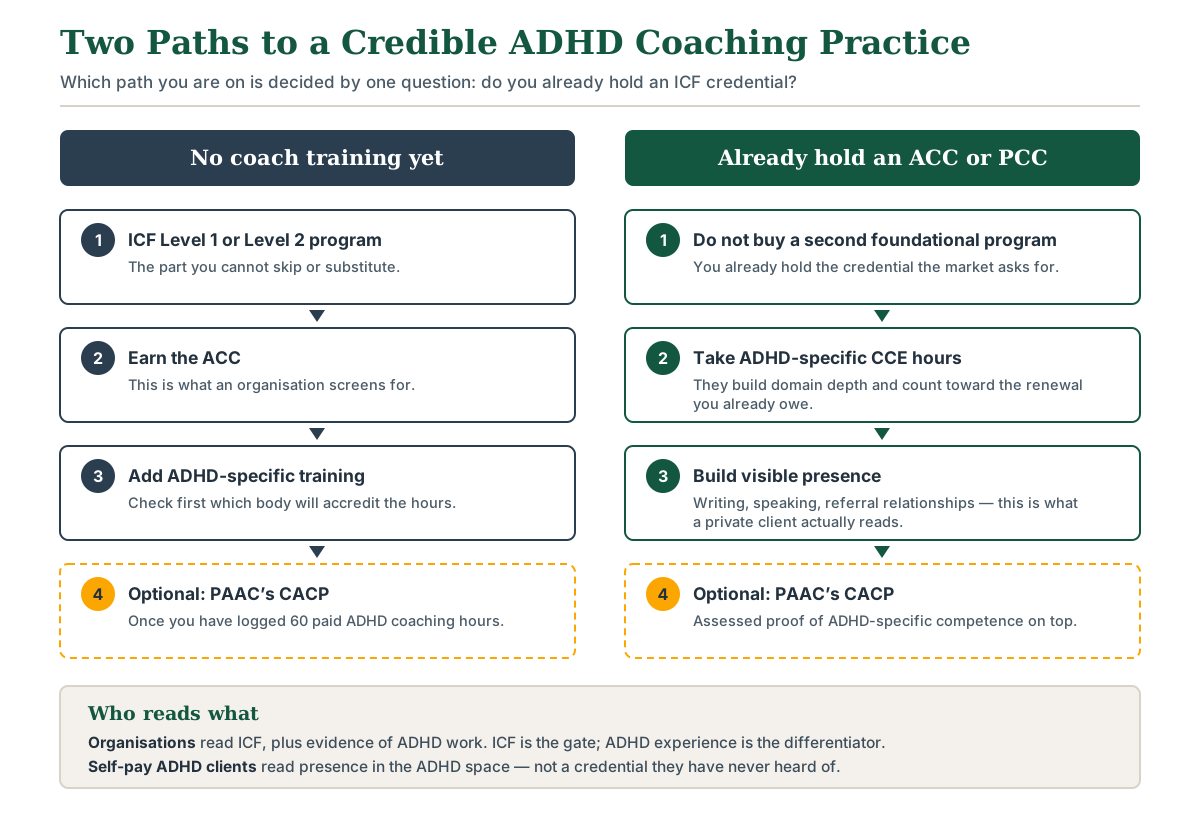
If you have no coach training yet:
- Take a foundational ICF Level 1 or Level 2 program. This is the part you cannot skip or substitute.
- Earn the ACC. It is what an organisation screens for.
- Add ADHD-specific training, checking first which body will accredit the hours.
- Consider PAAC’s CACP once you have logged 60 paid ADHD coaching hours, if that is where your coaching practice is heading.
If you already hold an ACC or PCC:
- Do not buy a second foundational program. You hold the credential the market asks for.
- Take ADHD-specific CCE hours. They build domain depth and count toward the renewal you already owe.
- Build visible presence - writing, speaking, referral relationships - because that is what a private client reads.
- Add PAAC’s CACP if you want assessed proof of ADHD-specific competence on top.
Either way the shape is the same: get the credential that proves you can coach, then go deep in the domain. Reversing the order produces someone with professional experience in ADHD and no independent assessment of their coaching. That holds whether you are building an adhd coaching practice from scratch or adding clients with adhd to an existing one. Someone with ADHD choosing a coach cannot audit your training hours. They can tell whether you know the territory.
Our Own Stake in This
Tandem sells an ADHD course, so weigh what follows accordingly.
The limits first. It is 20 hours against the 60 required for an ACC. It can contribute toward an initial credential only through the Portfolio route, with that route's additional documentation and application requirements. ICF has approved the course for 20.0 CCE hours: 13 Core Competency and 7 Resource Development, including the three ethics renewal hours. It confers no credential of any kind.
Who it fits: a coach who already holds an ACC or PCC, wants ADHD depth, and wants those 20 approved hours to count toward renewal. Who it does not fit: anyone without coach training who wants to become a certified ADHD coach. That reader needs foundational coach education and then the appropriate credentialing route. If you are in the first group, our ADHD Coach Training course is the thing being described. If you are in the second, the sections above are the useful part of this page.
Frequently Asked Questions
Is ADHD coaching certification required by law?
No. Coaching is unregulated and no jurisdiction licenses ADHD coaches. Certification is a competence signal that organisational buyers screen for. It is never legal permission to practise.
Do I need both ICF and PAAC?
Not necessarily. They answer different questions: ICF certifies that you can coach and is what organisations ask for, PAAC certifies ADHD-specific competence and is recognised inside the niche. Coaches who work mainly with adults impacted by ADHD and also sell to organisations tend to hold both.
Can CCE hours count toward my ACC?
Only through the Portfolio application route. The Level 1 and Level 2 routes do not accept CCE hours toward an initial credential. For renewal, CCE hours are exactly what is required: at least 40 credits every three years, at least 24 in Core Competencies.
What happened to IAAC?
The Institute for the Advancement of ADHD Coaching ceased operations in 2013. Its credentials - ACAC, CAC and SCAC - are no longer issued or renewed by anyone, though the post-nominals still appear after some coaches’ names and at least one high-ranking page still lists it as current.
Is a $99 online ADHD coach certification legitimate?
A $99 online ADHD coach certification is legitimately a certificate of completion, which is layer 1 training. Ask which body will accredit the hours and toward what credential. If the answer is neither ICF nor PAAC the hours do not transfer, which may still be fine if you are buying knowledge rather than a credential.
ADHD Coach Training CCE Course
Coach ADHD clients across the life, executive and entrepreneur lenses, with the clinical boundary drawn where it belongs. MCC-led, self-paced, 20 ICF CCE hours pending.
See the CCE Course →