



























Executive Function Checklist for Adults at Work
What Is an Executive Function Checklist for Adults at Work?
An executive function checklist for adults at work is a list of 24 yes-or-no lines about what happened in your last normal week, grouped into six work systems: tasks, calendar and time, email and messages, handoffs and delegation, digital tools and workspace. Count the checks in each area and start with the area that has the most.
Free kit in this article Free printable executive function checklist, with the weekly planner it feeds
You hear about a deadline when someone asks for the work. The decision from Tuesday's meeting still has no owner on Thursday, and the strategy memo gets written at 10 p.m. Search for an executive functioning checklist and most of what comes back was made for students and teachers. The versions for adults tend to be questionnaires about you.
Children and Adults with Attention-Deficit/Hyperactivity Disorder (CHADD) defines the term this way: “Executive function refers to brain functions that activate, organize, integrate and manage other functions.” At work, systems can carry part of that load, and this checklist looks at those systems. If you are reading about executive functioning challenges because your week keeps breaking, it shows you where to start.
Key Takeaways
- The checklist has 24 yes-or-no lines about your last normal week in six work systems. Every line is something a colleague could have seen happen.
- Count the checks in each area. The area with the most is where your week breaks first, and a tie goes to the area that cost you an evening.
- Write that area's first fix as Monday's one task, then run the list again after four weeks to see whether a different area comes out on top.
- Each area has one first fix you can see, such as one capture list for tasks or a waiting-on list for handoffs.
The Executive Function Checklist: 24 Lines in Six Work Systems
This executive function skills checklist is written for adults at work. Each line describes something you or a colleague could have seen happen in a work week, so you can answer it with a yes or a no.
This is a list of what happened in your work week. It is not a test or a diagnosis, and coaching is not treatment. If you are worried about ADHD or another condition, talk to a doctor or a licensed professional.
Use your last normal week, not the week of a launch or a holiday. Check a line if it happened at least once, and read it literally: it happened or it did not. If a normal week for you now runs on late evenings, read about ADHD burnout at work before you add anything new to it.
Tasks
- A task I agreed to in a meeting or in passing never reached my list
- My tasks sat in more than one place: inbox, notebook, sticky notes, chat, my head
- I found out about a deadline when someone asked for the work
- I started a day without the most important task written down
Calendar and Time
- Two or more deadlines landed within a day or two of each other
- I had no block of 90 minutes without a meeting or an interruption
- Deep work moved to the evening or the weekend
- A meeting started while I was still finishing the last thing
Email and Messages
- My inbox or chat was open all day, and I answered most messages within minutes
- A request got lost in a chat thread or under newer email
- An instruction I was given out loud was never written down
- Email took the first hour of a day, before the work that mattered
Handoffs and Delegation
- Work I passed to someone came back late, wrong or not at all
- I did a task myself that I could have handed to someone
- A decision from a meeting had no owner or no date
- Something I was waiting for slipped, and I had no note of who owed it
Digital Tools
- I searched more than once for a file, a note or a link I knew I had
- My notes for one project were in more than one app
- Notifications from three or more apps broke into focused work
- Work sat in my downloads folder or on my desktop under a name I could not find
Workspace
- Someone interrupted me at my desk during work that needed focus
- Noise around me made me stop, move or put work off
- Papers for different projects shared one pile
- I went looking for something I needed for a task: a charger, a document, a notebook
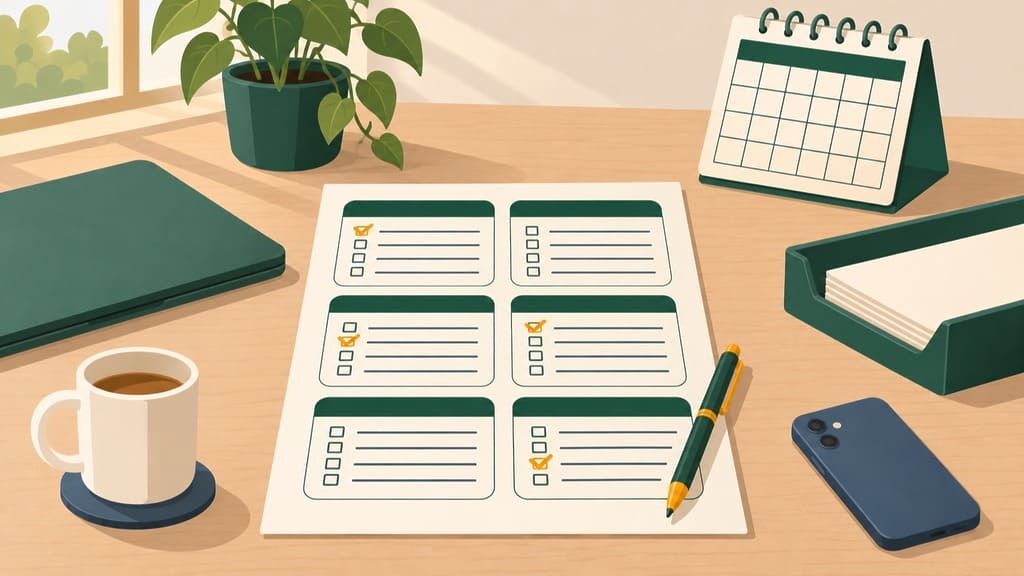
The printable version, with a box beside each line, a tally of checks per area and a line for your first fix, comes in the free kit below with the weekly planner it feeds. Download it once and keep a blank copy for the next run.
How to Score Your Executive Function Checklist
The first step is a count. Add up the checks in each area, from zero to four. The area with the most checks is where your week breaks first, and it is the one you fix first. There is no total out of 24 and no good or bad number, because the count describes how six systems ran last week.
When two areas tie, the tie goes to the area that cost you an evening. When the checks are spread evenly and no area cost an evening, I'd start where you can take something off the week before you add anything to it, such as a standing meeting you can drop or a report someone else can own. Cut the load first and add structure after. One or no checks in every area means your systems are holding.
Write the first fix for your top area as Monday's one task, on a free printable ADHD planner or wherever you keep your week. You don't need to create a checklist of your own for the next run. Print a fresh copy of the kit's version and run it again after four weeks. If a different area comes out on top, the first fix is working. If the same area tops the list twice, the problem is bigger than a first fix, and that system needs a closer look at why it keeps failing.
What Each Area Means at Work, and a First Fix for Each
A cluster of checks in one area usually points to one missing system. Each first fix below is small on purpose, one change in one area, so you can see its impact on the next run. Each is also something you can see, because with ADHD, out of sight is out of mind. In the weeks leaders describe to me, late work, missed meetings and evenings spent catching up come up most, which points to calendar and time and to tasks.
Want a Score for Each Area?
The free ADHD Executive Systems Audit asks eighteen questions across the same six areas and shows which system to fix first. About eight minutes.
Tasks: One Capture List
Checks in tasks mean the work lives in several places. An action agreed out loud never gets written anywhere you look, so you hear about the deadline from the person waiting for it. The first fix is one capture list, and every meeting ends with your actions written on it before you leave. With one list you can prioritize from one place. Managing ADHD in meetings covers the end-of-meeting habit, and work strategies for ADHD productivity cover the rest of the day.
Calendar and Time: Two Focus Blocks
Deadlines that land together and a week with no 90-minute block come from how the calendar is run. Time management starts with two focus blocks a week, 60 to 90 minutes each, booked before anyone else can take the time and kept as a weekly routine. Add more once those two hold for two weeks. If the work inside them keeps running over, look at underestimating how long work takes before you add more blocks.
Email and Messages: Set Windows
When email takes the first hour, the day starts on other people's priorities, and each new message asks you to shift away from your work. The first fix is email in set windows, two or three a day, with notifications off between them so the distractions stop at the source. Set windows reduce context switching, and organization systems for ADHD cover what to do with the inbox once it is open.
Handoffs and Delegation: A Waiting-On List
Many leaders I work with are great starters who hand work on fast, and the handoff is where their week breaks. Work passed on with no owner, date or written outcome comes back late, or you end up doing it yourself. The first fix is a waiting-on list with a name and a date on every line, checked each Friday, so a delay shows up days before the deadline. A delegation ladder helps with the earlier question of what to hand off at all.
Digital Tools: One Home for Each
Searching twice for a file, or keeping one project's notes in two apps, means your tools have no agreed homes. The first fix is one home for notes, one for files and fifteen minutes on Friday to organize both. Pick homes you already open every day, which keeps the setup manageable. When you do need something new, apps and technology tools for ADHD executives covers how to choose.
Workspace: A Visible Signal
For interruptions at the desk and one pile of papers for every project, the first fix is a visible do-not-disturb signal during focus blocks, a cue colleagues can read without asking, and one tray for incoming paper. If noise caused your checks, a quiet room or noise-canceling headphones for focus work also count. Setting up an ADHD-friendly workspace goes further.
What Executive Function Skills Are, and Where They Show Up at Work
The Center on the Developing Child at Harvard University compares executive function to air traffic control at a busy airport: “In the brain, this air traffic control mechanism is called executive function.” The center writes about child development, and it names “the cluster of executive function skills (working memory, attention, inhibitory control, etc.)”.
In her 2013 review “Executive Functions” in the Annual Review of Psychology, Adele Diamond names three core executive functions: inhibition, working memory and cognitive flexibility. She describes them as needed “when going on automatic or relying on instinct or intuition would be ill-advised, insufficient, or impossible.” At work, a routine week runs on habit. A reorganization, a board deck or three days of travel asks for those skills, and that is when the systems underneath matter most.
The checklist does not measure any of these skills or your ability to plan. It counts what happened in a work week. Lists, calendars and written handoffs carry part of the load, which is why every first fix above is a system. Executive functioning in leadership covers the skills themselves in more depth.
When Your Role Sets the Top Area: Senior Work and Other People's Time
Much of a senior week belongs to other people. Decisions are made in meetings, work goes to a team and requests arrive in passing, so in senior roles we often see the checks gather in handoffs, calendar and email. Two pairs are worth reading together. Calendar plus email means the day belongs to others, and tasks plus handoffs means commitments leave your sight once they are made.
That is why the first fix at this level often changes how other people work with you. Above a certain level, the strongest fix is often extra support. An assistant or chief of staff who owns the calendar, the follow-up and the waiting-on list fixes several areas at once.
When a fix needs your employer to change something, you can ask for it as a workplace accommodation. The Job Accommodation Network, a free service funded by the US Department of Labor's Office of Disability Employment Policy, lists calendars and planners, checklists, written instructions and uninterrupted work time among its accommodation ideas for ADHD, along with the tip “Create checklists for yourself and others.” Our guide to ADHD accommodations at work covers how to ask.
From a Checklist to Systems That Hold
The checklist found the area, and the first fix is a start. The rerun after four weeks tells you whether it held. When the same area comes out on top twice, the next step is the ADHD Executive Systems Plan: a deeper audit of six areas, the three recurring misses that cost you most, a private PDF that shows which systems fail and why with the fixes in order, then short check-ins over 90 days with a before and after on day 90. Nothing goes to your employer.
When your top area is about how you lead, delegate or run meetings, a new system will only carry part of it. Read about executive function coaching for adults, or see our ADHD executive coaching services, which are one to one and confidential.
Frequently Asked Questions About the Executive Function Checklist
Is there an executive function test for adults?
A formal assessment of executive function, or of ADHD, is done by a doctor or another licensed professional. This checklist is a different thing. It shows where your work week breaks and cannot tell you anything about a condition, so if you are worried about one, start with your doctor.
What is the difference between executive function and ADHD?
Executive function is a set of skills, such as working memory and cognitive flexibility, that every job draws on. Attention deficit hyperactivity disorder is a diagnosis that a licensed professional makes. CHADD's overview for adults links the two: “Individuals with ADHD may also have difficulties with maintaining attention, executive function and working memory.”
What are executive function skills?
They are the mental skills behind planning, focusing and changing course. Adele Diamond's 2013 review names three core ones: inhibition, working memory and cognitive flexibility. The checklist above looks at the work systems that support those skills.
Is this checklist only for people with ADHD?
Every job asks for executive function, so the six systems help anyone whose week keeps breaking, with or without ADHD. I also have ADHD, and many of the leaders I work with have no official diagnosis, which does not change whether the systems help them. To see what coaching adds, read how ADHD executive coaching works.
How often should I run the checklist?
Run it now on your last normal week, again after four weeks and then once a month, as the kit's guide suggests. Run it again when your role or team changes, because a new role moves the load onto different systems.
Get the ADHD Workweek Kit
The printable executive function checklist with its tally, the weekly planner, a standard week, daily time blocks and the Friday review, in PDF and Word. Free.
Get the Free Kit →