Executive Function Coaching for Adults and Leaders
What is executive function coaching for adults?
Executive function coaching for adults is one-on-one coaching for working adults and leaders. An executive function coach helps you strengthen the skills behind planning, prioritization, focus, and follow-through, and build external systems that carry what memory and willpower cannot. The work happens inside your real job, once your workload has outgrown the routines that used to carry it.
There is a point in many careers where the systems that carried you stop scaling. The mental juggling that worked when you ran one team buckles when you run four. Details slip. Decisions pile up until choosing what to eat for lunch feels like one demand too many. You are working longer and producing less, and the quiet story you tell yourself is that you have gotten worse at your job. You have not. Your role outgrew the informal operating system you have been running on, and that operating system has a name. It is your executive function, and it can be rebuilt. Executive function coaching is how working adults and leaders do exactly that. This guide explains what it is for professionals, who it fits, the skills it strengthens, how it differs from therapy, tutoring, and adjacent kinds of coaching, what an engagement looks like, and how to choose a coach worth your time.
Key Takeaways
- Executive function is the brain's management system: the skills that turn intention into follow-through, not a measure of effort or character.
- Slipping focus and dropped details usually signal a workload that outgrew your systems, not a willpower problem.
- The discipline serves working adults and leaders, with or without ADHD; stress, burnout, and cognitive overload stretch executive function too.
- It differs from therapy (clinical), tutoring (academic), and broader executive coaching, which it sits underneath as the cognitive-systems layer.
- When you choose a coach, look for an assessed ICF credential (PCC or MCC) and experience with working adults.
What Executive Function Coaching Is – for Working Adults and Leaders
Executive function is the brain's management system: the set of mental skills that turn intention into follow-through. Planning, prioritizing, starting, holding information in mind, shifting between tasks, and regulating impulses all run on it. Psychologist Adele Diamond, whose review of the research maps the core components of executive function, groups these capacities around working memory, inhibitory control, and cognitive flexibility. When that system has more load than its current routines can carry, even a brilliant professional starts dropping the ball in ways that look careless and feel personal.
Executive function coaching is a one-on-one partnership that strengthens those cognitive skills and builds the external systems that support them, so a professional can run a workload that has outgrown the routines they used to rely on. The coach helps you see how your attention, memory, and decision-making actually behave under real conditions, then co-designs structures that work with that wiring instead of against it. The unit of change is your operating system, not your character.
Much of what is published about executive function coaching is written for students and parents: homework, study habits, getting through college. That work matters, and the skills carry straight into adult life. The same skills that help a teenager finish assignments decide whether a vice president can hold strategy and execution in the same week. This guide covers the adult and professional version of the work, where the stakes are a career and a team rather than a report card.
The Executive Function Skills That Drive Leadership Performance
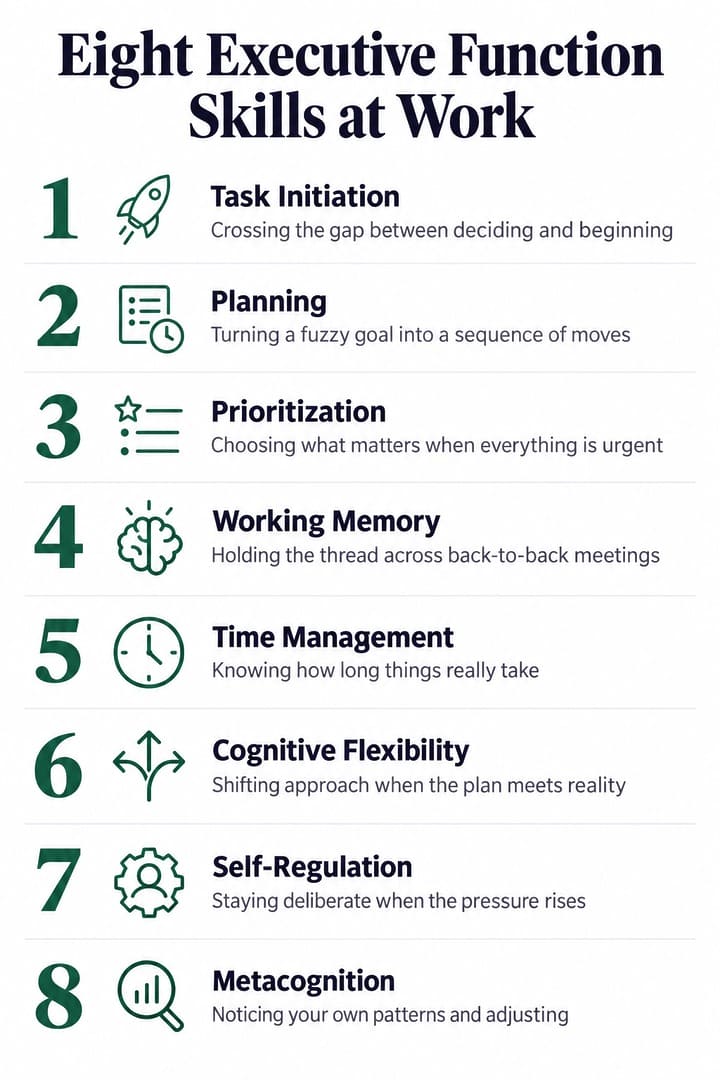
Executive function is not one ability. It is a cluster of distinct skills, and many professionals are strong in some and stretched thin in others. Naming them turns a vague sense of overwhelm into something specific enough to work on. Here is the cluster, framed for the work you actually do.
- Task initiation – starting the board deck you have circled for a week. The hardest part is rarely the work itself; it is crossing the gap between deciding and beginning.
- Planning – turning a fuzzy objective into a sequence of moves. Leaders who carry this well can see the path from quarter-goal to Monday's first action. Strong strategic planning frameworks make this repeatable rather than heroic.
- Prioritization – choosing the one thing that matters when everything is labeled urgent. This is triage under pressure, and it is a skill many executives run on instinct alone.
- Working memory – holding the thread across back-to-back meetings without losing the decision you made in the first one. When working memory is overloaded, good ideas evaporate before they reach a calendar.
- Time management – building an accurate relationship with how long things take and when they are due. Many capable adults experience time blindness in executives, where the felt sense of time and the clock disagree.
- Cognitive flexibility – shifting approach when the first plan meets reality, without grinding the gears. The cost of switching context is real, and learning to manage the cognitive cost of context switching protects a leader's best thinking.
- Self-regulation and emotional regulation – staying deliberate when a meeting heats up or a deadline looms, so impulse control serves the moment instead of hijacking it.
- Metacognition – noticing your own patterns in real time and adjusting. This is the skill that lets every other skill improve.
One more skill sits underneath all of them: knowing what to offload. Senior leaders who treat delegation as cognitive offloading free up working memory for the decisions only they can make. The point of strengthening executive function skills is not to do more in your head. It is to build a system that holds what your head should not have to.
Signs Your Job Outgrew Your Systems
The clearest signal is a gap between your capability and your output that keeps widening no matter how many hours you add. The work is not harder than what you have done before. There is simply more of it arriving in parallel, and the methods that used to absorb it were never designed for this volume.
A few patterns tend to show up together. Your days run reactive, shaped by whatever lands in the inbox rather than what you decided mattered. The important-but-not-urgent work – strategy, development, the relationships that compound – keeps sliding because nothing forces it onto the calendar. Decision fatigue sets in earlier each week. You rely on memory and adrenaline to catch what a system should have caught. And you leave most days feeling busy and behind at the same time.
None of that is a willpower problem, and reading it as one keeps people stuck for years. It is load exceeding the capacity of informal systems. The fix is not to push harder on a structure that has already maxed out. It is to design executive productivity systems that scale with the role you actually have now, which is the work executive function coaching is built to do.
Executive function is the brain’s management system, and a management system can be rebuilt.
Who Executive Function Coaching for Adults Is For
Executive function coaching for adults fits a situation more than a personality. It is built for capable people whose circumstances changed faster than their systems did, and it tends to fit one of a handful of situations.
- A role that multiplied. A promotion or a reorganization added teams, stakeholders, and decisions, and the habits that handled one scope are now carrying three.
- A company that outgrew its founder’s routines. What worked with five people and one product now has to hold a leadership team, a board, and a calendar you no longer control.
- ADHD, diagnosed or not. You have long run on intensity, deadlines, and memory, and the role now asks for steadier structure. The work starts from your strengths and builds systems that fit how your attention works.
- A heavy season of life. A new child, caring for a parent, grief, illness, or months of short sleep. The same research review from Adele Diamond notes that executive functions are the first to suffer, and suffer most, when you are stressed, sad, lonely, sleep deprived, or not physically fit. A capable person can feel suddenly scattered for reasons that have nothing to do with ability.
It is the wrong tool in a few cases, and saying so saves you time. If anxiety, depression, trauma, or another clinical concern is driving the struggle, start with a licensed clinician; coaching can run alongside that care once it is in place. If the gap is subject knowledge, a course or a tutor fits better. And if the role is simply more than one person can carry, the answer may be a conversation with your organization about scope, which coaching can help you prepare for.
Executive Function Coaching vs Therapy, ADHD Coaching, Tutoring, and Executive Coaching
Five kinds of help get used interchangeably, and buying the wrong one wastes months. The fastest way to tell them apart is to ask what each targets, where it points in time, and who leads the work.
| Modality | What it targets | Time orientation | Who leads | When it fits |
|---|---|---|---|---|
| Executive function coaching | Cognitive skills + the external systems that support them | Present and future | Client-led, coach-guided | Your workload outgrew your routines and you want durable systems |
| Therapy | Mental health, emotional healing, clinical conditions | Often past and present | Clinician-led | You are treating anxiety, depression, trauma, or a diagnosed condition |
| ADHD coaching | Executive function with an ADHD-informed lens | Present and future | Client-led, coach-guided | ADHD is the driver and you want strategies tuned to that wiring |
| Tutoring | Subject-matter mastery and academic content | Present | Tutor-led | You need to learn a specific subject or pass a specific exam |
| Executive coaching | Leadership, role, strategy, presence | Present and future | Client-led, coach-guided | You are growing as a leader; executive function coaching is the cognitive-systems layer underneath it |
Two distinctions matter most for professionals. Therapy and coaching are different disciplines with different training; a good coach refers to a therapist when clinical needs surface, and the two often run well in parallel. And executive function coaching sits beneath executive coaching rather than competing with it. Leadership strategy lands only when the cognitive system underneath can execute it. For leaders whose driver is ADHD, the same work runs through an ADHD-informed frame; that is the focus of our leadership strategies for ADHD executives.
What an Executive Function Coaching Engagement Looks Like
A real engagement is concrete, and knowing the shape of it removes much of the hesitation people can feel before starting. It begins with discovery: a clear look at how your attention, memory, and decision-making behave across a normal week, and an audit of the systems you are already running, formal and informal. From there, you and the coach choose one or two executive function skills to work on inside real work, not abstract exercises.
The middle of the engagement is system design. You co-build the external structures that carry load your head should not: a capture method you actually trust, a planning cadence that survives a chaotic week, decision criteria for the calls you make repeatedly, and an energy map so the hardest thinking lands when you have the most to give it. The change happens in your actual days, so sessions often end with a small experiment you choose to try in your real week. To see the texture of a single session, our walkthrough of what a coaching session looks like shows the rhythm in detail.
Progress is tracked against things you can feel: follow-through on what you committed to, the load you are carrying, the number of balls that hit the floor. The test is whether your new systems hold up in a hard week. Our approach to measuring coaching progress keeps the work honest about whether it is actually changing how you operate.
Executive Function Coaching and ADHD (No Diagnosis Required)
ADHD and executive function coaching are often mentioned together, and it is worth saying plainly: you do not need a diagnosis to benefit. Executive function runs lighter or heavier for many reasons. Chronic stress taxes it. So do burnout, anxiety, grief, recovery from illness, the years when sleep is scarce, and the simple reality of a knowledge-work job that asks the brain to hold more than any brain was built to hold at once. Plenty of professionals who would never describe themselves as having a condition still hit the ceiling of their informal systems.
Talk About ADHD-Informed Coaching
Tell us about your role and what is getting in the way, and we can help you decide whether ADHD-informed coaching fits.
For leaders who do have ADHD, the work runs through a frame tuned to that wiring, and the strengths that come with it. Our ADHD coaching engagement for executives starts from the premise that an ADHD brain is not broken; it is built differently, and it performs when the systems around it fit. If that is your situation, the companion resources go deeper: executive function strategies for ADHD leaders, the broader picture of coaching executives with ADHD, and concrete productivity strategies for ADHD professionals.
One boundary stays firm in every case. Coaching builds skills and systems; it does not diagnose or treat. If something clinical is in play, a credentialed coach will say so and help you get the right kind of support alongside the coaching.
Why Credentials Matter: What an ICF Credential Tells You
Anyone can call themselves an executive function coach. Some come from education or psychology, some from a certificate program focused on executive function, and some from professional coaching. Many are knowledgeable and helpful. For a professional buyer, the useful question is what has been independently assessed: the coach’s knowledge of the topic, or their skill at coaching itself.
The International Coaching Federation (ICF) is a global professional body for coaches, and it awards individual credentials at three levels. Associate Certified Coach (ACC) is the entry credential, Professional Certified Coach (PCC) the established professional level, and Master Certified Coach (MCC) the highest. To earn the MCC, a coach must already hold the PCC, log at least 2,500 hours of coaching with 35 or more clients, pass ICF’s credentialing exam, and submit two recorded coaching sessions for performance evaluation (ICF’s MCC requirements). At the end of 2025, about 2,800 coaches held an active MCC, out of roughly 59,000 active ACC, PCC, and MCC holders (ICF’s credential statistics).
Executive function is the subject. Coaching skill is what turns it into change in your week.
The credential measures coaching skill itself: the ability to partner, listen, and help a client create change, assessed by the profession. For an executive paying for results, that is the standard worth measuring a coach against, and the MCC is its highest level.
Tandem Coaching’s executive function coaching is led by Cherie Silas, MCC. Before she became a professional coach, Cherie spent more than 20 years as a corporate leader, and she has ADHD herself. That combination shapes the work: assessed coaching skill, first-hand knowledge of what a demanding leadership role asks of executive function, and a lived understanding of how an ADHD brain behaves under real load.
How to Choose an Executive Function Coach for Adults
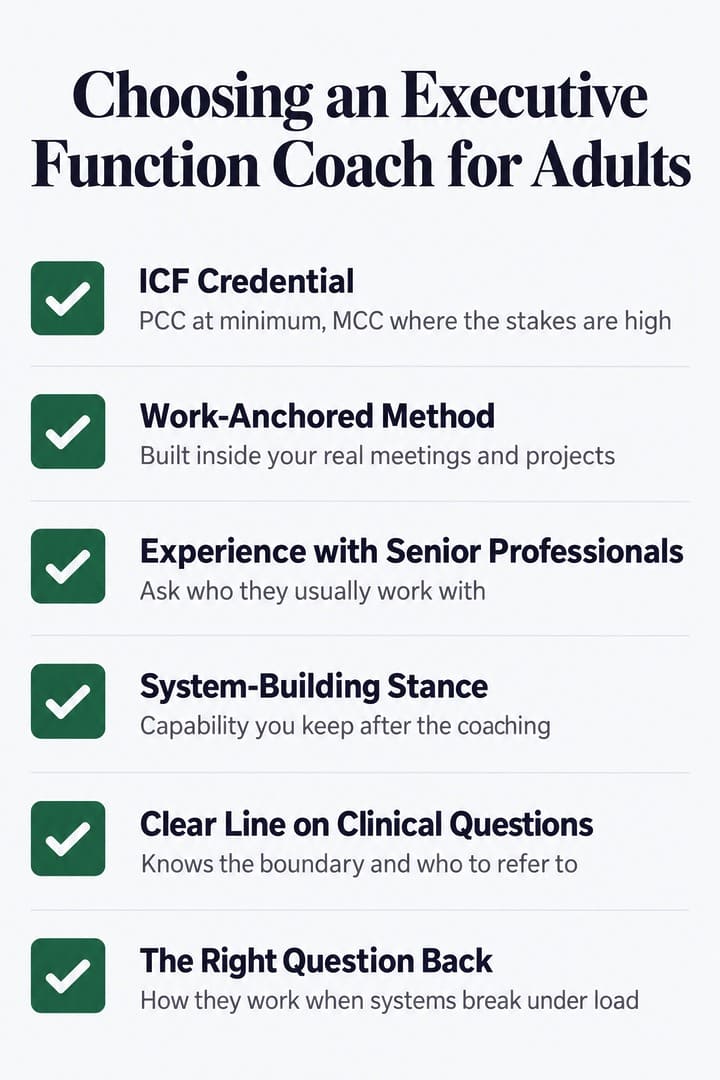
To choose an executive function coach for adults, check three things first: an assessed ICF credential, experience with working professionals, and a method that builds systems inside your real work. A professional buyer can size up a coach quickly with the short checklist below. Use it on a discovery call.
- Credential. Look for an ICF credential, PCC at minimum and MCC where the stakes are high. It is the cleanest signal of assessed coaching skill.
- A work-anchored method. The work should happen inside your real meetings, decisions, and projects, with tools shaped to the way you actually work.
- Experience with senior professionals. Coaching a leader whose workload outgrew their systems is different from coaching a student. Ask who they usually work with.
- A system-building stance. A strong coach helps you build capability you keep, rather than handing you advice you depend on them to refresh.
- A clear line on clinical questions. Ask what the coach does if something clinical comes up. A good answer names the boundary and how they would help you find the right professional.
- The right question back. Ask a candidate how they work when a client's systems break under load. The answer tells you whether they coach the person or just prescribe tactics.
If your workload has outgrown the systems that used to carry you, the next move is a conversation about what you are actually trying to change. That is where good executive function coaching begins.
Frequently Asked Questions
Does executive function coaching work for adults?
It can. Executive functions can be improved at any age, according to psychologist Adele Diamond’s review of the research, and adults can test new systems on real, high-stakes work right away. The work targets planning, prioritization, focus, and follow-through inside your actual job, so results show up where you spend your day.
What does an executive function coach for adults do?
An executive function coach for adults works with you one-on-one to see how your planning, prioritization, focus, and follow-through behave in a normal week. Together you design systems that fit: a capture method you trust, a planning rhythm, and decision rules for calls you make again and again. The coach asks questions and helps you test what works. The coach does not diagnose or treat.
Is executive function coaching covered by insurance?
Generally no. Coaching is a professional development service, not a clinical or medical treatment, so it falls outside health insurance. Some leaders fund it through a professional development budget or an executive coaching allowance. If you need clinical care, that is a separate path, and a good coach will help you find it.
What is the difference between executive function coaching and a coach for ADHD?
They overlap heavily. ADHD coaching is executive function coaching delivered through an ADHD-informed frame, tuned to how an ADHD brain processes attention, time, and reward. Executive function coaching is the broader category, serving anyone whose cognitive systems are stretched, with or without ADHD.
Do I need an ADHD diagnosis to benefit?
No. Stress, burnout, anxiety, major workload growth, and ordinary cognitive overload all stretch executive function without any diagnosis involved. Coaching meets you at how your systems behave now, not at a label. If patterns suggest something clinical, a credentialed coach will point you toward an assessment.
How do I find an executive function coach for adults?
Start with Tandem Coaching. Our executive function coaching for professionals and leaders is led by Cherie Silas, MCC, who spent more than 20 years as a corporate leader before she became a coach and has ADHD herself. Tell us about your role and we can talk through whether it fits. Wherever you look, you can confirm any coach’s ICF credential in the International Coaching Federation’s directory, and a discovery call is the place to ask who the coach usually works with and how they handle the line between coaching and clinical care.
Is executive function coaching done online?
Yes, and it works well online. Sessions translate cleanly to video, and building systems inside your real digital tools, calendar, and inbox is often easier when the coaching happens in the same environment where you work. Tandem Coaching works with professionals remotely.
Not Sure Where to Start?
Tell us about your goals and we can help you find the right path forward.
Contact Us →