
ADHD Time Blindness at Work: Why I Underestimate Time
What is ADHD time blindness?
ADHD time blindness is a difference in how the brain registers the passage of time. The future feels abstract until it becomes the present, and you cannot sense how much time a task will take or how much has already passed while you work. It is a perception gap, not a discipline problem.
I believe I can get six things done today, and I believe each one will take me 20 minutes. Each one really takes 45. By the time I notice, I have overplanned the whole day, and by evening I feel defeated because I finished maybe half of what I promised myself. I am late on the assignment I swore would be quick. People are waiting on me, and I am letting them down. For years I read that as a discipline problem. It is not. It is ADHD time blindness - a difference in how my brain registers the passage of time - and naming it changed how I plan instead of how hard I scold myself.
Key Takeaways
- Time blindness is altered time perception, not laziness - the brain genuinely does not sense time passing the way the clock keeps it.
- Plan from history, not hope: write your honest estimate, then multiply by your personal number (mine is 1.5x, yours might be 2x).
- Protect your calendar: build 15 to 30 minute transition buffers between tasks, and leave open space - a packed day is a list of promises you will not keep.
- Do the honest self-talk at the planning moment, not at 6pm when the regret arrives and it is too late to act on it.
- When the pattern is bigger than any tool - shame, overwhelm, accountability you cannot hold alone - get support.
What Is ADHD Time Blindness?
Time blindness is a weak internal sense of time - a difference in time perception where the future feels abstract until it becomes the present. For me, time runs on a now / not-now switch. A deadline two weeks out is "not now," so it carries no weight, and then it is suddenly "now" and I am scrambling. Time is an abstract thing I have to translate, the way someone else might translate a foreign language. I cannot feel how much time has passed while I work, and I cannot feel how much a task will eat before I start it. Understanding time blindness starts there: my perception of time is altered, so I experience time differently from how the clock keeps it.
The term time blindness sounds dramatic, but blindness is a term that fits - the way I experience time blindness is genuinely a missing sense, not a missing effort. It describes a gap in sensing the passage of time, and this aspect of ADHD is a common symptom of ADHD - one of the clearest signs and symptoms once you know to look for it. The link between time blindness and ADHD shows up early; a child with ADHD often loses an afternoon the same way an adult does. Russell Barkley, whose research first connected Attention deficit hyperactivity disorder to a disrupted concept of time, frames it as a problem of executive functions rather than a problem of caring. When I was diagnosed with ADHD, naming this part of it was a relief. People with ADHD are not careless about clocks. Our awareness of time simply does not run in the background the way it does for most people, so we lose track of time without noticing it slip.
Why I Underestimate How Long Things Take
I underestimate because my brain does not save the receipts. Last week the report took two hours. This week, when I plan, I do not feel that two hours - I feel the optimistic version, the one where everything goes right and nothing interrupts me. That is the planning fallacy: the well-documented habit of estimating how much time a task will take based on the best case, ignoring every past time the same task ran long. Daniel Kahneman and Amos Tversky named this fallacy in 1979, and most people fall for it. The ADHD brain falls for it harder.
Two things stack up. First, working memory is thin, so the lived record of "this always runs long" does not surface when I need it, which makes it hard to estimate how much time a familiar task really needs. The prefrontal cortex - the seat of executive function and the part that should be projecting consequences forward - is exactly where executive dysfunction shows up for individuals with ADHD. Second, dopamine drives my attention toward what is interesting right now, which collapses my time horizon. I operate on a shorter time horizon than the calendar requires, so a task that lives in next week barely registers until it is overdue. The same wiring is associated with ADHD and several other neurodevelopmental disorders, but in ADHD it lands hard on the clock.
This is the connection between ADHD and chronic lateness that gets misread as a character flaw. I want to be on time. I am not disorganized about it on purpose. When I try to estimate the time a thing will take, I am guessing how much time something will take from hope, not from record - and the time management challenges that people with ADHD often face flow straight out of that. The gap is in assessing the amount of time, not in wanting to do it well. It is closer to procrastination's quiet cousin: the task does not scare me, I just keep misjudging its size. Once I understood that underestimating how much time tasks take is a predictable feature of how the ADHD brain works, I stopped trying to want it harder and started building a system around the wiring.
What Time Blindness Actually Costs Me
The cost is rarely a single dramatic miss. It is the slow accumulation. I overcommit based on what I believed the timeline would be, then I run late on assignments because I planned more than I could ever do in a day. Colleagues who depend on my estimates get frustrated, and fairly so - when I say "end of day," they build their own work around it. When my "end of day" is actually tomorrow noon, the ripple touches everyone downstream.
Tired of the Defeated-Evening Feeling?
A coach can hold the accountability and reframing that no calendar can - so your estimates stop costing you trust.
An estimate is a promise, and a promise you keep missing erodes trust faster than any one late deliverable.
An example of time blindness at work, the kind that compounds: an over-stuffed calendar where every block butts against the next, no recovery room, so one task running long topples the rest like dominoes. Then comes the defeated feeling when the day is done - the running tally of what I did not finish, which I read as proof that I am failing. That story is the most expensive part - more costly than the lost half hour. The shame makes me avoid planning at all next time, which guarantees the same outcome.
If you lead anything, the stakes climb. People model their own commitments on yours, and how time blindness affects you quietly shapes how the whole team plans. What I am really chasing is a little more control over time - enough that I can manage my time and keep the commitments other people manage their time around. Manage time blindness and you are not just protecting your calendar - you are protecting the reliability your team reads you by.
The 1.5x Rule: Plan From History, Not Hope
Here is the single change that helped me most: plan from what history tells you about your time, not what you hope is true. If I think something will take an hour, history says it takes an hour and a half. So I plan an hour and a half. The 1.5x multiplier means fifty percent more time than my gut estimate - not a small rounding, a real cushion. I write down my honest guess, then I add half again, and the result is what goes on the calendar. Coaches who want a structured way to teach clients this kind of multiplier thinking can learn it inside our practitioner course built around real ADHD time-management patterns.
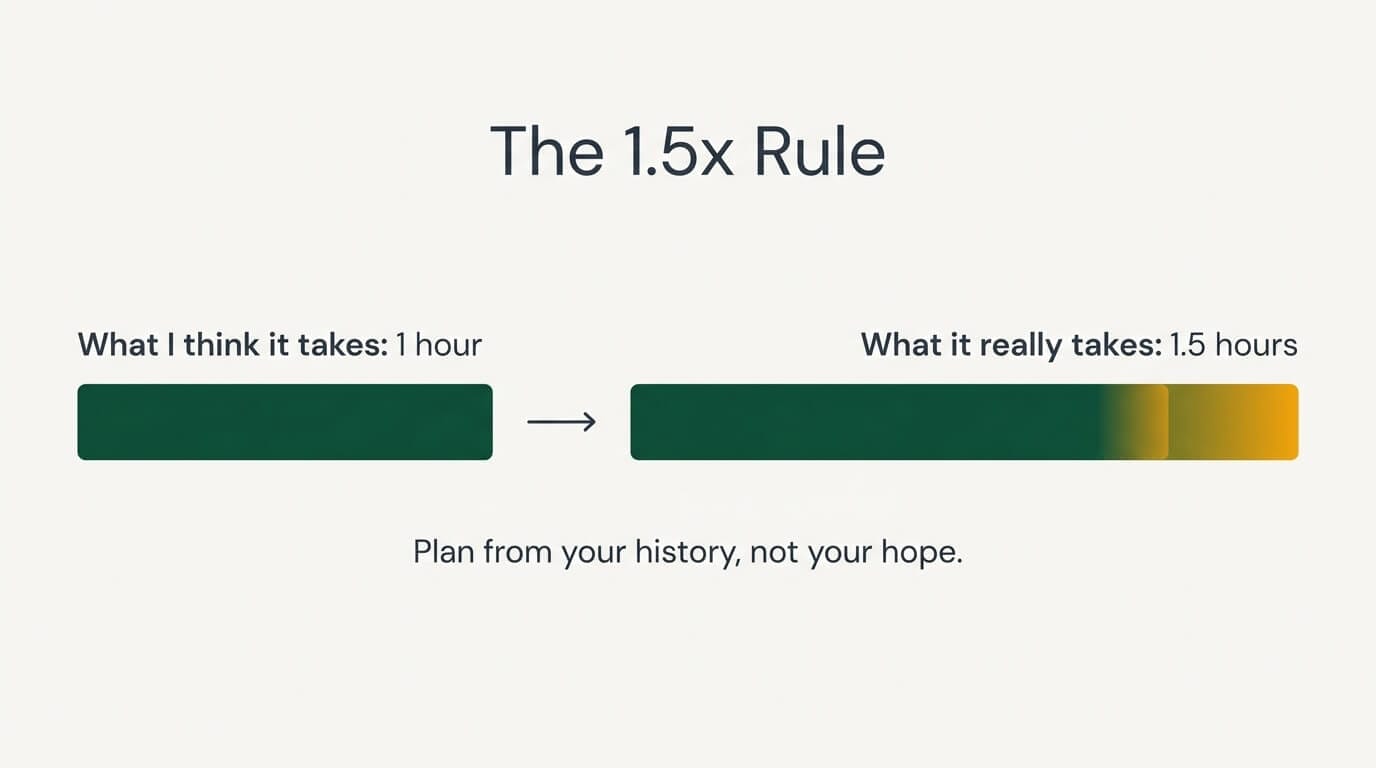
The multiplier is personal. Mine is roughly 1.5x. If your pattern is that a one-hour job consistently swallows two hours, your multiplier is 2x - plan double, and stop arguing with the evidence. The way to find your number is to track a couple of weeks of guesses against actuals. Write "I think 30 minutes" before you start, note what it really took, and the ratio reveals itself. You are calibrating against your own record instead of borrowing a neurotypical person's confidence.
A worked example. I estimate a draft will take 45 minutes. My multiplier is 1.5x, so I block 68 minutes - call it 70. If that draft is one of six things on the list, I no longer pretend six fit into two hours; the honest math says they do not, and I cut the list before the day cuts it for me. This is what it looks like to estimate time the way an ADHD brain actually performs it. The multiplier is the time management skills lesson nobody taught me: good planning is honest before it is fast. Pair it with realistic planning and the defeated evenings get rare.
Leave Space Between Things (Transition Time)
The multiplier fixes how long each task gets. It does not fix the seams between tasks, and that is where another chunk of my day disappears. Just because something takes a half hour does not mean I can run half hour, half hour, half hour back to back. My brain cannot snap instantly from one thing to the next. There is a cost every time I switch, and that cost is real time, not a feeling.
So I build buffer time between blocks - 15 to 30 minutes of nothing scheduled. That window is where I let the last task land, answer the email that piled up, take the phone call, refill the coffee, and let my attention catch up to where I am supposed to be next. Without it, I carry the residue of the last task into the next one and do both badly. The switching tax is well documented, and for an ADHD brain it runs higher than average.
I also cannot work non-stop. A full morning of back-to-back focus is a fantasy; I need a break before I burn out and start making the kind of errors that cost more time to fix than the break would have taken. When I split time into multiple blocks, I treat the gaps as load-bearing, not optional. The buffer is not slack I should have filled. It is the part of the plan that keeps the rest of the plan true.
Don't Fill Every Minute
White space on the calendar is a feature, not wasted capacity. An over-stuffed day is just a list of plans I will not fulfill, dressed up to look like productivity. When I leave a few hours genuinely open, the unexpected has somewhere to go - the call that runs long, the fire that was not on the schedule, the task that needed my 2x multiplier and got my 1x optimism instead.
I plan from what history tells me about my time, not from what I hope is true.
Travel is the clearest case. If I think a trip will take 30 minutes, I plan an hour, because I underestimate that too, the same way I underestimate everything else. The drive, the parking, the walk in, the few minutes of settling - none of it shows up in my gut estimate, and all of it is real. Padding travel is not pessimism. It is matching the plan to how the world actually moves.
The deeper reason to protect open space is that a packed calendar feeds the shame spiral. Every miss in an edge-to-edge day reads as failure, and the failures pile up because the design guaranteed them. Leave room, and a single task running long is absorbed instead of catastrophic. I would rather end the day having finished an honest list than having drowned in an impossible one.
When My Own Plan Triggers Resistance
Here is the trap nobody warns you about: just because I schedule something does not mean I will feel like doing it when the time comes. I can put a task on the calendar in good faith on Monday and meet a wall of resistance to my own plan by Wednesday. The plan becomes a demand, and some part of me digs in against it - even though I am the one who made the demand.
Two moves help me work with that instead of against it. The first is knowing ahead of time. When I decide "on Tuesday I am going to do this thing," the decision itself carries me up to Tuesday; the choice is already made, so Tuesday morning I am not relitigating whether to do it, only doing it. Telling myself in advance turns a fresh battle into a kept appointment. It is a small reframe and it lowers the activation cost more than I expected.
The second is scheduling around my energy. I know which time blocks are mine - if I am sharpest in the morning, the tasks I am most likely to avoid go first thing, before the day erodes my willingness. If you run better in the evening, put the dreaded thing there. The point is to stop fighting two battles at once. Do not schedule the task you resist into the hour you are already weakest; you are setting up a loss and then calling it laziness when it arrives.
The Self-Talk That Helps (at Planning, Not After)
The self-talk that changed things for me does not happen after I blow the estimate. It happens while I am still planning. The moment I am about to commit to a timeline is the decision point - that is when the questions belong, not at 6pm when the regret arrives and it is too late to do anything but feel bad.
So as I plan, I ask myself a short set of honest questions. How long is this realistically going to take? How often is it actually true that when I think something will take 20 minutes, it takes 20 minutes? What might slow me down today specifically? What buffer do I need, and how much transition time between this and the next thing? Those questions take ninety seconds and they catch most of the overcommitment before it happens.
This is not beating myself up - it is doing it better. When I do miss, the question is not "what is wrong with me," it is "what can I learn from this that I need to apply next time?" If I keep misjudging the same kind of task, I put a parameter in place so I stop: a standing 2x multiplier on that task type, a hard buffer, a smaller list. The work of emotional self-regulation here is steering the inner voice toward the next plan instead of the last failure - treating each miss as learning, not as evidence.
Tools That Put Time Outside My Head
Because I cannot keep track of how much time is passing on my own, the time management tools that help most do one thing: they put time outside my head where I can see it. For someone who struggles with time the way I do, that externalizing is the whole game. None of these fix time blindness. They make it visible, which is enough to act on. The table below is what earns a place in my setup, and why.
| Tool | What It Externalizes | Best For |
|---|---|---|
| Analog or visual timer | The passage of time as a shrinking wedge you can watch | Feeling a 25-minute block actually drain, instead of guessing |
| Time-tracking app | Estimate versus actual, logged automatically | Finding your real multiplier across a couple of weeks |
| Calendar with built-in buffers | Transition time as scheduled blocks, not afterthoughts | Stopping the edge-to-edge day before you build it |
| Single visible clock | A constant, glanceable visual representation of time | Anchoring "now" when the workday blurs together |
Keep it light. A pile of time management apps becomes its own avoidance project, and the most reliable setup is the one I will actually use without fuss. Pick one timer, one place to log, one calendar that holds the buffers, and let the rest go.
When It's Bigger Than Tools
These strategies carry me most days. The multiplier, the buffers, the planning-moment questions - they are the difference between a defeated evening and an honest one. For a lot of adults with ADHD, that is the whole answer, and self-help is genuinely enough. Time blindness rarely travels alone in adult ADHD; ADHD in adults tends to bundle it with impulsivity and emotional dysregulation, the other ADHD symptoms that complicate work for adults with ADHD in demanding roles. Seen through a neurodiversity lens, this is a wiring difference to design around, not a flaw to fix.
But sometimes the pattern is bigger than any tool, and it starts touching your mental health. When the real weight is the shame that makes you avoid planning, or the overwhelm that no calendar untangles, or the simple fact that you cannot hold yourself accountable to your own good intentions, a thinking partner helps. Reaching for that support means recognizing where self-management hits its ceiling, which is its own kind of clear-eyed honesty. A coach can hold the accountability and the reframing that you cannot reliably do for yourself - and that is a different kind of help than another app.
Frequently Asked Questions
Is time blindness real, or just an excuse?
It is real and measurable. Time blindness is a common challenge tied to how the ADHD brain handles time perception and executive function, studied for decades, including in Russell Barkley's work on ADHD and time. Researchers measure it through tasks like time reproduction, where someone with time blindness reliably misjudges a known interval. It describes a genuine difficulty perceiving and managing time, not a lack of effort. The strategies here work because they treat the wiring, not the willpower.
What are the symptoms of time blindness?
Common symptoms of time blindness include losing track of how much time has passed, chronically underestimating tasks, and being surprised by deadlines that felt far away an hour ago. Understanding how time blindness can show up - in a student with ADHD missing a due date, or an adult running late despite good intentions - makes it easier to plan around. Time blindness affects almost everyone with ADHD to some degree, though not equally.
Can you fix ADHD time blindness?
You do not cure it, but you can manage your time around it well enough that it stops running your day. The fix is structural: plan from your history with a personal multiplier, build buffer time between tasks, protect open space, and do your honest self-talk at the planning moment. You are not repairing the brain; you are building scaffolding it can lean on.
Why do I always underestimate how long a task will take?
Thin working memory means past experience does not surface to calibrate the estimate, and a shorter time horizon makes future tasks feel small. Add the planning fallacy - the universal habit of estimating from the best case - and you get chronic underestimation. The fix is to estimate honestly, then multiply by what your own tracking shows, usually 1.5x or 2x.
Is time blindness only an ADHD thing?
No. Anyone can lose track of time when absorbed in something, and time blindness is linked to other conditions too - it shows up in ADHD and other neurodevelopmental disorders, including autism, and alongside some forms of anxiety. But people with time blindness who also have ADHD struggle with it more often and more disruptively, where it is one well-known aspect of executive dysfunction rather than an occasional lapse. If you struggle with time blindness day to day, ADHD is the most common reason, and someone with ADHD will usually recognize the pattern instantly.
When Time Blindness Is Bigger Than Tools
In a free consult, we’ll find where your planning keeps breaking - and pick one or two changes you can start this week.
Book a Free Consultation →