
What Happens in a Group Mentor Coaching Session, From the First Minute
What happens in a group mentor coaching session?
In a group mentor coaching session, one person coaches and one is the client while the others observe. Before the coaching, the coach names what they want feedback on. Afterward the coach speaks first. The observers share what made them curious. The mentor coach goes last and leaves the coach with one competency to work on.
“We decide who's going to be the coach and who's going to be the client.” That's how a group mentor coaching session starts when I run one, and everything after it follows an order.
Group mentor coaching is one of the ways coaches working toward an International Coaching Federation (ICF) credential get their mentor coaching. One person coaches and another is the client. The rest of the group observes, with a mentor coach in the room. Below is the order I run it in, from choosing roles to the one thing the coach takes away, with the questions I ask each person along the way.
Key Takeaways
- Before the coaching starts, the coach names the areas they want the group to listen for, and the feedback starts there.
- Feedback runs in a fixed order. The coach speaks first and the mentor coach goes last, with the observers in between.
- Observers share what made them curious and what they learned, so the whole group learns from one person's coaching.
- Live feedback in a group is a set of things the mentor coach noticed. A detailed review of a recording happens one-on-one.
- The coach leaves with one digestible chunk to work on, such as asking about the client's learning and progress.
Three Seats in a Group Mentor Coaching Session
A group mentor coaching session has three seats: the coach, the client and the observers, and each one is a place to learn. As I put it, “You learn from being a coach, you learn from being a client, and you learn from being an observer.” The goal is that everybody's learning, whichever seat they're in.
ICF's own list of Mentor Coaching Competencies has one for this work, Manages Group Mentor Coaching: “Effectively manages the group mentor coaching process.” ICF names the competency. It doesn't prescribe a format, so the running order below is my practice. If you're an ICF mentor coach who runs group sessions, or a coach about to join one, it shows what happens in the room.
You don't need your own coaching to be observed or recorded that day to build your coaching skills in a group. The observer seat has its own work to do, and I ask observers for it directly after the coach has spoken.
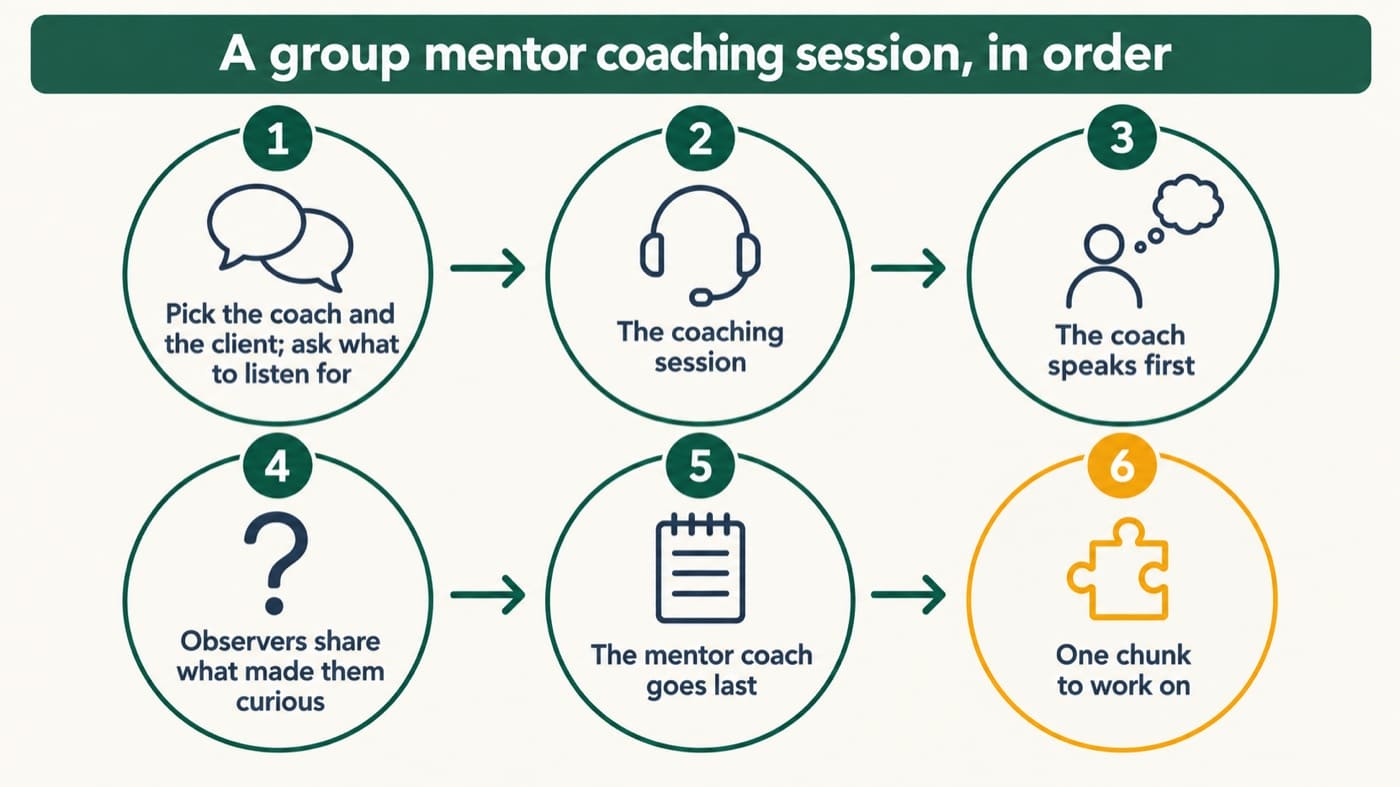
Before the Coaching: Roles and What to Listen For
Before the coaching starts, two things happen. We decide who will be the coach and who will be the client. Then I ask the coach what they want the group to listen for, so the feedback afterward is about the areas where they're trying to grow as a coach right now.
The question I ask the coach is this: “Are there any specific areas you're trying to grow in, that you want us to listen for and give you specific feedback on?”
Whatever the coach names becomes the first thing we talk about later. Then they do the coaching session.
During the Coaching: What the Mentor Coach and the Observers Listen For
During the coaching, the mentor coach and the observers listen for different things. I'm doing fairly detailed feedback against ICF's standard for the ICF credential level the coach is working at. The observers listen mostly for what they were taught in class: are you asking open-ended questions, and did the coaching agreement get met?
For a coach pursuing ACC, the Associate Certified Coach credential, that standard is the ACC Behaviorally Anchored Rating Scales (BARS). For a coach working at the Professional Certified Coach (PCC) level, it's the PCC Markers. Which one I use depends on where the coach is and what level they're working at. Either way, the feedback stays in alignment with the ICF Core Competencies at that level.
The observers listen for the BARS and markers to the extent they know them. What they're really listening for is what they learned in their coach training. They aren't thinking about whether the coach met all the BARS and markers. They're thinking, “Are you doing what we learned how to do?”
The Coach Speaks First
When the coaching ends, we call everybody back. The first person I go to is the coach. Before the coach can receive feedback from anyone else, they give their own view of how they think they did and what they would change. I ask them questions like these.
- What did you do well?
- What would you do differently if you were to do this again?
- What was challenging for you?
The coach's own view of the session comes before anyone else's. ICF lists the mentoring client's reflection on their demonstrated coaching skills and areas for further growth as a required element of mentor coaching.
A coach who is used to reflecting on their own coaching usually has a lot to say here. A coach who isn't gets practice every time they sit in this seat.
What Observers Share: Curiosity and Questions
After the coach, everybody else goes around, or volunteers. I don't ask observers to rate the coaching. I ask what they noticed that made them curious and what they learned. I also ask what would be worth talking about as a group, so that the whole group learns from one person's coaching.
These are the questions I ask the observers:
- What did you notice in the session that made you curious, that made you have a question?
- Should we be doing that? Should we not be doing that? How could that be different?
- What did you learn that you're not doing?
- What would be valuable for us to talk about as a group so we can all learn?
I'm not asking them to judge whether it met the standard, because the goal is that everybody's learning. By talking about what they saw and having a discussion about it, they're all learning from the coaching.
The observer seat is easy to underuse. In our Mentor Coaching Foundations course, one assignment asks students to design a group mentor coaching session. In feedback on those submissions (the English course, 161 students, May to October 2026), 12 growth notes on designs that were accepted pointed to the same thing: inclusion plans that keep observers busy without saying what each one gains.
One way to name what an observer gains is the question “What did you learn that you're not doing?” There's more on what trips up students designing a group session in our piece on mentor coaching mistakes.
The Mentor Coach Goes Last: Live Feedback and Its Limits
As the facilitator, I generally go last and review what I saw. In a group session I'm doing it live, so I caught what I could catch. I don't do timestamps, and I don't take notes on the behavior, because there's no time for that live. It's just, “Hey, you said this, and this was this competency.”
Practice Running a Group, With Live Feedback
In our Mentor Coach Specialization training, each participant runs a group mentor coaching round while the lead faculty observes, then gets feedback in class.
I usually turn on transcription, so I'm pulling things out of the transcript and pasting them on my form, because that makes it a little easier.
Then I give the disclosure: “This is not a full-blown assessment. These are just some things I noticed, some helpful feedback, to help you see in the big picture where you are.”
Live mentor coach feedback is a different thing from the review I do on coaching recordings. With recorded sessions, I can stop the recording, mark where each piece of evidence is and describe the behavior beside it. That written feedback goes into far more detail than anything I can catch in the room, and a full review of recorded coaching sessions belongs in individual mentoring.
We're really just catching what we saw and what we were able to capture when we can't hit pause.
The broader skill set a good mentor coach brings to all of this is in my piece on what a mentor coach has to be able to do.
Start With the Coach's Focus, Then Open It to the Group
My feedback starts where the coach asked for it. If the coach said they were specifically focusing on the coaching agreement, then we go to the coaching agreement first. What were your concerns about it? Did you do it? What was strong, what did you miss, and how could you cover that next time?
Then the group gets involved. We might have a discussion about how that would look. What could you ask? Where could you have asked it?
After the coach's focus area, I go over everything else the same way. Some of that depends on how much time we actually have.
One Digestible Chunk Instead of Nine Markers
I close by giving the coach the big picture and one thing to work on. I'll say something like, “It looks like you're naturally meeting these four, five, six competencies. Those things are happening naturally, so don't give any energy to them. Just let them happen.” Then I name the area where the energy should go.
For example, Competency 8. Maybe the coach didn't cover it well or enough, or missed it completely. In the ICF Core Competencies, Competency 8 is Facilitates Client Growth. At the PCC level it has nine markers, and six of them have to be demonstrated. In the ACC-level BARS it has three statements, and two have to be demonstrated.
That's how ICF counts a competency: at least two-thirds of its skills, each one demonstrated at a competent level in at least one observed session. Nine markers is still a lot to hand someone at the end of a group session.
I'm not going to tell them, “There are nine markers there. You need to do them all.” Those markers bunch up. There are several about learning and progress, and then several about next steps. So I bunch learning and progress together: in the next couple of sessions you do, really make it a point to ask what progress the client made, what they learned and how they're going to apply that learning. You can do it throughout the session or at the end of the session. It doesn't matter.
Or I might send them to the actions, to get deeper into them. The questions go past what the client is going to do. How are you going to do it? What do you expect to learn from it? What are your barriers? What might get in the way? What support do you need? Those questions help the client build a plan for how they're going to be successful between sessions.
So the mentee leaves with one little chunk to work on, so they can start to integrate it. I pick the most valuable thing they can fix and let them work on improving that.
They can't fix everything, and they don't need to fix everything at once.
If you run group sessions, try this with the next coach you observe. Of all the coaching competencies you saw, which one chunk would you leave them with?
Bring Your Hardest Problems to Group
If you're the coach in a group, bring your hardest problems from your coaching practice. Across your mentor coaching, before anyone reviews a recording of yours, bring all your hardest stuff and all your problems, and get those resolved. That's a great thing to do in group mentor coaching, and a great thing to do in class.
The review of a recording happens in individual mentor coaching sessions, and those one-on-one sessions ask for different preparation. I recommend doing group mentor coaching right after your training, before you go out and get the rest of your hours, so you know early what you need to improve. When to start, and how to prepare for the individual sessions, is a topic of its own.
Group mentor coaching is something I run for coaches working toward ACC and PCC. When a coach is working toward the Master Certified Coach (MCC) level, my mentoring is all one-on-one. I don't run a group for the MCC credential.
Whichever mentor coaching program you choose, the rules on how group and individual mentor coaching count toward the mentor coaching requirement are in our guide to ICF mentor coaching. If you'd rather work with a mentor in a group, our mentor coaching for ICF credentials includes group sessions.
If you mentor coaches, or want to, running a group session like this is a skill you can learn, and ICF counts it as a mentor coaching competency of its own. Our overview of the ICF Mentor Coach Specialization (MCS) sets out what it requires at each level. In Tandem's Mentor Coach Specialization training program, each participant facilitates a faculty-observed group mentor coaching round and gets live feedback in class. Alex Kudinov and I hold the MCS at all three levels, and every mentor coach on our team holds it at the level they mentor.
Questions About Group Mentor Coaching Sessions
What do observers do in a group mentor coaching session?
They listen for what they were taught in class, such as open-ended questions and whether the coaching agreement got met, and for the BARS and markers to the extent they know them. After the coach speaks, they share what made them curious and what they learned, without judging whether the coaching met the standard.
Who gives feedback first in a group mentor coaching session?
In the group mentor coaching sessions I run, the coach goes first with their own view of how they did. The observers go next, and I generally go last as the mentor coach, starting with whatever the coach asked the group to listen for.
Is the mentor coach's live feedback a full assessment?
Live feedback in a group session is not a full assessment. I catch what I can catch, without timestamps or notes on the behavior, and I say so: “This is not a full-blown assessment.” A detailed review of recorded coaching sessions happens one-on-one.
Who can lead mentor coaching after January 1, 2027?
ICF has said that from January 1, 2027, all new mentor coaching, including mentor coaching for renewals, must come from an MCS holder at that level or above. In other words, your mentor coach must hold the MCS at your level or above, whether you're going for ACC, PCC or MCC. That rule touches ICF credentialing at every level.
Train as a Mentor Coach With Cherie Silas, MCC
Twelve weeks of live classes, with group mentor coaching rounds you run while the lead faculty observes. $2,997, or from $999 on a payment plan.
See Cohorts & Pricing →