Leadership Coach Certification for L&D Professionals: What Counts
What does leadership coach certification mean for an L&D professional?
Leadership coach certification gives an L&D professional coach-specific education, assessed practice, and a portable ICF credential. Existing facilitation, training, or manager-development work builds useful skills but does not automatically count as client-coaching experience. ACC or PCC eligibility depends on the current education and documented coaching-hour requirements you can meet.
If you're sourcing coaching or leadership-development programming for your organization rather than becoming a coach yourself, our leadership development consulting services are built for that role; this guide is for the practitioner path.
If you're an L&D, HR, talent-development, or organizational-development professional weighing leadership coach certification for yourself, start here. Your background is a genuine, recognized starting point for International Coaching Federation coach certification, but it is not automatic - coaching is a distinct discipline with its own experience-hour rules. Which path fits you - current-role, internal coach, or independent practice - depends on the goal you're pursuing, not on how much coaching-adjacent work you've already done.
Key Takeaways
- Your L&D, HR, or OD skills transfer, but prior work does not automatically become ICF client-coaching experience.
- The central shift is from designing and advising to letting the client’s agenda lead.
- Current-role capability, internal coaching, independent practice, and a blended path are different goals, not a ranking.
- ACC and PCC eligibility depends on documented education and coaching hours, not corporate seniority.
- Organizational capability frameworks and an individual ICF credential answer different questions.
Why This Question Is Landing on L&D and HR Desks Right Now
CIPD's coaching and mentoring guidance is direct on this point: designing and managing coaching and mentoring programmes sits inside the L&D specialist knowledge area, and HR and L&D business partners are increasingly expected to demonstrate coaching capability. That is exactly why ICF certification questions keep landing on your desk - your role already sits next to coaching, sometimes inside it.
Here is what that evidence proves, and what it doesn't. ICF's guide to becoming a coach speaks directly to people arriving from backgrounds that include human resources. It does not prove that your current coaching-adjacent work - facilitation, workshop design, one-on-one development conversations - already qualifies as ICF coaching experience. Those are two separate questions, and this guide answers both.
In the cohort observations behind this article, L&D and HR professionals generally expected that their existing work would not count outright. What surprised them was the size of the gap: how little of that coaching-adjacent experience automatically converted into ICF-qualifying client-coaching hours, and how much documented, client-led practice they still needed.
From here, what actually applies to you depends on which of three goals you're pursuing, and this guide treats all three as equally legitimate rather than ranking them:
- Becoming more effective in your current L&D, HR, or OD role
- Serving as an internal coach, inside clear confidentiality and conflict-of-interest boundaries
- Building an independent or blended professional coaching practice
None of those goals is a lesser answer than the others. What changes between them is which ICF rules actually apply to you, and that's where the confusion usually starts. (Coming from a different professional background? Our career coach certification guide asks the same what-actually-counts question from a different starting point.)
What Actually Transfers - and What Doesn't
Start with the honest inventory. Your L&D, HR, or OD background gave you real skills that map onto the ICF core competencies, but mapping onto them is not the same as satisfying the rules built around them.
| What transfers | What changes in professional coaching | What does not automatically count toward an ICF credential |
|---|---|---|
| Listening | Client-led agenda | Teaching |
| Facilitation | Less advising | Training |
| Learning design | Less evaluation | Workshops |
| Leadership | Explicit coaching agreements | Mentoring |
| Pattern recognition | Confidentiality | Supervising direct reports and general professional seniority |
This table is useful without pretending to determine your personal eligibility - your actual hours and documentation still decide that. But it names the shift plainly: a coaching agreement hands the client the agenda, asks you to advise less and evaluate less than an L&D role typically does, and puts confidentiality and explicit consent at the center of the relationship instead of at its edges.
“You are not starting from zero, but professional coaching is a distinct discipline. Your skills transfer; your previous work does not automatically count as ICF coaching experience.”
That line cuts both ways. You are not starting from zero: listening, facilitation, learning design, leadership, and pattern recognition are real transferable assets when practicing the ICF Core Competencies inside a coaching agreement instead of a curriculum. But your previous work does not automatically count as ICF coaching experience, and treating it as though it does is a recurring misjudgment among experienced corporate professionals whose work was internally called coaching.
Understanding how coaching differs from mentoring matters here, because the two get blurred constantly in corporate language. Mentoring shares expertise and answers; coaching partners with the client to build their own answers. If most of what you currently do for direct reports or colleagues is mentoring, teaching, or supervising, that is valuable work - it simply is not the work an ICF credential measures.
The "less advising, less evaluation" column is the one L&D and HR professionals tend to underrate, because advising and evaluating are exactly the muscles a strong L&D career builds. A performance conversation asks you to assess against a standard and often to recommend next steps; a coaching conversation asks you to hold the standard-setting and the recommending back, on purpose, so the client's own thinking does the work instead. That restraint is a trained skill, not a personality trait some people happen to have and others don't.
The Shift From Program Designer to ICF Coach
L&D, HR, and OD work rewards designing the right program, advising stakeholders, and evaluating outcomes against a plan. ICF coaching asks for the opposite instinct: client-led agenda-setting, partnership, and restraint from supplying the answer or the curriculum. That is the actual shift a credential is training you for.
Name the specific muscle memory at risk. A strong facilitator's or designer's instinct is to structure the session, or to steer a conversation toward a known best practice, because that instinct is what makes someone good at L&D work in the first place. A coaching agreement asks you to hold that instinct back - to let the client's own agenda and their own next step lead, even when you can see a shorter path. Coach-specific education, including the hours ACC requires, gives you sustained practice in that different professional stance.
Consider an L&D professional moving through their first coach-training cohort, still catching themselves mid-sentence offering advice instead of asking the question that would let a client find it themselves. That correction is common, and it is not a sign the background was wrong for coaching. In the cohorts observed for this article, no negative difference showed up between L&D or HR learners and other career backgrounds. If anything, L&D and HR learners appeared more patient and more curious, and grasped the underlying stance shift - from designing and facilitating to client-led discovery - more readily than some other career backgrounds. That observation is bounded to the cohorts actually seen, not a claim about L&D professionals as a population, and no single derailment moment stood out as typical.
What that means practically: the discipline is learnable, and your existing skill set does not work against you here. It just is not, on its own, the same discipline. Mentor coaching, the required hours built into the ACC path, exists specifically to help a new coach see their own patterns - including the advising and evaluating reflexes an L&D career builds - and practice replacing them, session by session, with a real mentor coach's feedback instead of self-assessment alone.
Four Paths for L&D and HR Professionals
Once the shift is named, the question becomes which of four goals actually describes you. None of the four is more common, more serious, or more advanced than the others - they are different destinations, not stages of the same journey, and it's entirely possible to read all four and recognize pieces of yourself in more than one.
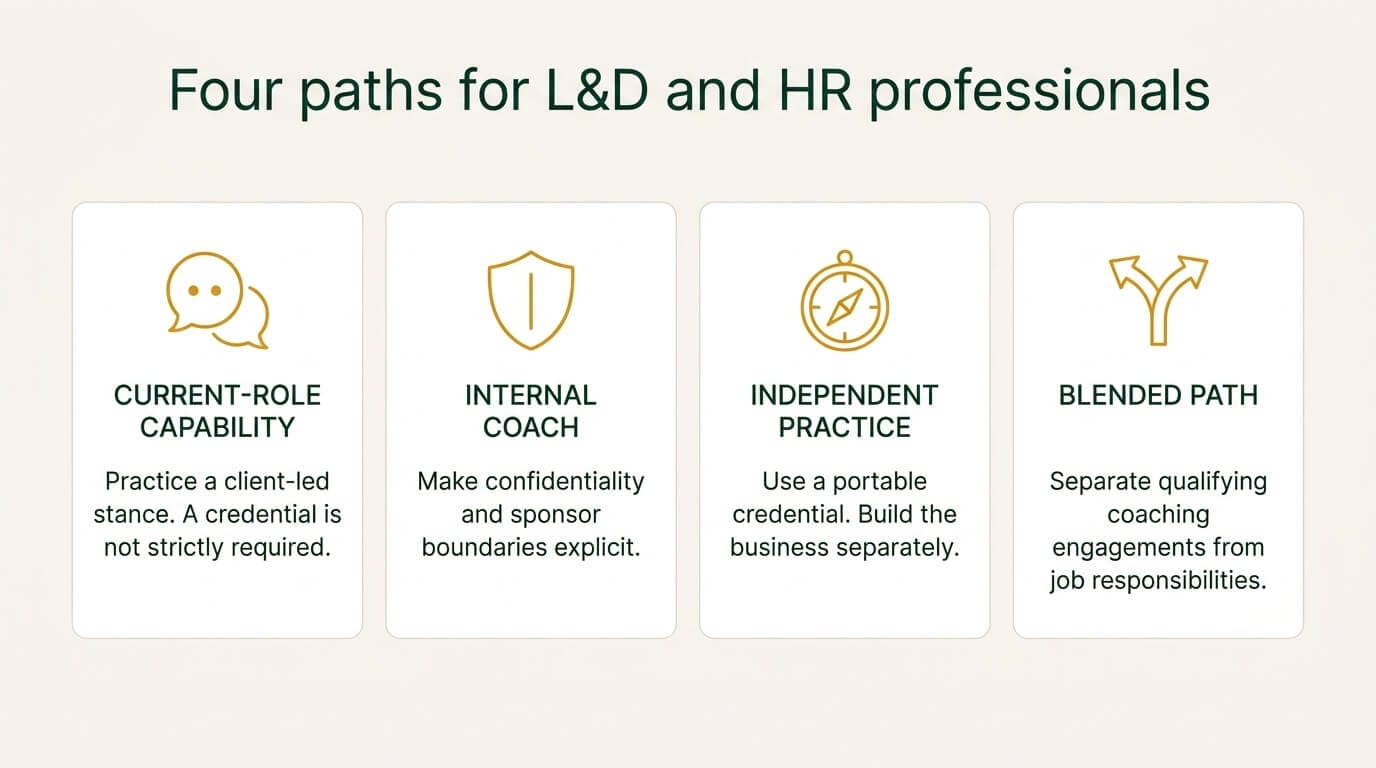
Current-Role Capability
Coach-specific skills can sharpen the work you already do: facilitation, stakeholder conversations, and the one-on-one development conversations that come with an L&D, HR, or OD role. No credential is strictly required for this goal - the value may be in learning and practicing a client-led stance that you can use when it fits the moment.
This path lets you test those skills in work you already understand. A manager who learns to ask one more question before offering a fix has another tool available alongside facilitation and advising, without confusing the management relationship with a formal coaching engagement. If you're still exploring whether any of this is worth a structured program at all, Tandem's free coaching tools library is a reasonable low-commitment starting point before you commit to formal training.
Internal Coach
Serving as an internal coach requires confidentiality and conflict-of-interest boundaries that are distinct from an HR-business-partner or L&D-manager relationship, where information routinely flows back to the organization. A coaching relationship draws a harder line, and that line has to be negotiated explicitly, not assumed. In an HR-business-partner conversation, some of what you hear is expected to inform talent decisions elsewhere in the organization; in a coaching conversation, it isn't, and the person across from you needs to know which relationship they're actually in before they say anything they wouldn't want repeated. Coaching from inside your own organization is entirely possible, but only once those boundaries are named out loud rather than assumed. The ICF Code of Ethics is the governing document for exactly this kind of boundary.
Coaching your own direct reports does not count toward ICF client-coaching hours, no matter how coaching-like those conversations feel. Qualifying internal coaching, outside that direct-reporting or sponsor-conflicted line, may count - confirm your specific arrangement against current ICF rules before you log the hours.
The confidentiality boundary becomes concrete when the party funding or sponsoring the coaching relationship - an HR director, your own manager, or an HR business partner - contacts you directly and asks for specifics. The ICF Code of Ethics' confidentiality standard - Section 2, Standards 2.2 and 2.3 on Confidentiality and Legal Compliance - requires a clear agreement about what information is exchanged and how, among everyone involved including the sponsor, negotiated before coaching begins. Handled after the sponsor already called, you're negotiating the boundary under pressure instead of by agreement.
Independent or External Practice
Here the credential becomes something different: a portable, third-party-verified asset that travels with you regardless of employer. That is a real advantage over an internally-recognized skill set, because it doesn't disappear if you change companies or industries the way an internal reputation for being "the person who's good at coaching conversations" does. But it answers a narrower question than it sounds like. Earning the credential and building a full transition into independent coaching with a viable client base are separate outcomes, and neither ACC nor PCC is a universal signal that a practice is ready to sustain itself. The credential proves you can coach to a verified standard; it says nothing about your ability to find clients, price your services, or run a business, which are their own separate skills with their own separate learning curve. Treat the credential as the entry ticket to the work, not as a business plan.
Worth naming directly: independent leadership coaching and life coach certification can serve different client groups and different kinds of conversations even where the underlying ICF credential is identical. Choose the practice area from the clients and problems you genuinely want to work with, not from an assumption that your previous title decides it for you.
Blended Path
Some L&D and HR professionals combine current-role use of coach training with qualifying client-coaching hours logged outside the organization, or through genuinely independent internal arrangements that clear the confidentiality and conflict-of-interest bar described above. That is one possible route through the four paths, not a claimed norm for this audience. It requires careful separation between work conversations and coaching engagements, plus documentation for every hour you plan to submit. If the path continues beyond a credential cycle, renewing your ICF credential becomes part of the plan as well.
What Counts Toward an ICF Credential - and Which Level Fits
ICF ACC requirements are the entry threshold: 60 hours of coach-specific education, 100 hours of coaching experience with at least 8 clients (75 of those hours paid, 25 within the 18 months before you apply), 10 hours of mentor coaching spread across at least three months, a performance evaluation, and the ACC exam. ICF PCC requirements are a substantially higher bar: at least 125 hours of coach-specific education and 500 hours of coaching experience with at least 25 clients (450 paid, 50 within 18 months), 10 hours of mentor coaching spread across at least three months, a performance evaluation, and the ICF Credentialing Exam. PCC is not a seniority badge - it is a function of verified coaching experience, not years spent in an L&D, HR, or OD role. The current ACC credential requirements and the ACC and PCC credential comparison both spell out the full documentation ICF expects at application time, which is worth reading before you assume you already know what will be asked of you.
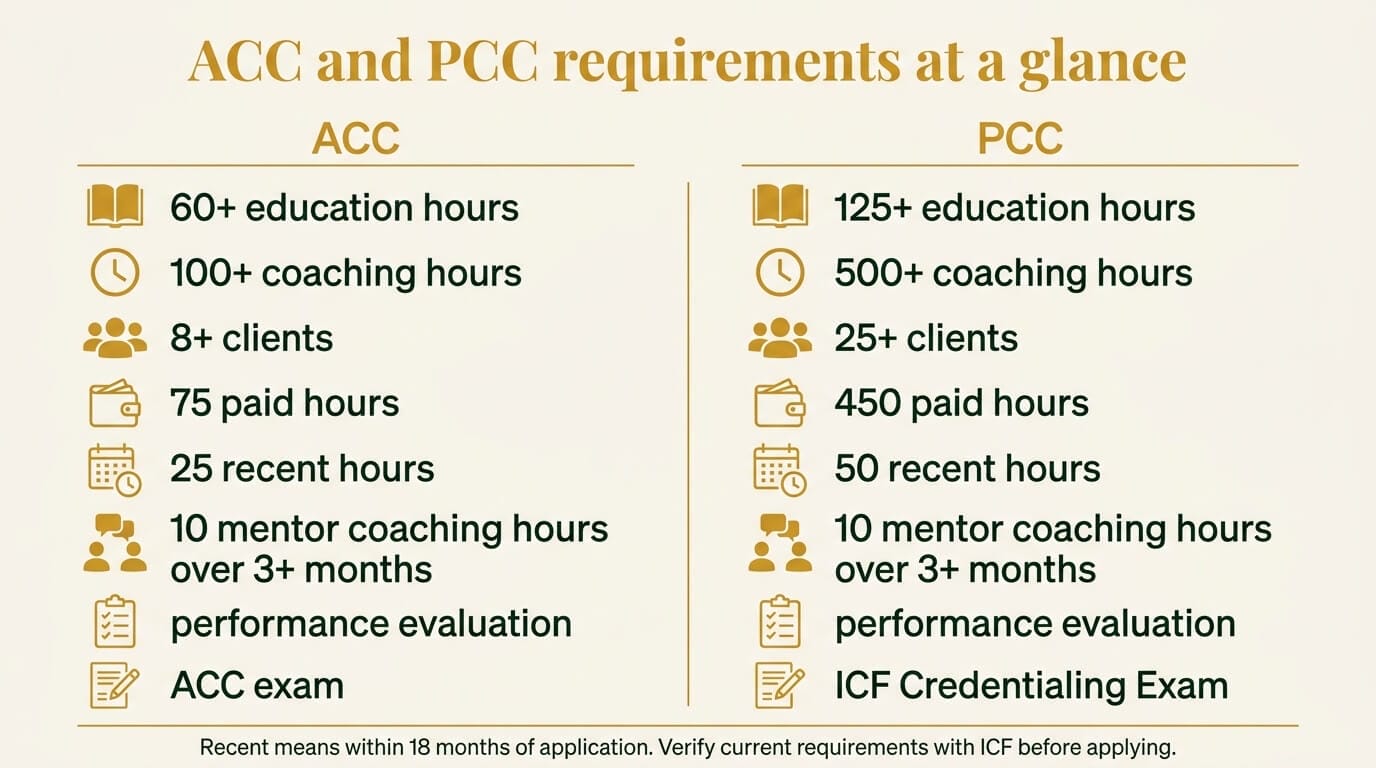
Which level fits depends on which of those current requirements you can actually document, not on your title. If you are new to documented, client-led coaching and cannot yet meet the PCC requirements, ACC is the available entry route regardless of seniority elsewhere in your career.
ICF's coaching-experience requirements are explicit about what does NOT count as client coaching hours, stated plainly here because the boundary is where the confusion concentrates:
- Training, teaching, and facilitating workshops
- Mentor coaching you give to other coaches - only mentor coaching you personally receive counts toward your own mentor-coaching requirement
- Coaching your own direct reports
- Coaching supervision and reviewing client assessments
- Coaching delivered inside a training program with students, trainers, or mentors, unless it's conducted separately, with a real client, outside the classroom or training credit
- General professional seniority, regardless of role or title
This pattern is common among highly experienced professionals whose corporate work was internally called coaching - performance conversations, one-on-one development discussions, manager-as-coach programs - who assume that experience transfers to ICF client-coaching-hour or mentor-coaching requirements. It doesn't transfer automatically on either count: that internal work doesn't meet the ICF definition of client coaching hours, and mentor coaching given to others as an experienced manager or program lead does not satisfy your own mentor-coaching requirement, which specifically requires receiving mentor coaching toward your own credential.
ICF ACC and PCC requirements can change. Re-verify the current hour and education thresholds against ICF's own credentialing pages before you build a plan around them.
The required mentor coaching hours are a separate line item from your coaching-experience hours, and it's worth understanding ICF mentor coaching for ACC, PCC, and MCC before you assume any prior mentoring you've given elsewhere applies. A performance evaluation is also part of the ACC path: a mentor coach or assessor listens to a recorded coaching session and evaluates it against the ICF competencies, which is a different kind of scrutiny than a manager's annual performance review and takes some getting used to for anyone accustomed to being the one doing the evaluating. If you're still deciding whether any of this is worth pursuing at all, is ICF certification worth it walks through that decision directly.
ATD/CIPD Capability Development vs. an ICF Credential
ATD- and CIPD-aligned capability development - a manager-as-coach program, or an internal coaching competency framework - supports your organization's ability to run coaching-quality conversations at scale. It is typically scoped to the organization that built it: the frameworks, the language, and the assessment rubric usually live inside that one employer's systems. An ICF credential is individual, portable, and verified by a body outside your employer; it travels with you, not with the role, and it means the same thing whether the organization that first sent you to training exists or not.
Neither one automatically substitutes for the other, and neither one outranks the other - they answer different questions. Only education and experience that independently meet the current ICF rules count toward an ICF credential, no matter how much ATD- or CIPD-aligned capability work sits behind it; hours inside a manager-as-coach program can count only if that specific training and practice happens to satisfy ICF's coach-specific education and experience rules on its own terms, not because it carried an ATD or CIPD label. And an ICF credential does not automatically satisfy an employer's internal capability framework, which may have its own separate requirements built around that organization's own leadership model.
Capability development answers whether your organization can run coaching-quality conversations at scale, across many managers, without every one of them holding an individual credential. An ICF credential answers a narrower, more personal question: whether one individual coach has been independently verified against a professional standard that holds regardless of employer. Both questions can matter to the same person at the same time - an L&D leader might be responsible for running the organization's capability program and separately deciding whether to pursue their own credential - and answering one does not answer the other.
If a portable, individually-verified credential is the right instrument for your goal, the next honest question is which specific program to choose, and what an ICF-accredited coaching program actually requires of you before you enroll.
Frequently Asked Questions
Does mentor coaching count toward ICF coaching hours?
Mentor coaching you receive counts toward the separate mentor-coaching-hours requirement, not toward your client-coaching hours. Mentor coaching you give to other coaches does not count toward your own requirement at all - it specifically has to be mentor coaching you receive, from a qualified mentor coach, spread across the required minimum number of months.
Can I count coaching my own direct reports toward an ICF credential?
No. Coaching your own direct reports does not count as client coaching hours under current ICF rules, regardless of how the conversation is structured. Qualifying internal coaching outside that direct-reporting line, with clear confidentiality and sponsor boundaries negotiated up front, may count.
What's the difference between ACC and PCC?
ACC requires 60 hours of coach-specific education and 100 hours of coaching experience. PCC requires at least 125 hours of education and 500 hours of experience. The right level depends on which requirements you can document; years in an L&D or HR role do not substitute for verified client-coaching hours.
Do ATD or CIPD credentials count toward an ICF credential?
Not automatically. ATD- and CIPD-aligned capability development and an individual ICF credential are separate, non-substitutable systems answering different questions - one about your organization's capability at scale, one about an individually verified coach. Hours from either can count toward an ICF credential only if they independently meet ICF's own education and experience rules.
Is ICF certification worth it for an L&D or HR professional?
It depends on which of the four paths actually describes your goal - current-role capability, internal coaching, independent practice, or a blended path. Read our honest answer for the full argument rather than a one-line verdict.
Where to Start
If you can't yet document PCC-level requirements, treat ACC as the entry route rather than a lesser option. Tandem's ACC coach certification program is designed around the current ACC education, mentoring, and performance requirements. If you can already document the PCC requirements, review the full PCC program. If you're still comparing credential levels before committing to either, compare ACC, PCC, and ACTC credential levels first - there's no penalty for taking that comparison seriously before you enroll anywhere.
Test the Client-Led Stance First
Free Foundations lets you experience coach-specific learning before deciding whether the full ACC program fits your professional goal.
One boundary before you decide anything: this guide does not promise income, client acquisition, promotion, or expanded organizational influence. Coach-specific education builds a professional capability - the same distinction this whole guide has been making since the opening paragraph. What you do with a credential afterward is a separate, later decision, and it's yours to make once you actually hold it, not something this article is in a position to predict for you.
Compare Your ICF Training Options
Choose an ACC or PCC pathway from the education and documented coaching-hour requirements you can actually meet.
Compare ICF Programs →