
Executive Career Pivot Strategy: Framework for Adjacent Moves
How should I pivot to adjacent executive roles?
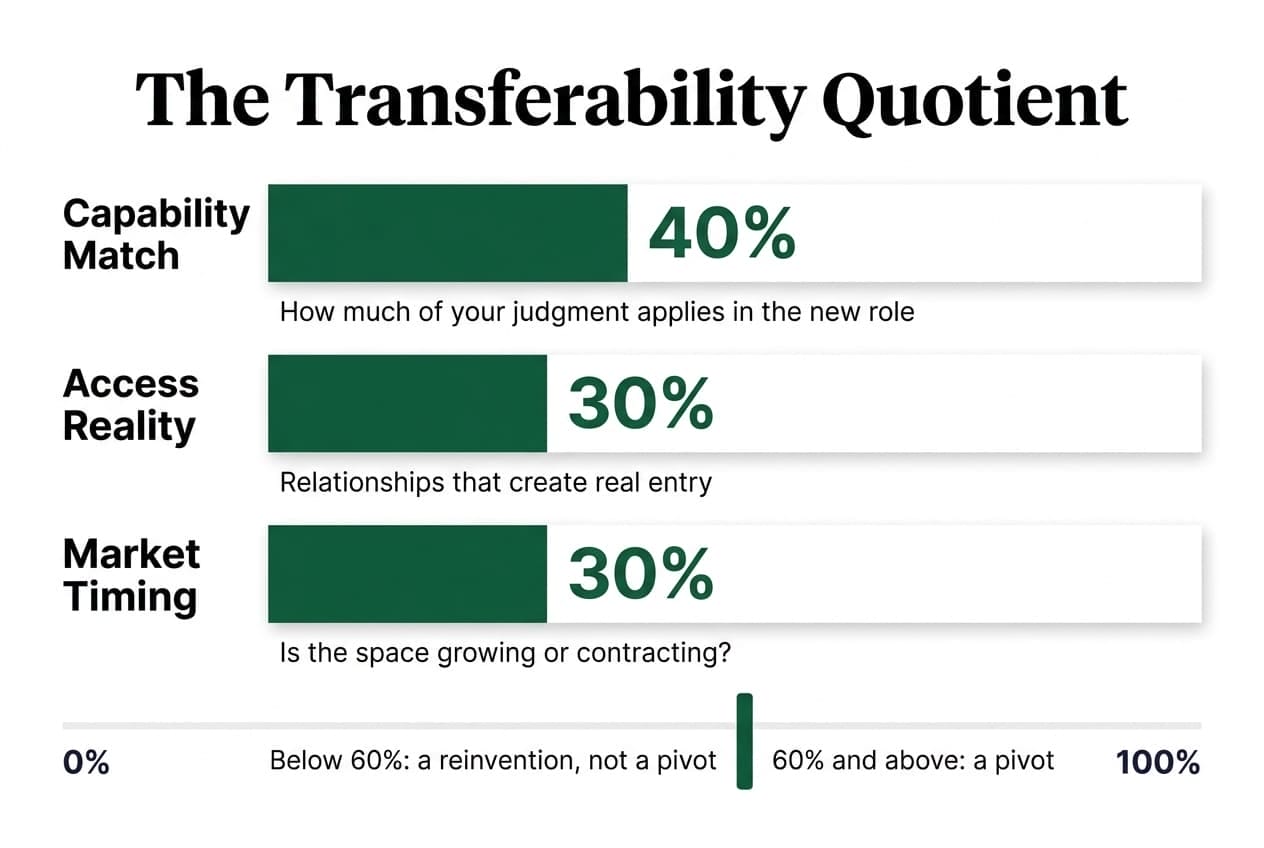
Score your top options using the Transferability Quotient across three dimensions: Capability Match at 40%, Access Reality at 30%, and Market Timing at 30%. Options scoring below 60% are reinventions, not pivots. Then identify five relationship-based access points for your highest-scoring option, because executive moves usually travel through relationships before they reach a job posting.
Executives who set out to make a career change tend to make one of two mistakes. They either aim so far from their current role that nothing transfers (the VP of Finance who decides they've always wanted to open a vineyard), or they move so close they haven't actually pivoted at all, just escaped from one vulnerable position to another. The adjacent move sweet spot exists. Finding it requires honesty about what actually transfers from your 20 years of experience, not just what you wish transferred. The assessment tools executive coaches use provide the behavioral data that separates a genuine sweet spot from wishful thinking.
The Pivot path within the four executive career paths framework represents a specific choice: same expertise, different application. You're not abandoning what you've built. You're deploying it in a new context where that expertise compounds rather than depreciates.
Key Takeaways
- A pivot deploys 20 years of accumulated judgment in adjacent terrain, where it compounds. Judgment patterns transfer almost completely; task-specific technical skills transfer poorly.
- The Passion Pivot feels like freedom but functions like reinvention: authentic desire and transferability are not the same thing.
- Access reality is the dimension most executives skip: the best pivot option on paper is worthless without relationships that create genuine entry.
- Moving from expert to leader is the move the score most often flatters. Rate Capability Match on judgment rather than domain mastery, and expect to earn authority through credibility before the title delivers it.
- Changing function and industry at the same time cuts the odds of a successful executive career transition sharply. Strategic pivots build on at least one dimension of existing experience.
Why "Pivot" Doesn't Mean "Start Over"
The word "pivot" gets misused. Generic career advice treats it as synonymous with "job search for a different kind of job" - heavy on LinkedIn tactics, resume rewrites, and interview coaching. That's tactical noise, not strategic positioning.
A genuine executive pivot is something different: leveraging accumulated value in an adjacent context where your judgment, relationships, and domain expertise actually apply. The 20-year CFO isn't "becoming something else." They're applying financial judgment in a new context - perhaps as COO where operational decisions require the financial lens they've spent two decades developing, or as an advisory board member where their pattern recognition compounds across multiple companies. Coaches guiding clients through exactly this kind of pivot can get formal career transition coach training through Tandem's practitioner series.
You're not starting over. You're compounding.
This distinction matters because it changes how you evaluate options. The relevant question isn't "What job can I get?" It's "Where does my accumulated judgment create the most value?" Those are very different filters.
The RUNWAY READY™ Calculator measures your three-dimensional readiness: financial runway (in months), psychological readiness (scored), and network strength (scored). Know what you can actually do – not just what you want to do.
The Adjacent Advantage: What Actually Transfers
Not everything transfers equally. After assessing hundreds of executives through career transition coaching, three categories emerge:
Judgment patterns - how you make decisions under uncertainty - transfer almost completely. The CFO who can identify when a business case is optimistic versus delusional brings that same calibration to any role requiring resource allocation decisions. The CMO who senses when a market position is eroding brings that pattern recognition to any growth-focused role. Your judgment is industry-portable because it's built on thousands of decisions, not memorized procedures. The way career pivots reveal your problem-framing habits is what separates a strategic move from a lateral escape.
Relationship capital - who trusts you and why - transfers substantially, though with constraints. Your reputation for delivering, for being direct, for navigating difficult board conversations - these travel with you. The specific relationships may not all be relevant in a new context, but the skill of building trust at executive level absolutely transfers. This is why assessing your career assets that transfer matters before evaluating pivot options.
Domain expertise - what you understand that others don't - transfers partially. You understand how technology companies actually work. You understand what makes healthcare regulation different from financial services regulation. You understand why manufacturing executives think differently than software executives. Some of this transfers to adjacent industries; little transfers to distant ones.
The higher your executive level, the more that transfers. Your judgment patterns, relationship capital, and domain expertise don't expire when you change your title.
What doesn't transfer well: task-specific technical skills (the specific ERP system you know), industry-specific processes (the particular regulatory filing sequences), and execution methodologies tied to your current context. The good news for executives: at your level, judgment matters far more than task execution.
The Career Assets Inventory sorts your skills into three buckets: what transfers directly, what needs adaptation, and what becomes obsolete. Essential before choosing your path forward.
The Transferability Quotient: Mapping Your Options
Most executives considering a pivot have multiple options swirling simultaneously. The problem isn't lack of possibilities - it's lack of criteria for choosing between them. The Transferability Quotient provides that structure.
Stuck Between 2–3 “Good” Pivot Options?
Use a coach to sanity-check your Transferability Quotient scores—especially access reality—so you don’t waste months on low-probability moves.
Rate each potential pivot on three dimensions:
Capability Match (40% weight): How much of your judgment and expertise applies in this new context? Score honestly. A CMO moving to Chief Customer Officer has high capability match - customer insight, brand strategy, and cross-functional influence all transfer directly. A CMO moving to startup founder has lower match than it appears - marketing strategy transfers, but the operational, financial, and fundraising demands may not.
Access Reality (30% weight): Do you have relationships that create genuine entry into this space? An executive move usually travels through relationships before it reaches a job posting. Mark Granovetter's study of professional, technical and managerial job changers found that personal contacts were the most common route into a new job, and a 2022 LinkedIn field experiment published in Science found that moderately weak ties, people you know but not well, did the most for job mobility. The best pivot in theory is worthless if you have no pathway into the rooms where those decisions happen. Networking here means building those relationships before you need them. Assess your network for pivoting before committing to a direction.
Market Timing (30% weight): Is this adjacent space growing or contracting? Pivoting into a shrinking field compounds your problem rather than solving it. The AI disruption reshaping your current role is likely reshaping adjacent roles too - in some cases creating opportunity, in others accelerating decline.
Consider a VP of Marketing at a mid-size tech company evaluating two options. Option A: Chief Customer Officer at a larger enterprise. Capability match is high (customer insight, brand influence, stakeholder management all transfer), access reality is moderate (she knows several CCOs through industry events), and market timing is positive (CCO roles are expanding as companies prioritize retention). Total score: strong.
Option B: Starting an AI marketing consultancy. Capability match seems high but is actually moderate (she knows marketing strategy, not consulting sales or service delivery), access reality is uncertain (knowing marketers doesn't mean they'll hire her firm), and market timing is crowded (everyone with marketing experience is entering this space). Total score: weaker than expected.
The Transferability Quotient doesn't tell you what to do. It helps you compare options with the same framework instead of gut feeling.
When the Pivot Is From Expert to Leader
One move trips up the scoring more than any other: going from technical or functional expert to broader leader, such as the CTO who becomes Chief Product Officer. IEEE Spectrum calls the move from technical expert to a leadership role "one of the most challenging phases in a STEM career," and asks the question this framework exists to answer: "How do I evaluate career transitions without discarding hard-won experience?"
Capability Match tends to score too high here because the domain hasn't changed. But an expert's value has been individual output, and task-specific skill is the bucket that transfers worst. Michael Watkins describes the move into enterprise leadership as a set of shifts, including specialist to generalist and bricklayer to architect. Score this dimension on judgment and on integrating across functions, not on command of the domain.
When the move is from expert to leader, a high Capability Match score can be the warning sign.
Access Reality changes shape too. Linda Hill's research on first-time managers found that authority does not come with the title; it comes from credibility with the people around you. IEEE asks the same thing: "How can I exercise leadership through credibility and collaboration, regardless of formal authority?" Early credibility comes from plain work: learn the business fast, secure a few early wins, and build alliances, the core of Watkins' The First 90 Days.
In our coaching work, the pattern that burns credibility fastest shows up under stress: the new leader falls back to familiar turf with some version of "I can do it better, faster than you." That disempowers a team that is often faster by now. The work is to recognize "that's me in that role" and catch it early, the move from maker to multiplier.
So this is an identity shift as much as a role change. I made a version of it myself, from software developer to coach. Herminia Ibarra's advice holds here: act your way into the new identity instead of waiting to feel ready. Your expertise stays, and the new role builds on it. Go deeper with when technical credibility stops being enough and the shift from execution excellence to influence.
Three Pivot Patterns That Work
Certain pivot patterns consistently produce results for executives:
Function-to-Function Adjacent: The CFO who becomes COO. The CMO who becomes Chief Customer Officer. The CTO who becomes Chief Product Officer. These work because leadership fundamentals transfer while functional expertise provides distinctive value. In our coaching work, leaders who bring deep functional expertise to adjacent roles often outperform generalists because they see angles others miss. The key: the receiving function must genuinely value what you bring, not just tolerate it.
Industry-to-Industry with Function Hold: The tech CFO who becomes a healthcare CFO. The manufacturing CTO who becomes a logistics CTO. Same function, different industry. Your financial judgment or technical leadership transfers; you learn the industry specifics. This works when the receiving industry values outside perspective and when your current industry's sophistication is valued by the target. Tech-to-healthcare often works well. Tech-to-government often doesn't - different value systems create friction. Hiring is starting to reward this kind of move. In an October 2026 Newsweek opinion piece, executive recruiter Marek Navratil describes a hotel chain that set out to hire a chief sales officer with hospitality credentials, refocused the search on transferable capability, and appointed a leader from IT sales. In his words, "A career history can tell us where someone has been. It does not necessarily tell us what they are capable of doing next."
Corporate-to-Advisory: The operating executive who moves to board seats and advisory roles. This works when you've built sufficient relationship capital and reputation that companies want your judgment without a full-time commitment. It's often the entry point to a portfolio career rather than a singular pivot.
Two Pivot Patterns That Rarely Work
Two patterns consistently underperform despite their psychological appeal:
The Passion Pivot: "I've always wanted to run a nonprofit." "I've always been interested in hospitality." "I've always dreamed of teaching." The appeal is obvious - finally pursuing what you've wanted instead of what you've been doing. The problem: passion doesn't create transferability. Your 20 years in finance doesn't transfer to nonprofit leadership nearly as much as you imagine (the skills are more different than they appear, and the credibility doesn't follow you). These pivots can work, but they function more like reinventions than pivots - requiring the longer runways and identity renegotiation of the complete career reinvention path.
The Status Lateral: Moving to essentially the same role at a different company because you need to escape your current situation. This isn't a pivot - it's a geographic relocation of the same vulnerability. If your CFO role is being disrupted by AI-driven automation of financial analysis, becoming CFO somewhere else doesn't solve that problem. You've reset your political capital and relationship network while importing the same structural exposure.
The adjacent move sweet spot exists - but finding it requires honesty about what actually transfers from your 20 years, not just what you wish transferred.
The Aspirational Trap: When Dreams Become Detours
Some pivots feel more like escape than strategy.
After years of building expertise that someone else defined as valuable, the executive pivot can become tangled with questions that have waited too long for answers. What did I actually want? What would I be doing if money weren't the constraint? What life did I imagine before I became this?
These are real questions. They deserve space. And pursuing them recklessly during a career transition can consume runway you don't have on paths that don't work.
The Aspirational Trap catches executives who confuse "I've always wanted to" with "This is the right move now." The vineyard. The boutique hotel. The startup that finally lets you be the visionary instead of the operator. These aren't wrong desires - they're often authentic ones, suppressed by decades of practical necessity.
But authenticity isn't the same as transferability. The career pivot is not the moment to test every road not taken. It's the moment to deploy what you've built where it creates the most value.
Choosing the high-transferability pivot over the aspirational fantasy is how your experience compounds.
The aspiration may still have its day. With a successful pivot establishing new income and new runway, the longer-term dream becomes possible later - pursued from stability rather than desperation. Call it sequence: the pivot comes first, and the dream follows.
Building Your Adjacent Move Strategy
Three concrete actions if you've identified the Pivot path as your direction:
Score your top three options using the Transferability Quotient. Be honest about access reality in particular - wishful thinking about relationships that "could" open doors wastes months. If you score below 60% on any option, it's probably not a pivot; it's a reinvention wearing pivot's clothing.
Identify five relationship-based access points for your highest-scoring option. Not job postings - people. Former colleagues now in the target space. Board members with visibility into relevant companies. Recruiters who specialize in this function or industry. The hidden job market for executives runs on relationships, not applications.
Research market timing signals for your target adjacency. Is this space growing or consolidating? Are AI tools creating or eliminating roles? What do people currently in this space say about its trajectory? Market timing is the easiest dimension to research and the one most executives skip.
The pivot path works when you're honest about what transfers and disciplined about pursuing high-probability options. Not every move that feels like forward motion actually is.
What Comes Next
If this framework reveals that your current situation requires more radical change than adjacency allows, the Reinvent path addresses complete career transformation. If it suggests that diversification across multiple income streams makes more sense than a single move, explore the Portfolio path.
For most executives who've chosen Pivot, the next step is systematic execution. The 90-Day Strategic Plan Template provides the structure - week-by-week actions that translate pivot strategy into actual movement.
If you haven't yet determined whether Pivot is your path, the TRANSITION BRIDGE™ criteria provides the decision framework for choosing between Transform, Pivot, Reinvent, and Portfolio based on where you actually stand, not where you wish you were.
The adjacent move doesn't require reinventing yourself. It requires seeing clearly what you've built and deploying it where it compounds.
If you want a thinking partner for an executive career change, here is how executive coaching works through a career transition.
The 90-Day Strategic Plan Template converts your TRANSITION BRIDGE™ results into week-by-week action. Path-specific activities for Transform, Pivot, Reinvent, or Portfolio. Includes milestones and "when to seek help" indicators.
Frequently Asked Questions
How long does an executive career pivot typically take?
Most executive pivots take 6-12 months from committed search to accepted offer. Higher-complexity pivots – particularly those crossing industries – can extend to 12-18 months. The timeline compresses significantly when you have strong network access to your target space and lengthens when you’re building relationships from scratch.
Should I pivot to a new industry or a new function, but not both simultaneously?
Generally, yes. Changing both function and industry simultaneously has lower success rates because you’re not leveraging either dimension of your experience. The exception: when your unique value proposition explicitly spans both (for example, a tech CMO with deep healthcare relationships pivoting to a health tech COO role).
How do I know if my "dream pivot" is realistic or aspirational fantasy?
Score it honestly on the Transferability Quotient. If Capability Match scores below 50%, it’s likely more reinvention than pivot. If Access Reality scores below 40%, you’ll need to build substantial new relationships before the pivot becomes viable – which changes your timeline significantly.
What if my experience genuinely IS unique with nothing adjacent?
Your tasks may be unique, but your judgment patterns are portable. Executives with highly specialized backgrounds often find that their strategic thinking, stakeholder management, and decision-making under uncertainty transfer even when their technical specialty doesn’t. Look at advisory roles or board positions where specialized expertise is specifically valued.
How do I evaluate whether an adjacent space is growing or declining?
Look at hiring volume, funding trends, and what practitioners say. LinkedIn job posting trends (not for you to apply to, but as market signals), venture funding in the space, and conversations with people currently in the role give you directional data. If people are exiting the space at your target level, that’s a meaningful signal.
What's the difference between a strategic pivot and just taking whatever's available?
Intent and selection criteria. A strategic pivot applies the Transferability Quotient to filter opportunities toward high-probability options. Taking whatever’s available accepts the first reasonable offer regardless of fit. The latter often results in another transition within 18-24 months.
Should I tell my current employer I'm considering a pivot?
Generally, no. Executive departures are politically complex, and announcing intentions before you have alternatives creates vulnerability. The exception: if your employer might create an internal adjacent role that serves both your interests and theirs. Some organizations prefer to keep talented leaders in new capacities rather than lose them entirely.
The TRANSITION BRIDGE™ Assessment evaluates five criteria across 15 questions to recommend your optimal career path. Takes 10-12 minutes. Get a ranked recommendation with confidence scores.
Pressure-Test Your Pivot Before You Burn Runway
Bring your top options and we’ll score capability match, access reality, and market timing to find the highest-transferability adjacent move.
Book a Free Consultation →