

Executive Coaching Tools: The Assessments and Frameworks That Drive Results
What tools do executive coaches use?
Executive coaches use four core assessments: ProfileXT for behavioral tendencies, Genos EQ for emotional intelligence, LEAD NOW! for leadership effectiveness, and 360-degree feedback for multi-rater perception. Results are synthesized into a development plan through a structured framework, so coaching targets measurable behavioral change rather than vague goals. The tooling keeps moving, which is one of the current trends in executive coaching worth tracking before you buy.
Key Takeaways
- Assessment-driven coaching uses objective data from tools like ProfileXT, Genos EQ, LEAD NOW!, and 360-degree feedback to identify development priorities before coaching conversations begin.
- The ASPIRE framework (Assess, Strategize, Plan, Inspire, Reflect, Evolve) structures the entire engagement, from initial assessment through sustained behavior change.
- Synthesizing multiple assessment data streams reveals patterns that no single tool can surface, giving coaching plans measurable targets tied to baseline scores.
- When evaluating coaching firms, ask whether they can name every tool they use, explain how results translate into a plan, and demonstrate MCC-level credentials.
Why Tools Matter in Executive Coaching
Every coaching firm claims to be evidence-based. Few can name the evidence. Ask a coach what tools they use and the answer is often “it depends on the client,” which sounds flexible but usually means there is no structured assessment methodology behind the engagement.
Stop Spending 3 Sessions “Figuring It Out”
Start with objective data, then focus coaching on the gaps you’re ready to close, with progress tracked against a baseline.
Assessment-driven coaching starts with objective measurement before the first coaching conversation happens. These assessments sit within a broader set of leadership development tools that organizations use to build capability at scale. By the time the conversation begins, the coach already has data on behavioral tendencies, emotional intelligence, leadership dimensions, and multi-rater perceptions. The work becomes about which gaps the leader is ready to close, not about spending the first three sessions discovering what those gaps are.
The difference shows up in business outcomes. When coaching begins with data, the engagement has direction from session one: the development plan targets specific behavioral shifts tied to assessment scores, and progress is measurable against a baseline. When coaching begins without data, goals tend to be vague, like “improve communication,” and progress is self-reported.
That gap matters because executives are skilled compensators. They have built careers by working around their weaknesses, and a vague goal lets the compensation continue. Structured assessment surfaces what that compensation looks like, so coaching can address root patterns instead of surface symptoms. It is also why what leadership development actually is depends on rigorous measurement at the start. Development is sustained behavioral change, not training, and change needs a baseline to aim from.
At Tandem, we name the tools: ProfileXT, Genos Emotional Intelligence, LEAD NOW!, and 360-degree feedback. Each measures something different. Together, they form the data foundation for every executive coaching process we run. The sections below explain what each tool measures and what it reveals.
The Four Best Assessments in Leadership Coaching and Why
The assessments below are the tools we administer in most executive coaching engagements. Each one answers a different question about the leader. None is sufficient alone. The value comes from reading them together.
| Tool | What It Measures | Format | What It Reveals |
|---|---|---|---|
| ProfileXT | Behavioral tendencies across 20 dimensions, cognitive ability, occupational interests | Online assessment, ~60 min | Job-fit alignment, thinking style, interpersonal orientation |
| Genos EQ | Emotional intelligence across 6 workplace competencies. See executive coaching for emotional intelligence in tech leaders for how EQ coaching plays out in practice | Self + rater assessment, ~20 min | Gaps between intended emotional impact and actual impact on others |
| LEAD NOW! | Leadership effectiveness across 21 dimensions (task vs. relationship balance) | Self-assessment + manager/peer input | Where the leader over-indexes on task execution at the expense of people leadership, or vice versa |
| 360-Degree Feedback | Multi-rater perception data from direct reports, peers, and supervisors. See leadership feedback for how to make this actionable | Confidential survey, 15–25 raters | The gap between how the leader sees themselves and how others experience them |
ProfileXT: The Behavioral Baseline
ProfileXT maps behavioral tendencies, cognitive processing style, and occupational interests across 20 dimensions. It is published by Wiley and used in both coaching and talent selection contexts. In coaching, we use it as the behavioral baseline for the engagement. The assessment takes approximately 60 minutes, is completed online, and produces a detailed report that the coach uses to structure the first several sessions. How well that data lands in the room depends on the coach’s listening and presence.
In roughly a third of ProfileXT assessments with technology executives, there is a gap between analytical dominance and interpersonal attunement that the leader has never named. They score high on problem-solving and structured thinking. They score lower on social orientation and persuasion. They have built careers by compensating: delegating people-facing work, relying on technical credibility instead of relational influence. ProfileXT makes this pattern visible and gives the coaching engagement a concrete starting point rather than an open-ended conversation about “areas for growth.”
The data tells us where the gaps are. The coaching conversation tells us which gaps the leader is ready to close.
Genos Emotional Intelligence
The Genos EQ assessment measures emotional intelligence across six workplace competencies: self-awareness, awareness of others, authenticity, emotional reasoning, self-management, and positive influence. Unlike personality assessments, Genos specifically targets how emotions show up in professional behavior.
What surprises most executives is the gap between self-perception and the data on emotional expression. Many leaders believe they manage emotions well because they suppress visible reactions. Genos measures whether that suppression actually works for the people around them. The leader thinks they are calm under pressure. Their team experiences them as disengaged or dismissive.
LEAD NOW!
LEAD NOW! is a 21-dimension leadership model developed by Stewart Leadership. It maps leadership skills across four quadrants: creating the business future, delivering business results, developing people, and leading people. The tool identifies where a leader over-indexes on task execution at the expense of relationship leadership, or the reverse.
For executives moving into broader roles, LEAD NOW! surfaces skill gaps that technical competence has been masking. A VP of Engineering who has succeeded through delivery excellence may score low on talent development and organizational influence, which are exactly the competencies their next role demands. The quadrant structure makes this visible at a glance: a leader who dominates the task quadrants but has gaps in the people quadrants has a predictable set of challenges that coaching can address systematically rather than reactively.
360-Degree Feedback
360-degree feedback collects perception data from direct reports, peers, and supervisors. It is the most powerful tool for surfacing blind spots because it compares the leader’s self-ratings against how others actually experience their behavior. The Center for Creative Leadership has published extensive research on how multi-rater feedback accelerates leadership development when paired with coaching.
We use the 360 when the presenting challenge involves how others experience the leader. If the issue is job fit or career direction, ProfileXT is the better starting point. If the issue is emotional regulation under pressure, Genos EQ surfaces it more precisely. The 360 quantifies perception gaps that no self-assessment can reach.
A common pattern: a VP whose 360-degree feedback shows a 30-point gap between self-perception and team perception on communication effectiveness. The leader believes they are clear and decisive. Their direct reports experience them as opaque and unavailable. That gap is invisible without multi-rater data, and it is costing the leader credibility every week it persists.
How Assessment Results Shape the Coaching Plan
Four assessment data streams produce a substantial amount of information about a leader. The synthesis process is not additive. It is triangulating: the coach looks for patterns that appear across two or more instruments.
If ProfileXT shows low social orientation, Genos EQ shows low emotional expression, and the 360-degree feedback shows a communication gap, that convergence tells us this is a real development priority, not an artifact of one assessment. We typically narrow to three or four priority areas where multiple data points converge.
The leader then chooses which priorities to work on first. The data tells the coach where the gaps are. The coaching conversation tells us which gaps the leader is ready to close. This distinction matters: a consultant would prescribe the priority order based on business impact alone. A coach recognizes that sustainable behavior change happens where the leader has both motivation and capacity to act. Forcing a leader to work on a skill they do not recognize as a gap produces compliance, not growth.
The assessment results feed directly into the development plan. Each priority area gets specific, measurable goals tied to the assessment baseline. If the Genos EQ data shows low emotional expression, the goal is not “improve communication” but “increase emotional expression scores from the 35th to the 55th percentile within six months, as measured by rater feedback.” That specificity changes how the coaching sessions are structured and how success is defined.
Progress is tracked against the baseline data throughout the engagement. In high-performance coaching engagements, we revisit abbreviated versions of the original assessments at the midpoint to measure change against the initial scores. This is how coaching produces results: not through conversation alone, but through a feedback loop between data, practice, and measurement. For leaders building their own roadmap, the assessment data also provides a foundation for leadership development planning that goes beyond generic skill lists.
The ASPIRE Framework
ASPIRE is Tandem Coaching’s proprietary engagement framework. It structures the coaching process from initial assessment through sustained behavior change. Each phase builds on the one before it.
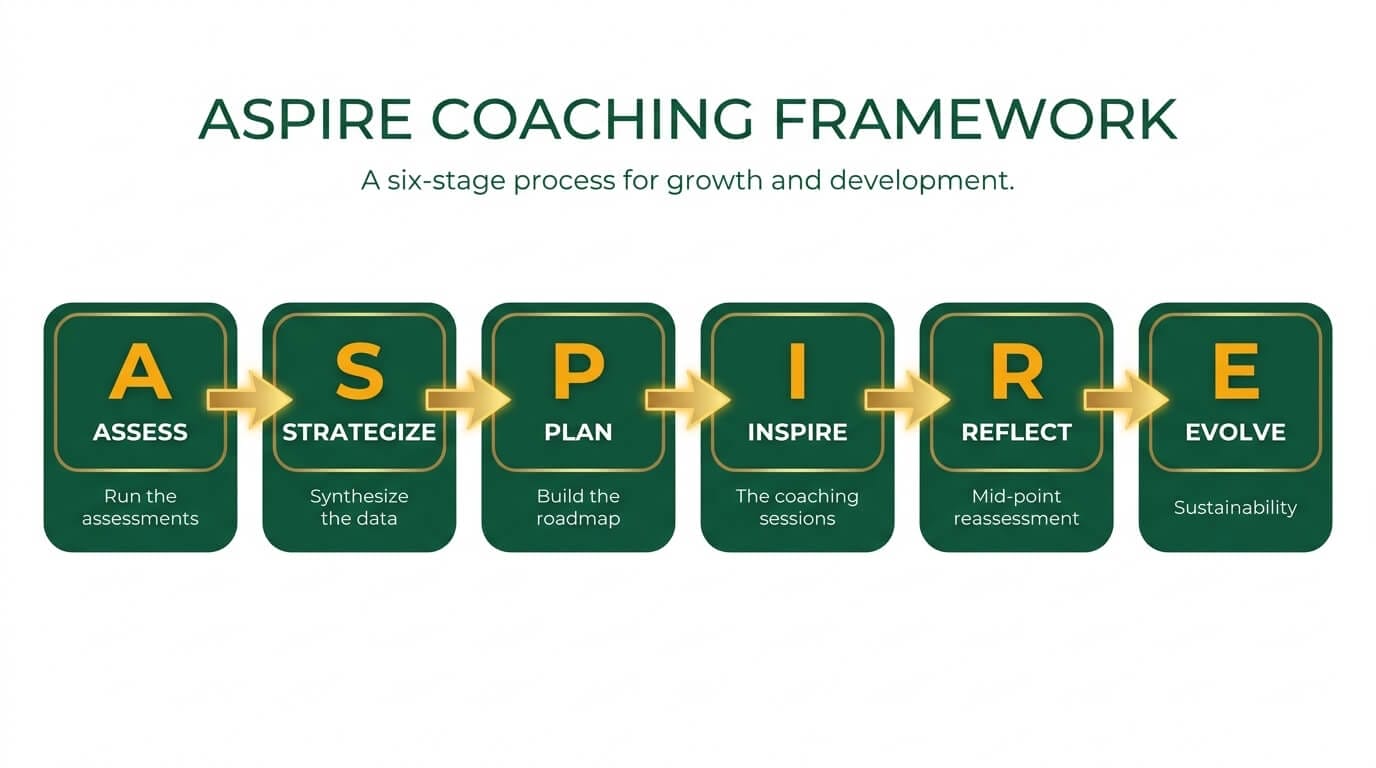
Assess: Administer ProfileXT, Genos EQ, LEAD NOW!, and 360-degree feedback. Gather organizational context from the executive’s manager or HR partner. This phase typically spans sessions 1-2.
Strategize: Synthesize assessment results across all four instruments. Identify the three or four priority development areas where multiple data points converge. Align priorities with organizational expectations and the leader’s own growth goals.
Plan: Build the development roadmap. Each priority area gets specific milestones, target behaviors, and measurement criteria drawn from the assessment baseline. Establish session cadence and accountability structures.
Inspire: The coaching conversations happen here. The coach works through each priority area with the leader, building new behavioral patterns session by session. This is the longest phase, typically spanning 4-8 months of regular sessions.
Reflect: Mid-engagement reassessment. Abbreviated versions of the original tools measure progress against baseline scores. The coach and leader review what has shifted and what remains. Course corrections happen here.
Evolve: Sustainability planning. The goal is not permanent coaching dependency. It is building the leader’s own capacity to recognize patterns, adjust behavior, and continue growth after the formal engagement ends. This phase connects assessment insights to setting leadership development goals that extend beyond the coaching relationship.
Most coaching engagements fail not because the coaching is bad, but because they skip the assessment or skip the sustainability planning. ASPIRE prevents both by making each phase explicit and sequenced. The framework also gives the leader’s organization visibility into the process: HR partners and managers can see where the engagement stands without needing to access confidential coaching content.
Most coaching firms say “evidence-based.” We name the evidence: ProfileXT, Genos EQ, LEAD NOW!, and 360-degree feedback.
Session-Level Coaching Models and Techniques
ASPIRE structures the engagement arc. Individual coaching sessions use their own frameworks to keep conversations productive and action-oriented.
The GROW model (Goal, Reality, Options, Will) is the most widely used session framework in executive coaching. It moves each conversation from abstract concern to concrete commitment. The coach helps the leader define what they want to accomplish in the session, assess where they stand today, explore options for closing the gap, and commit to specific action before the session ends.
SMART goals (Specific, Measurable, Achievable, Relevant, Time-bound) structure the development objectives that emerge from assessment data. Each priority area from the ASPIRE synthesis phase gets translated into SMART goals that the leader and coach track across sessions.
Beyond GROW and SMART, experienced coaches reach for other session frameworks when the conversation calls for it. OSKAR (Outcome, Scaling, Know-how, Affirm, Review) keeps a solution-focused session anchored to what is already working. CLEAR (Contract, Listen, Explore, Action, Review) front-loads the contracting step, which matters when a leader arrives with a tangled problem and no clear question. Underneath every one of these models sits the same technique layer: powerful questions that open new thinking, listening that catches what the leader is not saying, and accountability structures that carry a commitment from the session into the week. The framework organizes the conversation. The techniques are what make it land.
These session-level tools are well known and deliberately simple. Their value in executive coaching is not novelty but discipline: they ensure every session produces a concrete commitment, and every development goal has measurable criteria. The same principle runs through the executive coaching models that structure individual conversations: consistency of practice, not sophistication of method.
The interaction between engagement-level assessments and session-level models is where coaching gains traction. Assessment data identifies the priority areas. ASPIRE structures the multi-month arc. GROW structures the individual session. SMART translates assessment insights into trackable goals. Without the assessments, GROW and SMART are generic productivity tools. With the assessments, they become instruments for targeted leadership development, particularly when the focus is developing executive presence, where assessment data reveals whether the gap is expression, authority, or organizational context. Structured executive presence coaching then works on the specific behavioral shifts the data identifies, rather than telling the leader to “be more present.”
Executive Coaching Software and Platforms
Search “executive coaching software” and two very different products come back. Conflating them is the most common mistake leaders make when they price a coaching investment.
The first is practice-management software—scheduling, session notes, goal tracking, billing. CoachAccountable, Simply.Coach, and Delenta run the administrative side of a practice and give the leader a place to log commitments between sessions. Useful, and they measure nothing about the leader.
The second is enterprise coaching platforms—CoachHub, BetterUp, and Sounding Board. These marketplaces match coaches to employees at scale and bundle scheduling, progress dashboards, and light assessment into one subscription. For an organization rolling coaching out to a hundred managers, the platform solves an access-and-reporting problem that spreadsheets cannot, which is where most “manager coaching tools” and enterprise coaching resources actually live.
What none of this software does is the part that produces change. A platform can host a 360-degree survey; it cannot read the 30-point gap between how a leader sees themselves and how their team experiences them. It can schedule a Genos EQ debrief; it cannot sit with an executive who has just learned, in data, that the composure they are proud of reads to their team as disengagement. The assessment instruments and the coach’s interpretation move the needle. The software is the container they ship in.
So when a vendor sells you “coaching software,” ask two questions: which validated assessments run inside it, and who interprets the results. A platform that is all dashboard and no instrument is administration, not development. The assessments earlier on this page are what to look for underneath the interface.
What to Look for in a Coach’s Toolkit: Feedback Tools, Metrics, Coaching Resources
When evaluating coaching firms, ask three questions about their toolkit and methodology. Each one separates a structured assessment practice from a conversation dressed up as coaching.
First: can the coach name every assessment tool they will use and explain what each measures? If the answer is “it depends” or “we customize our approach,” that typically means there is no structured assessment methodology. A coach who uses real tools can tell you “we administer ProfileXT for behavioral tendencies and Genos EQ for emotional intelligence” before you sign a contract. A solid coaching agreement makes that transparency formal, defining scope, measures, and confidentiality before any session begins.
Second: does the coach explain how assessment results translate into a development plan, or do they go straight from intake conversation to coaching sessions? The gap between assessment and action is where most engagements lose rigor. A structured framework like ASPIRE makes this translation explicit.
Third: what credential level does the coach hold? ICF MCC certification requires demonstrating mastery across 2,500+ hours of coached practice. The credential tells you the coach has been evaluated by peers on their actual coaching skill, not just their training hours.
At Tandem, both founding coaches hold the MCC credential, the standard worth looking for when you are deciding how to find an executive coach. They do not just administer assessments and hand over a report. They interpret results across instruments, synthesize patterns that a single tool cannot surface, and build coaching plans grounded in data rather than intuition. The assessment toolkit and the credential together distinguish rigorous methodology from conversation dressed up as coaching.
If you want to see how assessment-driven coaching works in practice, explore executive coaching services at Tandem or learn about the coaching certification that teaches these tools. For leaders applying these assessment insights to their day-to-day operating model, the guide to executive productivity systems for senior leaders shows how to translate behavioral data into structural change.
Frequently Asked Questions
What tools do executive coaches use?
Executive coaches use four core assessments: ProfileXT for behavioral tendencies, Genos EQ for emotional intelligence, LEAD NOW! for leadership effectiveness, and 360-degree feedback for multi-rater perception. Results are synthesized into a development plan through a structured framework, so coaching targets measurable behavioral change rather than vague goals.
What is the difference between executive coaching tools and coaching models?
Tools and models do different jobs. Tools are the assessments that measure something objective: ProfileXT, Genos EQ, LEAD NOW!, and 360-degree feedback each produce data about how a leader thinks, feels, or is perceived. Models are the frameworks that structure the work, like GROW at the session level and ASPIRE across the whole engagement. The tools tell you where to aim. The models give the coaching its shape.
Is there executive coaching software or a platform?
There is scheduling, note-taking, and survey software that coaches use to run a practice, and it handles the administration well. The instruments that actually drive results are the assessments and the engagement framework, and a coach delivers and interprets those. A platform can host a 360 survey. Reading the gap between a leader’s self-perception and how their team experiences them takes a coach.
How much do executive coaching assessments cost?
Assessment cost depends on which instruments are used and how many raters are involved. A self-report personality assessment sits at the lower end; a full 360 with 15 to 25 raters costs more because of the survey administration and report generation. In most executive engagements the assessments are bundled into the overall coaching fee rather than billed line by line, so the more useful question to ask a coach is what the full engagement includes.
Can you use these assessment tools without a coach?
You can take many of these assessments on your own, and some publishers sell self-guided versions. Self-administration gives you data. The value comes after the data: knowing which results converge into a real pattern, which gaps to work on first, and how to turn a score into a sustained behavior change. That synthesis is the work a credentialed coach does, and it is where assessment data becomes development.
What is the ASPIRE framework?
ASPIRE is Tandem Coaching’s engagement framework: Assess, Strategize, Plan, Inspire, Reflect, and Evolve. It sequences a coaching engagement from the opening assessments through sustained behavior change, with a mid-point reassessment that measures progress against the baseline scores. The ASPIRE framework section above walks through what happens in each phase.
Want a Coaching Plan Built From Real Baselines?
If your goals feel like “improve communication,” we’ll map the right assessments and translate results into an ASPIRE-based plan.
Book a Free Consultation →