Self-Regard Journal
Keep an optional weekly record of specific moments you completed, enjoyed, appreciated, or handled with care.
Get This Tool
Free, print-ready PDF.
When to Use This Tool
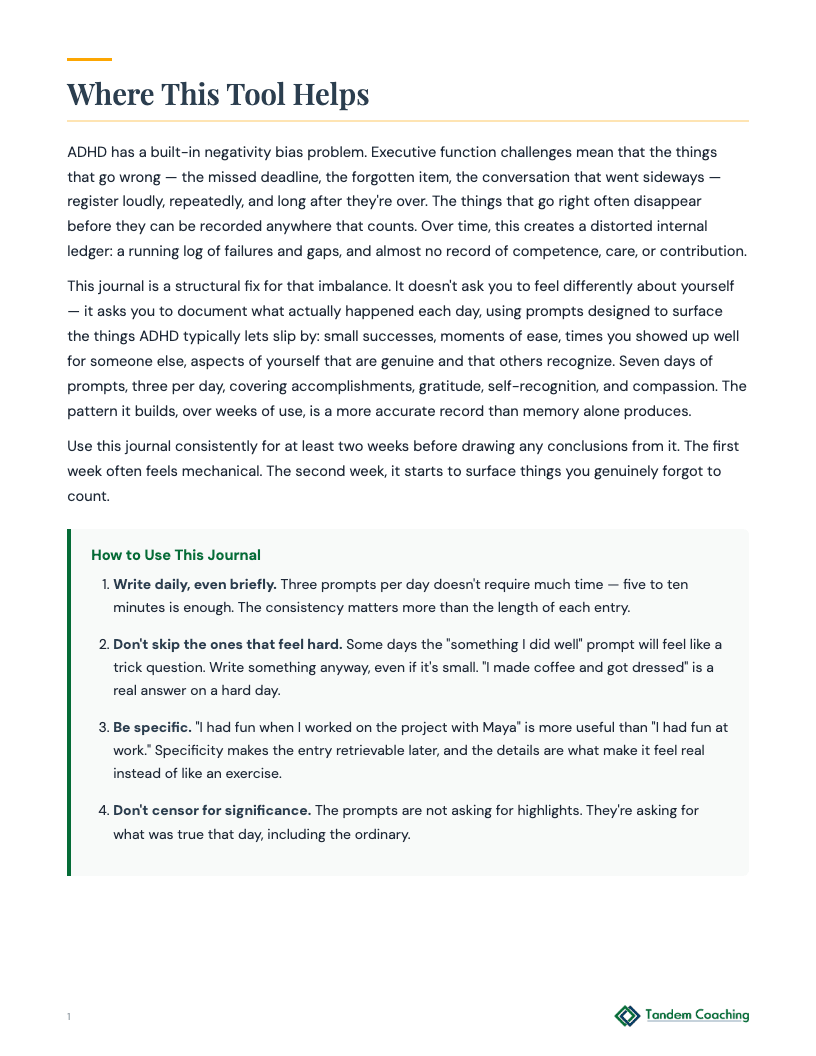
ADHD adult whose internal ledger skews heavily toward failures and gaps, with almost no record of wins
A client who needs a daily structured practice to surface accomplishments, positive moments, and self-recognition
Person who has tried journaling before but abandoned it because the prompts felt too vague
How to Introduce This Tool Plus
Which specific entry from the week feels useful to remember, and what context helped it happen?
Coaching Tool Disclaimer
This tool is designed for coaching contexts, not clinical use. If you or your client is in crisis, contact the 988 Suicide and Crisis Lifeline (call or text 988) or Crisis Text Line (text HOME to 741741).
Browse All Pages
Tool Classification
Domain
ADHD
Type
Worksheet
Phase
Reflection
Details
5 min
Between sessions
Weekly
Topics
Self-Care
Identity
Resilience
For the Coaching Practitioner
Plus
Coaching Scenarios
Plus
1 Software engineer with ADHD who received feedback about being too self-critical in code reviews ▶
Context
Mid-level developer at a tech startup who was told by their manager that they apologize excessively during code reviews and dismiss their own contributions in team retrospectives. Client believes they need to work on confidence and communication skills.
How to Introduce
Frame this as data collection, not self-improvement. 'Your manager noticed a pattern in how you talk about your work. Before we address the communication piece, let's see what your internal record-keeping looks like.' some people often have accurate technical memory but distorted self-assessment memory. This tool separates the two.
What to Watch For
Technical accomplishments will be detailed and specific. Self-recognition prompts will be vague or deflected to team contributions. Watch for entries that minimize individual contribution: 'we fixed the bug' instead of 'I identified the root cause.' Day 3-4 often shows the first genuine self-recognition entries.
Debrief
Start with the technical entries - they'll be confident here. Then ask: 'Read me your Thursday entry about what you did well.' The contrast between technical precision and personal vagueness is the conversation. Follow with: 'What would change if you talked about your code contributions the same way you write about them here?'
Flags
Coaching scope: do not diagnose, interpret symptoms, or recommend treatment. Adapt or stop for distress and use licensed health or emergency support when appropriate.
2 Marketing director who just returned from medical leave for ADHD-related burnout ▶
Context
Senior marketing professional at a mid-size company returning after three months of medical leave. Burnout was triggered by untreated ADHD and perfectionist work habits. Client wants to rebuild confidence and establish sustainable work patterns without losing edge.
How to Introduce
Position this as recalibration, not recovery tracking. 'You've been away from the daily grind for three months. Before we rebuild your work rhythm, let's establish a baseline for what actually energizes you versus what drains you.' Expect resistance to anything that feels like monitoring or self-surveillance.
What to Watch For
Early entries may focus heavily on productivity and work accomplishments, recreating the pre-burnout pattern. Look for absence of rest, play, or non-achievement entries. If 'fun' prompts consistently relate to work tasks, the burnout pattern is reasserting. Genuine recovery shows up as varied, non-productive sources of satisfaction.
Debrief
Count work-related versus non-work entries across all prompts. If more than 70% reference professional accomplishments, start there: 'I'm noticing a pattern in what you're counting as success.' Then ask: 'What would it mean if having fun wasn't connected to being productive?' This often surfaces the core burnout driver.
Flags
Coaching scope: do not diagnose, interpret symptoms, or recommend treatment. Adapt or stop for distress and use licensed health or emergency support when appropriate.
3 Operations manager whose team feedback shows they focus only on problems and gaps ▶
Context
Operations manager at a logistics company received 360 feedback indicating they're seen as overly critical and problem-focused in team meetings. Client is surprised by this feedback and believes they're just being thorough and solution-oriented.
How to Introduce
Frame as a perspective audit, not attitude adjustment. 'Your team sees you as problem-focused, but you experience yourself as solution-oriented. Let's track what your attention actually captures day to day.' The journal will reveal whether their mental recording system is balanced or skewed toward deficit-spotting.
What to Watch For
Accomplishment entries may focus on problems solved rather than things that went well. 'Fun' entries might be sparse or work-related. If gratitude prompts consistently identify what didn't go wrong rather than what went right, their attention system is deficit-calibrated. This shows up as relief-based rather than satisfaction-based entries.
Debrief
Look for the ratio of problem-solving to positive recognition across all entries. Ask: 'When you write about accomplishments, are you describing what you fixed or what you created?' Then: 'Your team experiences you as problem-focused. Based on this week's entries, what do you think they're picking up on?'
Flags
Coaching scope: do not diagnose, interpret symptoms, or recommend treatment. Adapt or stop for distress and use licensed health or emergency support when appropriate.
4 Project manager who insists they don't need self-esteem work but struggles with delegation ▶
Context
Senior project manager at a consulting firm who micromanages team deliverables and works excessive hours. Presents delegation as a time management issue, not a confidence issue. Believes they just need better systems and processes.
How to Introduce
Don't mention self-esteem. Frame as delegation reflective: 'You say you struggle to hand off work because your standards are high. Let's track what you're actually proud of when others aren't involved.' This sidesteps the resistance while gathering the same data. They'll discover the pattern themselves.
What to Watch For
Accomplishment entries will heavily feature solo work or work they personally quality-controlled. 'Proud of someone else' prompts may be perfunctory or focus on work they guided closely. If they can't identify team successes they didn't directly influence, the delegation issue isn't about systems - it's about trust in others' competence.
Debrief
Count individual versus collaborative accomplishments. Then ask: 'Looking at your entries about being proud of others - what's the pattern in terms of how much you were involved in their success?' This usually surfaces the control issue without triggering defensiveness about confidence.
Flags
Coaching scope: do not diagnose, interpret symptoms, or recommend treatment. Adapt or stop for distress and use licensed health or emergency support when appropriate.
Tool Flow
Plus
Requires
- None - standalone tool
→
Produces
- 7-day daily accomplishment and positive experience log
- written record of competence, care, and contribution moments
Pairs Well With
Wellness
Optional Wellbeing Intentions
Use this worksheet to explore self care and values and turn the client’s observations into one optional next step.
Why it pairsOnce the journal names what's working, the challenge locks those behaviors into a daily structure the client can track visibly.
ADHDFeeling Context and Support Notes
Use this framework to structure a conversation about emotions and mindset while keeping interpretation with the client.
Why it pairsWhen emotional dysregulation blocks the client from seeing wins, the zones framework gives them a reset before sitting down to write.
WellnessDaily Gratitude Reflection
A client wants to use Daily Gratitude Reflection as an optional reflection
Why it pairsShifting clients from listing wins to explaining why they matter is what the gratitude template adds to the seven-day record.
Related Articles


ADHD Coaching Certification: Which Path Actually Counts
Read article →
Group vs Individual ADHD Coaching: Which Works?
Read article →
The Formation Coaching Preparation Protocol: Six Prompts Before Every Session
Read article →
Adaptive ADHD Leadership: 7 Strategies That Work
Read article →