The Nonlinear Career Path Problem: Why Recruiter Interest Stalls Before the Offer
Why does a nonlinear career path stall at senior level?
Because a senior hire gets defended, not just assessed. A nonlinear career path widens the range of work you can do and narrows the range a search process can easily justify you for. Recruiters read breadth as risk they have to argue away, so interest arrives early and confidence never follows.
Recruiters keep calling. Nothing keeps happening.
You have spent years doing real work across functions, industries and problem domains, and on paper that range should open doors. In practice it stalls conversations at the moment they should be speeding up. Someone gets interested, sets up a call, asks good questions, then goes quiet. After the third or fourth time, the natural conclusion is that you have not found the right way to describe yourself yet, and the fix is a sharper CV or a cleaner LinkedIn headline.
That diagnosis is often incomplete.
A confusing signal and a confused person are different problems. Treating the first like the second keeps you rewriting a story that may not be what is stuck.
Key Takeaways
- Breadth raises the number of roles you could do and lowers the number a process can defend you for. Only one of those is visible to you.
- Interest and confidence are separate events. Interest costs a search firm nothing; confidence costs it credibility with the client.
- Understood, believed and entrusted are three hurdles with three different responses.
- Your record of the last several approaches beats your theory about it.
- Sometimes the route is the blockage rather than the story, and that is a thing to test.
What a Nonlinear Career Path Costs at Senior Level
A nonlinear career path, or a non-linear career path if you prefer the hyphen, is a professional journey that moves across different roles, industries or problem domains rather than a steady climb up the corporate ladder. Its advantages get argued often: a variety of experiences, transferable skills, cross-industry judgement, and a workforce that needs people who have seen more than one system work. The cost gets argued far less, and at senior level the cost decides outcomes.
Linear career paths make career progression legible. One function, one career ladder, career trajectories anyone can read at a glance. Most professional development advice still assumes that shape even when the people receiving it left it years ago.
Breadth increases the number of roles you could do. It lowers the number a conventional hiring process can easily defend you for. Those move in opposite directions, and only the first is visible from where you sit.
That bites hardest at the top. A mid-level hire gets screened against a list of requirements. A senior hire gets defended - to a board, to a chief executive, to whoever signed the budget. Defending a career trajectory that reads as one recognisable shape is straightforward. Defending one that reads as three or four plausible careers takes an argument, and arguments are where senior processes lose their nerve.
Plenty of writing on the future of work celebrates leaving the corporate ladder, and it describes accurately what a traditional career path costs you. Then it stops. The other half of the ledger, what leaving costs you, goes mostly unwritten.
Recruiter Interest Is Not Recruiter Confidence
Executive recruiters are not judging talent in the abstract. They are managing risk against a mandate they have to defend to a client paying for a specific hire. Interest is cheap for them. Confidence is not, because confidence is what they spend their own credibility on.
Diverse experiences across various roles read as uncertainty to someone who has to defend the choice, and uncertainty is the thing a shortlist exists to remove. A search firm sells defensibility. That is the product. A shortlist a client can accept without extra explanation is a good shortlist, and a candidate who needs a paragraph of context before the room understands why they are there makes the list harder to present. Someone whose record follows what changes at the top in a straight line gives the recruiter a sentence. Someone with a nonlinear career gives them a case to make.
A recruiter can be doing the job well and still pass on you. Those two facts sit together more comfortably than most people at this stage want them to.
None of that makes recruiters deficient, and none of it means executive search is the wrong route for you. Plenty of unconventional records land through an ordinary search process. It means value and legibility get measured differently, and a search process tends to reward legibility first. Knowing which one you are short on changes what you do next.
The other thing worth understanding is where conversations actually stop, because there is no single drop point. There are four, and they are told apart by how far things travelled before they ended. Sometimes nothing arrives at all despite sustained effort. Sometimes approaches arrive and die before any substantive conversation. Sometimes real conversations happen and shortlists never do. And sometimes you reach final stages repeatedly without an offer.
Those four are different problems wearing the same clothes. You will rarely be told which one you are in, because the feedback is usually not usable: they went in another direction, not quite the right fit. That is not evasion. A search firm has no reason to litigate a decision with a candidate it is not putting forward, and the polite non-answer is the default across the employment market, in every workplace culture that has ever had to decline someone. Which means the information you need is not in the last message you received. It is in the pattern across all of them.
Four Questions Decide Your Next Chapter, Not One
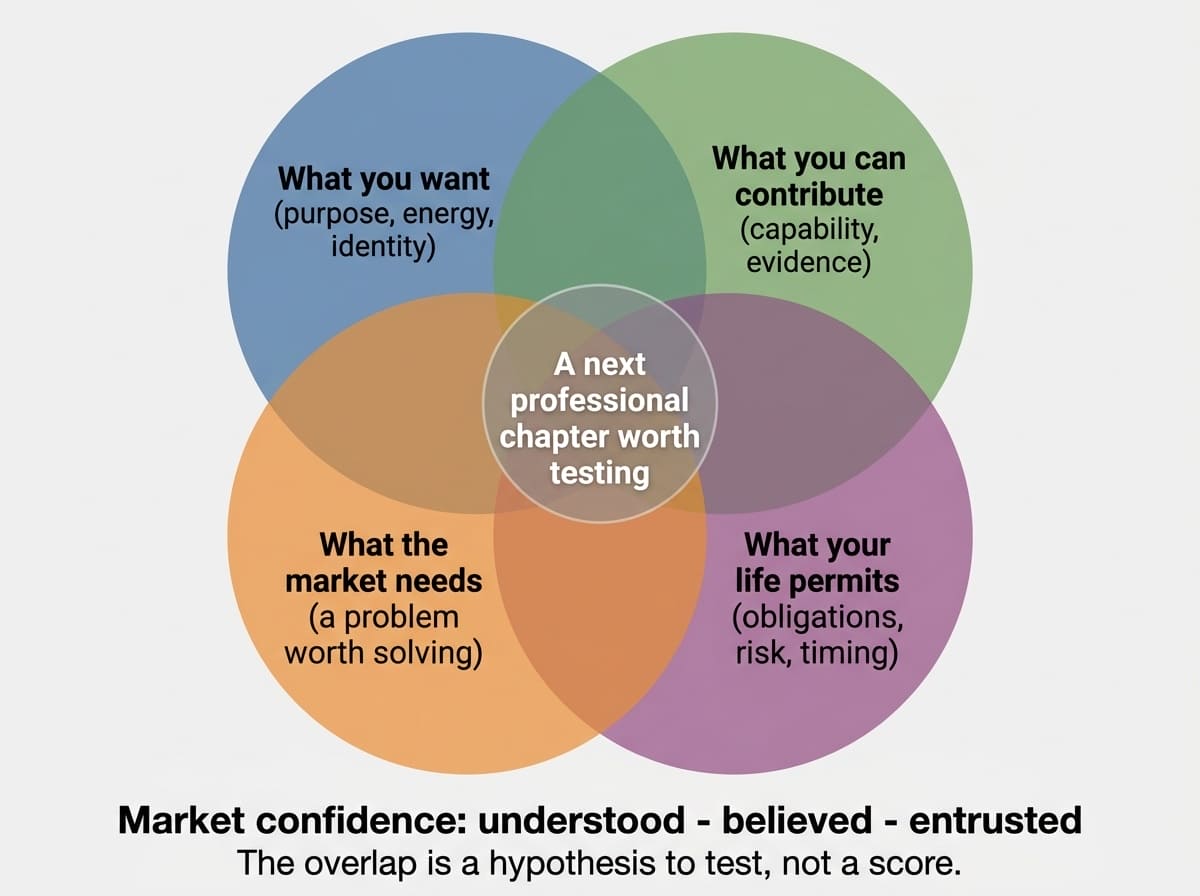
Most people at a career inflection point ask one question: what job comes next. Too narrow to answer on its own. A next chapter that holds up satisfies four things at once, and career development stalls when one is quietly unresolved.
What you want is not a job title or a list of career goals. Wanting is about the kind of problem you want to own, the environment that gives you energy, and which parts of your professional identity are worth carrying forward, and when starting over makes sense instead.
What you can contribute is bigger than a list of skill sets. Contribution is the pattern of situations that improved because you showed up, and whether a stranger could believe that without you in the room.
What the market needs is the question people skip. A capability becomes paid work only when someone with a budget and genuine urgency is trying to solve the problem it fixes.
What your life permits is not the soft part. Money, location, travel, caregiving, health and the risk you can absorb decide whether an option exists at all. The item most often left off the table is how long your runway lasts, because naming it feels like shrinking your ambition. It does the opposite. If what a direction requires you to build takes longer than the time you can finance, the direction changes. You do not simply try harder at it.
Together they do not point to a perfect job that has been hiding somewhere. They point to a next professional chapter worth testing.
Understood, Believed and Entrusted Are Three Separate Hurdles
An overlap between what you want, what you offer and what the market needs still guarantees nothing, because the people deciding have three gates to clear. They have to understand what you are proposing, believe you can do it, and trust you with what happens if you are wrong.
Those get treated as one gate constantly. You can be completely understood and still not trusted. You can be trusted inside your own company and nearly unreadable to a board that has never seen your kind of career, which is when technical credibility stops transferring.
Sort what is happening into three situations, because they call for different work. The evidence exists and is not visible. The evidence does not exist yet. Or an audience understands it completely and still will not extend the trust.
That third one happens, and it deserves care. Of the three, it is the only one that asks nothing further of you. Invisible evidence means translation work. Unbuilt evidence means facing a horizon longer than your runway. Withheld standing explains every rejection and requires nothing, which is why it is the most reached-for reading and the least often correct. One rejection does not put you there. A pattern across several serious conversations might.
Where standing genuinely is withheld, that is a fact about an audience, not a defect in you. It is closer to authority nobody granted permanently than to anything you did.
Read the Record Before You Rewrite the Story
Every approach that went nowhere over the last two years is data rather than failure, including the ones you turned down. Before writing another version of your story, take stock of your readiness for a career change and go back through the last several serious opportunities and separate what you were actually told from what you have quietly decided must be true.
For each one: what did they seem to see in you at first, what kind of role did they associate with your background, how far did it get, and what was said in words versus what you filled in afterwards. A pattern across five or six of these tells you more than any single answer, and it is the only way to tell the four stopping points apart.
The table below is a way to read that record without convicting yourself on one data point. Every row has more than one explanation, which is the point of it.
| What the repeated record shows | A question worth asking | A small next experiment |
|---|---|---|
| Nothing arrives at all, despite deliberate effort | Am I outside the consideration set entirely, or is the direction itself not one anybody is hiring for right now? | Run one bounded second route with the same materials and see whether anything moves. |
| Approaches arrive, then end before a substantive conversation | Does my record read as one recognisable thing to someone who does not know me, or as several? | Ask three people who have not worked with you to read the same materials and name the role they see. |
| Real conversations happen; shortlists do not | Is the evidence for this specific claim visible, or am I asking them to take it on trust? | Take one concrete piece of evidence directly to someone who owns the problem and watch what changes. |
| Final stages recur without an offer | Was anything substantive named, or did it end without a reason that explains it? | Ask for stage-specific feedback once, then compare against a different route to the same kind of role. |
| Offers arrive, but you cannot realistically accept them | Is this an option problem or a direction problem? Could any evidence make one of these right? | Name what would have to be true for you to say yes, and check whether that thing exists anywhere. |
If people keep approaching you for work you no longer want, the market may be reading an old version of you accurately. Your direction moved and your record did not, which is a different situation from being misread, and no rewrite fixes it.
Turn a Direction Into Two or Three Testable Mandates
The standard advice is to reframe the story or announce a pivot. The instinct behind it is to write a perfect new headline and declare a new identity. That asks language to do work only evidence can do, and it usually leaves your identity fused to a job title. Better to form two or three specific ideas, each stated as a problem you would solve for a particular kind of organization, then find out in real conversations whether anyone agrees.
State it narrowly. Not "I am a transformation leader," but something closer to "I help a mid-market industrial company fix a supply chain that has been quietly bleeding margin for two years." Take that sentence to people who own that problem and watch what happens to their attention. Narrow enough usually means an adjacent executive move, not a leap.
Herminia Ibarra's research on career reinvention makes a related point from another angle: people change direction through experiments with possible versions of themselves and through new relationships, not by thinking harder in private until the answer arrives. Her book Working Identity is worth reading if this is where you are stuck.
Small live exposure reveals what private analysis cannot. A short piece of advisory work, one conversation with someone who hires for that exact problem, sustained time inside a new professional community. Let the story follow what you learn.
Sometimes the Route Is the Constraint, Not the Story
A career that deviates from a template can keep struggling inside a process built to find the safest match to a written job description, however well the story gets told. Call that a limit of the mechanism rather than evidence of a broken one, and treat it as something to test.
Other routes work, when they work, because they change who carries the risk. In a retained search the recruiter defends the shortlist to a client, so an unfamiliar record is a risk held by someone who must justify it upward. Go directly to the principal who owns the problem and that risk sits with the person who also owns the benefit. Same record, different maths.
So: a direct relationship with the decision owner. A referral from someone a hiring principal already trusts. Board, advisory, and fractional work that grows into a mandate. A role built around a combination rather than pulled from a template. These are four routes senior leaders take, and they are not equally available to everyone.
Test it rather than declaring it. Run one bounded second route with the same materials. If conversations start happening, the route was the constraint. If neither produces anything, the constraint is the direction or the demand behind it. If the route reading is wrong, changing route changes nothing and you have spent months finding that out.
What Coaching Can Do Here, and What It Cannot
Tandem does not provide job placement, executive search, CV writing or access to employers. Saying that first matters, because a reader in this situation is primed to hear a pitch.
Work Out What Is Actually Stuck
Direction, evidence, how the market reads your record, or the route you are using. Coaching separates them. It does not place you, and it does not choose for you.
Here is what might happen in an engagement. Early on two things get sorted out: whether there is a direction you would take if it were offered tomorrow, and whether your record shows a repeated pattern of where access to it breaks. Those can point different ways, and the discrepancy is usually the most useful thing in the room. Then you read the record together, which is where most people find how much of their diagnosis was inference. A direction gets stated narrowly enough to be wrong, and one move gets designed that could disconfirm it.
What coaching cannot do deserves equal directness. It will not find or place you, and that includes introductions from a coach's own network, because opening that network turns a coaching relationship into an interested one. It will not choose for you: not the role, not the route, not the ranking. And it cannot guarantee that a particular audience or channel will grant you standing, however much honest work goes in.
It is also not the right instrument for everyone. If a hard credential gate is what blocks you, the answer is the credential. If you are under acute financial pressure and the honest need is income now, that is the more urgent problem. If there is no recent record to read, there is no pattern to work from.
Executive coaching for career transitions does one thing well: it separates the parts you are carrying as one thing. Ambition you inherited from ambition you still hold. The contribution pattern running through a career that looks scattered from outside. Evidence that is invisible from evidence not yet built. What it means to let go of a professional self that was successful and is now finishing. And reading silence without turning it into a verdict on your worth.
One Direction Worth Testing
You do not have to resolve all four questions before you take a step. Certainty and predictability are not on offer here, and waiting for them is its own decision.
What you need is one direction worth testing, and the willingness to let what happens next change your answer.
Frequently Asked Questions
Is a nonlinear career path a disadvantage for executive roles?
Not in capability terms. It changes what a hiring process can easily defend rather than what you can do, which makes it a legibility problem rather than a competence one. That distinction matters because the two call for different responses. A capability gap closes by building something. A legibility gap closes by translation, by evidence a stranger can read without you present, or by a route that does not require anyone to defend an unfamiliar record to a committee.
How do I explain a nonlinear career path to a recruiter?
Lead with the problem you solve for a particular kind of organization, stated narrowly enough that someone could disagree with it, rather than a title or a chronological summary. A recruiter needs a sentence they can repeat to a client, so give them one. Before investing heavily in wording, check whether explanation is genuinely what blocks you, because effort spent on a legibility problem you do not have produces nothing.
Can a career coach get me an executive role?
No. Tandem does not place candidates, run executive search, write CVs or supply access to employers, and any coach promising an outcome of that kind is describing a different service. Career transition coaching works on direction, on the evidence behind your claim, on how the market reads your record, and on the constraints your life imposes. The external moves remain yours, and so does the decision.
Which of the Four Questions Is Unresolved?
A broad record that keeps stalling is worth examining with someone outside the situation. A fit conversation can narrow it to the one worth working on.
Book a Fit Conversation →