Career Change for Teachers: Is ICF Coaching Right for You?
Is a career change for teachers into ICF coaching a real path?
Yes - a career change for teachers into International Coaching Federation (ICF) coaching is a real, recognized path. It is not automatic: ICF coaching is a distinct discipline with its own experience-hour requirements. ACC is the entry credential for educators who cannot yet document PCC’s requirements, and classroom or training hours do not count toward it on their own.
You already know what you are good at. You can hold a room, read what is and is not landing, adjust a lesson plan mid-sentence when the room goes quiet, and get twenty-eight different people moving toward the same goal on a Tuesday afternoon. The question is whether any of that transfers into professional coaching, and how much of it actually counts toward an ICF credential. The transfer is real, but it has limits.
Some teachers, principals, and school leaders start asking this question after a long career, wondering what a next chapter looks like. Others are not trying to leave the classroom at all - they want a better toolset for the job they already have. Both are reasonable starting points for a career change for teachers, and this guide treats them as genuinely different questions rather than flattening them into one story about burnout.
Key Takeaways
- Teaching builds real transferable skills - active listening, facilitation, developing others - but none of it automatically counts as ICF coaching experience.
- The hardest shift is professional, not technical: teaching rewards directing and explaining, and coaching asks you to hold that back and let the client lead.
- ACC requires 60+ hours of coach-specific education and 100+ hours of coaching experience; PCC requires 125+ hours of education and 500+ hours of experience. Classroom and training hours do not count toward either.
- Current teachers, former teachers, principals and school leaders, and retired educators are four different starting points with four different realistic paths - not one persona.
- Earning a credential and building a viable coaching practice are separate outcomes. This guide covers the first; it does not promise the second.
Why So Many Teachers Are Asking This Question Right Now
RAND’s 2025 State of the American Teacher survey found that 46% of teachers report their work leaves them too tired for private-life activities, compared with 13% of comparable working adults. That is a real, sourced pressure point that helps explain why an educator might start looking for what comes next. What it does not prove is that those teachers want coach training specifically, or that coaching is the obvious next step for exhausted educators. No source quantifies how many teachers who feel this way actually enroll in an ICF program, and this guide will not pretend otherwise.
Two patterns showed up in the conversations behind this article. One is the next-chapter search: a teacher, principal, or school leader who has given a long career to the work and is asking what comes after it. The other is someone who is not trying to leave at all, and is looking for a better toolset for the job they already have. Some arrive because a colleague or a mentor suggested it. Others find coach training on their own and treat it as an addition to their current role, not a replacement for it. We do not have a reliable split between these two groups, and this guide does not need one to be useful to either.
What this guide does is separate what genuinely transfers from teaching into ICF coaching from what a reader might reasonably - and wrongly - assume transfers. That is different work from deciding to become a career transition coach for other people going through a job change; if that is closer to what you are looking for, working with a career transition coach is a different service entirely from training to become one.
What Actually Transfers - and What Doesn’t
Start with what is real. ICF’s guide to becoming a coach speaks directly to people arriving from backgrounds that include teaching, human resources, and management. Years in a classroom or a principal’s office build a specific, genuine set of transferable skills: active listening, facilitation, learning design, developing other people, and the kind of pattern recognition that lets you read a room and adjust before anyone says a word out loud. The O*NET occupational profile for elementary school teachers lists many of these as parts of the job. The instinct that your experience should count for something is not wrong. It is incomplete, because what changes in professional coaching is the stance those skills serve: partnering with one client under the ICF core competencies, instead of directing a room.
This is the distinction that matters most in the whole guide.
You are not starting from zero, but professional coaching is a distinct discipline. Your skills transfer; your previous work does not automatically count as ICF coaching experience.
You are not starting from zero, but professional coaching is a distinct discipline. Your skills transfer; your previous work does not automatically count as ICF coaching experience. That second sentence is the one worth sitting with, because it is where the transition gets harder than it looks from the outside.
| What transfers | What changes in professional coaching | What does not automatically count toward an ICF credential |
|---|---|---|
| Listening | Client-led agenda | Teaching |
| Facilitation | Less advising | Training |
| Learning design | Less evaluation | Workshops |
| Leadership | Explicit coaching agreements | Mentoring |
| Pattern recognition | Confidentiality | Supervising direct reports and general professional seniority |
Read the middle column again once the table stops being new. It describes a coach who evokes the client’s own awareness through questions and leaves their answer intact, rather than replacing it with a better one - the opposite instinct from the one that makes someone an effective teacher. Every skill in the left column is real. None of them, on its own, adds up to that partnership stance, and that stance is what an ICF credential actually certifies.
None of what does not count is a judgment on the work itself. Teaching, training, and mentoring direct reports are demanding, skilled work. They are simply a different discipline, governed by a different agreement with the person in front of you. The ICF Code of Ethics is explicit that a coaching relationship runs on confidentiality and an explicit coaching agreement - a formal structure that a classroom or a staff meeting was never built to provide.
The Shift Teaching Doesn’t Prepare You For
Educators educate, and they command the room. That instinct is core to what makes someone an effective teacher or school leader - the reason a substitute can walk into your classroom and immediately sense whether you usually run it or whether it runs itself.
What breaks down in coach-specific training is the assumption that this same command transfers directly into coaching. It doesn’t. The hardest shift for an educator moving toward an ICF credential is giving up control of the room and letting the client lead. A teacher’s strength - directing, explaining, evaluating - is precisely the muscle a coaching agreement asks them to hold back.
Consider a teacher who has spent fifteen years correcting misconceptions the moment they surface, because that is good teaching. Now put that same person in a coaching conversation where a client is working through a flawed plan out loud. The teaching instinct says: name the flaw, offer the better approach, move the conversation forward efficiently. The coaching stance the ICF Core Competencies describe says something closer to the opposite: stay curious, ask what the client notices, let them find the flaw themselves even if it takes three extra minutes. Both instincts are honest. Only one of them is coaching.
Coach-specific education exists as a real, hour-bound requirement because this shift takes deliberate, sustained practice - not a weekend workshop, and not something a strong communicator picks up for free from experience alone. Educators are being asked to practice a different discipline until the new instinct is as available as the old one.
What Actually Counts Toward an ICF Credential
Here are the numbers, stated plainly. To earn the Associate Certified Coach (ACC) credential, ICF certification requires 60+ hours of ICF-approved coach-specific education, 100+ hours of coaching experience with at least eight clients (75 of those hours paid, 25 completed within 18 months of application), 10 hours of mentor coaching, a performance evaluation, and the ACC credentialing exam. ICF ACC requirements do not bend for years of classroom experience.
The Professional Certified Coach (PCC) credential asks for more: 125+ hours of education and 500+ hours of coaching experience with at least 25 clients, 450 of those hours paid and 50 completed within 18 months. It also requires 10 hours of mentor coaching spread across at least three months, a performance evaluation, and the ICF Credentialing Exam. ICF PCC requirements are not a seniority badge. A twenty-year career as a principal does not substitute for a single one of those logged, documented hours.
The mistake underneath the mistakes is broader than any single hour-logging error. Many educators arrive believing that some of what they already did was coaching - when in most cases it was teaching, training, mentoring, or supervision, not coaching as ICF defines it. That same misunderstanding can extend to the education side too, with some assuming hours completed before formal coach-specific training count toward the education requirement or toward client-practice hours. Once that root misconception is corrected, the specific mistakes - counting classroom hours, counting direct-report mentoring, not tracking hours until late in the process - mostly resolve on their own.
Classroom teaching, workshops and training delivery, mentor coaching given (not received), general facilitation, and managing or coaching direct reports at work do not count as ICF client coaching hours on their own. Qualifying internal coaching may count under specific conditions set by ICF, so verify your own situation against ICF’s current experience-requirements page rather than assuming it applies.
Two program pages carry the mechanics past this summary. How ICF mentor coaching hours work covers the 10-hour mentor-coaching requirement and the group-versus-individual formats ICF accepts, and Tandem’s own ICF mentor coaching for ACC, PCC, and MCC page shows how that requirement is delivered inside a structured program rather than assembled piecemeal. ICF requirements can and do change; these figures were verified against ICF’s own current sources at the time this guide was written, and it is worth re-checking ICF’s coaching-experience requirements and ICF’s ACC, PCC, and MCC credential overview directly before you commit to a plan built around them.
Four Different Starting Points - Which One Are You?
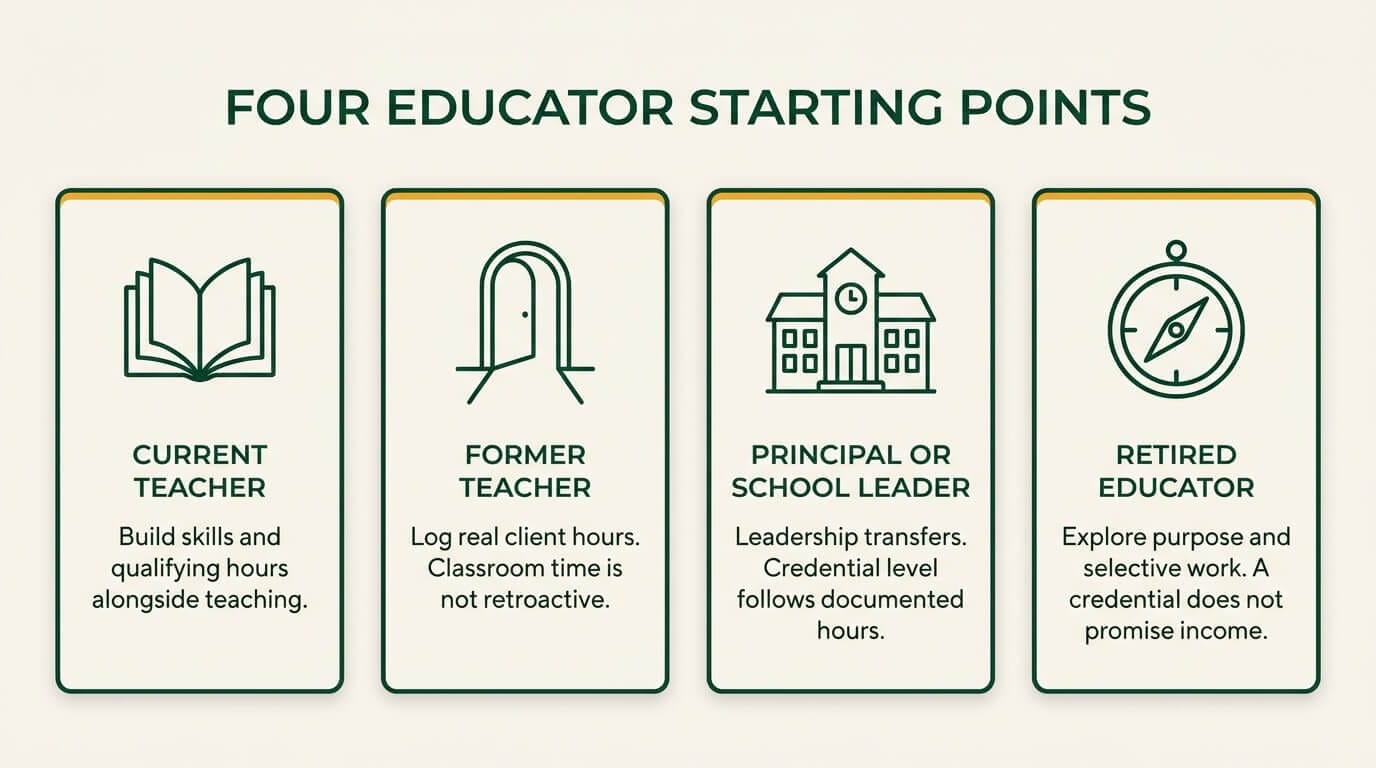
Everything above applies to all four groups. What changes below is the realistic next step, because a current classroom teacher, a former teacher three years removed from the building, a school leader, and a retired educator are not making the same decision, and this guide treats them as four separate questions rather than one.
Current Teachers
If you are still teaching, the RAND fatigue numbers from earlier may be familiar from the inside. Coaching can be a real next-chapter option to explore, or it can be a toolset you build now and use in your current role. One realistic sequence is to begin coach-specific education and seek early practice opportunities while still teaching, rather than quitting first and figuring out the rest afterward. Look for an ICF-accredited program whose schedule works alongside a full-time job. Tandem’s free coaching tools library is a low-commitment way to get a feel for coaching conversations before you commit tuition or a training schedule to anything.
Former Teachers
If you have already left the classroom, you may have more open calendar hours to build toward ACC or PCC than someone still teaching full time. The catch is that those hours have to be logged with real coaching clients, under a coaching agreement, not assumed from your years in the classroom. Nothing about having already left counts those years retroactively. Structured practice inside a training program, followed by volunteer or reduced-fee client work that meets ICF rules, is one possible way to begin building hours. This guide will not guess at your finances or your employment situation - only note that the coaching-hour clock starts when you start coaching, not when you stopped teaching.
Principals and School Leaders
Your leadership background is a genuine asset, not a talking point. The O*NET occupational profile for K-12 administrators lists developing teams, coaching and developing others, and resolving conflict as core parts of the job, and that base of experience is real. That leadership base does not itself establish PCC-ready hours or demonstrated coaching competence - the shift is from directing a system to partnering with one client. Which credential fits depends on the ICF PCC requirements you can actually document, not on your title. If you can document them, review the PCC professional coach certification program; if you cannot yet, ACC is where the documented path starts, with PCC available later once the additional hours and education are in place.
Retired Educators
You may be looking for continued contribution, flexibility, selective work, or simply a next chapter that uses some of what your educator career built. What this guide will not do is promise easy income, instant portability into paying client work, or a frictionless practice once you are certified. The credential and the practice are two different projects, and the second one takes its own time regardless of how strong your first career was.
Completing a coach training program and building a client practice afterward are two separate undertakings. A credential qualifies you to coach; it does not, by itself, produce clients, income, or a schedule. If a life coach certification path interests you as an alternative or a complement, the same separation between earning a credential and building a practice applies there too.
This section exists to make sure the decision gets made with the real requirements in view, for whichever of these four starting points is actually yours.
Professional Coaching vs. Teaching, Mentoring, Training, and Consulting
Educators already know several helping roles well: classroom instruction, mentoring a newer colleague, delivering training or facilitation, supervising a team, and consulting on a specific problem. Each one can build real skill. None of them automatically produces qualifying ICF client-coaching experience, and it helps to see why side by side rather than take that on faith.
Classroom instruction and training both center on transferring specific knowledge or skill from one person to many, on a timeline the instructor controls. Mentoring leans more personal but still runs on the mentor’s own experience as the reference point - advice flows from what worked for the mentor. Consulting diagnoses a problem and recommends a solution; the consultant is paid for the answer. Professional coaching does none of these things by design. It partners with one client, on that client’s agenda, and treats the client as the expert on their own life or work.
Use this as a fast fit test. If what you actually want to do is teach, advise, evaluate, or supply the answer, one of those adjacent roles may fit better than coaching does, and that is a legitimate conclusion, not a failure to reach the right one. If what pulls at you is partnering in someone else’s own discovery process, even when it is slower than just telling them, coach-specific education is worth exploring seriously.
The search results reviewed for this article usually treated coaching as one line item in a longer list of alternative jobs, next to instructional design and corporate training, without building it out into an actual path. A career coach certification guide covers the vendor-versus-ICF comparison from the non-educator side; comparing coaching certification options goes further into how the credentialing bodies differ. This guide exists because that gap - real interest, no real path - kept showing up for educators specifically.
Three Paths Forward
Once you know which of the four starting points is yours, the decision structure is the same for everyone: three broad paths, none of them guaranteed to end in a full-time coaching income, and none of them wrong to choose.
The first is skill-building inside your current role. Begin coach-specific education through an ICF accredited coaching program and look for early practice opportunities with real clients under a coaching agreement - perhaps a colleague outside your direct reporting line or a volunteer arrangement - while continuing to teach or lead. This lets you test the fit before making any bigger decision.
The second is a gradual transition: combining reduced teaching or leadership hours with qualifying coaching hours and mentor coaching, building toward ACC over a defined period rather than all at once. This is one option among several, not the presumed or statistically typical path, and it depends on financial and family circumstances this guide cannot see from here.
The third is independent practice, and this is where the honesty matters most. A credential and a viable coaching practice are separate outcomes. Earning ACC or PCC tells you and ICF that you can coach to a documented standard. It does not tell you that clients will find you, that your rate will support you, or that a practice will materialize on a predictable timeline. Treating a credential as a business-readiness threshold is a mistake this guide will not repeat on your behalf.
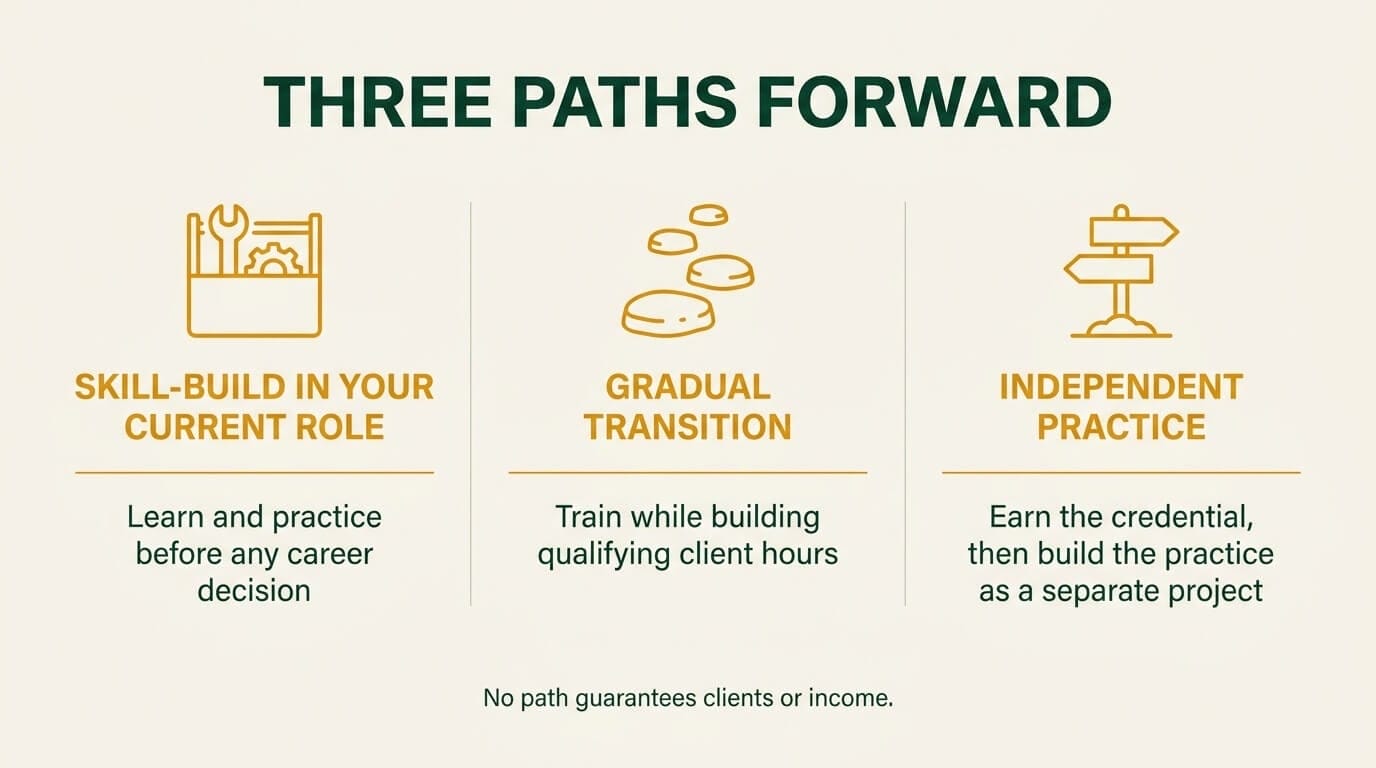
Which path fits depends on which of the four starting points is yours - the current-teacher, former-teacher, principal, and retired-educator sections above each point toward a different realistic sequencing of these three paths, and it is worth rereading the one that matches your situation before choosing. For readers who want the non-educator-specific mechanics of building a coaching business from here, the general path into career coaching covers that ground without repeating what is already above.
Frequently Asked Questions
Does teaching experience count toward an ICF coaching credential?
Not automatically. Teaching, training, workshops, and mentoring build real transferable skills, but ICF requires coaching hours logged with real clients under a coaching agreement. Classroom or leadership years on their own do not satisfy the ACC or PCC experience requirement, no matter how extensive they are.
Can a school principal become an ICF-certified coach?
Yes, and a strong leadership background is a real asset. But seniority does not substitute for documented coaching hours or demonstrated coaching competence. Which credential fits depends on the ICF experience requirements a principal can actually document, not on job title or years in the role.
Should a retired teacher start with ACC or PCC?
Start with the credential whose current education and experience requirements you can actually document. If you cannot yet document the fuller PCC requirements, ACC is the entry route, not a default recommendation based on your profession.
Is ICF coaching a good career change for teachers?
It can be a strong fit, but not automatically. Teaching builds real transferable skills, and ICF’s guide to becoming a coach explicitly addresses people coming from teaching backgrounds. Whether it is right for you depends on whether you want to partner in a client’s own discovery process rather than teach, direct, or evaluate.
Does ICF certification guarantee coaching income or clients?
No. Education and a credential qualify you to coach; they do not guarantee clients, income, or a viable practice. Is ICF certification worth it? That depends on what you are using it for. An independent practice still has to be built separately from earning the credential.
Where to Start
If you have read this far, identify which of the four starting points is yours and compare what you can document with the current credential requirements. If you cannot yet meet the PCC requirements, ACC is the available entry route - not because it is a lesser credential, but because its requirements are the ones you can begin documenting now.
See What Coach Training Feels Like
Free Foundations is the lowest-commitment way to test the coaching stance before deciding whether the full ACC path fits your next chapter.
Tandem’s ACC coach certification program is taught by MCC-level instructors and is designed around the current ACC education, mentoring, and performance requirements. If you are still deciding between credential levels, compare ACC, PCC, and ACTC credential levels to see how the full path is structured before you commit to a starting point.
Choose the Credential Path You Can Document
Compare Tandem’s ACC and PCC pathways against the education and coaching-hour requirements you can meet.
Compare ICF Programs →