Leadership Skills Keep Multiplying. Executives Keep Dropping the Same Three.
Adaptability is the leadership skill of 2026. The trade press has settled on it, Deloitte’s data backs it, and by December there will be a wave of programs teaching it. Last cycle the answer was psychological safety. Before that, resilience. Before that, emotional intelligence.
The list of leadership competencies gets longer every year. The failures stay flat.
Senior leaders can name a competency model and describe it accurately. They read the article, agree with it, and file it. Then their team still cannot say what the top priority is this quarter, people still wait three weeks for a decision on tooling, and a missed commitment still passes without a conversation. Nobody in that picture is short on information.
A leadership framework is a diagnostic instrument. Most executives use it as reading material. That difference is the entire gap between knowing what good leadership looks like and doing it, and closing it costs about twenty uncomfortable minutes.
Key Takeaways
- Every disruption cycle gets diagnosed as a missing leadership competency. Adaptability is 2026’s entry. The naming has never changed anyone’s behavior.
- Three responsibilities carry most leadership failures: communicate with clarity, support and resource, provide accountability. Executives drop one quietly and work harder everywhere else to cover it.
- A competency model read as content does nothing. Run as a diagnostic it tells you which side of your leadership went quiet, which is a much shorter and less pleasant exercise.
- Adaptability sits downstream of those three. A leader who spends every week re-explaining priorities has already spent the attention that adapting would take.
- You can run the diagnostic on yourself in twenty minutes. You will also grade yourself generously, which is what an outside read is for.
Why the Leadership Skills List Keeps Getting Longer
The list grows because every disruption gets diagnosed as a missing competency. Markets shift, so leaders need adaptability. Layoffs land, so leaders need resilience. The naming is fast, cheap, and produces a budget line. What it rarely produces is a leader who behaves differently on Monday.
The pressure behind the naming is real enough. Deloitte’s 2026 Human Capital Trends found that seven in ten business leaders say being fast and nimble is their primary competitive strategy for the next three years. EY-Parthenon’s 2026 Growth Survey put a number on why: of 271 corporate growth leaders surveyed, 97% said external forces pushed them to change their growth strategy inside a single year. Geopolitical and economic volatility drove it for 73% of them, technological change for 58%.
So the demand for adaptability is not manufactured. Executives really are being asked to change direction more often than their planning cycles were built for.
The number worth sitting with is the second one Deloitte reports. Eighty-five percent of leaders say building the workforce’s ability to adapt at speed is critical. Seven percent say they are actually delivering it.
A 78-point gap between what leaders believe and what leaders do is not the signature of a message that failed to land. They heard it. They agree with it. Adding the word to a competency framework, a performance review template, or a catalog of leadership development tools does nothing about a gap that was never about naming in the first place.
The Three Moves Most Executives Have Quietly Dropped
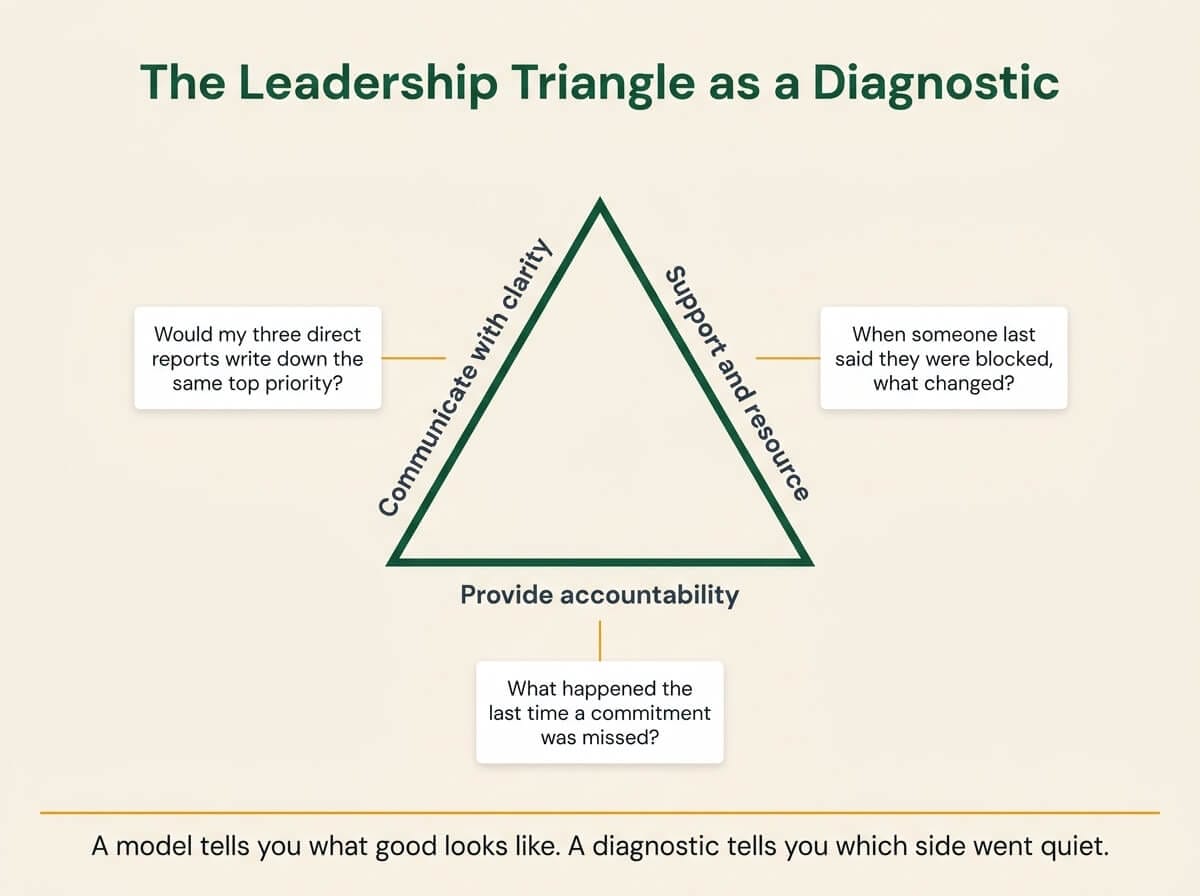
Most leadership problems trace to a responsibility the leader stopped carrying rather than a skill they never learned. Writing in Chief Learning Officer, an executive coach names the three that every leader owes a team: communicate with clarity, support and resource, provide accountability. He calls the set the leadership triangle, and credits it to Dr. Justin Irving.
One Row Hit Harder Than the Others
If the right-hand column gave you a familiar sting, that’s your starting point. A coaching conversation turns that recognition into a concrete next move.
None of the three is hard to understand. That is exactly the problem. They are the leadership equivalent of sleep, water, and moving your body, and executives abandon them for the same reason people abandon those. Dropping one costs nothing this week, and there is always something louder in the calendar.
The dropping is rarely a decision. Clarity usually goes first, during a reorganization when the priorities are genuinely unsettled and the leader waits to communicate until they are sure of something. The waiting becomes the pattern and outlasts the reorg. Resourcing goes next, when a leader starts routing every ask into a process instead of giving an answer. Accountability goes last and quietest, because letting one missed commitment pass is free.
What makes the triangle worth more than the average competency wheel is that each failure has a distinct signature in the team. You do not have to guess which side you dropped. You can read it off your people.
| The move | When it is happening | What the team does once it stops |
|---|---|---|
| Communicate with clarity | Everyone can state the same top priority and what it costs them | Each function invents its own priority and defends it in meetings |
| Support and resource | Blockers you hear about get a decision, including a clear no | People stop raising blockers and quietly route around them |
| Provide accountability | Missed commitments get a conversation within days | Dates become estimates, and the reliable people carry the load |
Read the right-hand column honestly and one row will be more familiar than the other two. That row is your leadership development goals list for the quarter, and it will outperform anything a competency assessment hands you, because it came from evidence you already have.
The Difference Between Knowing a Framework and Running One
A competency model can be read two ways. As curriculum, it tells you what good leadership contains, and you finish it agreeing. As a diagnostic, it hands you three places to check, and you finish it with one uncomfortable answer. Chief Learning Officer describes the leadership triangle as both a model and a diagnostic tool. Most readers only ever use the first half.
Curriculum reading is comfortable and produces nothing. You recognize each competency, you think of someone who is bad at it, you close the tab. Diagnostic reading is short and specific. Pick one side, find the evidence from the last thirty days, sit with what the evidence says. Ten minutes, and most executives will avoid those ten minutes for years.
In a coaching session the framework almost never gets taught. Say you are working with a VP whose opening line is that the team has gotten slow. Handing them adaptability as the answer would be fast and useless. The more productive move is to ask which of the three sides has gone quiet, then follow whatever the answer stirs up, because the first answer a leader gives is usually the one that costs them the least. Hersey and Blanchard works the same way when used as a coach’s diagnostic. The value is in locating where the leader and the situation have come apart, not in memorizing four styles.
Where Adaptability Actually Comes From
Adaptability sits downstream of the three moves. A leader who never established clarity spends every week re-explaining priorities, and that re-explaining consumes precisely the attention adapting would require. Capacity to change direction is what remains after the basics are handled. Skip the basics and nothing remains.
Run it through each side. A team without clarity cannot pivot, because a pivot is a change in priority and they were never certain of the current one, so the announcement arrives as noise. A team that cannot get a resourcing decision cannot pivot either. They will raise the blockers the new direction creates, hear nothing back, and within two cycles stop raising them. A team that has learned commitments are optional will not move when speed finally matters, because nothing has ever depended on their moving before.
This is why Deloitte’s eighty-five-to-seven gap holds so stubbornly. Organizations added adaptability as a competency and trained it as a competency. The concept was never the constraint.
Say you are coaching a COO whose board has told them to be more adaptable, and who is already at capacity. Putting adaptability on their development plan asks her to do more of what is currently failing. The question worth asking is what is eating the capacity right now, and the answer is usually one of the three sides running as a leak they stopped noticing years ago. Leaders in that position are often solving the wrong problem with real skill and real effort, which is what makes it so hard to see from inside.
Reading a leadership framework and agreeing with it is the most reliable way to never use it.
Creative Problem-Solving Needs Room the Calendar Never Gives
Traditional problem-solving is analytical and linear: define the problem, pick the best answer from options that have worked before. Creative problem-solving reframes the problem, generates many possible responses, and takes unconventional ones seriously. Both earn their place. The second one is what genuinely hard problems require, and an executive calendar is structured to prevent it.
No Deliverable. No Audience. Just the Work.
Executive coaching is the one hour in your week where nothing is due at the end—and that’s exactly why the hardest thinking happens there.
A piece in Chief Learning Officer on creative problem-solving makes a claim that sounds backwards until you sit with it. You cannot teach creative problem-solving inside an environment that mimics business pressure. Training that runs on the delivery clock pushes learners toward the fastest defensible answer, which is the exact reflex creative problem-solving has to suspend. The mechanism the author lands on for that insulation is play.
That claim explains a great deal of failed leadership development. Put twelve executives in a room, hand them a case, tell them to present in forty minutes, and you have faithfully rebuilt the pressure environment they came from. They will produce competent linear answers, because that is what the structure rewards. Then they go back to their week unchanged and someone concludes the content was wrong.
An executive coaching session has one structural property that is nearly impossible to find elsewhere in a senior leader’s week. Nothing is due at the end of it. No deliverable, no audience, no decision that has to survive a 5pm review. That is the insulation, and it is most of the mechanism, which is also why what a personal executive coach actually does looks so unimpressive from the outside.
If your leadership offsite has a deliverable due at the end of it, you are running a working session with better catering. Protect one block with no output attached, or the reflex you came to change is the reflex everyone will practice all day.
Culture Eats AI for Breakfast
At Semafor’s World of Work Summit on July 22, held in partnership with Gallup, Gallup CEO Jon Clifton reworked the line usually attributed to Drucker: you will never get your AI right if you do not get your culture right, because culture eats AI for breakfast. The other lesson executives brought to that stage was that change gets accepted when leaders model it first.
Modeling is the accountability side of the triangle turned around and pointed at yourself. Executives ask teams to adopt a new tool, a new rhythm, a new review cadence, and then leave their own calendar exactly as it was. The team reads the exemption long before it reads the memo.
Technology makes this legible faster than anything else does. A CTO who mandates AI adoption without having personally used the tools through a week of real work gets found out on the first all-hands question they cannot answer. The mandate then reads as a metrics exercise, and adoption numbers get gamed rather than earned.
Clifton is describing something mechanical. Leaders asked for a behavior change they had not demonstrated, and the organization priced that in immediately. The tooling was usually fine. This is one of the signals a leadership team stops hearing, because the people who notice the exemption first are rarely the people who get airtime.
Run the Diagnostic on Yourself
Three questions, one per side of the triangle. Each has a checkable answer rather than a feeling, which is the only reason the exercise works. Answer them from the last thirty days using evidence you could point to, and one will be noticeably harder than the other two.
- Clarity. If you asked your three direct reports right now to write down the single most important thing this quarter, would the three notes match? Not roughly overlap. Match.
- Resourcing. The last time someone told you they were blocked, what changed in the following week? Name the specific thing. If the answer is that you took it away to think about, that side has gone quiet.
- Accountability. What happened the last time a commitment was missed on your team? If nothing happened, your team already knows that, and they knew before you did.
Whichever question took the most work to answer honestly is the side you dropped. That is the leadership skill to work on this quarter, ahead of whatever a competency catalog would have recommended, and none of it requires a program.
The limitation here is obvious. You are grading yourself, and leaders grade themselves most generously on the exact sides they have quietly abandoned. That is the whole case for an outside read. Whether it arrives as executive coaching, as high-performance coaching, or as a standing quarterly conversation with someone outside your reporting line matters far less than the fact that somebody other than you is holding the instrument.
Frequently Asked Questions
What are the most important leadership skills to develop first?
Clarity, resourcing, and accountability, roughly in that order of how often they break. Before picking from a competency catalog, check whether your team can state the current top priority, whether the blockers you hear about get a decision, and whether missed commitments get a conversation. A gap in any of the three quietly undermines every more advanced skill layered on top of it.
Is adaptability a leadership skill you can train?
You can train the behaviors around it: scanning for change, making decisions in smaller increments, holding plans loosely. The constraint is usually capacity rather than technique. Deloitte found 85% of leaders call building adaptability critical while 7% say they are delivering it, and more training has not closed that gap.
What is the difference between a leadership framework and a leadership competency model?
In practice, very little. Both name a set of capabilities a leader is expected to demonstrate. How you use one matters far more than which you pick. Read as a description it changes nothing. Used as a diagnostic against evidence from the last thirty days, it gives you one specific thing to work on.
How is executive coaching different from leadership training?
Training delivers content on a schedule and usually ends with a deliverable. Coaching is a structured conversation with nothing due at the end, which is what makes it possible to examine a problem instead of racing to produce an answer for it. Training shows you what good looks like. Coaching helps you find where yours went quiet.
Which Side Did You Drop?
You already know the answer costs twenty uncomfortable minutes. A coach makes sure you don’t grade yourself generously.
Book a Free Consultation →