

8 Executive Coaching Trends for 2026, and the Gap Beneath Them
What are the top executive coaching trends in 2026?
Eight trends define executive coaching in 2026: digital-first delivery, AI-enhanced experiences, democratized access, data-driven outcomes, wellbeing and resilience, psychological safety as a measured outcome, team-based coaching, and specialized niche expertise. They sit inside a USD 112.98 billion market growing 9.11% a year, so the real question is not whether to hire a coach but which one has adapted.
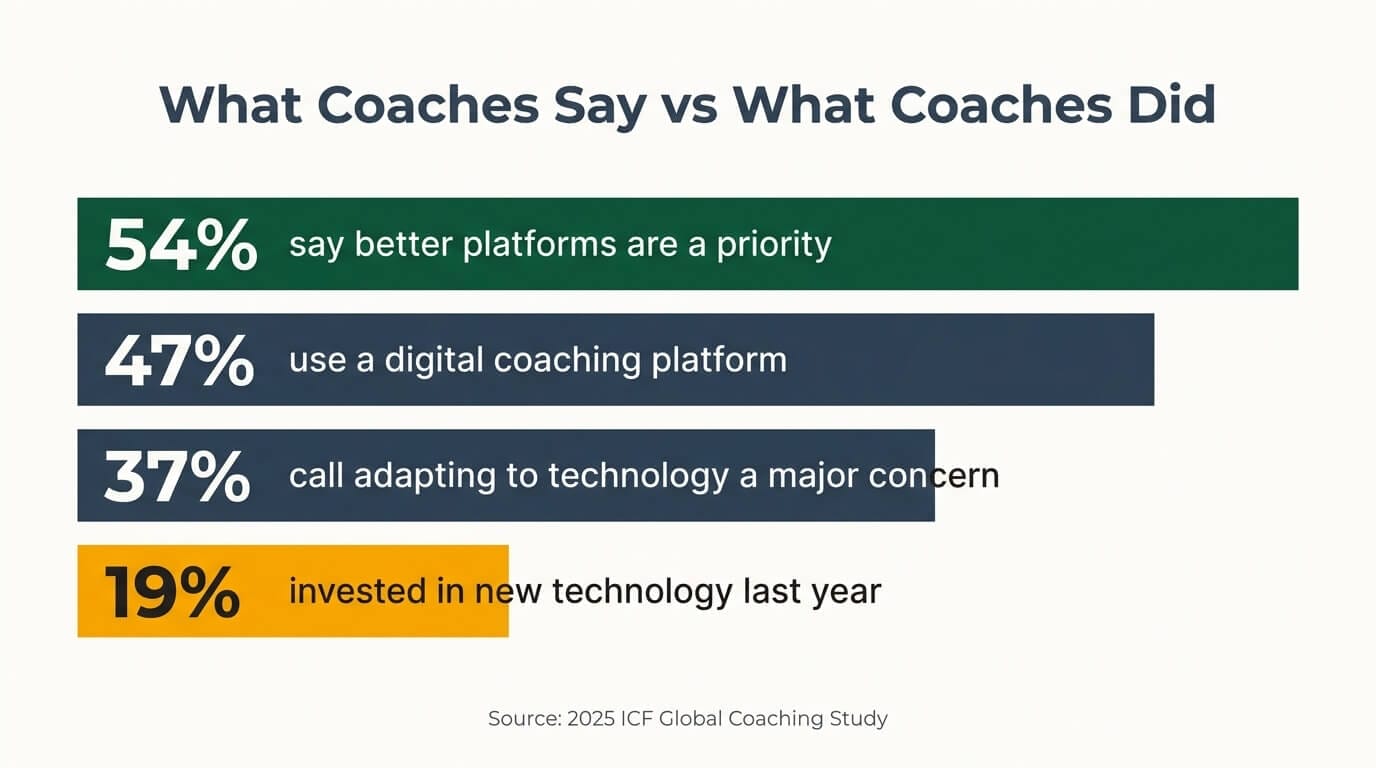
Fifty-four percent of coaches say better platforms and technology-driven solutions are a priority for meeting what clients will want next. Nineteen percent invested in any new technology last year.
Both numbers come from the same place - the 2025 ICF Global Coaching Study, conducted by PricewaterhouseCoopers across 10,035 coaches in 127 countries - and the distance between them is the most useful thing anyone can tell you about the future of executive coaching and leadership coaching right now. The profession knows what it needs to become. It has largely not become it yet.
Key Takeaways
- The 2025 ICF Global Coaching Study puts the profession at $5.34 billion in annual revenue and 122,974 practitioners - up 17% and 13% since 2023.
- Ambition outruns action: 54% of coaches call better platforms a priority, 47% use a digital platform at all, and 19% invested in new technology last year.
- The barrier is arithmetic. A $2,400 annual AI subscription is close to 5% of the $49,283 an active coach earns on average.
- 81% of C-suite executives now rate improving their mental health above advancing their career.
- For a buyer, the useful question is not which trends exist but what a specific coach changed, and when.
Here are the eight shifts reshaping how executive coaching is delivered, what the evidence actually says about each, and what they change about hiring a coach.
The Eight Trends Shaping Executive Coaching in 2026
Here is the pattern worth holding onto before the detail: the profession says one thing about where it is heading, and its own numbers say another. Stated ambition is high. Measured investment is low. That distance is the most useful thing an executive can know before hiring an executive coach, and it runs underneath all eight of the trends shaping 2026.
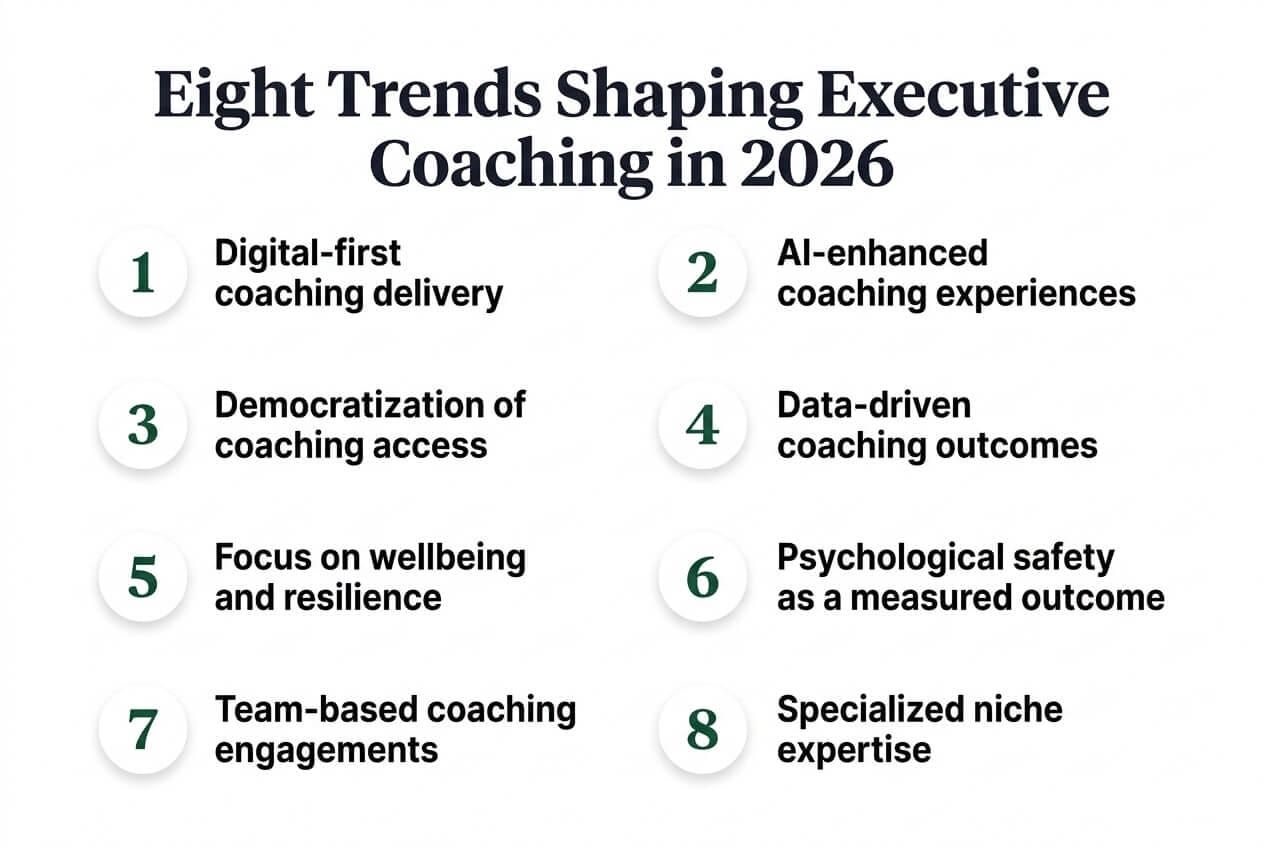
- Digital-first coaching delivery
- AI-enhanced coaching experiences
- Democratization of coaching access
- Data-driven coaching outcomes
- Focus on wellbeing and resilience
- Psychological safety as a measured outcome
- Team-based executive coaching engagements
- Specialized niche expertise
Why Executive Coaching Works in Today’s World
Executive coaching keeps growing because the results hold up when someone checks them. The field still cites a 788% return on investment - an ROI figure from a Metrix Global study - a number repeated for years now, and one better treated as evidence of what buyers believe than as a current measurement.
Need a Number Your CFO Will Accept?
If you are justifying a coaching line item, we help define the baseline, the measures and the review points before the engagement starts rather than after it ends.
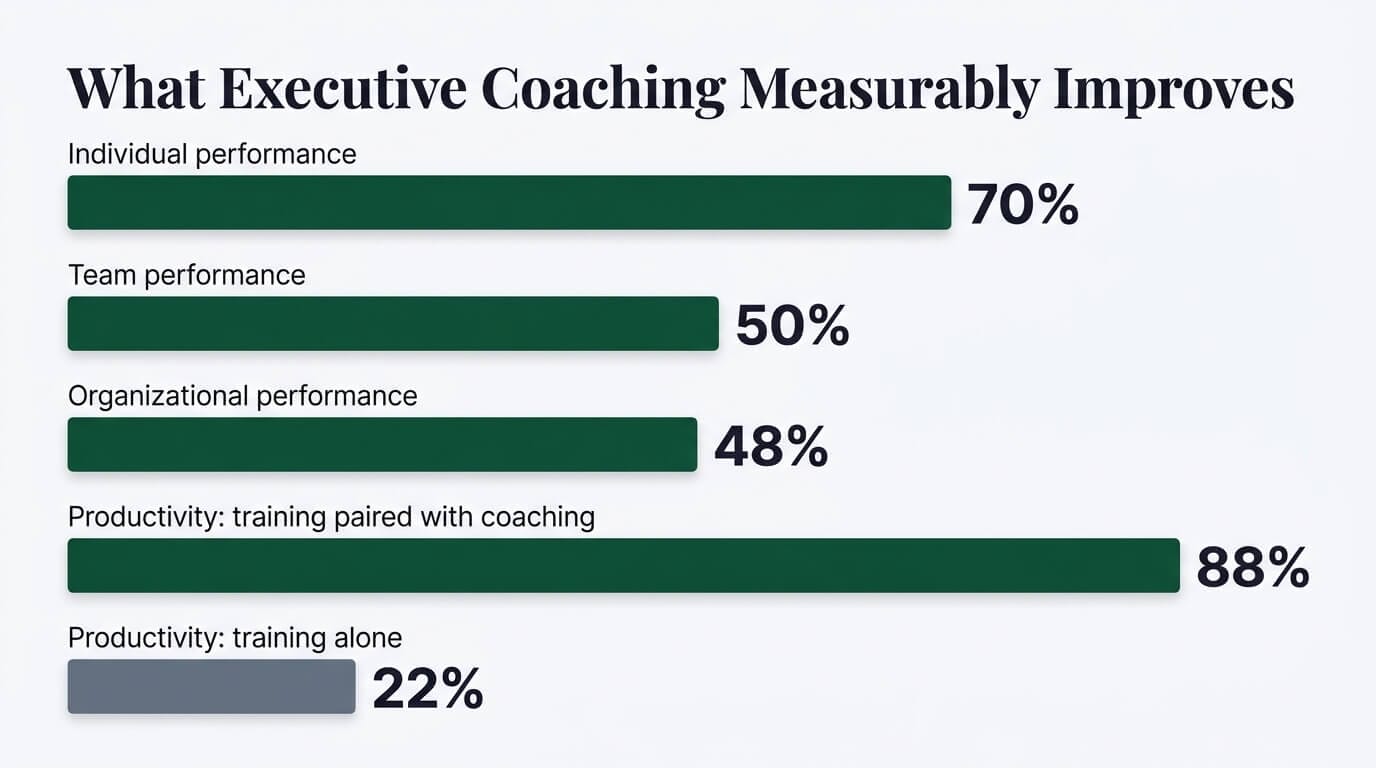
The performance figures collected alongside it in that same American University summary are steadier:
- 70% increase in individual performance
- 50% improvement in team performance
- 48% improvement in organizational performance
- 88% productivity when training is paired with coaching, against 22% for training alone
- Stronger stakeholder relationships reported alongside each of the above
The coaching profession reached $5.34 billion in annual revenue in 2025, up 17% in two years, with 122,974 practitioners worldwide - and nine in ten of them actively working with clients.
Those revenue and headcount figures come from the 2025 ICF Global Coaching Study, conducted by PricewaterhouseCoopers across 10,035 coaches in 127 countries. Global executive coaching sits inside that total, and practitioner numbers rose 13% since 2023 to a record high, and 90% are actively working with clients - about 110,492 people.
The market around them is larger again. Mordor Intelligence sizes executive coaching and leadership development at $112.98 billion for 2026, growing 9.11% a year through 2031, and names C-suite succession gaps as a driver. For the full data set rather than the headline, our coaching industry statistics page tracks the numbers across the whole coaching and leadership development market.
Key Drivers of Executive Coaching Trends
Several shifts are pushing executive coaching to change shape:
- Succession pressure: Mordor names C-suite succession gaps as a primary driver of budget growth. Coaching has become a way to build the leadership bench rather than a reward for people who already arrived.
- Compressed strategy cycles: Corporate strategy now turns over faster than a traditional development program can run, so organizations buy readiness they can apply this quarter.
- Growing demand: Wider recognition of the benefits of executive coaching - managerial skill, retention, promotion readiness.
- Hiring difficulty: When senior roles are hard to fill, developing the people you already have stops being optional.
- Scarce senior capacity: Coaches move toward executive clients as they gain experience. Among those with more than ten years in practice, 38% work primarily with executives and close to 30% with managers, against 18% and 10% for coaches in their first year (2025 ICF study). The most experienced capacity is concentrated, and it is finite.
What the executive coaching and leadership development market actually looks like
The numbers matter here because they explain the behaviour above. Per Mordor Intelligence’s executive coaching and leadership development market analysis, the market is worth USD 112.98 billion in 2026, up from USD 103.56 billion in 2025, and is forecast to reach USD 174.53 billion by 2031 – a 9.11% compound annual growth rate.
Three splits inside that figure are worth knowing before you buy:
- Delivery is still mostly human and in-person. In-person learning held 56.62% of the market in 2025, while online learning is the faster-growing mode at 11.64% CAGR. The digital-first trend is real, but it is a shift in mix rather than a replacement.
- Buying is concentrated in large organizations. Large enterprises accounted for 57.61% of spend in 2025 – though small and medium-sized organizations are growing faster, at 11.17% CAGR, which is what democratized access looks like in the data.
- Geography is moving. North America held 40.88% of the global market in 2025; Asia-Pacific is the fastest-growing region at 11.12% CAGR through 2031.
The practical read: demand is growing faster than the supply of experienced coaches, and the growth is concentrated in segments (SMEs, Asia-Pacific, online delivery) that were underserved five years ago. That is the pressure behind every trend below.
8 Growing Trends in Executive Coaching
Here’s a detailed look at how executive coaching is evolving to meet modern challenges:
1. Digital-First Coaching Delivery
Digital-first delivery means the default session happens on video, with in-person reserved for the moments that earn the travel. That much is settled. How far it reaches past video is not.
The pandemic-era move was near-total: the Henley Business School report found 98.3% of coaches went online between 2019 and 2021. Zoom carried most of it, with a minority adding shared whiteboards to make sessions more interactive.
What executives name as the gain:
- No travel, which is often what makes a standing session survivable
- A more private space to think in
- Lower cost for them and for the organization
The 2025 ICF study adds a correction worth holding onto: 47% of coaches use a digital coaching platform at all, and where they do, the main uses are one-on-one virtual sessions (35%) and scheduling and client management (23%). Digital-first describes the channel, not the coaching practice itself, and traditional coaching skills still carry the session. Virtual coaching is now simply the default; what a coach does with the executive coaching tools around the session is the more revealing question.
2. AI-Enhanced Coaching Experiences
AI in executive coaching is real, and it is considerably smaller than the marketing suggests. The honest 2026 picture is a gap between what coaches intend and what they have actually done.
The 2025 ICF study found 54% of coaches say improved platforms and technology-driven solutions are a priority for meeting what clients will want next. In the same study, only 19% invested in new technology during the past year, a figure they project reaching 27% over the next one to three years, and 37% named adapting to technology and digital tools as a major concern. ICF states the position plainly: adoption across the industry remains low.
The arithmetic explains more than attitude does. A top-tier AI subscription runs roughly $2,400 a year, and the same study puts average annual revenue for an active coach at $49,283. That single subscription is close to 5% of gross revenue in a solo practice - a capital decision rather than an impulse purchase, which is most of why intent and investment sit so far apart. We have also observed that new tooling of any sort moves slowly through this profession, and AI adoption asks for a bigger step than many practices have taken yet.
None of this is an argument against AI-driven support or the personalization it promises. It changes the question you ask. Rather than asking whether a coach uses AI, ask what specifically changed in their practice and in their coaching conversations, and when. Someone who has genuinely adapted answers with dates and examples. For the wider view of where AI actually bites for senior careers, we cover the reality behind the AI hype for executives separately.
3. Democratization of Coaching Access
Coaching is no longer reserved for the top of the house, and the clearest evidence is in who coaches actually serve as their practices mature.
The 2025 ICF study shows the pattern. Among coaches with more than ten years in practice, 38% work primarily with executives and nearly 30% with managers. Among those in their first year, it is 18% and 10%. Access has widened downward through organizations while the most seasoned capacity stays concentrated near the top.
That widening carries a cost worth naming. When coaching becomes available at every level, the range of quality widens with it - which is precisely why specialized expertise is trending at the same moment. The two are connected, and trend eight picks it up.
For you it means support arrives earlier in a career than it used to, whether through job search coaching, a career transition coaching engagement, or a leadership development program. For executives reading these trends through the lens of AI-driven role change, the AI Career Navigator hub collects the risk data and the four-path framework for that context.
4. Data-Driven Coaching Outcomes
Measurement is king in a modern coaching engagement, and the part that decides whether it holds up is when it starts.
Our own engagements open with a survey before the coaching does - not to grade anyone, but to establish where the client actually is by their own reckoning. The measures are co-created rather than handed over: the client defines the goal and, just as importantly, how progress on it will be judged. A measure someone helped build stays measurable, and it still means something eight months later.
From there the cadence follows the engagement. A longer one gets re-measured a couple of times, somewhere in the middle and again at the close. A shorter one may need only the closing measure. Either way the comparison runs against that client's own baseline rather than a benchmark borrowed from another organization or an average across coaching clients.
What this produces is continuous feedback instead of a verdict at the end. Feedback loops of that kind are also what make an engagement defensible to whoever approved the budget.
5. Focus on Wellbeing and Resilience
Leading is heavier than it was, partly because the AI productivity paradox for executives tends to create more work rather than less.
A Deloitte survey spanning the U.S., the U.K., Canada and Australia found nearly 70% of C-suite executives reporting burnout and seriously considering leaving for roles that would better support their wellbeing. The sharper finding sits right beside it.
81% of C-suite executives say improving their mental health matters more to them right now than advancing their career.
That reorders what people bring into a coaching engagement, and it makes stamina something to prioritize rather than assume. Your coach becomes a partner in building what we like to call your “leadership stamina” - the capacity to keep making good decisions across a long stretch rather than a short one.
In practice that means working on:
- Wellbeing strategies that fit the schedule you actually have
- Stress practices you can use in the middle of a hard week, not only after it
- Boundaries that hold when everything is urgent
6. Psychological Safety Becomes the Measured Outcome
What executives ask coaches to change has shifted. Less often it is an individual skill. More often it is a condition in the room - whether people will say the difficult thing while it still matters.
Psychological safety usually gets described in soft language, which does it no favors. The observable version is concrete: dissent surfaces early, before the decision, rather than afterward in a hallway. A team that has it argues more, not less. That is the signal, and it is a mindset shift before it is a behavior one - treating disagreement as information rather than as a challenge to authority.
It moved from culture conversation to budget line because it began showing up next to numbers people already watch: retention, decision speed, how long a problem sits before someone names it.
The coaching work is smaller and more specific than a workshop. Much of it lives in how a leader responds in the first ninety seconds after being contradicted in front of their team. What happens in that window teaches everyone watching what is safe here, and it teaches them faster than any stated value on a wall. A coach can work that window directly.
An outside observer matters because of where the blind spots sit. Leaders consistently read their teams as safer than the team experiences it, and the gap is invisible from inside the role. Worth being honest about the limit too: a coach can change how a leader handles dissent, and cannot repair an organization that punishes it elsewhere.
7. Rise of Team-Based Coaching
A Fortune 50 CHRO, quoted in SHRM’s study notes: “A lot of the C-suite have coaches. They’re all happy with their coaches, but it’s not helping us function better as a team or as a company.”
We have seen that exact pattern. Seven capable leaders, seven satisfied coaching relationships, and a leadership team that still cannot land a decision together.
It is not a failure of the individual work. Individual coaching cannot repair a trust deficit that exists between people rather than within them. One-on-one relationships across a leadership team may function perfectly well while the group still produces results no single relationship explains - decisions made collectively get relitigated in one-on-ones afterward.
Executive team coaching treats the leadership team as one system rather than a collection of individuals, which is the only vantage point from which that pattern is visible.
One question separates a genuine team coach from individual coaching in a group wrapper. Ask whether they will meet with members individually or coach you as a group. If the answer emphasizes individual sessions with periodic group check-ins, you have your answer.
8. Specialized Niche Expertise
The generalist is giving way to the specialist, and the 2025 ICF study shows how strongly experience drives it: among coaches with at least ten years in practice, 80% focus on business coaching, against 48% of those with less than a year.
Specialization is genuinely useful. If you are leading a digital transformation, a merger, or a turnaround, someone who has sat with that specific problem before will get to what matters faster, and executive coaching programs increasingly organize around those unique challenges.
It carries one risk worth knowing as a buyer. We have seen practitioners move to a niche before the underlying coaching craft is solid, and we have seen domain experts adopt the coach label without it. A career coach, for instance, is sometimes a recruiter by another name - drafting your resume, rehearsing your interview answers. That work has real value. It is not coaching, and the difference will matter to you.
So the discriminating question is not what someone specializes in. It is whether you are hiring a trained coach who went deep in your domain, or a domain expert who added the word coach.
Challenges in Adapting to Coaching Trends
If these shifts are so clear, why does a coaching engagement often look much as it did five years ago? The profession names the reasons itself.
Four Questions Worth Asking Any Coach
What changed and when. How progress gets measured. Whether your team gets coached as a team. Where the specialization actually came from. We answer all four.
- Technology adaptation: 37% of coaches call keeping up with technology and digital tools a major concern, and only 19% invested in it last year (2025 ICF study). Intent is not the constraint. Capacity is.
- Time: Continuous development competes directly with client hours in a solo practice, and client hours are what pay.
- Keeping the human part: Adding tools without thinning the attention that makes coaching work is a genuine balancing act.
- Fit in a crowded market: As niches multiply, matching the right coach to the right client gets harder for buyers, while narrow specialization shrinks a coach’s own market.
- Proving return: Demonstrating value to a budget holder still runs into measurement design, data ownership and confidentiality. This one remains the hardest, and it is why the question of what executive coaching actually returns keeps getting asked.
How Tandem Coaching Supports Modern Leaders
At Tandem Coaching, we understand your challenges – whether you’re stepping into a new executive role, aiming for that next promotion, or leading through high-stress decisions.
Our ASPIRE process combines personalized executive coaching with evidence-based development across key areas:
- Strategic Vision Development: We help you gain crystal-clear clarity on your goals and create actionable plans to achieve them, even when the path forward seems uncertain.
- Leadership Skills Enhancement: Through one-on-one expert coaching, you’ll develop crucial capabilities like:
- Executive presence training (how to command respect while staying approachable)
- Emotional intelligence (reading situations and people accurately)
- Strategic thinking (making complex decisions with confidence)
- Communication mastery (influencing others effectively)
- Performance Acceleration: Our structured yet flexible approach includes:
- Regular bi-weekly sessions to keep you accountable
- Progress checkpoints every four months
- Real-world application of new skills
Frequently Asked Questions
A few things buyers ask us once they have read the trends.
How big is the executive coaching market?
Mordor Intelligence puts the executive coaching and leadership development market at USD 112.98 billion in 2026, rising to USD 174.53 billion by 2031 at a 9.11% CAGR. North America held the largest share in 2025 at 40.88%, while Asia-Pacific grows fastest at 11.12%. In-person delivery still accounted for 56.62% of the market in 2025, which is worth remembering whenever someone describes coaching as having gone fully digital.
How is technology actually changing executive coaching?
Less than the marketing implies, so far. The 2025 ICF study found 54% of coaches call better platforms a priority while only 19% invested in new technology last year, and 37% call adapting to it a major concern. Video delivery is universal; anything past it is uneven. As with any change management process, the useful question is not which tools exist but which ones a specific practice has adopted and when.
What are the most in-demand topics for executive coaching in 2026?
Four come up repeatedly: wellbeing and sustainable pace, given that 81% of C-suite executives now rate their mental health above career advancement; psychological safety and how a leadership team handles disagreement; team effectiveness rather than individual performance alone; and readiness for succession, which Mordor names as a primary driver of market growth. Specialized situations - transformation, merger integration, turnaround - sit alongside them.
How can I tell whether a coach has actually adapted their practice?
Ask what changed and when. A coach who has adapted answers with dates and specifics: what they added, what they stopped doing, what it changed for clients. A coach who has not answers with adjectives. The same test works for specialization - ask about the last three engagements in that niche, including one that did not go well.
What should executives look for in a modern coaching program?
Genuine experience in your situation rather than your industry label, a measurement approach you help design at the start, and clarity about whether you are buying individual coaching or team coaching, since they solve different problems. Tandem Coaching’s executive coaching solutions are built around experienced coaches and measures agreed with you at the outset rather than reported at the end.
What To Do With This
Trends are only worth reading if they change a decision. This set does not settle whether to hire a coach – a USD 112.98 billion market growing above 9% a year has answered that one. It helps with which coach.
Each of the eight shifts hands you something specific to ask about: what they changed and when, how they will measure it with you, whether they will coach your team as a team, where their specialization actually came from. A coach who has adapted answers with dates and examples. One who has not answers with adjectives.
A note on the calendar, since this is a year-stamped list. Most of these eight are not 2026 stories that expire in January. Digital delivery, measurement, team coaching and specialization have been compounding for several years and the market forecast runs to 2031 – what changes year to year is which of them your industry has already absorbed and which are still arriving. Treat the list as a checklist for the conversation rather than a forecast with a shelf life, and the questions keep working into 2027.
Fair to ask it of us, too. Every engagement we run opens with a survey before the coaching starts, and the measures get built with the client rather than handed to them – they set the goal and how progress on it gets judged. We re-measure partway through and again at the close.
That is the whole difference, and you can usually hear it in a first conversation.
Ask Us What We Changed and When
It is the question this article tells you to put to any coach, so put it to us. Bring your situation and we will be specific about what we would do and how we would measure it.
Book a Free Consultation →