
The Change Management Process: Phases, Steps & Timeline
What is the change management process?
The change management process is a structured four-phase sequence: assess readiness, plan the approach, implement with support, and reinforce until new behaviors stick. Frameworks express these phases as three to eight steps—Lewin’s three stages, ADKAR’s five, Kotter’s eight—but share the same logic. What makes change stick is the leadership applied within each phase.
The change management plan was solid. Stakeholder analysis complete. Communication timeline built. Training schedule locked. The documentation could have served as a textbook example.
What the process didn’t account for: the COO who signed off on the initiative hadn’t told his direct reports why he agreed to it. He’d approved the budget, nodded through the project charter, and moved on. Six months of precise process execution built on that foundation — and the change reverted anyway. The process wasn’t the problem. What happened between the steps was.
This guide lays out the change management process end to end: the four phases every framework shares, how the major methodologies map their steps onto those phases, roughly how long each phase takes, and what leaders actually have to do within each one to make the process produce change instead of documentation.
The Change Management Process: Four Core Phases
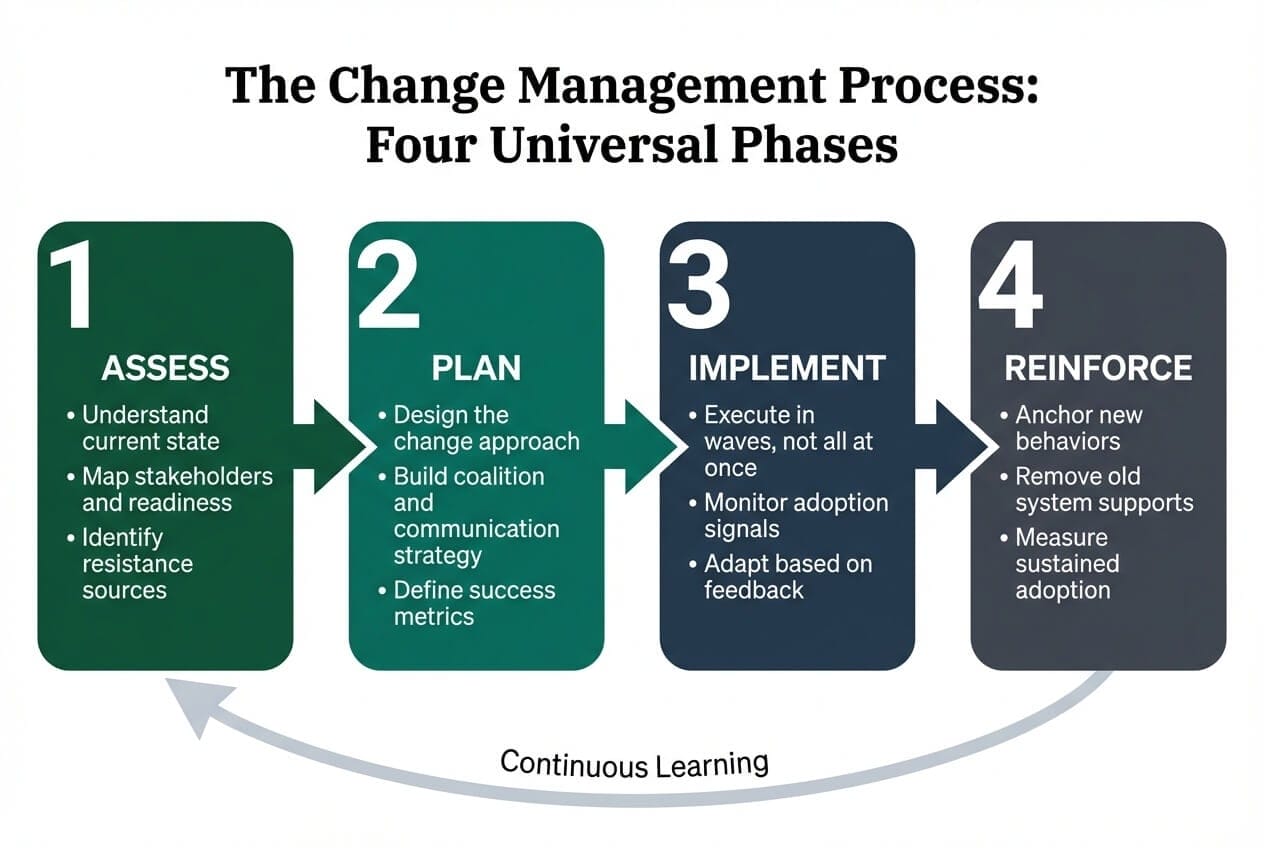
Strip away the branding and every change management process follows the same four phases: assess organizational readiness, plan the approach, implement with ongoing support, and reinforce until new behaviors stick. The framework you choose matters less than how thoroughly leaders execute within each phase.
- Assess and prepare: understand the current state, map stakeholders, and build readiness
- Plan and design: build the approach, sequence the work, and align people
- Implement and support: execute, adapt, and support people through the transition
- Reinforce and sustain: embed the change and prevent reversion to old behaviors
The phase names change across frameworks. The human requirements do not. A leader who cannot have honest readiness conversations will struggle whether using ADKAR or Kotter. What follows is the operational reality of each phase — but first, how the frameworks you’ve heard of map their steps onto this shared structure.
Change Management Steps and Stages Across Frameworks
The reason “how many steps are in change management” has no single answer is that each methodology slices the same four phases at a different resolution. Lewin compresses the process into three stages. ADKAR tracks five individual milestones. Kotter expands it to eight steps. Prosci wraps its ADKAR milestones in a three-phase organizational process. Laid side by side, they line up cleanly:
| Core phase | Lewin (3 stages) | ADKAR (5 milestones) | Kotter (8 steps) | Prosci (3 phases) |
|---|---|---|---|---|
| 1. Assess & prepare | Unfreeze | Awareness | Create urgency; build a guiding coalition | Prepare approach |
| 2. Plan & design | Unfreeze | Desire | Form the vision; enlist a volunteer army | Manage change (plan) |
| 3. Implement & support | Change | Knowledge, Ability | Remove barriers; generate short-term wins | Manage change (execute) |
| 4. Reinforce & sustain | Refreeze | Reinforcement | Sustain acceleration; institute the change | Sustain outcomes |
Two things to notice. First, no framework is “more steps, therefore more thorough” — Kotter’s eight steps and Lewin’s three describe the same journey at different zoom levels. Second, every framework front-loads awareness and readiness (phase one) and back-loads reinforcement (phase four), because those are the two phases organizations most reliably shortchange.
Choose the framework whose vocabulary your organization will actually adopt. A team fluent in project stages will run Kotter well; a change touching individual behavior maps naturally to ADKAR. The methodology is scaffolding. The four phases are the building.
How Long Does the Change Management Process Take?
There is no fixed change management timeline — a process re-design lands in a quarter, a culture transformation runs two years or more — but the proportions between phases are more predictable than the totals. Most initiatives underinvest in the first and last phases and overinvest in the visible middle. As a rough planning guide for a mid-sized organizational change:
- Assess and prepare — 2 to 8 weeks. Compressing this phase is the most common and most expensive shortcut. Readiness gaps missed here surface as resistance later, when they cost far more to fix.
- Plan and design — 3 to 8 weeks. Enough to sequence the work and align sponsors and middle managers, not so much that the plan calcifies before contact with reality.
- Implement and support — 3 to 12 months. The visible phase, and the one leaders assume is the process. The competence dip between weeks four and twelve lives here.
- Reinforce and sustain — 6 to 12 months, overlapping implementation. Reinforcement is not a final step you reach; it starts the day people begin working the new way and continues until the new behavior is simply how things are done.
The single most useful timeline decision is refusing to treat reinforcement as the phase you get to if there’s time left. Budget it from the start, or plan to run the change twice.
Phase 1: Assessment and Readiness
The assessment phase determines whether an initiative launches on solid ground or on assumptions that will fracture under pressure. Most organizations complete this phase. Few complete it honestly.
Need an Honest Readiness Diagnosis?
If surveys are telling you what leaders want to hear, a consult can help you pressure-test sponsor commitment, history, and manager bandwidth before launch.
Standard process prescribes readiness assessment, stakeholder mapping, and impact analysis. Necessary, but insufficient without the judgment to interpret what the data reveals. Three steps most teams skip:
Honest Readiness Diagnosis
Readiness assessments typically confirm what leadership wants to hear. Survey tools produce scores that reflect how people think they should respond, not actual readiness.
The honest assessment asks harder questions. Has the last change fully landed? Is the executive sponsor committed or merely compliant? Do middle managers have bandwidth for another transition? The answers might delay the initiative. That delay might save it.
Sponsor Self-Assessment
Before assessing the organization, assess the leadership. The most overlooked question: whether the people leading this change have the capability it demands.
A successful cost reduction doesn’t prepare you for a culture transformation. Most sponsors haven’t evaluated what this initiative will ask of them.
History Audit
What did the last change teach people about this organization’s follow-through?
In organizations with abandoned initiatives, “readiness” includes overcoming learned skepticism. People who watched three previous changes get announced with fanfare, partially implemented, and quietly dropped have drawn reasonable conclusions. That’s a trust problem, and no amount of messaging fixes trust eroded by experience.
Assessment is where coaching has the greatest impact. Conducting an honest change risk assessment at this stage means development can begin before sponsor capability gaps become visible failures.
Phase 2: Planning and Design
The planning phase translates assessment into a structured approach. Standard process calls for communication plans, training schedules, and stakeholder engagement. Effective planning goes further. It builds in the flexibility that real change demands.
Build a Plan That Assumes Adjustment
Plans that assume linear progress produce detailed Gantt charts and frustrated change teams. Organizations that manage change well build decision points into their plans, moments where the team pauses, evaluates what they’re learning, and adjusts based on reality.
This isn’t poor planning. It’s planning that accounts for how change actually unfolds.
Plan the Conversations, Not Just the Communications
Communication plans schedule announcements, email sequences, and town halls. What actually needs planning: the two-way conversations where leaders listen to concerns, answer real questions, and acknowledge what they don’t know yet.
Organizations with the most detailed communication plans often have the worst adoption. They’ve optimized message delivery while neglecting reception.
People adopt change because someone they trust explained what it means and listened to their response.
Design for Middle Managers
Middle managers translate executive strategy into team reality. If the plan doesn’t account for their bandwidth, capability, and belief in the change, it’s missing its most critical implementation channel.
Mapping specific implementation activities to each phase ensures planning doesn’t remain abstract. The gap between a planning document and concrete actions middle managers can execute is where many initiatives stall.
Phase 3: Implementation and Support
Implementation is where process meets reality. The best assessment and planning doesn’t prevent friction when people change how they work. Effective implementation accounts for that friction rather than being surprised by it.
Support Leaders Through the Competence Dip
Weeks four to twelve are where adoption slips. Coaching helps sponsors stay visible, adapt execution, and build support structures that outlast go-live.
Week three of a rollout. Early adopters are running smoothly. The late majority is stuck between “I knew how to do my job yesterday” and “I can’t figure out this new approach.” Nobody is focused on the 60% in the middle who need patient support through the competence dip.
The competence dip is predictable, documented, and still catches organizations off guard. Support through weeks four to twelve, after the novelty has worn off but before proficiency has developed, is what separates adoption from reversion.
Sustained Sponsor Visibility
Launch-day enthusiasm is the easy part. Sustained attention through the messy middle is where sponsors earn or lose credibility. When a sponsor is visible in month one and absent by month four, the organization draws a conclusion about real priorities.
Adaptive Execution
Implementation reveals what assessment missed and planning assumed. The skill is adjusting the approach without abandoning the direction. Teams that treat the plan as fixed push through signals that modification is needed. Teams that adapt make mid-course corrections based on what they hear, and those corrections almost always improve adoption.
Support Structures That Outlast the Launch
Go-live support is standard. What’s often missing: support after launch, when the help desk has moved on but the workforce hasn’t fully adapted. Building the process leadership skills to recognize when people need continued support makes implementation effective.
Phase 4: Reinforcement and Sustainability
Reinforcement determines whether a change initiative produces lasting shift or temporary compliance. This phase receives the least investment, yet it determines whether change persists.
After supporting organizations through change for many years, the pattern is consistent. Implementation gets the budget. Planning gets the attention. Reinforcement gets what’s left over. Change teams disband, and behavior changes are expected to continue on their own.
Align Systems with New Behaviors
If the performance review still measures old behaviors, the new behaviors are suggestions. Reinforcement demands alignment between what the organization says it wants and what it rewards. Promotion criteria, recognition programs, and operational metrics all need to reflect the change. When they don’t, people learn quickly which behaviors the organization truly values.
Build Sustainment into Line Management
The change team disbands. The behavior changes must continue. Building reinforcement capability into line management before the change team exits — part of a broader strategy of team coaching organizational integration — is the difference between integration and reversion. Managers who understand their role in sustaining change become the infrastructure for adoption.
Monitor with Honest Signals
Six months post-implementation, ask front-line employees: “Are you doing this because it works, or because someone is watching?” The answer reveals whether adoption is genuine. Measuring process success through dashboard metrics alone misses the difference between compliance and commitment.
Reinforcement is where coaching has the longest impact. Leaders who can recognize and reinforce new behaviors, who notice drift early and address it without blame, who distinguish real progress from metric progress. Those are coached capabilities that determine whether change becomes permanent.
The Leader Development Within the Process
Each phase has a corresponding leader development requirement the process doesn’t teach. Assessment requires honest self-evaluation. Planning requires the courage to build an approach stakeholders might resist. Implementation requires adaptive execution. Reinforcement requires sustained attention long after urgency fades.
The methodology conversation treats change as a process problem. A coaching perspective adds a different dimension: change is also a development problem.
The process can be sound. If the people executing it haven’t developed the capability each phase demands, it fails anyway. This is where change management coaching earns its place — developing the readiness conversations, adaptive execution, and reinforcement discipline the process assumes but never builds.
Organizations that develop their leaders’ change capabilities alongside methodology consistently outperform those that invest in methodology alone. The capability to execute makes the difference between a successful initiative and one that never took root.
Change Management Process FAQs
What are the four phases of the change management process?
Assess and prepare, plan and design, implement and support, and reinforce and sustain. Every major framework maps onto these four phases — Lewin’s unfreeze/change/refreeze, ADKAR’s five milestones, and Kotter’s eight steps all describe the same sequence at different levels of detail.
What is the difference between change management steps, phases, and stages?
They’re the same thing described at different resolutions. “Phases” or “stages” usually refer to the four broad blocks of the process; “steps” refers to how a specific framework subdivides those blocks — three steps in Lewin, five in ADKAR, eight in Kotter. More steps doesn’t mean a more thorough process, just a finer breakdown of the same journey.
How many steps are in the change management process?
It depends on the framework. Lewin uses three stages, Prosci’s ADKAR uses five milestones, and Kotter uses eight steps. All of them collapse into the same four core phases, so the “right” number is whichever your organization will actually follow and remember.
How long does the change management process take?
Anywhere from a single quarter for a contained process change to two years or more for a culture transformation. The reliable pattern is the proportion between phases: assessment runs 2–8 weeks, planning 3–8 weeks, implementation 3–12 months, and reinforcement 6–12 months overlapping implementation. The most common failure is compressing assessment and reinforcement to protect the visible middle.
Which change management methodology is best?
None is categorically best — they share the same four-phase logic. Choose the vocabulary your organization will adopt: Kotter suits project-driven cultures, ADKAR fits changes that hinge on individual behavior, and Lewin works when you need a simple, memorable model. The framework matters far less than the leadership capability applied within each phase.
What Makes the Process Work
The change management process is well-documented across every framework. Any competent practitioner can follow the steps. The sequence is not mysterious.
The question is whether following the process produces change or just documentation. That difference depends on what leaders do within each phase: the honest conversations during assessment, the flexibility built into planning, the sustained presence through implementation, the attention to reinforcement when every other priority competes. Those aren’t process steps. They’re leadership capabilities that develop through practice, reflection, and coaching.
Key Takeaways
- Every reputable change framework shares the same four-phase logic—assess, plan, implement, reinforce—and Lewin (3 stages), ADKAR (5 milestones), and Kotter (8 steps) are just different resolutions of that same sequence
- More steps doesn’t mean a more thorough process; pick the framework whose vocabulary your organization will actually adopt and remember
- Phase proportions are more predictable than totals: assessment 2–8 weeks, planning 3–8 weeks, implementation 3–12 months, reinforcement 6–12 months overlapping—and compressing the first and last phases is the most common, most expensive shortcut
- The competence dip between weeks four and twelve, after novelty wears off but before proficiency develops, is where most changes fail without sustained support
- The coaching dimension develops the capabilities each phase demands—honest self-evaluation in assessment, adaptive execution in implementation, and sustained attention to reinforcement long after urgency fades
The process tells you what to do. What determines whether it works is who you become while doing it.
When Change Becomes Documentation, Not Adoption
Let’s map where your initiative is breaking down—sponsor ownership, the competence dip, or reinforcement—and what to do next.
Book a Free Consultation →