
Coaching Industry Statistics 2026: Market Size, ROI & ICF Data
How big is the coaching industry in 2026?
The global coaching industry generated $5.34 billion in revenue in the most recent reporting period, drawn from the 2025 ICF Global Coaching Study. An estimated 122,974 coach practitioners operate worldwide, a 15% increase since 2023 and a 54% increase since 2019. ICF and independent analysts project continued growth at 8 to 9 percent CAGR through 2028.
Key Takeaways
- $5.34B / 122,974 coaches - Global coaching revenue and practitioner count from the 2025 ICF Global Coaching Study; +15% practitioners since 2023, +54% since 2019.
- 72% - Share of practicing coaches who are women globally, 2023 ICF Global Coaching Study.
- 5.7x - Average ROI on executive coaching per Manchester Inc.’s 2001 study, still the most-cited rigorous benchmark (methodology caveats apply).
- 85% - Coaching clients who value working with credentialed coaches, per the 2022 ICF Global Consumer Awareness Study.
- ~1,800 - Coaches worldwide who hold the ICF Master Certified Coach (MCC) credential, the highest of three ICF certification levels.
Global Coaching Market Size and Growth
The most recent ICF Global Coaching Study, published in 2025, places global coaching industry revenue at $5.34 billion for the past-year reporting period. The 2023 edition of the same study reported $4.564 billion in revenue for the prior year, and the 2020 edition reported $2.85 billion. Read across editions, that is roughly a 60% revenue increase between 2019 and 2023, followed by another step up of approximately 17% between the 2023 and 2025 measurements.
Practitioner counts have grown alongside revenue. ICF estimated 122,974 coach practitioners worldwide in the 2025 study - a 15% increase over the 109,200 estimated in the 2023 study, and a 54% increase since 2019.
Independent market-research firms project continued growth, though their projection methodologies and base years differ. Grand View Research and IBISWorld typically place compound annual growth rate (CAGR) estimates in the 8% to 9% range through 2028. ICF’s own retrospective figures place the historical industry growth closer to 8.5% CAGR across the 2015 to 2024 window.
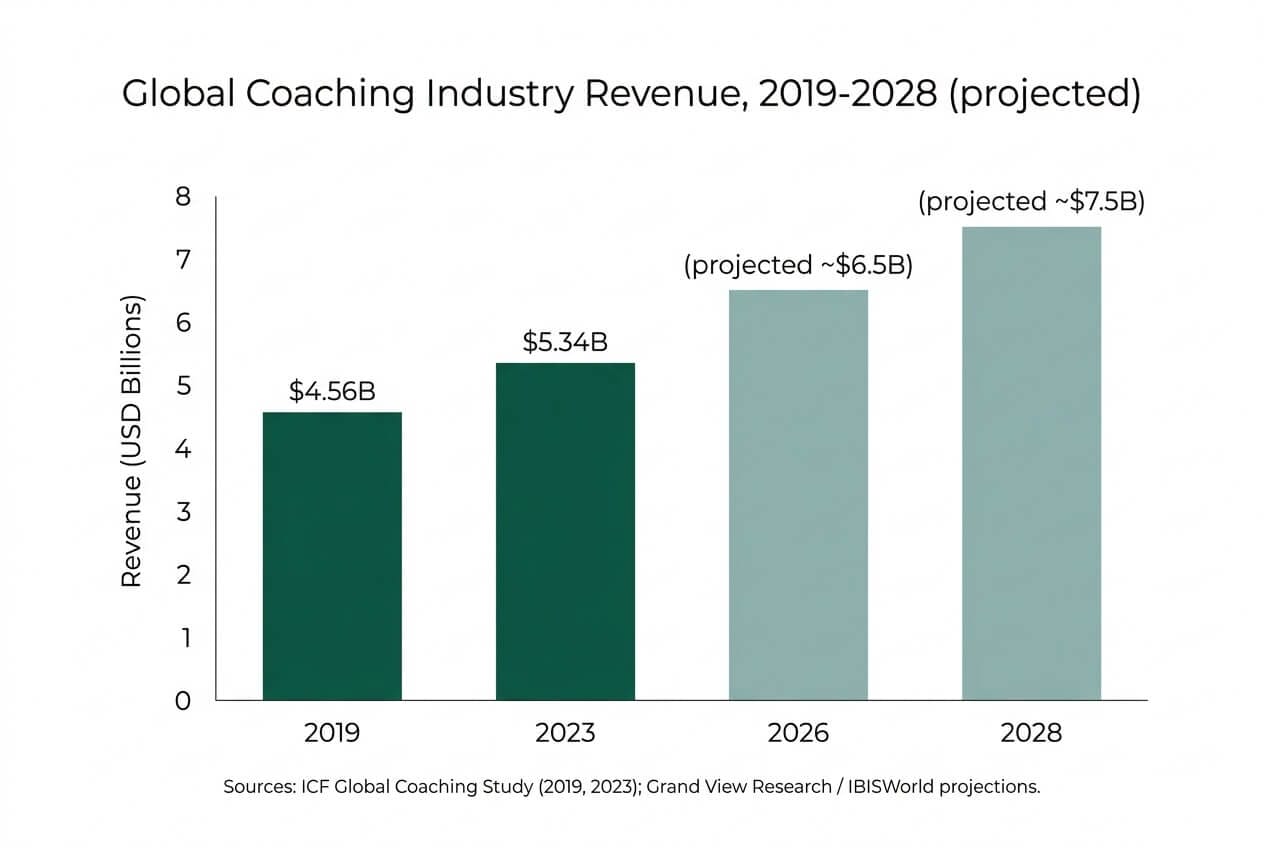
One methodology note that matters when citing CAGR figures: market projection numbers vary by 20% to 40% across analyst firms because they define "the coaching market" differently. Some include only paid coaching engagements; others include adjacent categories like coaching-skills training for managers, coach-training program enrollment, or digital coaching platform subscriptions. When citing a CAGR claim, name both the source and the market-definition basis.
Coach Demographics
The most detailed demographic breakdown of the global coach population comes from the 2023 ICF Global Coaching Study, drawn from a survey of practicing coaches across more than 100 countries.
Gender. Approximately 72% of practicing coaches globally identify as women, per the 2023 ICF study. This share has grown over consecutive editions of the study and is consistent with broader trends in human-development professions.
Age and experience. The 2023 ICF study reports a coach population concentrated in mid- to late-career years. The largest cohorts fall between ages 45 and 64, with smaller but growing shares of practitioners under 40 and over 65. Years of coaching practice cluster between 5 and 15 years, reflecting the post-2010 growth of the profession.
Geographic distribution. ICF’s membership and credentialing data place the largest concentrations of coach practitioners in North America (United States and Canada combined), followed by Europe (United Kingdom, Germany, France, and the Netherlands), then Asia-Pacific (notably Australia, Singapore, and Hong Kong). Latin America and Africa show the highest year-over-year growth rates, though from smaller base populations.
Full-time vs. part-time. The 2023 ICF study indicates that a majority of coach practitioners derive coaching income alongside other professional roles - consulting, teaching, leadership coaching within an organization, or therapy. Full-time independent coaching practice is a minority pattern, more common at higher credentialing levels (PCC and MCC). Coaching income statistics show wide variance: median full-time annual income runs roughly $50,500 globally per the 2023 ICF Global Coaching Study, but credentialed practitioners at PCC and MCC levels earn substantially more per session and per engagement than non-credentialed peers.
Prior career backgrounds. Coaches commonly enter the profession from corporate leadership, human resources, organizational development, training and development, or therapy and counseling backgrounds. ICF data does not currently publish a definitive prior-career breakdown, so any specific percentage claim should be treated with skepticism. Our audience-specific guide examines the decision for educators moving into professional coaching.
Coaching ROI - Published Studies and Findings
Coaching ROI is one of the most-cited and most-misused statistics in the field. The figures below are the rigorous, named studies that the citation chain traces back to. Where source methodology is contested or the figure is frequently misread, the methodology note is included. The impact of coaching on organizational outcomes - revenue, retention, engagement, decision quality - is what each study below attempts to measure, with varying methodological rigor.
The most-quoted ROI figures in coaching come from two studies published in 2001. Citing them as current 2026 industry benchmarks - without sample size, methodology, or the two-decade interval - is the citation hygiene problem this section exists to fix.
| Study | Year | Sample | Methodology | Headline Finding |
|---|---|---|---|---|
| MetrixGlobal LLC (Anderson) | 2001 | n=43 leaders, single Fortune 500 telecommunications company | Self-reported financial impact estimates | 529% to 788% ROI claimed (see methodology note below) |
| Manchester Inc. (McGovern et al.) | 2001 | n=100 executives across multiple firms | Self-reported business and behavioral outcomes | 5.7x average return on coaching investment; 77% improved working relationships |
| ICF / PricewaterhouseCoopers Global Coaching Study | 2009 | n=2,165 coaching clients globally | Self-reported financial recovery of investment | 86% of companies recouped at least their investment from investing in coaching; median ROI 7x |
| ICF Global Consumer Awareness Study | 2022 | ~10,000 respondents across 25 countries | Survey of clients and prospective clients | 85% of clients value coaches with credentials; 28% higher satisfaction with credentialed coaches |
| BetterUp Labs / CoachHub workplace research (various) | 2020-2024 | Varies by study; samples drawn from BetterUp / CoachHub member populations | Survey + platform behavioral data | Productivity, engagement, and retention gains documented; specific figures vary by report |
| International Journal of Evidence Based Coaching meta-analyses | 2010-2020 | Aggregated peer-reviewed studies | Meta-analytic effect-size synthesis | Moderate-to-large positive effects on goal attainment, well-being, and performance metrics |
For organizations seeking to measure coaching ROI in their own programs rather than relying on field-wide averages, see our team coaching ROI methodology for the measurement framework.
One pattern worth flagging: most published ROI claims rely on self-reported financial impact estimates collected from coaching clients themselves. Self-report has well-documented limitations - clients have a stake in believing the engagement worked, recall is imperfect, and counterfactual financial outcomes are unobservable. The figures above are still informative, but a defensible internal coaching ROI program supplements self-report with behavioral measures (peer review deltas, retention data, productivity metrics) rather than treating self-reported satisfaction as outcome.
The most credible direction for organizations evaluating coaching investment is to design measurement before launching the program. Choose 3-5 measures observable at 12 to 18 months, baseline them, and track the cohort against a comparable non-coached control where possible. The studies in the table above are useful as field benchmarks but should not substitute for organization-specific measurement.
Executive Coaching Pricing and Market Rates
Executive coaching rates vary by credential level, geography, industry, and engagement structure. The figures below reflect typical ranges in the United States and Western Europe; rates in Asia-Pacific and emerging markets generally run 30% to 50% lower for comparable engagements.
| Credential Level | Avg Hourly Rate (USD) | 6-Session Package | 12-Session Package |
|---|---|---|---|
| Non-credentialed | $150 - $300 | $1,200 - $2,400 | $2,400 - $4,800 |
| ACC (ICF Associate Certified Coach) | $200 - $400 | $1,800 - $3,600 | $3,600 - $6,000 |
| PCC (ICF Professional Certified Coach) | $300 - $600 | $2,500 - $5,000 | $5,000 - $9,000 |
| MCC (ICF Master Certified Coach) | $500 - $1,500+ | $4,500 - $12,000 | $8,000 - $20,000+ |
Industry context shifts these ranges. Financial services and technology sector engagements typically pay at the upper end. Nonprofit and education sector engagements typically pay at the lower end, often supplemented by foundation grants or sliding-scale arrangements. The 2023 ICF Global Coaching Study reports a global average annual coaching income of approximately $50,500 for full-time coaches, though that average masks wide variance between credentialed and non-credentialed practitioners.
Fortune 500 companies commonly budget $25,000 to $75,000 per executive coaching engagement at the senior level, with C-suite engagements regularly running $100,000 or higher. Team coaching engagements price separately and typically run $15,000 to $50,000 per multi-session program depending on team size and scope.
Virtual and remote coaching have compressed in-person coaching rate premiums since 2020 but not eliminated them; in-person engagements still command roughly a 20% to 30% premium where geographic proximity is feasible. The cost of executive coaching also varies sharply by session length - 60-minute coaching sessions are the modal unit, but 90-minute or shorter check-in sessions price differently. For a more detailed cost breakdown by program type, see our detailed breakdown of executive coaching pricing.
ICF Certification Landscape
The International Coaching Federation (ICF) is the largest professional body in coaching by credential count and geographic reach. The 2025 ICF Global Coaching Study reports tens of thousands of active credential holders worldwide, distributed across three certification levels.
| Credential | Approx. Active Holders | Required Coaching Hours | Required Training Hours |
|---|---|---|---|
| ACC (Associate Certified Coach) | ~30,000+ | 100 hours | 60 hours |
| PCC (Professional Certified Coach) | ~25,000+ | 500 hours | 125 hours |
| MCC (Master Certified Coach) | ~1,800 | 2,500 hours | 200 hours |
Credential counts last verified May 2026 against the ICF credentials and standards page; live counts shift by quarter as new credentials are issued and renewals lapse.
The MCC credential is the scarcest and most demanding of the three. The required 2,500 logged coaching hours and the rigorous performance assessment make MCC a slow ladder to climb; the global population of active MCCs sits in the low thousands across all countries combined. By contrast, the ACC entry-level credential has grown rapidly with the post-2019 expansion of coaching as a profession.
The 2022 ICF Global Consumer Awareness Study reports that 85% of coaching clients value working with credentialed coaches, and that clients of credentialed coaches report 28% higher satisfaction with their coaching experience compared to clients of non-credentialed coaches.
Tandem Coaching operates ICF-accredited ACC certification programs and PCC-pathway training; this is disclosed because we publish this page and have a direct interest in the ICF credentialing system. For program tuition and complete fee structures, see our full cost breakdown for ICF credentials.
Coaching Industry Segments
The coaching profession divides into segments by client type, modality, and specialty. Revenue and practitioner share differ sharply across these segments.
Executive and Leadership Coaching
Executive and leadership coaching is the largest revenue segment by a wide margin. ICF and HCI’s Building a Coaching Culture reports indicate that approximately 65% to 70% of Fortune 500 companies use external executive coaching, with most maintaining ongoing relationships with multiple coaches or coaching firms. Companies with a strong coaching culture - meaning coaching is integrated into management practice rather than reserved for top-of-house intervention - report higher employee engagement, retention, and revenue performance compared to peers without that integration. Average engagement length runs 6 to 12 sessions, often spread across 6 to 12 months. Corporate buyers (HR, talent development, learning and development functions) account for the majority of executive coaching spend; individual self-funded engagements are a smaller minority.
Life Coaching Statistics
Life coaching is the largest segment by practitioner count, though average engagement size is smaller than executive coaching. The life coaching market sits at the intersection of personal development and self-improvement spending and overlaps with adjacent fields including therapy and wellness. Demand for life coaches has grown alongside broader consumer interest in personal development; the 2022 ICF Global Consumer Awareness Study reports that the most-named coaching topics among consumers are personal growth (cited by ~40% of respondents), relationships, and life transitions. Benefits of life coaching most commonly named by clients include clarity on goals, improved decision-making, and follow-through on stated commitments. The life coaching market remains effectively unregulated in most jurisdictions; entry barriers are low and credential adoption is uneven, which complicates direct revenue measurement.
Business and Small-Business Coaching
Business coaching serves small-business owners and SMB executives, typically focused on growth strategy, hiring, and operational scaling. Small business coaching specifically targets owner-operators of firms with fewer than 50 employees, where the coach often functions as an outside thinking partner on decisions the owner cannot easily share with their team. Engagement structures vary widely: some business coaches operate on monthly retainers ($1,000 to $5,000/month), others on project-based engagements, and some hybrid the role with consulting or advisory work. The boundary between business coaching and small-business consulting is blurred in practice. The business coaching market is harder to size precisely than executive coaching because so many practitioners blend coaching with consulting in their fee structure.
Team and Systemic Coaching
Team coaching is the fastest-growing specialty within coaching, per EMCC Global research. Engagements typically span 6 to 18 months and address team dynamics, decision-making patterns, and inter-team coordination rather than individual performance. Team coaching is sometimes confused with group coaching, but the two differ in design: team coaching addresses an intact team working toward shared goals, while group coaching brings together unrelated individuals for parallel personal development on a common topic. The professional body of team coaches is smaller than the population of one-on-one coaches but growing in both ICF (Advanced Certification in Team Coaching) and EMCC certification systems.
Agile and Technical Coaching
Agile coaching emerged from the software development community and overlaps significantly with the leadership coaching population. Scrum Alliance and ICAgile maintain certification systems separate from ICF, though many agile coaches also hold ICF credentials. The agile coaching segment’s market size is harder to measure precisely because it spans coaching, training, and consulting roles within enterprise transformation programs.
Health and Wellness Coaching
The health and wellness coaching market has grown alongside broader healthcare consumer trends. The National Board for Health and Wellness Coaching (NBHWC) maintains a credentialing system parallel to ICF for health-specific practitioners. Health coach roles span clinical, corporate-wellness, and direct-to-consumer channels. Coaching helps clients with sustained behavior change in areas like nutrition, sleep, exercise adherence, and chronic-condition management. Health coaching can improve documented behavior-change adherence in clinical trial settings, and the integration of health coaching into corporate wellness programs has accelerated since 2020.
Career Coaching
Career coaching addresses transitions, advancement, and re-entry. Demand has been driven by sustained labor-market churn since 2020, AI-driven role displacement concerns, and the growth of mid-career career-pivot patterns. Career coaching engagements typically run shorter than executive coaching engagements (3 to 6 sessions is common) and are often self-funded by individuals rather than employer-sponsored. The career coaching market sits at the boundary of coaching and outplacement services.
Financial Coaching
Financial coaching is a smaller but growing segment, distinct from financial planning or investment advice. Financial coaches work with clients on behavior around saving, debt repayment, money management, and money-related anxiety. Most financial coaches operate as independent practitioners; the segment has limited credential standardization compared to executive or life coaching. Financial coaching differs from financial advising in that the focus is on behavior and money relationship rather than investment selection or product recommendation.
AI in Coaching - Adoption and Impact Data
Adoption data on AI tools in coaching practice is thin compared to other professions. Most published numbers come from coaching-platform vendors (BetterUp, CoachHub, Torch) or from informal practitioner surveys; rigorous independent measurement at field scale has not been published.
What is observable: the coaching platform market has raised substantial venture capital across the 2020-2024 window. BetterUp reached unicorn valuation in 2021 and continues to expand AI-assisted features. CoachHub raised similar growth-stage capital across multiple rounds. The combined market capitalization of digital coaching platforms now sits in the tens of billions of dollars, though much of that valuation is forward-looking. The future of coaching as a profession is increasingly shaped by how AI augmentation, hybrid delivery, and platform consolidation reshape the work.
Coach adoption of AI tools in their own practice (note-taking, session prep, marketing, scheduling) appears to be increasing rapidly based on practitioner-community signals, but no large-sample survey has measured the rate at field scale as of mid-2026. Estimates from coaching-vendor surveys put the share of practicing coaches using some form of AI tool at 40% to 60%, but those samples skew toward platform users.
ICF has published position statements on AI in coaching across 2023 and 2024, generally framing AI as an augmentation tool subject to confidentiality, ethical, and disclosure requirements rather than as a replacement for the coaching relationship. The EMCC has issued similar guidance.
This section last updated May 2026. AI adoption data in coaching is evolving rapidly; expect substantive revisions on the next annual update.
DEI in Coaching
Demographic depth in coaching field data remains limited beyond the gender breakdown. The 2023 ICF Global Coaching Study and ICF’s subsequent DEI reporting have begun publishing more detailed demographic data, though gaps remain.
Race and ethnicity. Within the United States coach population specifically, the 2023 ICF study reports approximately 75% of practicing coaches identify as white, with Black, Hispanic/Latino, Asian, and other underrepresented groups making up the remainder. The gap between coach demographics and client demographics is itself documented: organizational coaching populations in Fortune 500 settings are more racially diverse than the practicing coach population, creating a representation mismatch that several institutional buyers have flagged as an active concern.
Coaching access. Organizational coaching sponsorship has historically concentrated at the executive and senior leadership levels. ICF and HCI’s coaching culture research suggests that broader access (manager-level coaching, individual contributor coaching) is growing but remains a small share of total organizational coaching spend.
BIPOC coach development. ICF has launched DEI-focused initiatives across 2021-2024, including credentialing scholarships and community development programs. The growth rate of credentialed Black, Hispanic/Latino, and Asian coaches has outpaced the overall credentialing growth rate over the past five years, though absolute numbers remain disproportionate to the broader workforce.
Pay gaps within coaching. Income data within the coaching profession suggests gender and racial pay gaps that mirror broader professional service patterns, though detailed comparative data is not consistently published. Where data is thin, the responsible practice is to acknowledge the gap rather than fabricate a number.
Coach Training and Certification Market
The coach training market is a distinct segment from the coaching delivery market - it is the supply side that produces credentialed coaches. ICF maintains an accreditation system for training programs at three levels (Level 1, Level 2, and Continuing Coach Education or CCE), with several hundred accredited programs operating worldwide as of 2026.
Explore ICF-Accredited Training
ACC, Professional Coach (ACC+PCC+ACTC), Systems Coach Bridge, and ACTC programs with training, mentoring, and supervision included. See what fits your goals.
Coach training program costs vary widely by level, format, and provider:
- Level 1 (ACC pathway): Typically $4,000 to $8,000 for a complete program covering 60+ training hours and supervised practicum.
- Level 2 (PCC pathway): Typically $7,000 to $15,000 for the additional training hours and mentor-coaching required to qualify for the PCC credential.
- MCC pathway: The MCC requires 2,500 logged coaching hours plus advanced mentor coaching; cost varies dramatically depending on whether mentor coaching is bundled with a Level 2 program or sourced separately.
The shift to online and hybrid delivery has been the dominant trend in coach training since 2020. Most ICF-accredited programs now offer online or hybrid pathways; in-person residential programs continue to operate but represent a minority of total enrollment. Completion and dropout rates are not consistently published across the accredited program population, though anecdotal practitioner data suggests dropout rates of 10% to 25% across the credentialing pathway, with higher attrition between credential levels (ACC to PCC) than within a single program.
For prospective coaches researching the market, our ACC certification program and PCC certification program pages document specific program structures, schedules, and costs. Tandem Coaching operates ICF-accredited programs at both levels; this is disclosed because we publish this page and have a direct interest in the coach training market.
Methodology and Data Sources
Every statistic on this page links to a named source with a publication year. Where a source’s methodology is contested, the methodology is documented rather than suppressed. That is the entire commitment.
This page aggregates statistics from primary research published by professional bodies, market research firms, and peer-reviewed coaching journals. Primary sources include the references listed below, alongside our original GSC data study covering search-side demand patterns across 400+ coaching articles. Primary sources include:
- ICF Global Coaching Study - 2019, 2020, 2023, and 2025 editions, drawn from surveys of practicing coaches across 100+ countries. Primary source for revenue, practitioner counts, demographics, and growth rates.
- ICF Global Coaching Client Study and Global Consumer Awareness Study - Most recently 2022, drawn from surveys of coaching clients and prospective clients across 25 countries. Primary source for client-side perception, credential value data, and how clients perceive ICF coaching specifically.
- EMCC Global research - Primary source for European coaching market data and team coaching specialty data.
- Sherpa Coaching Executive Coaching Survey - Annual industry survey focused specifically on executive coaching practice.
- Peer-reviewed journals including the International Journal of Evidence Based Coaching and Mentoring, and the Coaching: An International Journal of Theory, Research and Practice. Primary source for ROI meta-analyses and effect-size data.
Methodology caveats. Market projection figures (CAGR, future revenue) vary by 20% to 40% across analyst firms because they define "the coaching market" differently - some include adjacent categories (coaching-skills training, manager-as-coach programs, digital coaching subscriptions), others restrict to formal one-on-one and team coaching engagements. Where this page cites a CAGR figure, the source and base year are named.
Disclosures. Tandem Coaching publishes this page. We operate ICF-accredited coaching certification programs and provide executive coaching services. Where statistics relate to areas where Tandem has a direct business interest (the ICF credentialing system, executive coaching pricing, coach training programs), this page links to our own service pages and discloses the relationship. Statistics not related to our business interests are cited from independent primary sources.
Update schedule. Data current as of May 2026. Next scheduled update: January 2027, aligned with the ICF Annual Report release. ROI study citations are reviewed annually; new published ROI studies that meet methodological rigor standards are added in subsequent updates. Where source methodology is contested (the canonical example being the often-recycled 700%+ ROI figure from MetrixGlobal’s 2001 study), this page documents the methodology rather than suppressing it.
Frequently Asked Questions
How big is the coaching industry in 2026?
The most recent 2025 ICF Global Coaching Study places global coaching industry revenue at approximately $5.34 billion for the past-year reporting period, with 122,974 coach practitioners worldwide. That is roughly a 60% revenue increase from the 2019 baseline of $2.85 billion, with continued growth projected at 8% to 9% CAGR through 2028 per Grand View Research and IBISWorld market projections.
What is the ROI of executive coaching?
Rigorous coaching ROI tracks behavioral and organizational signals over 12 to 18 months, not self-reported satisfaction. The defensible measures are: decision quality changes (peer review or 360 deltas), retention of high-potential leaders at 12 months post-engagement, time-to-productivity for newly placed executives, and observable shifts on behavioral competency frameworks (ICF-aligned or organization-specific). Survey-only data should be treated as input signal, not outcome. The most-cited published benchmark on the broader ROI of coaching is Manchester Inc.’s 5.7x figure from 2001, though that study’s methodology limits should be noted (see our ROI Studies section above for full methodology context on the canonical figures).
How many professional coaches are there in the world?
The 2025 ICF Global Coaching Study estimates 122,974 coach practitioners worldwide, a 15% increase since 2023 and a 54% increase since 2019. This figure includes practitioners across all coaching specialties (executive, life, business, leadership, team, health, and others) and across all credential levels including non-credentialed coaches.
What percentage of coaches are women?
Approximately 72% of practicing coaches globally identify as women, per the 2023 ICF Global Coaching Study. The share has grown over consecutive editions of the study and is consistent with broader trends in human-development professions.
How fast is the coaching industry growing?
Revenue grew approximately 60% from the 2019 baseline ($2.85B per the 2020 ICF Global Coaching Study) to the 2023 figure ($4.564B), and another 17% to the most recent 2025 figure ($5.34B). Practitioner count grew 54% from 2019 to 2023 and another 15% from 2023 to the 2025 study. Independent market research firms project continued CAGR of 8% to 9% through 2028, though projection methodologies vary.
What is the average salary of a life coach?
The 2023 ICF Global Coaching Study reports a global average annual coaching income of approximately $50,500 for full-time practitioners, but this figure masks wide variance. Life coaching income specifically tends to run lower than executive coaching income because session rates are lower and clients are more often individuals (paying out of pocket) rather than organizations. Credentialed life coaches command higher rates than non-credentialed practitioners; full-time independent life coaching practice remains a minority pattern within the broader coach population.
Is coaching a growing industry?
Yes. Both revenue and practitioner counts have grown across every consecutive ICF Global Coaching Study edition since 2015. The 2025 study documents a 15% practitioner-count increase since the 2023 study and a 54% increase since 2019. The benefits of coaching cited by clients - personal growth, decision-making clarity, and goal attainment - have driven sustained consumer demand alongside corporate procurement. Independent market research firms project continued growth at 8% to 9% CAGR through 2028.
How many ICF-certified coaches are there?
The International Coaching Federation maintains three credential levels: ACC (Associate Certified Coach), PCC (Professional Certified Coach), and MCC (Master Certified Coach). Approximate active credential counts as of 2026: ACC ~30,000+, PCC ~25,000+, MCC ~1,800. The MCC credential is the scarcest of the three, requiring 2,500 logged coaching hours and a rigorous performance assessment. Live counts shift quarterly; verify against the ICF credentials page for the current tally.
What percentage of Fortune 500 companies use executive coaching?
Approximately 65% to 70% of Fortune 500 companies use external executive coaching according to ICF and HCI’s Building a Coaching Culture research. Most large enterprises maintain ongoing relationships with multiple coaches or coaching firms rather than single-vendor arrangements, and engagements typically span 6 to 12 sessions across a 6- to 12-month window.
How much does executive coaching typically cost?
The cost of executive coaching varies by credential level and engagement scope. Hourly rates range from approximately $150 to $300 for non-credentialed practitioners, $200 to $400 for ICF ACC, $300 to $600 for ICF PCC, and $500 to $1,500+ for ICF MCC. Fortune 500 companies commonly budget $25,000 to $75,000 per executive coaching engagement at the senior level, with C-suite engagements regularly running $100,000 or higher. The benefits of executive coaching most often cited by L&D buyers - improved decision quality, leadership effectiveness, and team performance - track to behavioral changes that compound over the engagement window rather than to single-session outcomes. See our detailed breakdown of executive coaching pricing for full cost ranges by program type and engagement structure.
Not Sure Where to Start?
Tell us about your goals and we can help you find the right path forward.
Contact Us →