
AI Workforce Readiness: Why Training Alone Isn’t Enough
What is workforce readiness for AI?
Workforce readiness for AI is the organizational capacity to evaluate, challenge, and override what AI systems produce. It sits above tool fluency, which is operating the software, and above AI literacy, which is understanding what the software does. Readiness shows up when someone can defend an AI-assisted decision after the fact.
Seventy-eight percent of HR leaders expect AI to change what skills their workforce needs within three years. Twenty-four percent of organizations have a documented workforce strategy for AI. Both numbers come from the same survey, reported by Relocate magazine at the end of July.
The gap between those two figures usually gets read as a budget problem. Buy more training. Add AI literacy to the learning management system. Give someone the upskilling portfolio. Nearly every learning and development publication landed somewhere in that neighborhood over the last two weeks.
We read it differently. Course hours are not the scarce resource. The scarce resource is the set of conditions under which people build judgment about AI output, and those conditions live in how decisions get made rather than in what gets taught. If you are the learning leader inside the 76% with no documented strategy, you already knew that, and you already know most of the levers that would fix it are not yours to pull.
Key Takeaways
- Tool fluency and AI literacy are teachable through content. Operational judgment is not. It gets built where people are required to defend a call, disagree in front of others, and be wrong out loud.
- The competence illusion, where a person confuses what they understood with what the model organized for them, is now an organizational exposure. No dashboard you currently run will show it to you.
- Handing AI workforce readiness to L&D alone is a routing error. Most of the fixes sit in decision rights, review rituals, and manager behavior.
- Four interventions do the work: require the reasoning rather than the artifact, make overriding AI an expected and logged act, protect the entry-level work people learn from, and move managers from approving output to asking what shaped it. None of it holds if executives keep rewarding the fastest polished answer in the room.
What Workforce Readiness for AI Actually Means
Workforce readiness for AI is the capacity to evaluate, challenge, and override what an AI system produces. Organizations routinely collapse three separate things into that phrase: tool fluency, which is operating the software; AI literacy, which is understanding what the software does and where it fails; and operational judgment, which is being accountable for the output once it leaves your hands.
The first two are teachable through content. Run a workshop on prompting, publish a guide on model limitations, measure completion. Plenty of organizations have done exactly that and can show you the numbers.
The third behaves differently. Chief Learning Officer made the point in late July: the goal is teaching people to think critically inside an AI-enabled workplace, not turning every employee into a prompt engineer, with L&D building operational judgment rather than building courses. Right framing, and it quietly raises the difficulty, because judgment has never been transferable through a slide deck.
Judgment gets built in a specific kind of moment. Someone produces an answer. Someone else asks how they got there. The first person reconstructs the reasoning out loud, and either it holds or it does not. That moment is structural, and whether it happens depends on your review rituals, your meeting norms, and what managers do when handed a finished document. Which makes workforce readiness for AI an organizational coaching question before it is a curriculum question.
The Competence Illusion Is Now an Organizational Risk
The competence illusion is the experience of mistaking what a model organized for you with what you actually understand. From the inside it feels identical to genuine comprehension, which is what makes it dangerous at scale. Nobody reports it, because nobody detects it in themselves.
A Chief Learning Officer piece from July described the moment precisely. The author, twenty-five years into the field, was moving fast through an AI-supported research project and caught themselves thinking they really understood the material. Then they paused and asked whether they understood it or understood what the model had arranged. Their conclusion: if someone with that much experience can fool themselves, every employee in every organization can too.
The frame they reached for is Noel Burch's competence model, which runs from unconscious incompetence, through the stage where the gap becomes visible and then workable, to unconscious competence, where a skill finally works without effort. AI-assisted work compresses the felt distance between having read something, having understood it, and having performed it. The feeling of that last stage arrives without the reps that produce it.
Sit with what that costs a person. Someone produces a document they cannot fully defend, and they are not lying and not lazy. They experienced fluency. The organization rewarded the output. Nothing in their week told them a gap had opened. When it surfaces, usually in front of a client or a board, it lands as personal failure for something the system arranged.
Coverage of AI-driven skill decay in mexicobusiness.news makes the organizational version of the argument: prioritizing machine capability over the worker's own reasoning erodes critical thinking and analytical grit over time. Measurement is the part executives should sit with. Your engagement survey will not catch this. Neither will completion rates, throughput, or cycle time. Every metric you run will look better while the capability underneath it thins out.
Why L&D Cannot Close This Gap Alone
Learning teams have been handed a problem whose controls sit outside their authority. They can build awareness, design practice, and run the reflection sessions. They cannot change who signs off on a decision, what a manager asks for in a one-to-one, or whether disagreeing with a model output is career-safe.
Routing Error or Resource Problem?
If your AI readiness work sits entirely inside L&D, the fix requires executive decision rights you don’t control yet. A coach can help you map the real authority structure.
The survey numbers describe a function already past capacity. Relocate reported 95% of HR leaders carrying rising workloads and 91% saying their responsibilities grew over the past year. Sixty-seven percent name AI adoption a strategic priority, and fewer than a third feel prepared to lead the organizational change it requires. The Conference Board added the sharper finding, from interviews with 35 enterprise leaders and a global survey of nearly 1,300 workers: organizations are training people for the AI in front of them today rather than the jobs AI will produce.
Read together, that is a routing error rather than a performance problem. The work went to the function with the least authority over the actual mechanism. Most of what needs to change sits closer to change management skills and decision design than to course design.
| What the survey found | What it actually tells you | Who owns the fix |
|---|---|---|
| Only 24% have a documented AI workforce strategy | No one has decided which roles change and in what order | Executive team, with workforce planning |
| 95% of HR leaders report rising workloads | The function absorbing transformation has no capacity left to design it | COO and the executive sponsor |
| Fewer than a third feel prepared to lead the change | A capability gap in leading change, separate from any AI gap | Leadership development, jointly with the CEO |
| Training targets today's AI, not tomorrow's jobs | Curriculum is following tool releases instead of a role roadmap | Workforce planning, then L&D |
| 67% call AI adoption a strategic priority | Budget exists, but it is pointed at tools rather than judgment | CFO and the technology sponsor |
One row in that table belongs to L&D. The rest are executive decisions wearing a training costume. Assign the whole problem to the learning function and you get exactly what the Conference Board found: well-run programs aimed at the wrong target, because the people running them were never given authority to pick a different one. Treating the organization as the system you are working on changes both what you measure and who has to be in the room.
Reading Workforce Readiness at the System Level
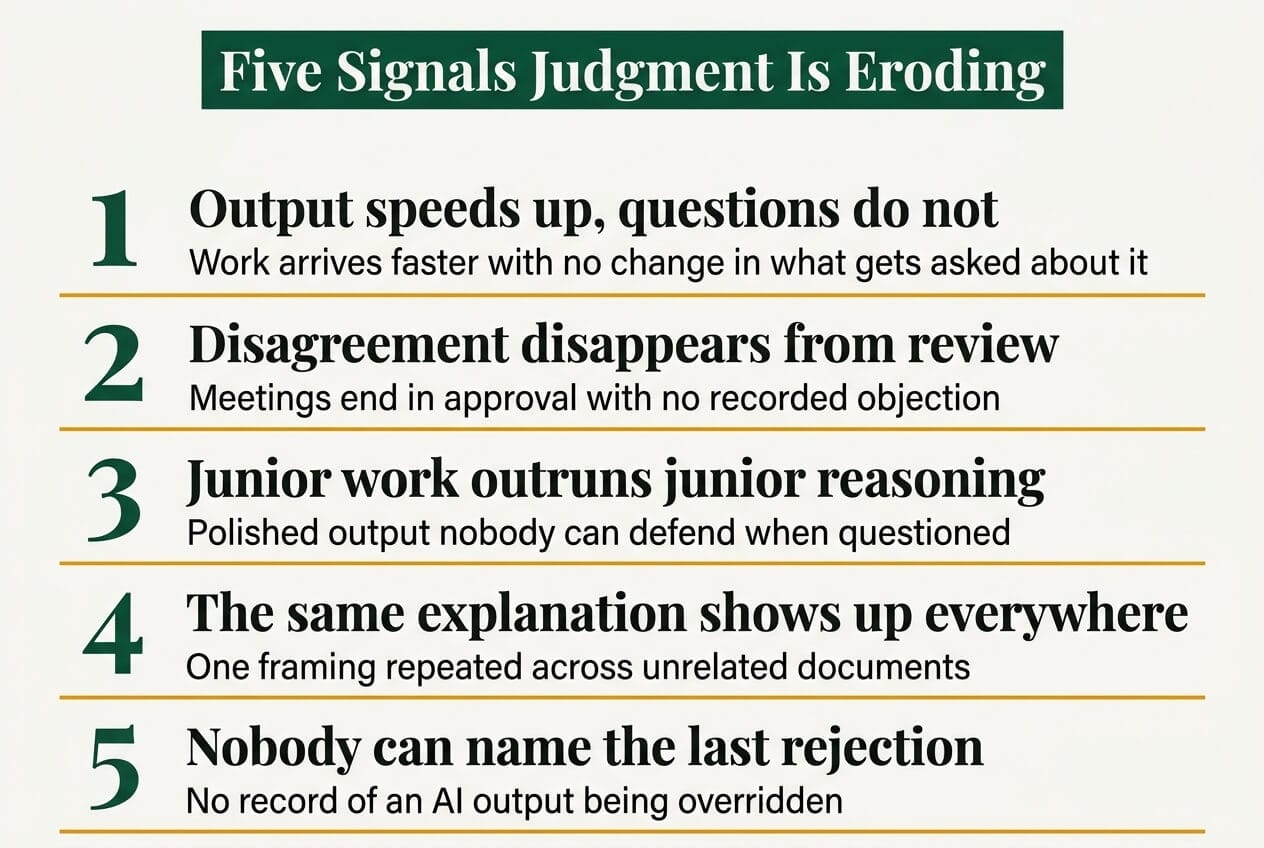
You will not find judgment erosion in your learning data. It shows up in how work moves: what gets asked in review, how much disagreement survives to the end of a meeting, whether anyone can reconstruct the thinking behind a finished artifact. Five signals are worth watching.
Output speeds up and the questions do not change. Work arrives faster, volume climbs, and the review conversation is what it was eighteen months ago. Throughput improved while scrutiny stayed flat, which is a widening gap rather than a productivity win.
Disagreement disappears from review. Track how often a review meeting produces a recorded objection. If that number quietly dropped toward zero while volume rose, people are approving work they have not interrogated. Speed makes disagreement expensive, and expensive behaviors stop.
Junior work outruns junior reasoning. A two-year analyst turns in something an eight-year analyst would be proud of, then cannot answer a second-order question about it. That is the competence illusion becoming visible, and the earliest reliable warning you get.
The same explanation appears across unrelated documents. One framing, one structure, one set of caveats showing up in a strategy memo, a client proposal, and a board update written by three different people. A model is doing the thinking and the humans are doing the formatting.
Nobody can name the last time an AI output was rejected. Ask directly in your next leadership meeting. If the room cannot produce an example from the past month, you do not have an override culture, whatever your AI policy says.
Civil Service World caught the texture of this in a piece on management skills and automation: the beautifully written email with flawless grammar and impeccable structure that does not sound like the person who sent it. Generic tone. Slightly over-polished language. Convincing, without ringing true. Their conclusion is the right one for our purposes. Those are judgement problems rather than AI problems, and they surface first as a quality issue nobody can quite name.
Four Coaching Interventions That Build Judgment
Judgment gets built through repeated exposure to one demand: reconstruct your reasoning where other people can examine it. Four interventions create that demand structurally, so it happens whether or not a manager remembers to ask. Each is a change to a ritual you already run.
Install These Interventions With Support
Changing review rituals and override norms requires more than a memo. Coaching embeds these shifts into how your leaders actually run meetings and sign off on work.
1. Review the reasoning, not the artifact
Change what gets submitted. Alongside the deliverable, the person brings a short account of how they got there: what they asked, what came back, what they kept, what they threw out, what they are still unsure about. The review starts there.
That makes the reasoning the object of attention, the one thing an AI system cannot supply on the person's behalf. It also hands the reviewer a real question to ask, which most reviewers want and few have. The failure mode is compliance: if the account becomes a template filled in afterward, you have added paperwork and changed nothing.
2. Name the override norm out loud
Make rejecting an AI output an expected, recorded, non-punitive act. Say it in a leadership meeting: we expect regular overrides, and a month with zero is a signal we will look into. Log them, review the log quarterly to learn what people are catching. The mechanism is psychological safety applied to one narrow behavior, because nobody slows a fast process to raise a doubt unless the cost is visibly low.
Do not tie override counts to individual performance ratings. The moment overrides are scored, people generate cosmetic ones and stop reporting the real ones, and you lose the only early-warning signal you had.
3. Protect the work junior people learn from
The tasks AI absorbs first are the ones apprenticeship was built on: first drafts, background research, summarizing a document set, assembling the initial model. Those tasks were never valuable as output. They were valuable as the mechanism by which someone developed a feel for the material.
Preserve some of that work as human-first and be explicit about why. Have junior staff produce the draft before seeing the model's version, then compare. The comparison is the development event. Skip this stage and you quietly drain the leadership pipeline you are counting on, four years before the shortage shows up in a succession review.
4. Move managers from approving to asking
A manager reviewing AI-assisted work has two available moves: evaluate the artifact, which the model already optimized for, or ask what shaped it. The second is coaching, and most managers have never been asked to make it.
The training is small and the shift is large. Three questions work on any submitted piece of work. What did you consider and reject? Where is this weakest? What would change your mind? None can be answered from the artifact alone. Run them consistently and you are building coaching into the organization as a lasting capability rather than a workshop people attended once.
What Leaders Have to Model First
Every intervention above asks people to slow down at the exact moment AI makes speed available. That request has no credibility from a leader who visibly rewards the fastest polished answer in the room. The modeling goes first.
The World Economic Forum analysis reported in late July describes the shift as moving from managing people to enabling them, with adaptability, human judgment, and continuous learning valued above operational oversight. The practical translation is smaller than it sounds. Say "I do not know yet" in a meeting where you could have produced a confident answer in thirty seconds. Answer honestly when your own team asks how you reached a decision.
What makes that hard is not the calendar. Admitting incomplete understanding costs an executive something real, and everyone in the room knows it, which is exactly why it lands when a leader does it. You cannot ask a twenty-six-year-old analyst to expose the limits of their thinking in a review if nobody senior has ever done it in front of them.
High Point University surveyed more than 500 C-suite executives, reported by Forbes in July, and found life skills predict who gets hired, promoted, and trusted to lead more reliably than AI or technical credentials do. Emotional intelligence, coachability, problem-solving, working well with other people. Any leadership development strategy that treats AI fluency as the headline and those capabilities as a footnote has the weighting backwards.
Pick one thing for this quarter. Ask your leadership team when they last rejected an AI output and what they did with the time it bought back. The quality of the silence will tell you where you are starting from.
Common Questions About AI Workforce Readiness
What is the difference between AI literacy and workforce readiness?
AI literacy is understanding what an AI system does, where it fails, and how to prompt it usefully. Workforce readiness includes that and adds the harder capability: evaluating output against something other than its own fluency, challenging it in front of colleagues, and owning the resulting decision. Literacy is teachable in a workshop. Readiness gets built through repeated practice under real stakes.
How do we measure whether judgment is actually improving?
Count behaviors rather than completions. Track recorded overrides of AI output per team per month, the proportion of reviews producing a documented objection, and how often a submitted artifact arrives with an account of the reasoning behind it. All three are countable from processes you already run, and the principle matches measuring development by behavior change rather than completion.
Should we still run AI training programs?
Yes. Tool fluency and AI literacy are real prerequisites and content delivers them efficiently. Correct the expectation rather than cancelling the program: a literacy course will not produce judgment, so do not measure it as though it should, and do not treat a completed rollout as evidence that workforce readiness has been handled.
Who should own AI workforce readiness if not L&D?
The executive team owns which roles change and in what sequence. Line managers own the review rituals where judgment gets built or lost. L&D owns capability design and the reflective practice supporting it. The failure pattern is handing all three to L&D and calling it a strategy.
Close the 76% Strategy Gap
Most organizations handed AI readiness to L&D without the authority to fix it. A coaching conversation can map which levers are yours—and who needs to be in the room.
Book a Free Consultation →