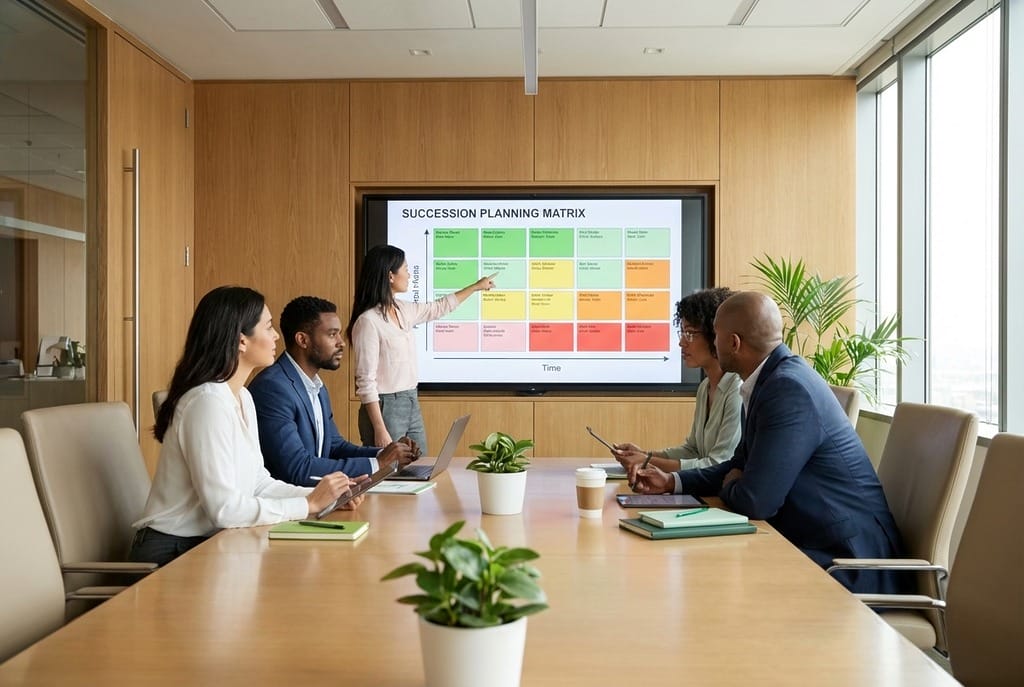
Leadership Development and Succession Planning: The System
What is the system for leadership development and succession planning?
Leadership development and succession planning operate as one integrated system with two loops. The organizational loop maps critical roles and pipeline depth. The individual development loop builds readiness against specific role requirements. Executive coaching connects them, translating succession designations into development agendas and feeding progress data back into organizational decisions.
Most succession programs produce lists. They call them HIPO lists, talent matrices, succession slates. Once the names are on the list, the organization considers its planning done.
The lists are not the problem. The problem is what organizations do not do next.
In a Harvard Business Review analysis, the authors estimated that companies in the S&P 1500 lose nearly one trillion dollars in market value each year due to poor succession planning. The gap is not in identifying the right people. It is in the distance between being named a successor and being genuinely ready to lead.
This article is about closing that gap: at the system level, not the individual level.
Key Takeaways
- Leadership development and succession planning are not two separate programs. They are two loops of one integrated system.
- Most succession programs fail because they confuse identification with development. Being named a successor is an organizational designation, not a readiness milestone.
- Executive coaching is not one method among many. It is the connective tissue that converts identified candidates into genuinely ready leaders.
- Succession health is measurable: internal fill rate, time-to-ready, and high-potential retention are the metrics that matter.
What Leadership Development and Succession Planning Actually Require
Leadership development and succession planning together form the organizational discipline of building a pipeline of leaders ready to move into critical roles. Those roles may open through growth, departure, or planned transition, and each situation requires deliberate change management during leadership transitions.
Leadership development is the ongoing process of building the capabilities, behaviors, and judgment that each organizational level requires. Succession planning is the organizational architecture that identifies which roles are critical, who the potential successors are, and what those successors need to be genuinely ready.
A 2022 Association for Talent Development survey of 243 organizations found that half were engaged in succession planning. Among organizations developing internal succession candidates, 81% used mentoring or coaching, 72% used stretch assignments, and 58% used formal learning. Those figures describe one research sample, not universal benchmarks. They show that succession planning depends on development activity after a candidate is identified.
The Center for Creative Leadership’s 2025 succession research makes the same practical distinction: naming a replacement answers who might be next, while leadership readiness asks whether the organization has enough capable people for the roles and conditions it may face. That broader view requires frequent evidence about pipeline depth, development movement, and retention risk.
A useful succession planning process has five recurring steps: identify the leadership roles that carry strategic risk, define the evidence required for each role, assess the internal candidate pool, assign development work, and review whether readiness changed. It is a long-term operating practice, not a document produced for one meeting.
The development mix may include training, mentoring, stretch assignments, job rotations, and coaching. Choose each method for the capability employees need to demonstrate. A proactive plan also names who owns the assignment, what evidence the sponsor will observe, and when the next readiness decision will occur.
The organizations that close the readiness gap are the ones that treat leadership development and succession planning as one system with two components, not two departments with a shared interest in talent.
Understanding what is leadership development at the organizational level is the prerequisite for building succession that works. Development is not a course catalog or an annual review cycle. It is the deliberate process of building leaders who can hold roles at a higher level of organizational complexity than the ones they currently hold.
Why They Must Be a System, Not Two Separate Programs
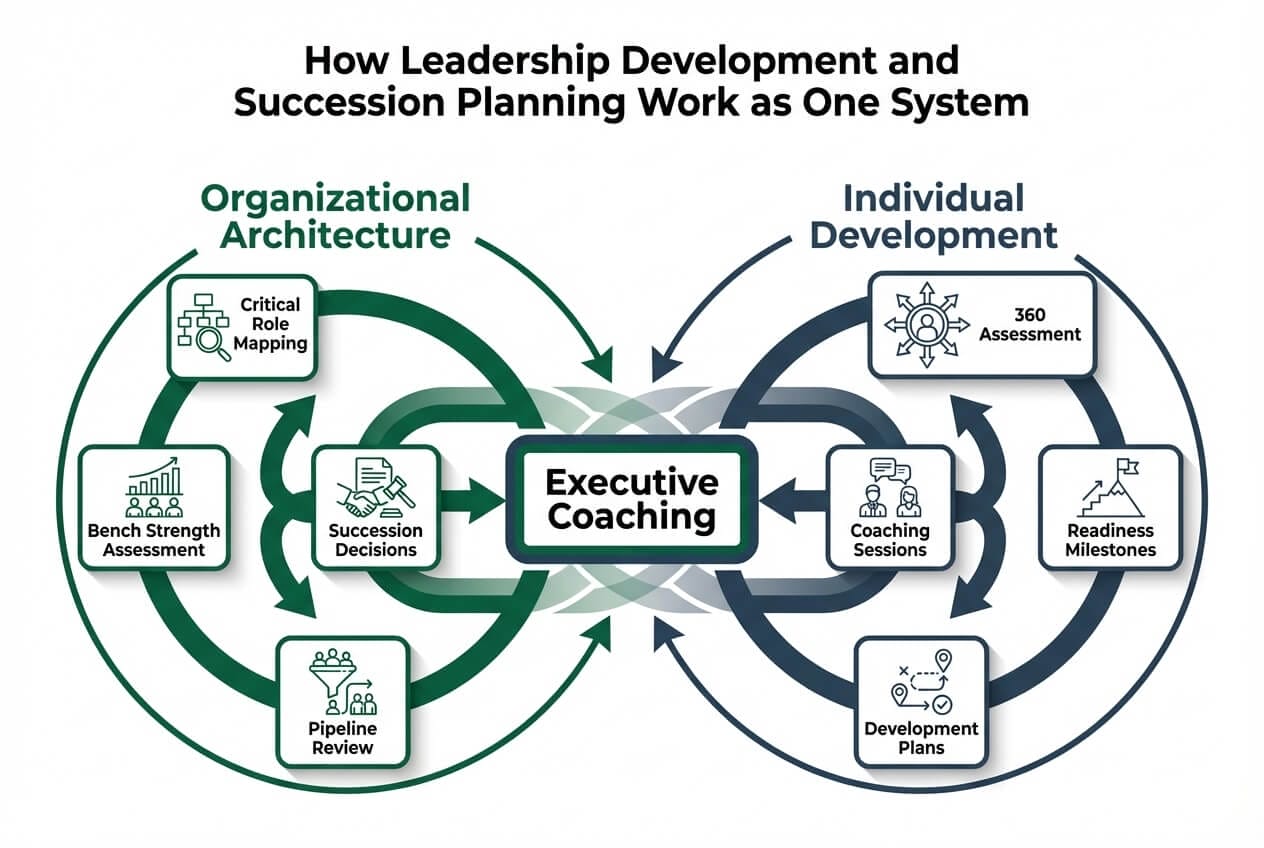
When organizations run succession planning and leadership development as separate processes, they create a structural gap that no individual effort can close.
The integrated system has two interconnected loops.
The organizational loop manages the supply and demand side of leadership: mapping which positions are critical to organizational continuity, assessing the current pipeline depth for each critical role, conducting periodic pipeline reviews with senior leadership, and making succession decisions when vacancies occur or can be anticipated. This loop answers the organizational question: do we have who we need, and will we have them when we need them?
The individual development loop operates at the person level: assessing where each succession candidate currently stands relative to the requirements of the target role, building a coaching and development agenda calibrated to that gap, tracking progress against explicit readiness milestones, and feeding that progress data back into organizational succession decisions. This loop answers the individual question: is this person actually moving toward readiness?
These two loops need to be actively connected. That connection is where most programs fail.
A succession program running only the organizational loop produces lists: updated annually, reviewed in talent reviews, rarely connected to actual development activity. A leadership development program running only the individual loop produces well-developed leaders who may or may not be aligned to the specific roles the organization most needs to fill. Coaches who deliver integrated programs like this one for client organizations typically have a coaching practice LLC and contracts in place before the engagement starts.
The connection between the loops is executive coaching. Coaching translates the organizational question (is this person ready for this role?) into an individual development agenda. The coach works with the succession candidate on the specific behavioral shifts, capability gaps, and identity transitions the target role requires. Progress in coaching sessions becomes signal that feeds back into the succession decision.
Being named a successor is not the same as being a ready leader. One is a designation. The other is a development achievement. That achievement requires active investment, not just a spot on a list.
This is the architectural difference between succession programs that produce ready leaders and succession programs that produce stagnant talent matrices with no meaningful movement in them year over year.
Building the Pipeline: From Identification to Readiness
Building an effective pipeline starts with an honest assessment of which positions actually matter. No fixed percentage identifies the critical roles in every organization. A role belongs in the succession system when a vacancy would threaten continuity, the capability is difficult to replace, the role carries essential institutional knowledge, or its decisions have an outsized effect on the strategy.
For each critical position, the target is a pipeline with genuine bench strength: two to three candidates at different stages of readiness. Bench strength is not redundancy for its own sake. It is organizational resilience. A bench of one candidate with no backup means a single resignation or unexpected departure creates a succession crisis that no planning document prevents.
CCL’s 2025 Blueprints for Success recommends examining succession depth and retention risk across readiness windows such as 0–2, 2–5, and 5+ years. The exact windows can vary. Their value is that they force leaders to test whether readiness is moving instead of carrying the same names forward each year.
The original 2001 Leadership Pipeline by Ram Charan, Stephen Drotter, and James Noel described six leadership passages. The revised 2024 third edition, written with Kent Jonasen, organizes the current model around five core passages: leading others, leading leaders, leading a function, leading a business, and leading an enterprise. Both versions examine the skills, use of time, and work values required at each transition. The five levels below are Tandem’s practical pipeline view, not a reproduction of either edition.
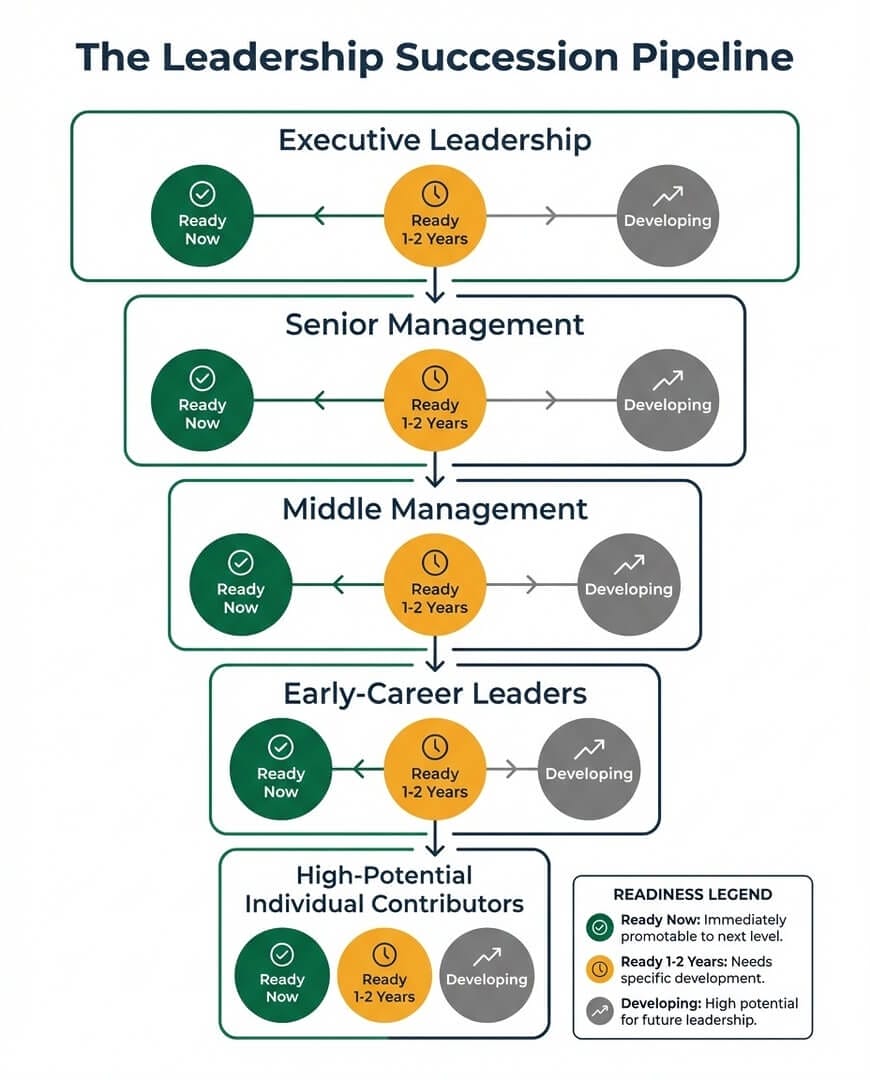
For the scorecard in this article, we map five practical pipeline levels: high-potential individual contributors, early-career managers, mid-level managers, senior leaders, and C-suite candidates. This is an operating view for succession reviews, not a claim that every organization has the same hierarchy.
For organizations building team coaching for succession readiness, group coaching at the pipeline level creates a cohort effect: candidates develop in parallel, learn from each other’s challenges, and build the peer relationships they will rely on when they are peers in senior roles. Building a development plan aligned to succession role requirements is not a generic planning exercise. Each candidate’s plan must be calibrated to the specific gap between their current capability and what their target role demands.
How Coaching Accelerates Succession Readiness
Coaching is one part of a broader development portfolio. In ATD’s 2022 survey, mentoring and coaching were the most frequently reported methods for developing internal succession candidates, followed by stretch assignments, formal learning, and regular performance feedback. The survey establishes common practice within its sample; it does not establish that one method causes succession success.
Within Tandem’s two-loop system, coaching has a specific job: connect organizational readiness evidence to an individual development agenda. Stretch assignments create the work. Feedback shows how the candidate is handling it. Coaching gives the candidate a recurring place to examine decisions, behavior, and the demands of the target role.
A 360-degree assessment can create a shared evidence base. The assessment should be tied to target-role criteria and interpreted alongside observed results, stakeholder feedback, and work samples. Used that way, it helps the organization assess the gap and helps the candidate decide what to practice. A 360 score alone is not a succession decision.
Leadership passages involve changes in work values and use of time. The Leadership Pipeline framework makes this distinction explicit. A high-potential director preparing for a vice president role may need less technical depth and more capacity to delegate authority, integrate across functions, and hold enterprise-level tradeoffs. Coaching can support that transition, but the candidate still needs assignments where the new behavior can be observed.
Cohort coaching can make the system visible. In Tandem’s practice, combining individual sessions with structured cohort work lets candidates compare challenges, test assumptions with future peers, and develop the organizational awareness required in senior roles. Treat that as a design choice to evaluate, not a universal requirement. The evidence should be movement in role-specific capabilities and behavior at work. Our leadership development coaching for rising leaders is built on that combination: individual coaching and monthly mastermind groups, with a 360 assessment at the start and again at the end.
In my experience, coaching earns its place in succession work when it moves a candidate from identified to demonstrably more ready.
The quality of the organizational integration of coaching matters more than the presence of coaching on a benefits list. Sponsors, coaches, and candidates need a clear agreement about the target capabilities, confidentiality boundaries, evidence sources, and review cadence.
Succession Readiness Matrix and Scorecard
A succession matrix should show evidence and development movement, not just a color or a name in a box. Use four readiness levels: 1: exposure only, 2: can perform with support, 3: ready for a planned move, and 4: has demonstrated the capability at target-role scope. Do not average away a critical gap. The lowest capability essential to the target role should control the readiness decision.
Define the evidence standard before discussing any candidate. That keeps a confident sponsor, a recent success, or a familiar name from quietly changing the meaning of “ready” during the review.
| Candidate | Target role | Readiness | Critical gap | Evidence | Development action | Sponsor | Review date |
|---|---|---|---|---|---|---|---|
| [Name or confidential ID] | [Role] | [Ready now / 1–2 years / 3+ years] | [Lowest critical capability] | [Observed behavior, result, or assessment] | [Stretch assignment, coaching, rotation, or practice] | [Named leader] | [Date] |
Complete the blank matrix with confidential identifiers when the document may circulate beyond the succession group. Store the working record inside the organization’s approved talent system, with access limited to people who have a legitimate role in the decision.
Review one critical gap at a time. A long development list hides the capability that could prevent a successful move, while one explicit gap gives the candidate, sponsor, and coach a testable development priority.
Here is a completed example. It is a model, not a Tandem client case:
| Candidate | Target role | Readiness | Capability evidence | Development action | Owner and review |
|---|---|---|---|---|---|
| Candidate A, VP Operations | Chief Operating Officer | Ready in 1–2 years | Enterprise strategy: 2; board communication: 2; talent leadership: 3; change leadership: 3 | Lead one cross-enterprise portfolio, present quarterly to the board committee, and use executive coaching to review stakeholder impact and decision patterns. | CEO sponsor; quarterly review |
At portfolio level, track ready-now coverage for critical roles, candidates moving from 3+ years to 1–2 years, completion of role-specific development actions, internal fill rate, and retention of identified candidates. A scorecard is useful only when the same evidence standard is applied at each review cycle.
Measuring Whether Your Succession Program Is Working
If you measure succession program health by the number of names on your HIPO list, you are measuring input, not outcome.
Use leading indicators to see whether development is moving, and outcome indicators to see whether the pipeline supplied capable leaders when roles opened. CCL’s 2025 evidence review identifies bench strength, retention, candidate-development progress, and time or cost to fill as common quantitative measures. Tandem recommends defining each measure against your own critical-role population before comparing periods.
Ready-now coverage is a leading indicator. Divide the number of critical roles with at least one candidate who meets the agreed ready-now standard by the number of critical roles assessed. Report roles with one ready candidate separately from roles with two or more; both count as covered, but they do not carry the same continuity risk.
Readiness movement is a leading indicator. Count candidates who moved to a shorter readiness window because new evidence met the target-role standard, then divide by all candidates reviewed in that period. Do not count a changed label without changed evidence.
Internal fill rate is an outcome indicator. Divide critical roles filled by internal candidates by all critical roles filled during the measurement period. Segment planned transitions from emergency vacancies so a single blended rate does not hide where the system broke down.
Time-to-ready is a development measure. Record the elapsed time from an agreed baseline designation to evidence-backed readiness. Use a median when a few unusually long or short cases would distort the average, and compare similar role levels.
High-potential retention is a risk indicator. Divide identified candidates who remain through the period by the number in the defined cohort at the start, adjusting transparently for planned exits or completed moves. Review the measure by manager, role level, readiness window, and access to development.
Succession utilization is an outcome indicator. Divide appointments from the formal succession slate by roles for which an approved slate existed. A low rate warrants a case review: the candidates may not have been ready, the role may have changed, or the hiring decision may have bypassed the process.
Connect these measures to leadership development goals, leadership team development outcomes, and the wider discipline of change management metrics. Keep the definitions stable across review cycles. A scorecard cannot reveal movement if the denominator or readiness standard changes whenever the result is uncomfortable.
If you measure succession health by how many names are on your HIPO list, you are measuring the wrong thing. The question that matters is how many of those people are actually ready. What are you doing this quarter to move that number?
Frequently Asked Questions
What is pipeline leadership?
The Leadership Pipeline is a succession and leadership-development framework created by Ram Charan, Stephen Drotter, and James Noel. The original edition described six passages; the 2024 third edition, written with Kent Jonasen, uses five core passages. Both versions define each transition through changes in skills, use of time, and work values. A succession program can use those role demands to set development targets and assess readiness more precisely.
What are the five levels of succession planning?
This article uses five practical levels for its readiness scorecard: (1) high-potential individual contributors preparing for a first leadership transition; (2) early-career managers; (3) mid-level managers building function-level capacity; (4) senior leaders developing enterprise perspective; and (5) C-suite candidates developing organizational and board-level accountability. The levels are Tandem’s operating synthesis. Organizations should adapt them to their own structure and define different readiness evidence for each level.
What role does coaching play in succession readiness?
In Tandem’s two-loop model, coaching connects organizational succession architecture with individual leadership development. A 360-degree assessment can contribute evidence to the organization’s review and the candidate’s development agenda when it is tied to target-role criteria and combined with observed results. Useful measures include movement in role-specific capabilities, time to readiness, internal fill rate, and whether development actions change behavior at work. Our review of the research on executive coaching benefits explains why a universal ROI percentage is not a credible substitute for those engagement-specific measures.
Sources and Citation Guidance
The two-loop system, five-level operating view, readiness rubric, and scorecard are Tandem Coaching’s practitioner synthesis. The sources below support the published evidence, Leadership Pipeline attribution, and measurement guidance discussed in the article.
When using the page in coursework or an internal paper, cite the original source for its research finding and cite this page for Tandem’s system, interpretation, or scorecard. The cited studies use different samples and methods, so their percentages should not be combined into one benchmark.
Succession plans contain sensitive employment information. The public template shows the evidence structure, while each organization remains responsible for access controls, retention rules, and the employment decisions made with its completed records.
- Fernández-Aráoz, Claudio, Gregory Nagel, and Carrie Green. “The High Cost of Poor Succession Planning.” Harvard Business Review, May–June 2021.
- Association for Talent Development. “ATD Research: More Companies Are Turning to Succession Planning to Identify Future Leaders.” 25 Aug. 2022. The survey report used a sample of 243 organizations.
- Center for Creative Leadership. “Succession Planning Research for Leadership Pipelines.” 2025. See the linked Evidence-Driven Succession and Blueprints for Success reports.
- Charan, Ram, Stephen Drotter, James Noel, and Kent Jonasen. The Leadership Pipeline: Developing Leaders in the Digital Age. 3rd ed., Wiley, 2024.
Cite this page in APA: Silas, C. (2026, September 16). Leadership development and succession planning: The system. Tandem Coaching. https://tandemcoach.co/leadership-development-and-succession-planning/
Cite this page in MLA: Silas, Cherie. “Leadership Development and Succession Planning: The System.” Tandem Coaching, 16 Sept. 2026, https://tandemcoach.co/leadership-development-and-succession-planning/.
Conclusion
The organizations that build succession programs producing ready leaders are the ones that recognize leadership development and succession planning as a single integrated system, not two separate programs that happen to share an interest in talent.
The integration mechanism is executive coaching. When coaching is positioned not as a benefit but as the operational connective tissue between the organizational loop and the individual loop, succession programs stop producing stagnant lists and start producing leaders who are genuinely ready when the role arrives.
Tandem’s team of MCC-level coaches works at the intersection of organizational succession design and individual leadership development. If your organization is building or evaluating a succession-integrated leadership development program, that is exactly the kind of engagement we design for.
Pressure-Testing Your Succession Plan?
In a free consult, map critical roles, define competencies, and identify the fastest development moves before a transition hits.
Book a Free Consultation →Plan the engagement first →