























Leadership Team Offsite: Planning an Offsite Agenda That Ends in Decisions
How Do You Plan a Leadership Team Offsite?
Plan a leadership team offsite backward from one purpose sentence the leader can check on the last afternoon. Three to four weeks ahead, every member answers a short team check. The agenda then holds three or four big topics over two days, each session ends in a named output, and a follow-through plan reaches every member within 48 hours.
Free kit in this article The Leadership Team Offsite Kit
A leadership team offsite is judged on the Monday after it ends. If the weekly meeting then runs as it did before, with the same updates and the same argument coming back, the team has spent two days of its most expensive time and settled nothing.
Most offsite agendas are topic lists: strategy, budget, culture, a team-building afternoon and a dinner. This guide builds the agenda backward from what the team must leave with. It starts with a purpose you can check and a short check of how the members see the team, fills two days with working sessions that each end in a named output, and ends with a follow-through plan for the next 90 days.
It is written for the leader and for whoever organizes the team offsite, often a chief of staff or an HR or learning and development leader. The sample agenda and the session plans come from Tandem’s free Leadership Team Offsite Kit, offered after the agenda section.
Key Takeaways
- Write the offsite’s purpose in one sentence the leader can check at 3 p.m. on the last day.
- Check the team three to four weeks before, and give the lowest area and the widest spread a session each.
- Hold three or four big topics in two days, name every session’s output and decide on day two.
- Choose working sessions that end in a decision or an agreement over games.
- Send the follow-through plan within 48 hours and review it at day 30 and day 90.
What a Leadership Offsite or Retreat Is For
An offsite earns its days when it settles what the weekly meeting cannot settle, such as a decision that needs everyone, a disagreement that keeps returning or a habit that has stopped working. In Off-Sites That Work (Harvard Business Review, 2006), Bob Frisch and Logan Chandler note that management teams spend a day to a week a year at off-sites, at a cost to U.S. companies of hundreds of millions of dollars a year in salaries, and that an off-site differs from every other meeting senior leaders attend.
Leadership offsites come in four kinds, and the kind decides what the executive team leaves with.
- Strategy. The direction is open. The team leaves with a few priorities, an owner for each and what stops to make room.
- Priorities and plan. The direction is set, but the priorities outnumber the people and the money. The team turns the strategic plan into a short ranked list and says the trade-offs out loud.
- The team itself. Decisions do not hold and the same conflict returns. The team leaves with agreements on how it meets, decides and disagrees.
- A reset. New members, a new leader, a merger or a stalled change. The team leaves with a shared account of where it stands.
When two kinds mix, one leads and the second gets no more than a third of the time. For a reset after a stalled change, a change model such as Kotter’s helps the team find where the change broke down.
Every offsite needs its purpose in one sentence that starts with “By the end of the last session, we will have” and ends in a verb you can check. Test it three ways. Would anyone notice the difference on the Monday after? Does it need this whole team? Could the chief executive officer tell at 3 p.m. on the last day whether it happened? “Align the leadership team on next year” fails the last test. “By 3 p.m. on day two we will have chosen no more than three company priorities, each with one owner” passes all three and gives the two days a goal the team can reach.
Strategic offsites also need a boundary. Say in the invitation what the offsite will not settle, such as the budget line by line or a member’s performance, which belongs in a one-on-one. If the leader already knows an answer, say so beforehand, because a team asked to decide what is already decided stops trusting the next question. The boundary keeps the strategic work for what only the whole team can answer.
Who Comes, How Long and Who Handles Facilitation
The full team comes, and for most of the time nobody else. A guest, such as a board member, joins one session with a clear question and leaves before the team discusses it. An outsider taking minutes changes what people say, so the organizer or a member records the decisions.
Length follows the purpose. One day fits one narrow decision. A day and a half with a night fits one hard conversation on day one and the decisions that depend on it the next morning, after people have slept on it. Two full days fit strategy with real analysis, a new team or a merger. Energy drops after lunch on the second day, so the follow-through comes before it.
When you are planning an offsite, choose an offsite location away from the office but close enough that nobody leaves for an evening meeting. Keep one conference room for every session, with walls to write on and a table where everyone around the table can see everyone. Agree in the invitation that devices stay away except in breaks.
Then settle facilitation. A leader who facilitates steers, and a leader who steers speaks first, so the leader takes part and someone else runs the room. The organizer, from outside the team, can do it if the team trusts them to stop the leader. A member can run one session each and take little part in it. An outside facilitator fits when the check points to conflict, the team is merging or the leader’s view is already known. Either way, the leader must be free to fully participate. If you are choosing between a facilitator or a team coach, decide first whether the team needs help for two days or for the months after.
Check the Team Before You Write the Offsite Agenda
An agenda the leader writes starts from the leader’s view of the team. A short check, sent to every member three to four weeks before, adds everyone else’s view. The agenda then spends its time where the team needs it, and it shows where the team dynamics the members describe differ from the leader’s.
The Team Effectiveness Check in Tandem’s kit has twelve statements across six areas, adapted from the conditions for team effectiveness in Senior Leadership Teams (2008) by Ruth Wageman, Debra Nunes, James Burruss and J. Richard Hackman.
- A real team. Is it clear who is on it, and does its work need all of them?
- A compelling purpose. Is there work only this team, together, can do?
- The right people. Does it have the perspectives and teamwork skills its work needs?
- Sound structure. Does it have a workable size, real shared tasks and explicit norms?
- A supportive context. Do rewards, information and resources support working as one?
- Team coaching. Does someone skilled with teams help it look at how it works?
Tandem wrote the statements for this use and has not validated them, so read the scores as a pointer to where the team should talk. Tandem’s guide to leadership team development explains what each condition means for a leadership team.
Every member answers alone, the leader included, in about five minutes. Someone outside the team, the organizer or an HR business partner, collects the forms and shares only the tally, and the leader marks theirs so the collector can set it beside the team’s. Say up front that in a team of six or eight a note in the margin is easy to trace.
For each area the collector notes the average and the spread, the highest score minus the lowest. An average under 3 gets a session of its own. A spread of 2 or more is named at the opening, because members experience the team differently. A leader who scores a point or more above the team hears it first, in private. These cut-offs are rules of thumb for choosing what to talk about.
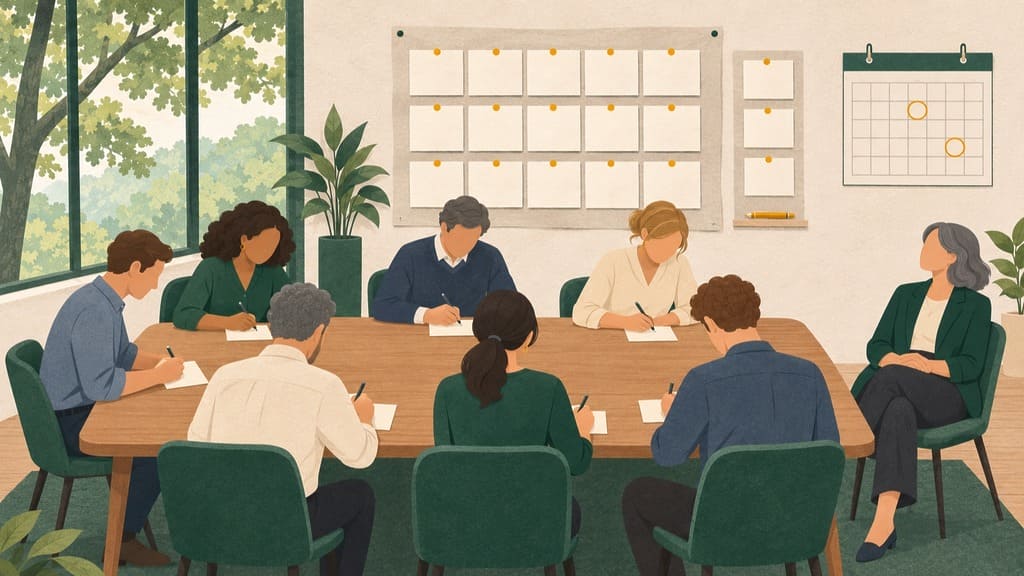
The check is the first piece of pre-work. The second is one pre-read a week before, which holds anything that would otherwise be a presentation. The third is one written question, such as “What is the one decision this team has avoided this year?”, read out without names at the opening.
How to Structure Your Offsite: Seven Rules and a Two-Day Sample Agenda
To structure your offsite, build the agenda backward. Start from what the team must leave with, then the conversation each output needs, then what the team must know first. A clear agenda names every session’s output before anyone arrives, whether that is a decision, an agreement, a short list or a question parked with an owner and a date. Most of the time to design an offsite goes into those outputs, and seven rules set the order.
- Three or four big topics in two days, no more. Each needs time to explore before it is decided.
- Name each session’s output in advance. Write it on the agenda beside the session.
- Put the hardest conversation on day one, before the decisions that depend on it.
- Decide on day two, after the team has slept on day one.
- Hold the follow-through before lunch on the last day, never in the last half hour.
- Keep a break every 90 minutes to two hours. An overrun takes its time from the break, and the next session pays for it.
- Allow no presentation longer than 15 minutes. Send it as a pre-read and spend the time on questions.
The sample below is an illustration for a company of about 700 people with a leadership team of eight, whose check pointed to how the team makes decisions.
| Day | Time | Session | Output |
|---|---|---|---|
| Day one | 9:00 | Opening with the purpose, the agreements and what the check said | The purpose and the agenda, agreed |
| Day one | 10:15 | Break | |
| Day one | 10:30 | Where the business stands (pre-read, questions only) | What the priorities must answer |
| Day one | 12:00 | Lunch | |
| Day one | 1:00 | How this team decides | Agreements on where decisions are made and recorded |
| Day one | 2:30 | Break | |
| Day one | 2:45 | The long list, from fourteen candidate priorities to five | Five candidates, each with a one-page case |
| Day one | 4:45 | Close of day one | What is decided and what is still open |
| Day one | 7:00 | Dinner, with no agenda | |
| Day two | 8:45 | What has changed overnight | |
| Day two | 9:00 | Choose the priorities, from five to three | Three priorities, one owner each, two things the company stops |
| Day two | 10:45 | Break | |
| Day two | 11:00 | What the bonus plan rewards | A proposal for the board, with an owner and a date |
| Day two | 12:00 | Follow-through (owners, first steps, reviews) | The follow-through plan, filled in |
| Day two | 1:00 | Lunch | |
| Day two | 1:45 | What we tell our teams | One written summary every member uses |
| Day two | 2:30 | Close with one commitment each | Each member’s commitment, said out loud |
| Day two | 3:00 | End |
Change the times and keep the shape. Every session opens with its purpose and output, explores the question with written answers before any debate, decides by a rule named in advance and records the result where everyone can see it. A one-day offsite keeps the same order for its one decision.
Your check may point somewhere else, such as a purpose the members describe in different ways or rewards that pull each member toward their own function. Put that conversation in the day-one afternoon slot. Give an issue the room cannot settle alone, such as a bonus plan the board approves, a session whose output is a proposal with an owner and a date.
The kit below holds what the sample leaves out. It has the Team Effectiveness Check with its tally sheet, a blank offsite agenda, seven timed session plans and a blank one, the follow-through plan and a pre-offsite checklist, as a PDF guide and an editable Word file. Each session plan gives its purpose, its output, the minutes for each step and the questions to ask, which is the part of offsite design that takes longest to write.
Team Building Activities for Leadership Teams That End in a Decision
Search for team building activities for leadership teams and most results are lists of games, from escape rooms to icebreakers. A game can fill an afternoon and give people a good evening. Tandem’s view is that the activities worth a senior team’s offsite time are working sessions, each built around a real question the team faces and each ending in a decision, an agreement or a short list. Team building happens along the way, as members learn how the others think and disagree by working through hard questions together.
Plan a Session Where the Team Practices a Skill
Choose the behavior to change, the time, the format and the group size. The free workshop sequencer gives a timed agenda with facilitation notes and debrief questions. No email needed.
The sessions below come from the kit’s session plans and from published methods. Each fits a slot in the sample agenda and names its output before it starts, so whoever runs it knows when it is done. Leadership development activities, where people practice a skill together, are a different job and belong in a session of their own, with its own plan.
Personal Histories, for a New or Merged Team
Sarah Hodges of Pillar VC describes Patrick Lencioni’s personal histories exercise, adapted from his book The Advantage. Going around the table, each member says where they grew up, how many siblings they have and where they fall in the order, and one challenge or experience from childhood. It suits a team with new members or one formed by a merger.
Write First, Then Talk
Before any discussion of a hard question, each member writes an answer alone for two minutes and then reads it out in a round, with the leader last. 1-2-4-All, from Henri Lipmanowicz and Keith McCandless’s Liberating Structures, runs from a minute alone to pairs, fours and the whole room in about 15 minutes. Its authors say it engages everyone at once and reduces power differentials, which matters when everyone in the room reports to the same person.
A Decision Session With Its Rule Named First
The kit’s decision session opens by naming the decision and the rule for making it. The leader decides after hearing everyone, the team decides together or the team votes and the leader can overrule. The team agrees three or four tests every option must pass, reads each option’s one-page case in silence, and each member writes a choice before a round in which the leader goes last. Real decisions get made in this session, each written as what, who and by when. Paul Rogers and Marcia Blenko make the wider case for clear decision roles in Who Has the D? (Harvard Business Review, 2006).
A Premortem Before a Decision Is Final
When agreement comes fast on a hard topic, run Gary Klein’s premortem (Harvard Business Review, 2007). The team assumes the decision has already failed, and each member writes down why. Klein’s point is that it makes it safe for the people who know the most to voice their doubts while the plan can still change.
The Conversation the Check Points To
The kit’s longest session takes the area the team scored lowest or saw most differently. Show the score and the spread with no names. Each member writes why they scored it that way, with one example from the last three months, and reads it out. Treat the round as feedback from the team to itself, with questions to understand and no answers yet, and then agree on one or two changes and how the team will notice a slip.
A shorter session on how the team works ends in no more than five agreements, each a behavior others could see. The team can start from team norms written for meetings, disagreements and decisions and edit each to fit. If the team wants them in a signed document, the team charter template turns them into a charter the whole team writes.
For a session where the team practices a skill, such as difficult conversations and feedback, the free leadership workshop sequencer lets you build a workshop sequence with timed activities, facilitation notes and debrief questions. For an offsite about a change, there are also exercises for a team leading change.
Running the Room at an Executive Offsite
At an executive offsite, the room tends to go wrong in a few familiar ways, and each has a move the facilitator can make on the spot. Four habits prevent most of them. Members write first and the leader speaks last. The team says how it will decide before it decides. Decisions are recorded where everyone can see them and read back before the session ends. A topic that does not belong goes on a parking list with an owner and a date, because a parked topic with no owner has been dropped politely.
- The leader gives a view early and the room agrees. Go back to written answers and ask for the case against.
- Two members argue and the rest go quiet. Run a round, a minute each, on where every member stands and why.
- A session runs over. Decide in the room whether to cut it, park the rest with an owner or take time from a named later session.
- Agreement comes fast on a hard topic. Ask “What would make this fail?” and run the premortem.
- The conversation the check pointed to does not start. Show the spread and ask what the people who scored the area low see that the others do not.
That last question often shows where decisions get made when the weekly group discussion only hears them afterward, in pairs or in the leader’s one-on-ones.
The leader’s seat is the hardest in the room. Speaking last, hearing the case against your own view and changing how you run the team all happen in front of the people you lead. That work belongs in individual executive coaching, away from the team.
Why Offsites Fail After Everyone Goes Home: The First 90 Days
By the Monday after, every member is back to the office in a full week, explaining decisions to people who were not in the room. Offsites fail after everyone goes home for four ordinary reasons.
- Each member remembers the decisions in their own words and tells their team a different version.
- Owners leave with no first step and no date, so the first step waits for a quiet week.
- Nobody owns the review, so the team next looks at the decisions at the next offsite.
- The weekly meeting goes back to updates, and the agreements on how the team works go with it.
The follow-through plan answers each one, and the team fills it in during the last working session where everyone can see it. It holds every decision in one sentence as read back in the room, one owner per decision with a first step dated within two weeks, what stops to make room, how the team works, the message each member gives their own team from one written summary, each member’s commitment and the reviews. It is the team’s action plan, and every one of its next steps has a name and a date.
- Within 48 hours. The organizer emails the plan and the written summary to every member.
- Within a week. Each member tells their own team, from the summary.
- Weeks 1 to 4. Fifteen minutes in the weekly meeting for each owner to report the first step, done or not.
- Day 30. The whole team reviews which agreements held and which slipped.
- Day 90. A half-day review of the decisions against their dates, with the check run again.
Run the check at 90 days with the same form and the same collector. A score that rises with nothing changed behind it is a team being polite. The weekly check-ins also close the loop on communication further down, and skip-level conversations show within weeks whether the members’ teams heard the same message.
The strategy needs the same care, and Tandem’s piece on why offsite clarity fades by Monday covers the thinking side. When the same agreement slips at day 30 and again at day 90, the habit behind it needs more than reviews, which is where coaching the leadership team over several months comes in.
When One Offsite Is Not Enough
Two days can settle a direction and start new habits, and two questions stay open after them. One is whether members answer candidly when the leader reads the forms. The other is what the team does when the first hard quarter tests every agreement.
For the first, the Leadership Team Check from Tandem Coaching Partners lets five to twelve members answer anonymously while you, the sponsor, answer the same statements. A written report and a one-page note for the team name the three statements you and the team read most differently, each with one move to close the gap.
For the second, executive team coaching works with the whole team on its real business over eight months, from a team assessment and a two-day strategy offsite in month one, through team coaching twice a month, to a reassessment in month eight. It is not always the answer, so read the conditions that predict team coaching failure first. Either way, keep the cadence the follow-through plan set.
Frequently Asked Questions
How long should a leadership team offsite be?
Match the length to the purpose. One day fits one decision. A day and a half with a night fits one hard conversation and the decisions that follow it. Two full days fit strategy with real analysis, a new team or a merger.
What should a leadership offsite agenda include?
A one-sentence purpose, three or four big topics, a named output for every session, the hardest conversation on day one, the decisions on day two, kept breaks and a follow-through session before lunch on the last day.
Who should facilitate a leadership team offsite?
Someone other than the leader, who needs to take part. The organizer can do it if the team trusts them to stop the leader. Bring in an outside facilitator when the check points to conflict or the team is merging.
Is a leadership retreat the same as an executive offsite?
For planning purposes, yes. Companies use retreat, offsite and executive offsites for the same job, a senior team away from the office to settle what the weekly meeting cannot. The purpose, the check and the follow-through apply to all team offsites.
How do you follow up after a leadership offsite?
Send the follow-through plan and a written summary to every member within 48 hours. Members tell their teams within a week, owners report first steps weekly for a month, and the team reviews at day 30 and day 90.
Get the Offsite Check, Agenda and Session Plans
The free kit holds the Team Effectiveness Check and tally sheet, a blank agenda, seven timed session plans and a blank one, the follow-through plan and a last checklist, in PDF and Word.
Get the Free Kit →