
Mentor Coach Calibration: Why Two ICF Mentor Coaches Hear One Session Differently
What is mentor coach calibration?
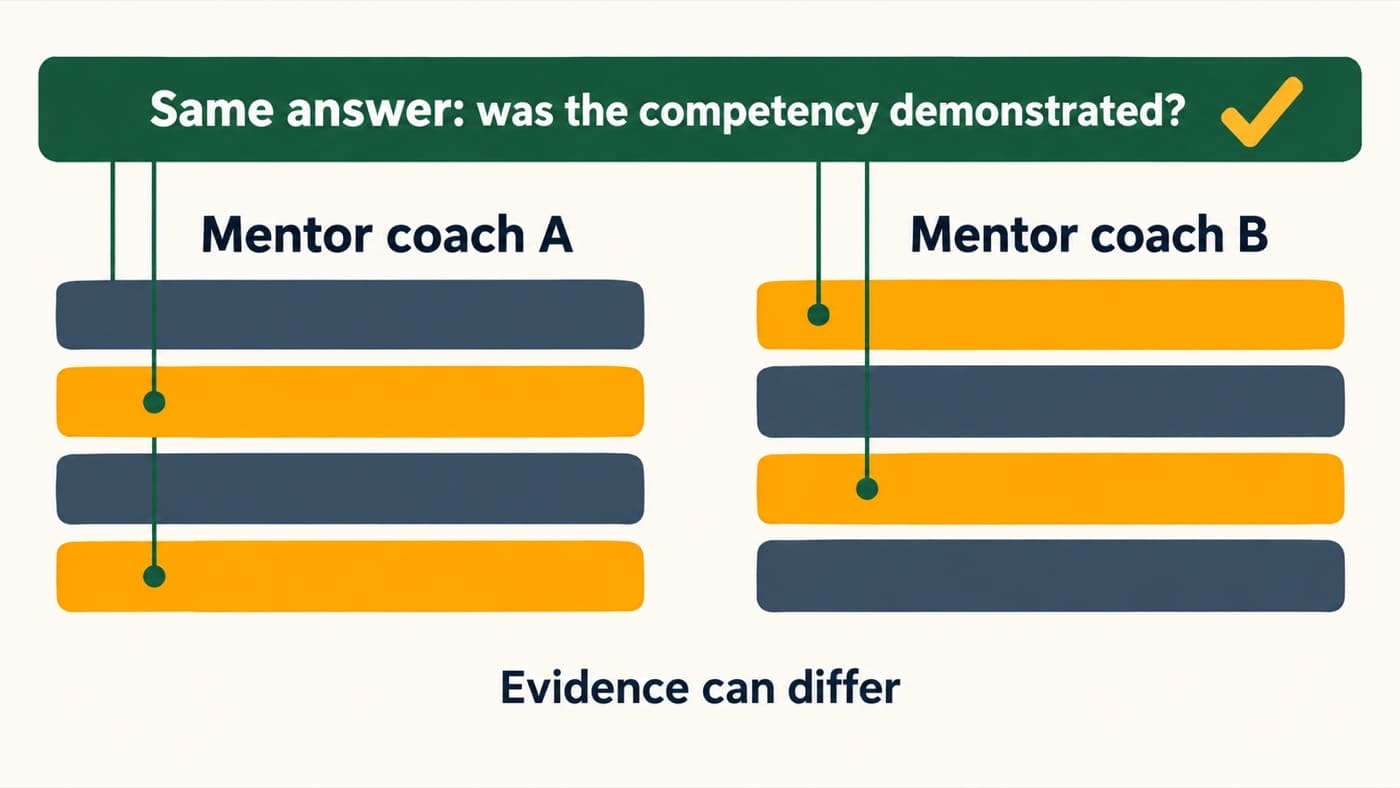
Mentor coach calibration is the process of aligning mentor coaches so they read the same coaching recording the same way against ICF's standard for the credential level. Two calibrated mentor coaches can cite different evidence on individual markers, but they reach the same answer for each competency: did the coach demonstrate it or not?
In a company, calibration usually means managers lining up their employee ratings before performance reviews. In mentor coaching it means something narrower. A mentor coach reviews recordings of a coach's real sessions and gives feedback against the International Coaching Federation (ICF) standard for the credential the coach is working toward: the ACC Behaviorally Anchored Rating Scales (BARS) for the Associate Certified Coach (ACC) credential, the PCC Markers for the Professional Certified Coach (PCC) credential, and the MCC BARS for the Master Certified Coach (MCC) credential. Mentor coach calibration is the work of getting two mentor coaches to hear the same session and land in the same place.
I run that work in our Mentor Coach Specialization (MCS) training, where credentialed coaches learn to do this kind of review. When participants review the same recording, their forms don't always match mine. Some of those differences are fine. Some of them change the answer, and calibration is how we sort out which is which.
It matters to coaches as well as mentors. The ICF requirements for mentor coaching put that review at the center: a mentor coach observes recorded or live sessions and gives the coach feedback on strengths and development areas. If you're working toward an ICF credential and two mentor coaches would hear your session differently, the feedback you get depends on which one you have.
Key Takeaways
- Calibration aims at one shared answer for each competency: did the coach demonstrate it or not? Two forms can cite different evidence on the bars and still be calibrated.
- When forms differ, the cause is missed evidence, evidence filed under the wrong statement, or a statement read differently. In my training, it's all three.
- The test of a reading is the behavior: explain what the coach did and how it meets the words of the marker.
- In a calibration discussion, a piece of evidence moves or stays where it is. Either way, everyone learns why. The alignment comes from hearing each other's reasoning.
- A right conclusion without the behavior behind it is probably preferential feedback, and it doesn't belong on the form.
What Mentor Coach Calibration Aims At
Mentor coach calibration aims at one shared answer for each competency: did the coach demonstrate it or not? Two forms can differ line by line and still be calibrated. What we're doing is calibrating and aligning, so that overall we're seeing things the same way and understanding things the same way.
The competency is the right place to aim because that's where ICF's counting lands. A skill counts as demonstrated when it is rated at a competent level in at least one of the observed sessions. A competency is demonstrated when at least two-thirds (67%) of its skills are, and each coaching competency is counted on its own. The three credentials describe different levels of coaching competency, so the counts differ by level, and one level's threshold never carries over to another.
The Competency Review Form at the end of a mentor coaching engagement records exactly that answer: for each competency, whether the coach demonstrated enough of its statements. A minimum of three Session Observation Forms, from three different sessions, inform it. In the ICF credentialing process for a portfolio application, ICF has said the coach submits only the Competency Review Form, and the Session Observation Forms are uploaded if the application is selected for audit.
Calibration also sits inside the mentor coach's own standards. ICF describes six Mentor Coaching Competencies, a separate framework from the eight ICF Core Competencies a coach demonstrates, and one of the six is Conducts Formative Appraisals: evaluating the degree to which the mentor coaching client's coaching aligns with the ICF Core Competencies. Two mentor coaches can only do that consistently if they read the same way.
Why Two Mentor Coaches Read One Session Differently
When participants in my training review the same recording, their forms differ from mine in three ways: evidence they missed, evidence filed under the wrong statement, and a statement read differently from how I read it. Asked which one it usually is, I'd say it's all three. Some of those differences matter more than others.
How far apart can coaches land on one recording? Tandem's Mentor Coaching Foundations course gives a sense of it. Every student analyzes the same recording of a 25-minute coaching session, which the course presents as a PCC-level demonstration. Of the 120 first attempts that gave an overall level, before any feedback, 37 (31%) placed it below PCC. These are students in our course (English course, May to October 2026), not participants in my training, and the full data with its caveats is in our article on how 132 first attempts placed one recording.
Markers where many pieces of evidence will do
Some markers, by their nature, could hold any number of pieces of evidence, and you don't have to put all of them in. On both ACC and PCC there's a bar or marker about whether the coach is asking about the client and the client's situation: the who or the what. Almost every question is going to be about either the who or the what, so a mentor coach doesn't need to put everything in there. It's really just selecting which thing was the who and which was the what.
There are several markers like that. You could put a lot of things in, so just pick a few. Two mentor coaches will pick a different few, and their forms will look different on those lines without either of them being wrong.
Reading a statement differently
The second kind of difference is interpretation. On ACC, for example, there's allowing the client to lead, and a mentor in training may have a different interpretation of what leading is. Picture a session where the client says something, and the coach pulls from what the client said and asks the next question. Some mentors in training credit that as letting the client lead. No, that's being responsive to the client. The coach is working within the client's topic. That is different from asking “Where would you like to go from here?” and giving the client choice.
When the difference is interpretation, we talk about the interpretation. Every word in a statement matters here. On the ACC BARS, ICF has said a statement with “and” in it needs both parts present to meet the standard. Two readers who weigh the words differently will land in different places.
Where ICF leaves blanks to fill
In my experience, ICF leaves a lot of things vague, especially on ACC. That makes it a lot harder, because you have to fill in the blanks. When a coach is working toward the ICF ACC credential, two mentor coaches can fill the same blank in two ways, and their forms will differ. Calibration is where we talk the blank through until we fill it the same way.
Two more sources
Two more sources of difference get their own articles in this series. One is squeezing evidence into a marker it doesn't fit, because a marker with nothing under it feels like a gap to fill. The other appears when a PCC coach reviews an ACC session and cites missed opportunities that belong to PCC-level coaching and PCC-level expectations, which an ACC review doesn't ask for. Experienced coaches bring their own coaching experience to a review, and calibration brings the expectation back to the level being reviewed.
Calibrate at the Competency, Not Every Line
Calibrated mentor coaches reach the same answer for each competency, even when their forms look different line by line. That's the standard I hold before I trust someone in my training to offer mentor coaching. Two forms can list different statements, and slightly different ways of seeing which marker goes with what, and still be calibrated.
Say I've got a competency with four bars underneath it. The forms have to match on the question that sits above all four: did they actually display this competency, or did they not?
We might cite some different evidence on the bars, but we need to agree at the competency level.
There are some markers I don't worry as much about, the ones where you could really put anything in. I'm not going to stress over whether a mentor in training picked the same short question I picked for that piece of evidence.
A difference in evidence starts to matter when it changes whether a skill counts, because enough of a competency's skills have to count for the competency to be demonstrated. That standard is mine, and it follows the way the ICF competencies are counted.
Show Me How That's What They're Doing
When a mentor in training says a piece of evidence meets a marker and I'm not seeing it, I ask them to explain the specific behavior they're seeing and how it meets this competency or this marker. If they can explain it, and it makes sense, it meets the marker.
If it's a stretch, we go back to the marker itself. Whether it's the ACC BARS or the PCC Markers, the wording is the standard, and the behavior has to match it. If they can't connect what the coach did to those words, it doesn't meet the marker. That's how we handle that piece of the training.
Let's read the words of that marker. This is what it says. Show me how that's what they're doing.
The question moves the conversation off the conclusion and onto the behavior, where both of us can check it against the same words.
What a Calibration Discussion Sounds Like
A calibration discussion starts with a question about one piece of evidence. Usually a mentor in training brings it: “Does that fit there?” Or, “On my review, this is what I put, but I'm not sure it was there.” Other times we're reviewing somebody's form together and I start it myself.
Calibrate Your Reading Against the Words of the Marker
In Tandem’s Mentor Coach Specialization training program, you review real recordings and talk the evidence through until you and the other mentor coaches read them the same way.
I'll say, “Okay, let's take a look at these. Read these ones for 3.4. Do you feel like these fit there, or do they fit somewhere else?” (3.4 is a marker number in Competency 3, Establishes and Maintains Agreements.) Then we have the conversation about it. Sometimes things move, sometimes they stay where they are, and sometimes the other people learn something about why it is that or why it isn't.
I choose my words for this on purpose: we have a discussion. It's a learning process. It's about figuring out how to align, and the alignment comes from hearing each other's reasoning as much as from where the evidence ends up.
I learned how much this matters early. In my first cohort, there was an extreme amount of calibration needed, and I redesigned the course around it. I've written about why I rebuilt the course around calibration, and why releasing mentor coaches who couldn't yet do the evaluation was a personal ethics question for me.
When the Conclusion Comes Without the Behavior
A mentor coach can reach the right conclusion and still not be able to explain how they got there. When that happens, they're using their own bias: what they like and what they don't like, and what they do compared with what the mentee did. When they see what they do, they think, “Yes, that's good.”
If they can't tell me what behavior it is and why that behavior meets that marker, it's probably not valid feedback. It's probably preferential feedback, and it doesn't belong there. Or maybe it would be a “consider.” The easiest yardstick to reach for is your own coaching style, which is exactly what doesn't belong on the form.
They're not trying to make the mentee coach like them. They're trying to make sure the mentee is meeting the bar.
ICF's guidance on written feedback points the same way. It asks mentor coaches to keep personal preference, bias and personality judgments out of their written feedback, and ICF's bias framework asks for “disciplined evidence gathering and disciplined self-observation.” Checking your own preferences before and after a review is its own practice, and I cover it in a separate article. In a calibration discussion, the test is simpler: a conclusion that can't be traced to a behavior isn't ready to give a coach.
Calibrating Your Own Reading
If you mentor other coaches, you can start with your own last form. Read it again, and for each piece of evidence ask two questions: could I defend this by reading the words of the marker, and would it change whether the competency is demonstrated? The pieces you can't defend are where a calibration discussion with another mentor coach would start.
Calibrating alone only goes so far. Whether you're one mentor coach or a program director calibrating a coach training faculty, it takes other readers on the same recording and an experienced mentor coach to run the discussion. That's why, if you're choosing where to train, calibration is the first thing I'd look for in a program.
Calibration is built into how we teach mentor coaching skills in Tandem's Mentor Coach Specialization training program, accredited under the ICF Advanced Accreditation in Mentor Coaching. Alex Kudinov and I hold the MCS at all three levels, and every mentor coach on our team holds it at the level they mentor. That matters for the profession now: from January 1, 2027, ICF has said all new mentor coaching has to come from someone who holds the MCS at that level or above. If mentor coaching is part of your coaching practice, our guide to the ICF Mentor Coach Specialization sets out what it requires, and the program is where you can develop your mentor coaching skills.
Questions About Mentor Coach Calibration
Do two calibrated mentor coaches have to cite the same evidence?
Two calibrated mentor coaches can cite different evidence on the bars. What has to match is the answer for each competency: did the coach demonstrate it or not? On markers where many pieces of evidence would do, I don't stress over whether someone picked the same question I did.
Can evidence from two recordings count toward one marker?
ICF has said that evidence for a marker can't be accumulated across sessions. Whatever a marker needs has to be there within one session, so two mentor coaches calibrating on a marker are comparing what happened in the same recording.
Why is ACC harder to calibrate?
In my experience, ICF leaves a lot of things vague on ACC, so mentor coaches have to fill in the blanks, and two of them can fill a blank differently. Every word of an ACC BARS statement counts: when a statement includes “and,” both parts must be present to meet the standard.
Is feedback valid if the mentor coach can't name the behavior?
Probably not. If a mentor coach can't say what behavior it is and why it meets the marker, it's probably preferential feedback. At most it would be a “consider.” The aim is to make sure the mentee is meeting the bar.
Train as a Mentor Coach With Cherie Silas, MCC
Learn to review recordings against the ACC BARS and PCC Markers and to calibrate your reading with other mentor coaches, in a program accredited under ICF’s Advanced Accreditation in Mentor Coaching.
See the Program →