
Mentor Coaching Feedback: Name the Behavior, Not the Style
What is good mentor coaching feedback?
Good mentor coaching feedback describes what the coach did: you asked an open question, you summarized what the client said. It leaves the coach's style alone. It suggests a type of question to consider and leaves the words to the coach. It is written so the mentee can use it when the mentor coach is not in the room.
There are two ways to tell a coach about a question that didn't land. One sounds like this: “You said it like this, you should say it like this.” The other sounds like this: “Consider asking the client what they're believing in this moment.” Both are about the same moment in a recording. One gives the coach my words. The other gives them something to try.
I mean feedback in the International Coaching Federation (ICF) sense. A coach working toward an ICF credential at the Associate Certified Coach (ACC), Professional Certified Coach (PCC) or Master Certified Coach (MCC) level submits a recording of a coaching session, and a mentor coach listens to it, reads the transcript and gives feedback against ICF's standard for that level. That feedback is a large part of how a coach gets ready to earn their ICF certification, and it's what I teach mentor coaches to write in Tandem's Mentor Coach Specialization (MCS) training.
I write the behavior beside every piece of evidence. That's my interpretation of what ICF asks for, and it's how I mentor now. Here is what that feedback says.
Key Takeaways
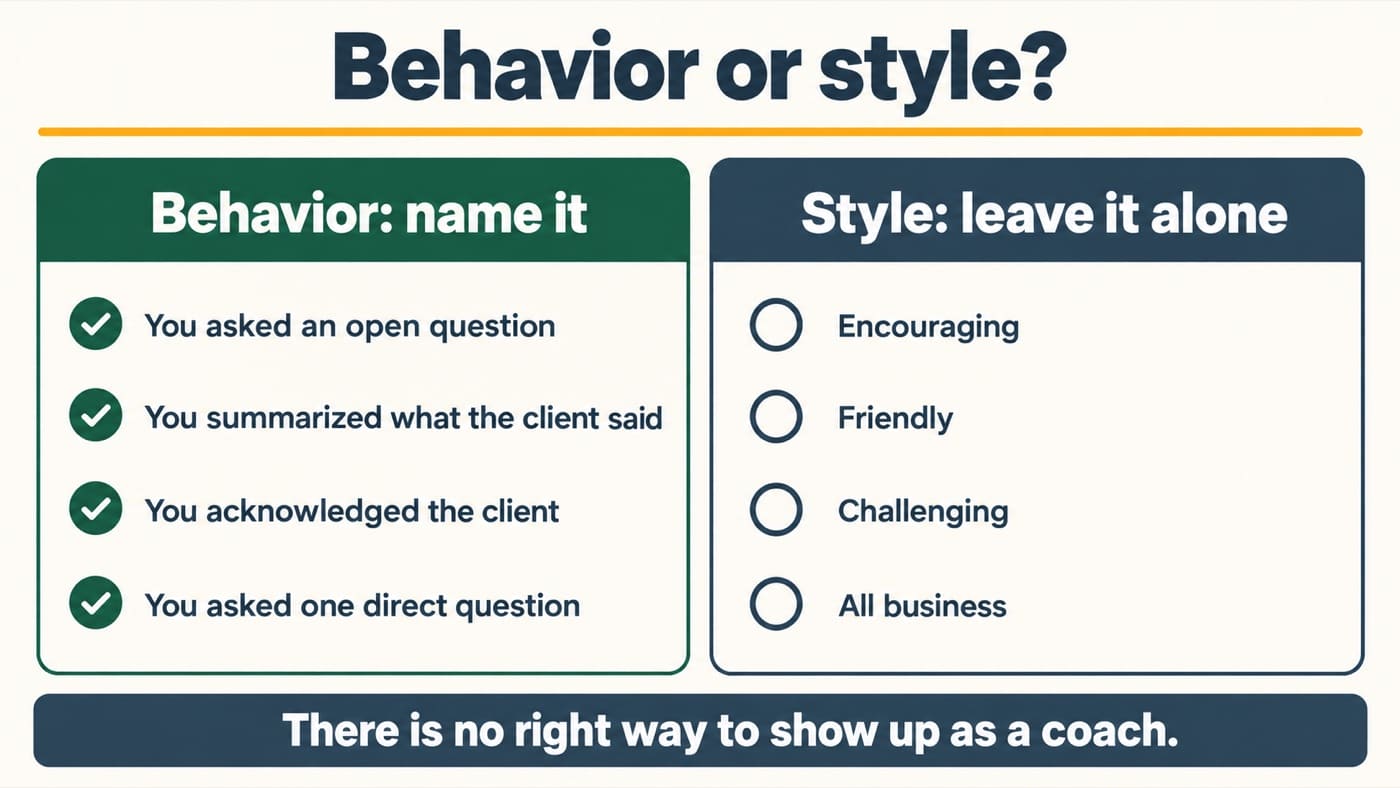
- Good feedback describes behavior the coach can find in the recording: you asked an open question, you summarized what the client said, you acknowledged the client.
- Style, whether encouraging, friendly, challenging or all business, stays out of the feedback. There's no right way to show up as a coach.
- A “consider” points the coach toward a type of question and leaves the words to them. A script hands over the words.
- Check your bias before you review a recording and again after. Liking a coach's style doesn't mean they meet the competencies.
- ICF asks written feedback to name at least two competencies as strengths and two as development opportunities, each tied to behavioral statements or markers.
What Good Mentor Coaching Feedback Names
Good mentor coaching feedback names what the coach did, in words the coach can recognize and repeat. It describes behavior: a specific thing that happened in the coaching session, at a point you can find in the recording. Then it connects that behavior to the competency it shows, or to the place where the coach still has room to grow.
Feedback on behavior is: this is what you did. You asked a question about this. You summarized what the client said. You asked an open question. You acknowledged the client. I can actually describe the behavior you did.
Each of those sentences names a specific skill the coach can find in their own recording and use with the next client, whatever that client's goal. Summarizing what the client said is active listening the coach can see on the page. None of it asks the coach to guess what I meant.
What ICF asks written feedback to contain
ICF gives written feedback a structure. Its guidance on evaluation feedback asks the mentor coach to identify at least two competencies from the ICF Core Competencies as strengths and at least two as development opportunities, and to tie each Core Competency it names, such as Establishes and Maintains Agreements, to the behavioral statements or markers behind it. The development areas should match the weaker demonstrated areas. The same statement or marker shouldn't appear as both a strength and a development area, because that creates mixed messaging. And the language stays free of personal preference, bias, personality judgments and verdicts.
Feedback is verbal and written, every session. The Session Observation Form carries the written feedback for each session, and the Competency Review Form gathers it across the mentoring. The coach also reflects on their own strengths and areas of growth, a required part of each session. That is what ICF requires of mentor coaching feedback, and Tandem's free forms for each level are built for writing it.
Writing the behavior beside each piece of evidence goes past that structure. That part is mine, because the behavior is what the coach can take to another client.
Feedback on Behavior Versus Style
Behavior is what the coach did. Style is maybe the way you asked the question, and it's so hard to describe. Somebody's style might be encouraging, so they give a lot of encouragement throughout the process. Maybe they're friendly, and maybe they're challenging. Maybe they create a space that feels like friends in a relationship, or one that feels like all business. Those are style things.
There's no right way to show up as a coach. There are behaviors you exhibit as a coach, and those behaviors are what say you're competent or not competent. So my feedback stays on the behaviors. An encouraging coach and an all-business coach can both ask an open question, summarize what the client said and acknowledge the client. Their styles differ. The behaviors are the same, and they show the same competence.
ICF's own language points the same way. Its Mentor Coaching Competency 5, Facilitates Client's Skill Development, “supports the mentor coaching client's development of coaching skills, and unique coaching style.” Its guidance for written feedback rules out personal preference and personality judgments. The style belongs to the coach. The feedback belongs with the behavioral statements of the ACC and MCC Behaviorally Anchored Rating Scales (BARS) and with the PCC Markers.
I've written before about feedback that names the behavior under the words, and about keeping style for the mentoring conversation and out of the rating. Here the point is narrower. Whatever you write on the form, the coach should be able to read it and see an action, never a personality.
Try it on the last feedback you wrote. Which sentences describe something the coach did, and which describe how the coach came across?
How to Give Feedback Without Handing Over a Script
You give feedback without handing over a script by offering the coach a kind of move to try and leaving the words to them. A script tells the coach what to say next time. An example invites them to consider a type of question or a possibility, and the coach finds their own words for it with the next client.
Learn This With Cherie Silas, MCC
Our mentor coach training is a 71-hour live cohort, accredited under ICF’s Advanced Accreditation in Mentor Coaching and matched to the Standard Path to the Mentor Coach Specialization.
Handing them a script is, “You said it like this, you should say it like this,” or, “What you should have asked here is this,” or, “What I would have asked here is this.” Offering an example, I think, is more like: consider asking this type of question next time. Consider what would happen if you did this. Consider asking the client what they're believing in this moment. It's not, “Here are the words you need to use.”
A consider points the coach's next steps in a direction and stops there. The coach who knows the behavior can find new words with every client. The coach who was handed my question has one question, and it fits one client on one day.
The instinct to hand over the better question is strong, and it shows up in our own data. In Tandem's Mentor Coaching Foundations course (161 students in the English course, May to October 2026), students write a developmental feedback document to the coach in a recorded session. In the feedback on those submissions, reviewers flagged scripting in 33 comments. On feedback work that was accepted, the most common growth note, in 28 comments, was the same thing: a word-for-word question for the coach to use next time, even when the student framed it as an invitation.
The full numbers, including how many first drafts offered the coach example questions at all, are in our piece on the habit of directing instead of developing.
Ask Why Before You Name the Behavior
When a coach's wording gets in the way, I ask why before I offer anything. The coach's answer points to the behavior, and the behavior is what the feedback needs to name. A better question would fix one moment in one session. The behavior behind the extra words can show up again with any client until the coach sees it.
There are times when the coach is adding extra words, and those extra words aren't helping. Or they ask a second question, or they clarify the question, and you would have done better to just stick with the first question. It was a good question.
So we have a discussion about why. Why did you clarify this question? Why did you add another question? What made you ask a question, then explain the question, and then ask a different question? Were you thinking and talking at the same time? Did you not trust that the client could understand the question? What was happening?
I can hear a stacked question when I listen to the recording. What I can't hear is what the coach was trying to achieve with the second one, and their answer gives us both that insight. The why is what lets us define the behavior. From there we partner on the change, and the better question is theirs to find.
That way we can identify the behavior you need to change, not the question you need to ask.
Check Your Bias Before and After
Before I give feedback on a recording, I check my own bias, and I check it again after. The phrase I use is “check your bias at the door.” If this is somebody I really like, and I like their style, am I going to automatically say they meet the competencies? No. I need to actually state facts.
Just because I like the way they coach doesn't mean they meet the competencies.
So check your bias before you do anything, and then check it again after you've done it, to make sure you haven't looked at it through biased eyes. Make sure there's no conflict of interest.
Which of my own preferences shows up most? I don't know. Actually, I guess I do know. I like to balance challenge and support, and when I hear coaches challenging their clients, not confrontational, but direct, that makes my heart sing. But if they aren't challenging, that's a style thing. Asking a direct question, instead of asking three questions or softening all the questions so you don't hurt anybody's feelings, is a behavior. Being a challenging coach is a style.
When you notice a pull toward a coach, ask whether it comes from the behavior or the style. A direct question belongs in the feedback. Noticing your own pull is reflective practice, and a recording asks for it as much as a client does.
ICF's guidance on bias gives the check two sides: “doing,” which is disciplined evidence gathering, and “being,” which is disciplined self-observation. It names 12 bias types, among them similarity, cultural style, and energy or expressiveness. Several of them are ways a coach's style can color what you observe and how you evaluate it.
The same gap shows up in the feedback on submissions to our Mentor Coaching Foundations course. Among the developmental feedback documents sent back on a first attempt, 45% had no bias self-check, and 25% had a missing or thin acknowledgment of the coach's style. Those are shares of the work sent back, not of every student. The strongest work did the check properly: it named a specific preference, showed how it colored the first read, and went back to the evidence.
Judgment Words Are Emotion
Judgment words report how the mentor coach felt about the coaching, and they leave the coach nothing to work with. That was good. That was great. That felt icky. Those aren't behaviors; that's emotion. A coach can repeat a behavior with the next client. Nobody can repeat “great.”
Praise slips into feedback as easily as distaste does. Calling a question great feels kind, and it still leaves the coach guessing which part worked. A mentor coach brings their knowledge of the competencies to the feedback, and a judgment word uses none of it. Competency-based feedback replaces the adjective with the behavior: you asked one open question, then let the client think.
ICF's guidance asks the same of written feedback: no personal preference, no personality judgments. “That felt icky” is both. There's a second trap close to this one, going through the form line by line from a place of assessment, and it deserves its own article.
Write It for When Your Mentee Is Not in the Room
Write your feedback for the week after the session, when your mentee is on their own with it. That's why having the behaviors on there is important. We don't want them to just go practice the same questions. We want them to look at the behaviors and see how they need to interact with their client.
So really consider how you write up that feedback. How are they going to be able to use this when they're not in the room with you, when they're trying to implement this feedback in their coaching? It's worth spending the extra time and giving them all the information. It's also feedback written for the mentee to keep: ICF has said the mentoring client is the one who holds the forms.
Picture a coach new to the profession, alone with the form a week later, before their next coaching session. A line that says a marker was met tells them where they stood. A line that names the behavior under each coaching competency tells them what to do again, and that is the valuable part of the record. So here's the practical test for every sentence you write: could the coach act on it with nobody to ask?
I've had people say, “Well, can't I just put three things, like, ‘Yep, they met each one of those markers’?” Well, technically you could. But is that going to be the best thing for your mentee?
Don't do the minimum you can do and get away with. Do what's right by your mentee.
This is the feedback I teach mentor coaches to write. Alex Kudinov and I hold the MCS at all three levels, and every mentor coach on our team holds it at the level they mentor. Our overview of the Mentor Coach Specialization sets out what ICF requires at each level, and Tandem's mentor coach training cohort is where we teach this work.
On the next recording you review, check your bias before you start and again when you finish. Then read your feedback once the way your mentee will, alone.
Questions About Mentor Coaching Feedback
How many strengths and development areas does ICF ask for in written feedback?
At least two Core Competencies as strengths and at least two as development opportunities, each tied to the behavioral statements or markers behind it. The development areas should match the weaker demonstrated areas, and the same statement or marker shouldn't appear as both.
What's the difference between feedback on behavior and feedback on style?
Behavior is what the coach did: asked an open question, summarized what the client said, acknowledged the client. Style is how the coach shows up: encouraging, friendly, challenging or all business. There's no right way to show up as a coach, so the feedback names the behavior.
Is suggesting a question the same as handing over a script?
A script gives the coach the exact words, such as “What I would have asked here is this.” An example invites the coach to consider a type of question or a possibility and leaves the wording to them.
Does mentor coaching feedback have to be written?
ICF's handbook calls for verbal and written feedback from the mentor coach every session: written feedback on each Session Observation Form and cumulative written feedback on the Competency Review Form. ICF staff have described an accommodation for feedback delivered only verbally; confirm it with ICF in writing before you rely on it.
Train as a Mentor Coach With Cherie Silas, MCC
Tandem’s Mentor Coach Specialization training program is a 71-hour live cohort accredited under ICF’s Advanced Accreditation in Mentor Coaching. See the cohort dates and pricing.
See Cohorts & Pricing →