
How to Review a Coaching Recording: Three Times Through the Session
How do you review a coaching recording?
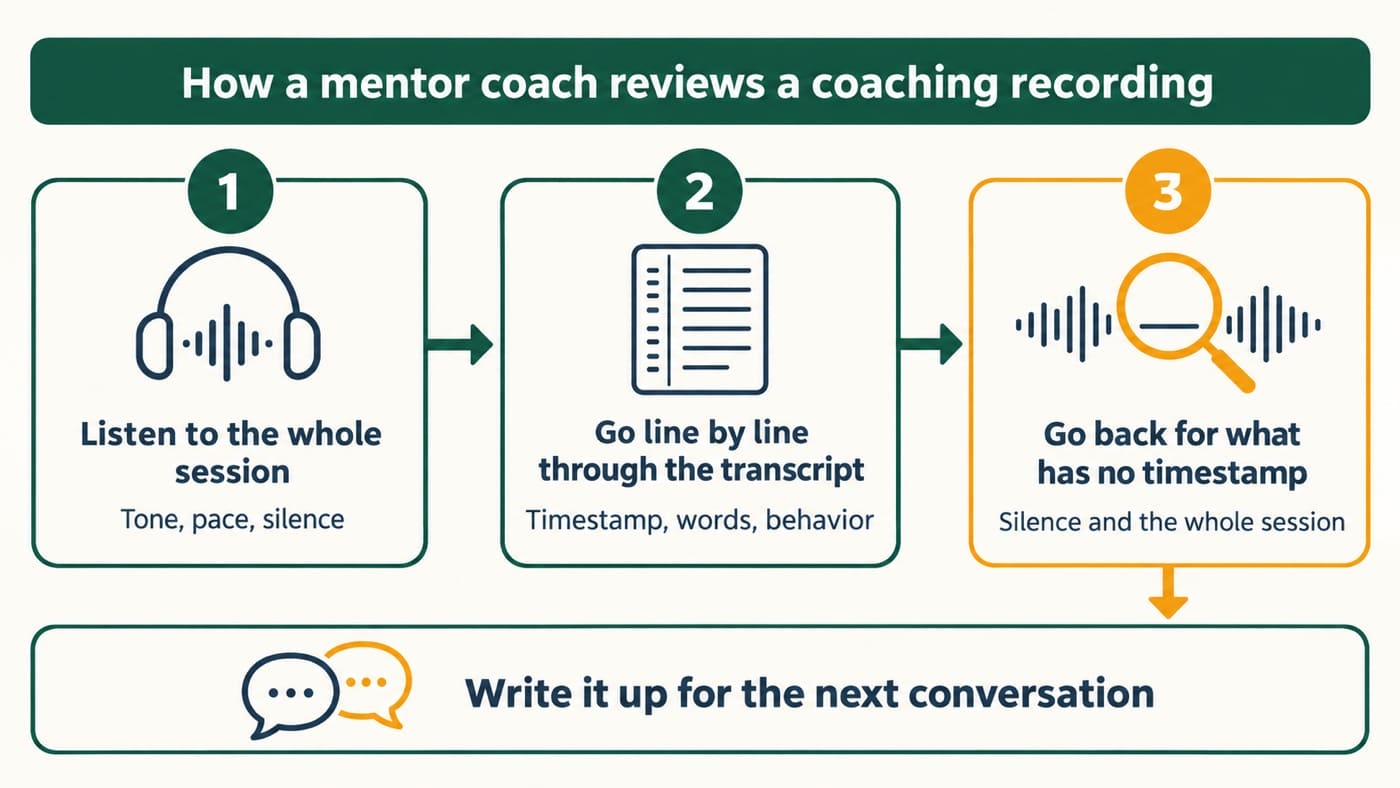
Listen to the whole session first for tone of voice, pace and silence. Then go line by line through the transcript and mark every line against the standard for the credential level, noting the timestamp, the words and the behavior. Go back for what has no timestamp, such as silence. Then write it up for the next conversation.
Before I read a single line of a transcript, I listen. The audio tells me things the page can't: the coach's tone of voice, the speed they're talking at, whether there's any silence. That first listen is one level of understanding, and it's where my review of every coaching recording begins.
Mentor coaching is a specific kind of mentorship. A coach working toward an International Coaching Federation (ICF) credential at the Associate Certified Coach (ACC), Professional Certified Coach (PCC) or Master Certified Coach (MCC) level sends a recording of a real coaching session. A mentor coach reviews it against ICF's standard for that level: the ACC Behaviorally Anchored Rating Scales (BARS), the PCC Markers or the MCC BARS. If you're a mentor coach, or a mentor in training, reviewing another coach's recording, this is the order of work I follow. If you're the coach who sent the recording, this is what happens to it.
What follows is a high-level overview, because the whole process would take me forever to describe. It covers the three times I go through a recording, the test I use to tell evidence from impression, how I read a competency in context, and how I write it up.
Key Takeaways
- Listen to the whole recording before you read the transcript closely. The audio carries tone of voice, pace and silence. The transcript loses them.
- Go line by line and give every line a mark: it meets the bar, it's below the bar, the coach didn't do it, or it wasn't applicable. Note the timestamp, the words and the behavior.
- Evidence is something the coach did that you can point to and explain against all the words of the marker. What new mentor coaches usually miss: they squeeze evidence into a marker so it looks met.
- Read each competency in the context of the whole session. A few stacked questions pasted into the form don't mean the competency wasn't demonstrated.
- A careful review takes time. A 30-minute recording takes me about an hour and a half to write up, and a 60-minute recording two to two and a half hours.
What a Review Is For, and What ICF Counts
A review gives the coach something to learn from before their next recording, whatever certification level they're working toward. That makes it a different job from assessment, where the point is a verdict on the recording. ICF's unit of judgment is the session: a skill counts when the coach demonstrates it at a competent level in at least one observed session.
The standard comes from the ICF Core Competencies, read through the statements for the level: the ACC BARS, the PCC Markers or the MCC BARS. A competency is demonstrated when at least two-thirds (67%) of its skills are. The number of skills differs by competency and by level, so one level's threshold table never carries over to another. That is what ICF requires of mentor coaching, and it shapes every coaching session I review.
Two competencies work differently. Competency 1, ethical practice, is a yes or no check. Competency 2, the coaching mindset, isn't rated from the session at the ACC or MCC level, and ICF has said it carries no score at PCC either. So I don't go hunting for mindset evidence to rate.
Writing down the behavior behind every piece of evidence is my method, and it's how we mentor at Tandem. ICF's own requirements for written feedback come later in this article. The method exists so the coach can see their coaching skills clearly enough to grow them.
Listen to the Whole Session First
I start by making sure we have an accurate transcript, and then I listen to the whole recording before I read anything closely. I'm hearing the big picture: the coach's tone of voice, what speed they're talking at, whether there's silence. Getting the audio version is one level of understanding, and the transcript alone can't give it.
The transcript loses things. Sometimes I read what the coach said and think, “I'm so confused, I don't know what they're saying here.” When I listened to it, I understood. Reading it, I have no clue. That tells me the coach's questions aren't clear. A question could be long, but sometimes I just can't read the language they're using and understand it. I would have to be listening to it.
I hold what I notice on that first listen as context. An unclear question I could only follow by ear is more of an impression than evidence, and the difference between the two comes back later in this article. The first listen gives me the overall picture of the recorded session, and everything after it is closer reading.
Go Line by Line Through the Transcript
Next I go line by line through the transcript and decide, for each thing the coach said or did, where it sits against the standard. Either it meets the bar, it's below the bar, they didn't do it at all, or it wasn't applicable. I go through the entire transcript, all of it, and every line gets a mark.
For a coach preparing for the ICF ACC credential, that standard is the ACC BARS. For PCC, it's the ICF PCC Markers. I'm also checking the other direction: whether a moment sits above the bar, really a PCC marker rather than an ACC bar. How listening differs between the levels is a subject of its own, so I'll leave it there.
Then I write it on the form, in the same order every time. “Here's the timestamp. Here are the words you used.” And then: “And here's the behavior I'm seeing or hearing happen.” Sometimes that behavior is exactly what the competency says, and sometimes it's different. Some competencies can be shown by doing this, this or this, so I'm identifying which one the coach is doing.
If there's something the coach says that I don't mark, that was intentional, because it didn't meet a bar or a marker. An unmarked line is a decision I can explain, the same as a marked one.
All the words of the bar or the marker are important. ICF's guide to the ACC BARS makes one version of this explicit: when a statement includes “and,” both parts must be present to meet the standard. Reading every word is what keeps the documentation on the form honest, and it gives the coach specific evidence they can find again in their own recording.
Go Back for What Has No Timestamp
After the first listen and the line-by-line work, I go over what I've written and look for areas I haven't covered. Some things don't sit on any single line of the transcript. Silence is the clearest example, so I think about how silence showed up and how the coach used it, and I might go back and listen to part of the recording.
I'm not necessarily going to find a timestamp for silence.
This is my third time through the recording, and I treat it as an overview. What did I miss that will round it out? That way I can tell whether a marker really didn't show up, or whether I just didn't catch it going line by line because it was a bigger-picture thing, not a single timestamp.
ICF's PCC Markers guide treats one marker this way too. Marker 7.8 is judged on the coaching session in its entirety, and it also needs more than one clear piece of evidence. What ICF doesn't allow is borrowing across sessions. Evidence for one marker can't be added up from two recordings, so the marker is demonstrated inside one session or not at all.
Listening again for silence gives me an insight the line-by-line work can't. It's also where I notice the bigger-picture things that run through the whole session.
Evidence Versus Impression
Evidence is something the coach actually did or didn't do. I can point to it in the transcript, and I can explain the behavior and why that behavior met the competency, the marker or the bar. An impression is something I sensed but can't point to that way, and it doesn't go on the form as evidence.
An impression can still tell me something. The question I couldn't read on paper tells me the coach's questions aren't clear, but that's more of an impression. The speed of talking is another. I can't look at a timestamp and say, “You were talking faster than the client,” but I can hear it. ICF's bias awareness guidance names twelve types of bias a reviewer has to watch for in themselves, and pacing or rhythm is one of them.
Then there's style. If a coach is using a different style than I would use, I can't judge the style. I have to mark the competency. For other reviewers, I would say that's bias: they don't like the style. Giving feedback on behavior rather than style is a skill of its own.
We see the same pull toward impression in Tandem's Mentor Coaching Foundations course. In feedback on submissions from 161 students in the English course between May and October 2026, many stated a level from their overall impression of the session. Of the first-attempt session analyses we asked students to redo, 25% reached no overall level conclusion at all, and 20% made observations without tying them to a credential level. Among our notes on analyses we accepted, 15 pointed to evidence written down without a timestamp.
Read Each Competency in Context
I read a competency across the whole session. If the coach did something consistently throughout and there were two times they did the opposite, they did it right most of the time, so that meets. My feedback says both: overall you did this, this marker is met, and here are two instances where it was below, so let's look at why.
Then they learn from that.
They don't have to get everything right.
Stacked questions are a good example. There are times when I'm reviewing a recording and what I paste into the form is, “Look, they asked a stacked question here,” and I might paste three different stacked questions. That doesn't mean the competency wasn't demonstrated, because what I didn't paste in there was the 36 questions they asked that weren't stacked. I have to take things in context.
So I do one of two things. I go and grab ten questions that do meet, ones that aren't stacked, or I write a summary note citing the evidence: throughout the session, asked short open-ended questions one at a time. There were a few instances of stacked questions, and we'll discuss those in the session. But it still meets.
ICF's PCC Markers guide describes reviewers gathering and weighing evidence and contra-evidence before deciding whether a marker is marked. In our Mentor Coaching Foundations course, we saw students name the same competency as both a strength and a gap in one session, and there's more on what those session analyses showed in a separate piece.
What New Mentor Coaches Miss: Squeezing Evidence Into a Marker
In my experience training mentor coaches, what they usually miss is this: they don't read all the words of a marker. They feel like their job is to find evidence that every marker was met. So they squeeze things in where they don't fit, because they're thinking, “Oh, I don't have anything for that marker.”
Just because you have a marker that's not met doesn't mean you get to shove anything in there just to say it was met.
Reading the markers as a checklist to complete pushes a reviewer this way. Something may fit a marker, but that doesn't make it evidence for the one that's empty. My test is simple. If I can't describe why it met the bar, this is the behavior you did and this is why it met the bar, then it doesn't meet. Anything else would be me trying to make something meet that doesn't really meet.
When a reviewer reaches a conclusion they can't explain behavior by behavior, it's usually their preference talking, and that's where calibration between mentor coaches comes in. It's the same reason the question at the center of what makes a good mentor coach is whether they did what the marker says.
Writing the Feedback for the Next Conversation
Once the form is filled in, I go through each competency and give the coach an overview: how this competency showed up, what was strong, and where any challenges in it are showing up. Then I write their main strengths, usually three or so, and the development areas, always with the next recording in mind.
Practice Writing Feedback on Real Recordings
In our mentor coach training, you mentor a peer on their coaching recordings, then debrief the sessions live in class with Cherie Silas, MCC.
ICF's guidance sets a floor for written feedback. It asks for at least two competencies as strengths and at least two as development opportunities, each tied to a specific behavioral statement or marker and anchored in observable evidence. It also rules out language that reflects personal preference, bias or personality judgments, or that reads as a verdict. ICF's handbook describes verbal and written feedback from the mentor coach on the coach's strengths and development areas.
In the conversation, I focus the coach on the most important thing. If you're going to focus on one thing between now and the next time we meet, this is what you should focus on. Sometimes that's “You really need to focus on your coaching agreement.” If it's a big thing like that, it's the only thing I give them, and in that next recording we want to see the coaching agreement. I'm not going to drown them with every nitpicky thing.
That focus becomes the coach's next steps, and it's what I look for in the next recording. Everything in the write-up serves the mentor coaching relationship and the next conversation. The goal is a better coach on the next recording.
ICF expects at least three Session Observation Forms, from three different live or recorded sessions, and one Competency Review Form across them. We built free forms for each level. From January 1, 2027, ICF has said new mentor coaching has to come from someone holding the Mentor Coach Specialization (MCS) at that level or above.
How Long a Careful Review Takes
In my practice, recordings run 20 minutes to an hour. One that's 30 minutes long takes me about an hour and a half to write up. A 60-minute recording takes two to two and a half hours, and anything else falls somewhere in between. That time is the real cost of mentoring this way.
Those lengths are my agreement terms. ICF has said mentor coaching has no minimum or maximum length, only that it is a full, complete coaching session. The familiar window of 20-60 minutes is an ICF performance evaluation rule. A performance evaluation recording is part of some ICF credential applications, and ICF has said it will take no new ACC or PCC portfolio applications with a performance evaluation from April 1, 2027, so it's worth knowing what replaces the performance evaluation.
If you'd rather skip the review and just have the conversation, you probably need to be an instructor, not a mentor. I've written more about how much work mentor coaching is.
Pick one recording, your own or one you're reviewing, and make one of these trips through it on purpose. Which line did you leave unmarked, and was that a decision? If you want to build this skill with practice reviewing a peer's recordings and debriefing them live in class, that's how we train mentor coaches to review recordings. Our overview of the Mentor Coach Specialization covers what each level requires and what changes on January 1, 2027.
Frequently Asked Questions About Reviewing a Coaching Recording
Do I need the audio if I have a transcript?
Yes. The audio carries the coach's tone of voice, the speed they talk at and any silence, and silence has no timestamp. Some questions only make sense when you hear them. If you can't follow a question on paper, listen to that part of the recording before you decide what it shows.
Can evidence from two recordings be combined for one marker?
No. ICF has confirmed that evidence for a marker can't be accumulated across sessions. Where a PCC Marker needs more than one clear piece of evidence, every piece has to come from the same session. A skill counts as demonstrated when the coach shows it at a competent level in at least one observed session.
What if the coach's style is different from mine?
Mark the competency. If a coach uses a different style than you would, you can't judge the style. Ask whether the behavior meets the bar or the marker, and keep your own preference off the form. A judgment you can't explain behavior by behavior is usually preference.
How many strengths and development areas should written feedback name?
ICF's guidance asks for at least two competencies as strengths and at least two as development opportunities, each tied to a behavioral statement or marker with observable evidence. I usually name three or so strengths. In the conversation, I focus the coach on the development area that matters most before their next recording.
Train as a Mentor Coach With Cherie Silas, MCC
Learn to review recordings this way, with practice on real recordings and live debriefs, in our training program accredited under ICF’s Advanced Accreditation in Mentor Coaching.
See the Program →