
Is the Mentor Coach Specialization Worth It for Experienced Coaches?
Is the Mentor Coach Specialization Worth It?
The Mentor Coach Specialization (MCS) is worth it when a school or program sends you mentees, you coach at a high PCC or MCC level, and you enjoy detailed review. It is not a marketing plan. ICF has said that from January 1, 2027, new mentor coaching must come from an MCS holder at the level mentored or above.
I'm Cherie Silas, a Master Certified Coach (MCC), and I train mentor coaches at Tandem Coaching Academy. We sell that training, so weigh what follows with that in mind.
When ICF announced the Mentor Coach Specialization, my first reaction was good. Before it, anybody could mentor coach.
A word on terms, since "mentor" covers a lot of ground. This article is about ICF mentor coaching: a qualified coach reviews your recorded sessions against ICF's standards and gives you feedback while you work toward an ICF credential. Mentorship at work, where a senior colleague guides your career, is a different thing.
If you hold a Professional Certified Coach (PCC) or MCC credential and you're weighing the specialization against its expense and its workload, the answer turns on a few things about you: who will send you mentees, how long you have coached at a high level, and whether you like the detailed work the job is made of.
Key Takeaways
- The Mentor Coach Specialization pays off most clearly when a school or program already sends you mentees. Don't count on it to bring in mentoring clients by itself.
- If you're not coaching at a high PCC level yet, my advice is to wait and build more coaching experience first.
- Expect about two hours of reviewing the recording and writing up feedback for every one-hour mentoring session.
- Choose a program that calibrates you to the ACC BARS and PCC Markers, gives you plenty of practice on recordings and is taught by long-experienced mentor coaches.
- ICF has said that from January 1, 2027, all new mentor coaching must come from an MCS holder at that level or above.
It Depends on Who You Mentor
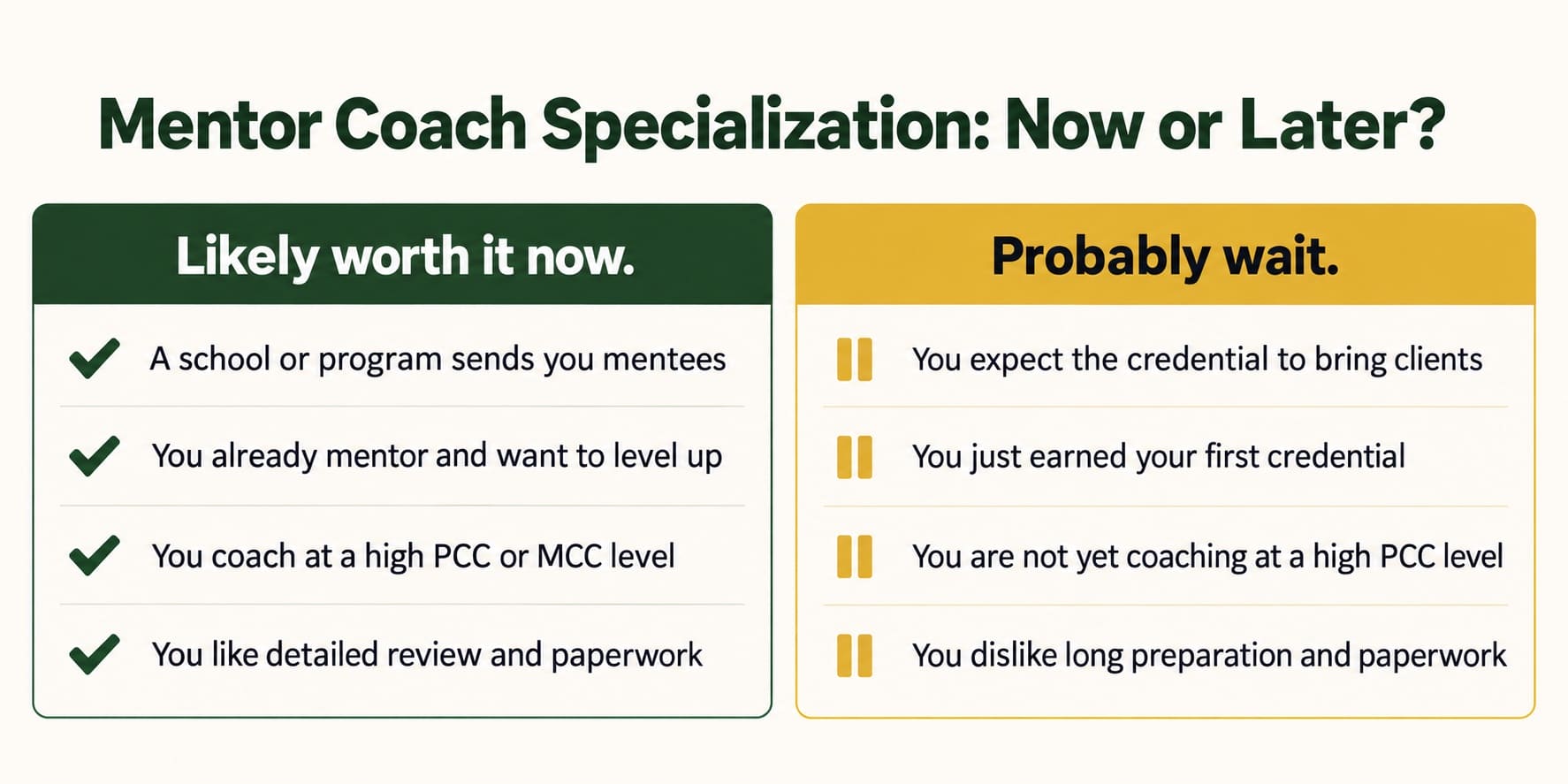
Whether the ICF Mentor Coach Specialization (MCS) is worth it depends on who your target client is and how you intend to use the mentor coaching credential. If you work with a school and mentees are sent to you, it's probably worth it, because that's a more consistent stream of people coming in.
The benefit there is concrete. Mentor coaching for ICF credentialing purposes is regulated work: the coaches you mentor are trying to become credentialed, and ICF decides who may mentor them. ICF has said that from January 1, 2027, only an MCS holder at the right level can take on new mentor coaching, and the section on that date below covers the details.
Now picture a different coach, one who hasn't been mentoring until now and expects the certification to bring in a whole new revenue stream. That's probably not going to happen. It's a business question: how you market what you offer, and how people learn you exist and come to you for it. It's not my job to teach you how to run your business. You've got to figure that part out.
The specialization lets you keep doing the work. It won't find the work for you.
The expense of the training is easier to weigh once you know which of those two coaches you are. If you sit somewhere in between, mentoring a few clients on your own, the next sections should help you place yourself.
Why the MCS Exists, From Where I Sit
Before the specialization, if you weren't mentoring inside a school, you only had to hold a credential, or have been an Associate Certified Coach (ACC) and renewed it. There was no mentor coach qualification. And people really weren't helping with the assessment part, because they didn't know how. So I liked the change. I thought it was a good move by ICF.
What surprised me came from the other direction. ICF took the assessment of recordings out of mentor coaching and made it purely developmental. At the same time, the way we judge whether someone is showing competence got much stricter, and I was very, very happy about that.
ICF's new standard for mentor coaching also gave the work a framework of its own. The six ICF Mentor Coaching Competencies describe mentoring a coach. They are a separate framework from the eight ICF Core Competencies, which describe coaching a client.
In our own program, I made passing a calibration on reviewing recordings the gate for graduating, because I didn't want to graduate somebody I didn't think was qualified. The article on what makes a good mentor coach tells how that came about.
Who It Suits, and Who Should Wait
The specialization suits three kinds of coach: those who already mentor and want the skills and the credential to match the work they do; those who teach or mentor inside a school or program; and experienced coaches working at a high PCC or MCC level who want to add mentoring and are ready for the review work that comes with it.
Now, who should wait. This might just be my personal opinion: if you're not coaching at a high PCC level, you probably need to wait. We have had people apply to our course who had just earned a PCC as their first ICF credential and wanted to become mentor coaches. My advice to that applicant is to get more coaching experience before jumping into mentor coaching. That's probably my own personal bias.
Then think about where your mentees would come from. In my experience, the people who come to an independent mentor coach are mainly ACC holders who need mentor coaching for their ICF credential renewal. Candidates usually get their mentor coaching inside a Level 1 or Level 2 ICF coaching education program, along with the rest of their training. We also see quite a few coaches putting their own training together to apply through the ICF portfolio path.
That open-market work is what our mentor coaching for ACC, PCC and MCC candidates covers. If a coach you mentor is still weighing their own credential, whether ICF certification is worth it is a good place to send them. If you're ready for this one, name the people or programs that would send you mentees before you enroll.
What Mentor Coaching Work Actually Demands
Mentor coaching is mostly preparation. If I have a one-hour session with someone, I've already spent 2 hours reviewing the recording and writing up feedback before I ever talk to them. If you don't love paperwork and detailed work, and you don't want to prepare for two hours before meeting a mentee, you're not going to like mentor coaching.
Reviewing a coach’s recording asks for a different mindset from coaching. In a coaching session you walk in and you're in the moment. In a review you're watching, listening and reading for what is said, which behaviors show up and how they match the competencies. It's very detailed, and it takes a lot longer.
Your coaching skills still carry the mentoring session itself, because you mentor from a coaching stance. The forms are where the review work shows. ICF's Accreditation Alignment and Compliance Guide sets a minimum, for each mentoring client, of three completed Session Observation Forms and one completed Competency Review Form. ICF has said the three Session Observation Forms must come from three different sessions.
In our training, I think coaches new to mentoring struggled more. Some came in thinking, I'm a coach, this is a great idea, I could add a new product. One participant dropped out, saying it was way more work than they thought it would be. Which is valid. You can look at free mentor coaching forms before you decide whether this is work you want.
Knowledge Versus Competency: Our Answer on BARS and Markers Training
Quite a few people who come to us for Mentor Coach Specialization training ask for a discount because they already took ICF's evaluation training, the ACC BARS (Behaviorally Anchored Rating Scales) and PCC Markers courses. Our answer is no. That training gives you knowledge, and evaluating a recording is a competency.
You can pass an asynchronous online course and receive a certificate of completion. That certificate can't certify that you can do the evaluation on a client's recording. Assessing or evaluating recordings is a competency you build by doing it over and over, so the practice has to be built into the program itself.
You already have the competency to hold the conversation, because you're a coach. Reviewing the recording is its own competency.
ICF focused the training programs on the mentor coaching competencies and added that you also need the ACC BARS and PCC Markers training. In practice, I'd weigh those two the other way around.
The BARS and Markers training is the bigger piece, and it's the hardest part. It's not having the conversations as a mentor.
What to Look For in a Mentor Coach Training Program
Look for these four things in a mentor coach training program, in this order. The first carries the most weight, because without it you can teach mentees to coach like you and still not know whether they will pass ICF's standard.
See How Our Cohort Measures Up
An MCC instructor in every class, weekly practice on coaching recordings and ICF accreditation under its Advanced Accreditation in Mentor Coaching.
- Calibration. A program that is going to make sure you're calibrated is the number one thing. You need to understand what you're looking for in someone's coaching and how to identify whether the behaviors a coach can demonstrate in a recording meet the BARS or the Markers. There has to be enough focus on that.
- Practice. A decent amount of it: taking recordings, reviewing them and then holding mentoring sessions.
- Accreditation. Of course, an accredited program.
- Instructors. You want the highest-level trainers you can get: experienced mentor coaches who have mentored for a long time, not just recently. An MCC teaching you to mentor understands how ACC, PCC and MCC each look. An instructor at the ACC level will clearly understand ACC but won't really understand PCC or MCC. I'd want at least a PCC instructor, and people who know how it works in practice, not just on paper.
You can meet with people and teach them to be like you, but that doesn't mean you can help them understand if they're going to pass.
So you can hold us to the same list: Alex Kudinov and I hold the MCS at all three levels, and every mentor coach on our team holds it at the level they mentor. Our live cohort is accredited to ICF's Advanced Accreditation in Mentor Coaching standard. The details are on our mentor coach training page.
Questions to Ask Before You Enroll
When you talk to a school, ask these questions before you commit. The answers show whether the program will make you calibrated to ICF's standard or mainly teach you the mentor coaching competencies.
- Who is doing the instructing, and what kind of mentoring experience do they have? That's key.
- How will the school make sure you can write up feedback at the ACC, PCC or MCC level you'll be working at?
- What does the program teach beyond the mentor coaching competencies? Look for a high focus on the ACC BARS and PCC Markers and on calibrating to them.
- How much practice reviewing coaching recordings do you get before you complete the program?
- Did ICF accredit the program?
- Which levels will you be eligible to mentor at? ICF has said a mentor coach must hold the MCS at the level being delivered.
Put the same questions to us. Our mentor coaching program page shows who leads each of the 12 classes, how much practice on coaching recordings you get, and which levels the cohort prepares you to mentor.
What Changes for ICF Mentor Coaches on January 1, 2027
ICF has said that from January 1, 2027, all new mentor coaching must be delivered by an MCS holder at that level or above, and that includes mentor coaching for renewals. ICF has also said listings for mentor coaches without the specialization roll off its mentor coach registry after December 31, 2026.
These new requirements put the timing on you as the mentor coach. The requirement to plan around is the order of dates.
ICF has said a portfolio audit checks that the mentor coach's MCS award date comes before the dates the mentor coaching was delivered. Sessions delivered before your award date fail that check, so have the ICF MCS in hand before the sessions that will appear on your mentoring clients' forms.
The ACC and PCC portfolio pathway changes too. ICF has said that from April 1, 2027, it accepts no new portfolio applications involving the performance evaluation. For candidates on that path, ICF has said the applicant submits the Competency Review Form you complete. Our guide to what ICF requires of mentor coaching covers the candidate's side.
Renewal: 10 Hours of Mentor Coaching Education
Once you hold the specialization, you keep learning to renew it, and I think that will help. Up until now, there hasn't really been mentor coach training. In Europe, coaches connected to the European Mentoring and Coaching Council did train mentor coaches. In the Americas, which is ICF's base, there was never mentor coach training, and there weren't even competencies.
By adding the competencies and requiring more education, ICF gives mentor coaches a way to keep growing in the profession. That could help.
ICF has said the renewal is 10 hours covering every level you hold, not 10 per level. The 10-hour education requirement does not have to be Continuing Coach Education (CCE) accredited: ICF reviews non-accredited education for whether it is aligned with the ICF Mentor Coaching Competencies. Coaching supervision on your mentor coaching counts with no cap, and that supervisor needs the Coaching Supervision Specialization, not an MCS.
Treat the renewal hours as professional development you choose, and align them with the mentoring you do. If you're not sure how coaching supervision differs from mentoring, read up on that before you pick.
Before you enroll anywhere, sit with two questions. Who will send you mentees in the first year? And how do you feel about two hours of preparation for every hour you spend with one?
ICF Mentor Coach Specialization: Questions Coaches Ask
Can a PCC-level MCS holder complete ACC-level forms?
No, not without also holding the ACC-level MCS. ICF has said the mentor coach must hold the MCS at the level being delivered. A client may be mentored above the level they are applying for, as long as the mentor coach holds the MCS at that higher level. If the client does not clear the higher level, ICF has said the evaluation is redone at the lower level, and the same recordings can be reused.
How many forms does each mentoring client need?
ICF's Accreditation Alignment and Compliance Guide sets a minimum of three completed Session Observation Forms and one completed Competency Review Form for each mentoring client. ICF has said a portfolio applicant submits only the Competency Review Form, and applicants selected for audit are asked to upload the Session Observation Forms.
Do hours already delivered by a mentor without an MCS still count?
ICF has said they still count. Before applying, the client needs three Session Observation Forms and one Competency Review Form from an MCS holder. That means a minimum of three more hours of mentor coaching, not a fresh 10.
Does the MCS change anything for MCC candidates?
ICF has said new mentor coaching for an MCC candidate after January 1, 2027 must be with an MCC-level MCS holder. The forms are not required for an MCC submission, though ICF strongly encourages them as preparation for the performance evaluation, which remains at MCC.
Hold Our Program to the Same Questions
Cherie Silas, MCC, leads every class, you practice on coaching recordings each week, and the cohort prepares you to mentor ACC and PCC candidates. $2,997, or from $999 on a plan.
See Cohorts & Pricing →