
What Risk Means to You Is Not What It Means to Your Peers
Why do leaders disagree about risk?
Leaders disagree about risk because their careers trained them to watch for different dangers. Finance hunts for the loss nobody has sized. Technology worries about a big commitment made without a test. Legal guards against exposure the company cannot take back. To marketing, the danger is waiting. Operations fears whatever breaks continuity. Same word, five alarms.
Picture a CTO and a general counsel on the same project. Ask the CTO about risk and she describes a controlled experiment: ship a small version, see what breaks, fix it. Ask the general counsel and he describes a map of exposures to be identified and mitigated before anything ships. The CTO experiences the general counsel as someone who kills momentum. The general counsel experiences the CTO as someone who ignores consequences. Both are managing risk, with definitions their careers taught them.
Better meetings and clearer decision rights rarely settle this, because the disagreement sits underneath the process. What sets off your alarm, what counts as enough diligence, what “responsible” sounds like: a career that rewarded one version of risk management installed all of it, and labeled the other versions reckless or paralyzed. You rarely see your own version until you sit across from someone whose career installed a different one.
Key Takeaways
- Each function learns to fear a different risk: finance the unsized loss, technology the untested commitment, legal the exposure that cannot be undone, marketing the closing window, operations the broken system.
- Management research backs part of this. Executives tend to notice the problems their own function handles, and they judge risk against the targets they answer for more than against probabilities.
- The same research found that managers see more when they are asked to name more problems, which is the case for asking each seat’s question out loud.
- Your risk instinct was trained, so it can widen without being abandoned. A coach can help you tell a real danger from a reflex.
Five Definitions, One Word
What the word “risk” sets off varies by function in predictable ways: the alarm, the default response, the standard for enough due diligence. Treat these as tendencies. Plenty of finance leaders move fast and plenty of lawyers enjoy a bet, but after fifteen years in one function you will probably recognize yours.
Finance: risk as quantity. Risk is a number. It can be measured, modeled, probability-weighted and hedged. The responsible response is to quantify exposure and build scenarios before committing. A decision without a model is a guess, and finance leaders do not guess.
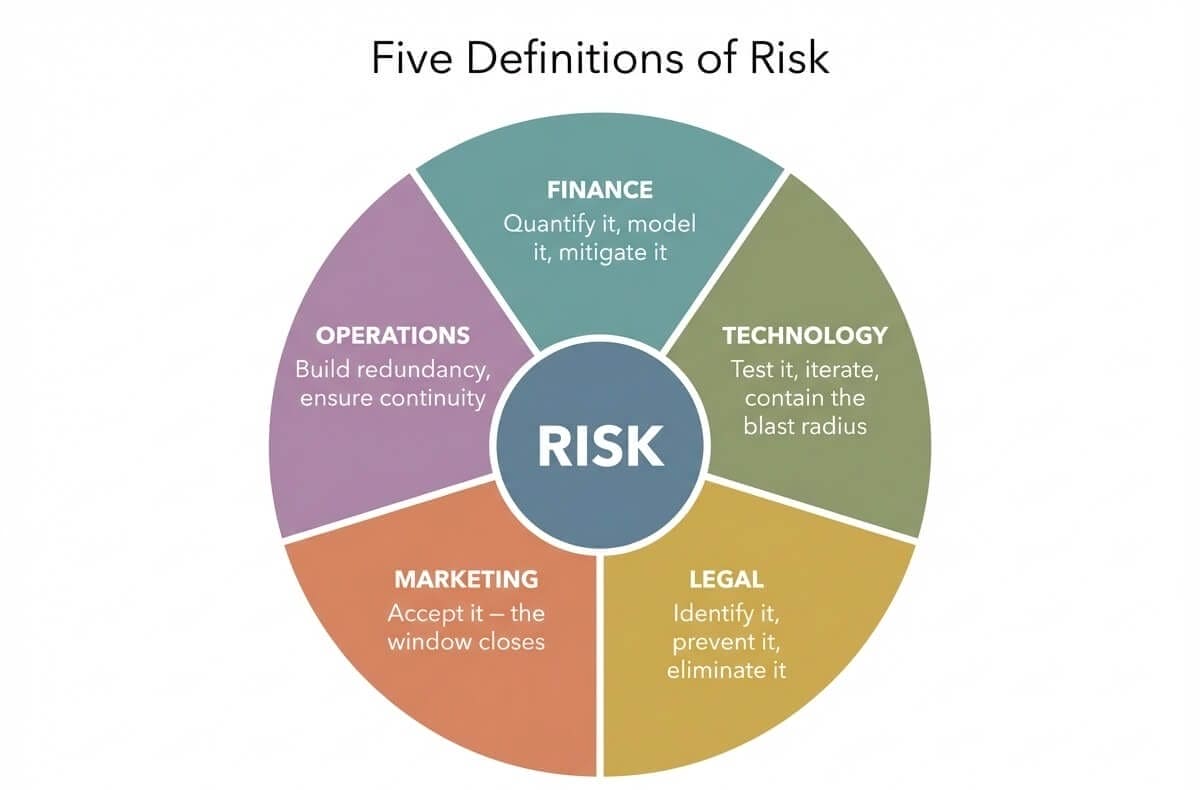
Technology: risk as experiment. Risk is an input to learning. Ship small, watch what breaks, iterate. The responsible response is to move fast but reversibly: contain the blast radius, learn from failure, never bet the whole system on an untested approach. An irreversible commitment without a prototype violates the engineering instinct.
Legal: risk as exposure. Risk is a set of liabilities to identify and close off before they materialize. The responsible response is prevention: no action until the exposure is mapped and mitigated. To legal leaders, a decision that knowingly accepts exposure looks negligent.
Marketing: risk as timing. Risk is the cost of inaction. Markets move, windows close, competitors take positions. The responsible response is to act on conviction before the data is complete, because waiting for certainty means the opportunity has passed. Analysis paralysis is the danger marketing fears most.
Operations: risk as disruption. Risk is anything that threatens continuity, reliability or throughput. The responsible response is redundancy, fallback systems and resilient process. Disrupting a working system for an unproven benefit is, to an operations leader, the definition of reckless.
Five leaders sit in the same room, hear the word “risk,” and five different alarms go off. What sounds like an argument about strategy is often an argument about which danger matters more.
What the Research Says About Function and Risk
Researchers have been testing this since 1958, when Herbert Simon and DeWitt Dearborn published a short study in the journal Sociometry on what they called the “departmental identifications of executives.” Executives from different departments tended to identify the problems tied to their own department (Dearborn and Simon, 1958).
The finding holds only with qualifications. In 1997, Janice Beyer and five colleagues repeated that study, along with a later one that had reached a different conclusion, and reported in the Academy of Management Journal that the two studies’ conclusions differed because their experimental procedures differed. Two of their results matter for a leadership team. Managers saw a broader range of problems when they were encouraged to identify more of them. And functional experience may produce blind spots as well as focus, which the authors called selective imperception.
A second line of research asked what executives mean by risk in the first place. James March and Zur Shapira, writing in Management Science in 1987, found that managers’ idea of risk departs from the textbook one: they pay little attention to probability estimates, their choices are shaped by the performance targets they have to hit, and they draw a sharp line between taking a risk and gambling (March and Shapira, 1987). If risk is judged against the targets you answer for, leaders who answer for different targets will see different risks in the same decision. That step is an inference from their findings, and it matches the five definitions above.
In 1984, Donald Hambrick and Phyllis Mason carried the argument to the top team. Their upper echelons perspective, set out in the Academy of Management Review, holds that an organization’s strategic choices and performance are partly predicted by the backgrounds of its top managers.
What Happens When Risk Definitions Collide
Picture the product launch meeting. The CTO wants to ship: the product is ready, the team is energized, the market window is open. The general counsel wants to review: the privacy assessment is incomplete, the terms of service need updating, the regulatory filing is unconfirmed. The CTO sees a bottleneck. The general counsel sees a liability.
Recognize These Collisions?
If your leadership team keeps having the same risk argument in different rooms, look at the functions the people came from before you look at their personalities.
Neither sees the logic driving the other. Technology handles uncertainty through iteration: ship, learn, fix. Legal handles it through prevention: identify, mitigate, then proceed. Both are sound ways to manage uncertainty, and they cannot share one timeline until someone names the tension.
The same collision plays out between the CFO and the CMO over investment, between the COO and the CEO over transformation, and between the CHRO and the CFO over talent spending. Each one looks like a disagreement about the decision. Underneath, it is a disagreement about what “responsible” means. Because “responsible” feels like a moral word, each leader hears the other’s position as irresponsibility rather than a different view.
| Collision | What Side A Sees | What Side B Sees | What Is Actually Happening |
|---|---|---|---|
| CTO vs. general counsel | Legal is killing momentum | Engineering is ignoring consequences | Iteration and prevention processing the same uncertainty |
| CFO vs. CMO | Marketing is spending without evidence | Finance is analyzing until the window closes | Quantification and conviction processing the same decision |
| COO vs. CEO | The CEO is disrupting what works | Operations resists all change | Continuity and transformation processing the same future |
Risk is one of several places this shows up. The same split runs through meetings where every function speaks its own language.
The Question Under Each Objection
Every one of these instincts is right about something. Unmeasured risk is dangerous, a missed window is costly, some exposure can sink a company, untested ideas never get better, and broken systems fail before new ones work.
That is why arguing harder rarely settles it. An objection in a leadership team usually carries a question the person raising it has not said out loud. Answer the question and the objection often changes shape.
| Seat | What the objection protects | The question that answers it |
|---|---|---|
| Finance | A downside nobody has sized | How big is the loss if this goes wrong, and can we cap it? |
| Technology | Learning before commitment | Can we test a small version before we commit to the whole thing? |
| Legal | Exposure the company cannot take back | What are we accepting that cannot be undone, and who has signed off on it? |
| Marketing | The cost of waiting | What does a delay cost, and when does the window close? |
| Operations | Continuity | What breaks if this fails, and what is the fallback? |
One question cuts across all five seats: if this goes wrong, how hard is it to undo? A decision that can be reversed cheaply needs less of the legal and operations caution. One that cannot be reversed needs more of it, and the finance model too. Sorting decisions this way gives the cautious seats a place to insist and the fast seats a place to move.
The research points the same way. Managers in the 1997 replication saw more when they were asked to name more problems, and asking each seat’s question out loud is one way to apply that to a leadership team. The voice your leadership team is not hearing is often the risk view that the room’s dominant function has pushed aside, because it handles uncertainty in a way the majority finds uncomfortable.
The useful question is “what does this decision need that no single function is providing?” Asked early, it turns a risk argument into an input the decision can use.
What Coaching Changes
For the individual leader, a coach who knows what each function is trained to protect helps separate trained caution from situational judgment. “I am uncomfortable with this decision” can mean “this decision is genuinely dangerous.” It can also mean “my training is reacting to uncertainty the way it was built to.” Both are real, and they call for different responses.
The more useful coaching question is: “Is your discomfort about this situation, or about how your career taught you to handle uncertainty in general?” Telling the signal from the reflex is where a leader develops risk judgment, instead of either overriding the instinct or being run by it.
For the team, a coach who understands every function in the room names the disagreement instead of refereeing it: “I am hearing two legitimate definitions of responsible that cannot both be satisfied at once. What does this decision need?” That question moves a team from arguing about who is right to working out what the situation requires.
Two related pieces go further: what your career taught you about risk, and what happens when the next level asks you to take the career risk your training warns against.
Risk as Formation, Not Personality
What risk means to you is not what it means to your peers, and that is useful. The finance leader’s instinct to quantify catches exposures the CMO’s sense of timing would miss. The engineering leader’s habit of testing produces learning the legal leader’s caution would block. Each function covers a blind spot in another.
Your risk instinct is usually right for the domain that trained it. The skill is seeing it as a trained response rather than an objective reading of the situation. Seeing it that way keeps your rigor and adds accuracy about when caution is serving you and when it is running you.
If these collisions sound like your leadership team, a conversation with an executive coach who understands the functions in the room is where the pattern starts to become visible and useful.
Frequently Asked Questions
Why do leaders from the same organization reach opposite conclusions about the same risk?
Each function trains a different definition of risk through years of rewards and consequences. Finance learns to quantify exposure before acting, technology to ship small and iterate, legal to prevent liability before proceeding. When those definitions meet on one decision, what looks like a disagreement about strategy is often a collision between different, equally legitimate ideas of what “responsible” means.
Can a leader change how they process risk without abandoning the instincts their career built?
Yes. A career-trained risk instinct is learned behavior, so it can widen without being thrown out. The goal is noticing when it is responding to the situation in front of you and when it is running on habit. A leader who can tell “this decision is dangerous” from “my training is reacting to uncertainty” develops judgment instead of swinging between caution and override.
What does a coach actually do when a leadership team can’t agree on risk?
The coach names the collision instead of ruling on whose position is correct. Asking “what does this decision need that no single function is providing?” turns a personality conflict into an input the decision can use, and moves the team from arguing about who is right to working out what the situation requires.
How does a leadership team decide when its members see the risk differently?
Start with the question under each objection: how big is the loss and can it be capped, can a small version be tested first, what cannot be undone, what does waiting cost, and what breaks if it fails. Then sort the decision by how hard it would be to reverse. Reversible decisions can move faster. Irreversible ones earn the slower, more cautious process.
A Conversation About What Risk Means to You
A 30-minute call about the risk instinct your career trained into you: where it serves you and where it runs you.
Book a Free Consultation →