
Hybrid Work Is a System Problem, Not a Location Problem
Is hybrid work bad for employee engagement?
No. Engagement outcomes track how a hybrid work policy is framed inside the organization, not how many days people spend in a building. Peer-reviewed evidence shows managers penalize the same two-to-three-day remote schedule when it reads as a personal accommodation and stop penalizing it when it reads as a universal option.
Two things happened within two weeks of each other this August. Researchers at the University of Colorado Boulder reported that fully remote employees show the highest wellbeing of any work arrangement they measured. EY started urging its junior consultants back into the office.
Both sides read that as evidence for their existing position, which is how you can tell neither one is looking at the right variable. The argument is being run about location, and location does not predict the damage. What predicts the damage is whether flexible work reads inside your organization as a system everyone operates under, or as an accommodation particular people had to request.
The sharpest study in this whole news cycle proves that, and almost nobody writing about the return-to-office fight acted on it. Same schedule. Same output. Different career penalty, depending entirely on what a manager privately concluded about why you were not in the room.
That is not a real-estate question. Real estate is where organizations go to avoid it.
Key Takeaways
- Managers rate remote workers lower on commitment, productivity, team spirit and promotion potential even at two or three days a week. The rating changes with the framing of the arrangement, not the schedule.
- Flexible work framed as a normal option for everyone weakens the penalty. Framed as a special arrangement for parents, it gets worse.
- Wellbeing research favors remote arrangements, and it is one healthcare organization with self-reported measures. The defensible finding is narrower and more useful: taking the choice away is what costs you.
- EY is right that junior people learn judgement by proximity to senior reasoning. Proximity is a proxy, and reaching for a proxy is what you do when you have not specified the mechanism.
- A return-to-office mandate is usually carrying a retention, development and continuity job that nothing else in the organization is doing.
What the Wellbeing Research Settles, and What It Does Not
Researchers at the University of Colorado Boulder analyzed survey responses from 7,704 employees at a large healthcare organization. Fully remote employees reported the highest wellbeing. Fully onsite employees reported the lowest. The study, published in July 2026 in Frontiers in Psychology, found little evidence that remote workers felt less connected to colleagues or to workplace culture, which is the specific fear that drives most mandates.
Stefanie Johnson, professor of organizational leadership at the Leeds School of Business and a co-author, put the operative point plainly: taking away people's choice of how they work is probably not going to help them. Her other line was blunter, and Inc. carried it to a wider audience in coverage aimed squarely at Jamie Dimon. Leaders are not making decisions based on data.
She is right about the decision-making. I would still slow down before treating this as settled.
One organization, one sector, self-reported measures. Healthcare has onsite conditions that do not generalize cleanly to a bank or a software company, and wellbeing reported by people who currently have the arrangement they wanted tells you something about choice rather than about remote work producing better outcomes in general.
Read narrowly, the finding survives every objection and is more useful than the headline version. Removing the choice is the expensive move. Nothing here says a fully distributed company outperforms a hybrid one. Plenty of it says an employee who had an arrangement and lost it by decree is worse off than the colleague who kept it.
Which raises the question the coverage skipped. If choice is the mechanism, what determines whether choice is real?
The Finding That Should Change Your Hybrid Work Policy
A peer-reviewed study by Senhu Wang and Heejung Chung, reported in The Hill in August, tested how managers evaluate remote workers. Managers rated them worse on commitment, productivity, team spirit and promotion opportunities. Not employees who disappeared for a month. Hypothetical employees who worked remotely two or three days a week, on schedules most organizations already run.
Then comes the part that should reorganize your policy.
When remote work was described as a normal option available to everyone, the stigma weakened. When the same arrangement was described as a special accommodation for mothers or parents, the stigma held or intensified. Identical schedule. Identical work. The penalty attached to what the manager believed the arrangement meant about the person.
Call that what it is: the difference between a system and an accommodation.
A system is a set of conditions everyone operates inside. Nobody applies for it, nobody owes anyone a reason, and using it carries no information about your commitment because it carries no information at all. An accommodation is something granted to you after you explained yourself. The explanation is the payload. Once a manager knows why you are remote, the reason becomes available in every subsequent judgement about you, including the ones made in a calibration meeting you will never see.
Most organizations write a flexible policy and then build an accommodation around it. The handbook says two days remote. Then there is a form. The form has a field for the reason. The reason lands in a system of record, and a well-meant policy has quietly manufactured exactly the condition the stigma research penalizes.
The Trip.com randomized trial published in Nature is the control on this. Two days of hybrid working cut quit rates by roughly a third. The schedule itself does not break teams. What breaks people is a schedule they had to justify, in an organization where the justification stays on file.
This is the layer organizational coaching actually works at. You cannot legislate an attribution.
Three Layers of a Work-Location Decision
Every work-location decision operates on three layers at once, and organizations conduct almost the entire debate on the first one. The written policy, the operating norm, and the private attribution. They can point in three different directions simultaneously, and usually do.
Stuck at Layer One?
Most leaders rewrite the handbook and wonder why nothing changed. A coach helps you reach layers two and three—where calibration and attribution actually live.
EY is the clean worked example. Reporting in People Matters confirmed the firm has not changed its formal flexible working policy. What changed is that senior partners started urging junior consultants toward in-person collaboration. Layer one untouched. Layer two moved. Layer three follows within about a quarter, because junior consultants are extremely good at reading what partners reward.
An employee cannot appeal an operating norm. There is no document to point at. The policy still says what it said, so the organization can truthfully report that nothing changed, while every person inside it correctly perceives that everything did.
| Layer | Who actually sets it | Working version | Failure mode |
|---|---|---|---|
| Stated policy | HR, published in the handbook | A default that applies to everyone, with no request step and no reason field | Flexibility written as an entitlement you apply for |
| Operating norm | Senior leaders, through what they praise, staff and promote | Executives visibly using the policy themselves | An informal push that contradicts the document nobody admits to |
| Private attribution | Individual managers, in their own heads | Schedule carries no information because everyone's varies | Remote read as lower commitment, applied silently in calibration |
The mandate fight happens at layer one because layer one is the only layer with a document. All of the career damage happens at layer three, where there is nothing to argue with. Rewriting the policy while leaving layers two and three untouched is the most common expensive mistake in this whole area, and it is the reason a company can publish a generous flexibility policy and still watch every remote parent stall out at the same grade.
Reaching layers two and three means working on promotion calibration, on what a manager asks in a one-to-one, and on whether senior people model the policy or quietly exempt themselves from it. That work is closer to change management skills than to policy drafting, and it is the part of leading remote teams that never appears in the announcement.
EY Is Worried About Something Real
Sayeh Ghanbari, EY's UK Head of Consulting, told the Financial Times that as AI absorbs routine work, the capabilities that separate people are communication, relationship building and judgement. That is the stated reason for pushing juniors back toward the office, and dismissing it would be lazy.
The worry is legitimate. Junior professionals build judgement by proximity to senior people making calls under uncertainty, getting some of them wrong, and recovering in public. That happens in the fifteen minutes after a client meeting, in the aside on the walk to the elevator, in overhearing a partner talk a colleague out of a bad recommendation. Remote-first organizations deleted most of that and, with a few exceptions, replaced none of it.
So the diagnosis holds. The instrument is where it falls apart.
Proximity is a proxy for feedback density and exposure to senior reasoning. Reaching for a proxy is what you do when you have not specified the mechanism. Put a junior consultant in the office four days a week next to a partner who takes every call behind a closed door and you have purchased commute time, not development. Put them on two calls a week where a partner narrates the decision out loud and they get more than the office ever gave them.
The coaching move is unglamorous and it is the whole job. Name the mechanism, then ask whether the building is the only way to deliver it. If the answer is genuinely yes for your firm, mandate attendance and say why in those terms. Most of the time the answer is no, and what the organization actually lacks is anyone accountable for how mentoring works inside a workplace where nobody sits together by default.
Forbes ran the counter-argument this month and it deserves a hearing: people weight the immediate benefits of working from home and underestimate the long-run value of shared space, the same present bias that makes you skip the event where you would have met someone useful. Fair enough. Present bias is an argument for making your case better. It is a poor argument for making the decision on someone's behalf.
Designing Connection Instead of Mandating It
Global employee engagement fell for a second consecutive year, at an estimated ten trillion dollars in lost productivity, while 52% of remote-capable employees continue working hybrid. Fast Company reported both figures and reached the conclusion the mandate crowd keeps skipping: hybrid work is not what broke engagement. Leadership did not evolve alongside it.
Design Connection That Survives the Commute Test
If your people can tell the in-office day exists to fill a lease, leadership has a credibility gap. Our coaches help you build the real thing.
Their structural point is the useful one. Employees stopped moving between two distinct environments and now occupy both at once, answering email while waiting on a repair technician, taking a call before school pickup, stepping out for an aging parent and back into a meeting. They are rarely fully present anywhere. Then they are measured against a workday designed for a workforce that commuted.
Nobody fixes that with a badge-swipe target.
The National Council of Social Service in Singapore offers the contrasting example. Angela Wong, its human resources director, describes pairing technology-enabled flexibility with structured interaction points and curated in-person gatherings, and the organization took Bronze for Best Remote Work Strategy at the Employee Experience Awards 2026. The distinguishing word is curated. Somebody decided what a specific gathering was for, designed it toward that, and could tell you afterwards whether it worked.
Compare that to three-days-in-office. What is the third day for? If the real answer is headcount in a building the company already leases, the policy is attendance with a connection story attached, and the people commuting for it worked that out before you did. What genuinely changes for a team working remote or hybrid is that connection has to become deliberate. Incidental contact was always doing more work than anyone budgeted for, and distributing the team is what sends the bill.
Four Moves to Run This Quarter
None of these require a policy rewrite, a consultant, or a decision about square footage. Each one attacks a layer the location debate cannot reach, and all four are runnable inside a quarter by a leadership team that already meets.
1. Test the attribution gap directly
Give your managers two anonymized performance profiles. Identical work, identical results, identical everything except that one person works Tuesday and Thursday from home and the other is onsite five days. Ask for a promotion-readiness rating on both. Then compare.
You get a number for your own organization instead of a study about someone else's, and it makes the bias visible to the person holding it, in their own handwriting, before you have asked them to change anything. Managers argue with research about bias. They do not argue with their own two ratings sitting side by side.
2. Make flexibility the default so nobody has to ask
Delete the request step. Delete the reason field. If a schedule needs coordinating, coordinate it in the team, not through an approval chain that files a justification against someone's name.
This is the single highest-value change available and it costs nothing. The request-and-approve process is what manufactures the exception, and the exception is what the stigma research penalizes. If your compliance obligations require a record, record the schedule and never the reason.
3. Name the apprenticeship mechanism and staff it
EY's concern deserves a real answer, not a badge reader. Write down what junior people are actually supposed to acquire: exposure to senior reasoning under uncertainty, fast correction on early work, and the pattern library that comes from watching several decisions land.
Then give each one an owner and a mechanism. Decision narration on live calls, where a senior person explains the call and what they nearly did instead. Reviews where the reasoning is the deliverable and the document is secondary. Deliberate exposure to meetings a junior person has no functional need to attend. All three work distributed, and none happens by accident, which is exactly why the office appeared to be delivering them.
4. Give in-person time a stated job
Every in-person day gets a published purpose and a way to tell afterwards whether it did its job. Onboarding week. Quarterly planning that needs a whiteboard and an argument. Deliberate cross-team exposure. The test is simple: if you cannot say what a specific day is for, it is attendance.
Psychological safety is the load-bearing condition under all four, because a manager who cannot say out loud that they distrust remote workers will act on it silently instead, and silent is the version you cannot coach. Treating the organization itself as the thing you are working on is what separates this from another policy memo.
One last thing worth sitting with. The 2026 NFP U.S. Executive Benefits Trend Report found 81% of organizations say they cannot afford to lose their top talent, while 49% have implemented no executive benefits strategy at all, and 62% name succession planning as a coming focus. Set that beside a return-to-office mandate justified on culture and retention. The mandate is being asked to carry a retention, development and continuity job that nothing else in the organization is doing, and it is being asked because it is cheap, visible, and produces a number by Friday. Serious leadership development and succession planning does not produce a number by Friday, which is why the mandate keeps winning the meeting.
Common Questions About Hybrid Work Policy
Does remote work actually hurt employee engagement?
The evidence points the other way. Gallup data reported by Fast Company shows engagement declining for a second year while 52% of remote-capable employees remain hybrid, which makes hybrid work a poor candidate for the cause. The University of Colorado Boulder study of 7,704 employees found fully remote workers reporting the highest wellbeing and little sign of disconnection from colleagues or culture. What damages engagement is a schedule people had to justify, in an organization where the justification follows them into promotion decisions.
How do I tell whether our hybrid policy reads as a system or an accommodation?
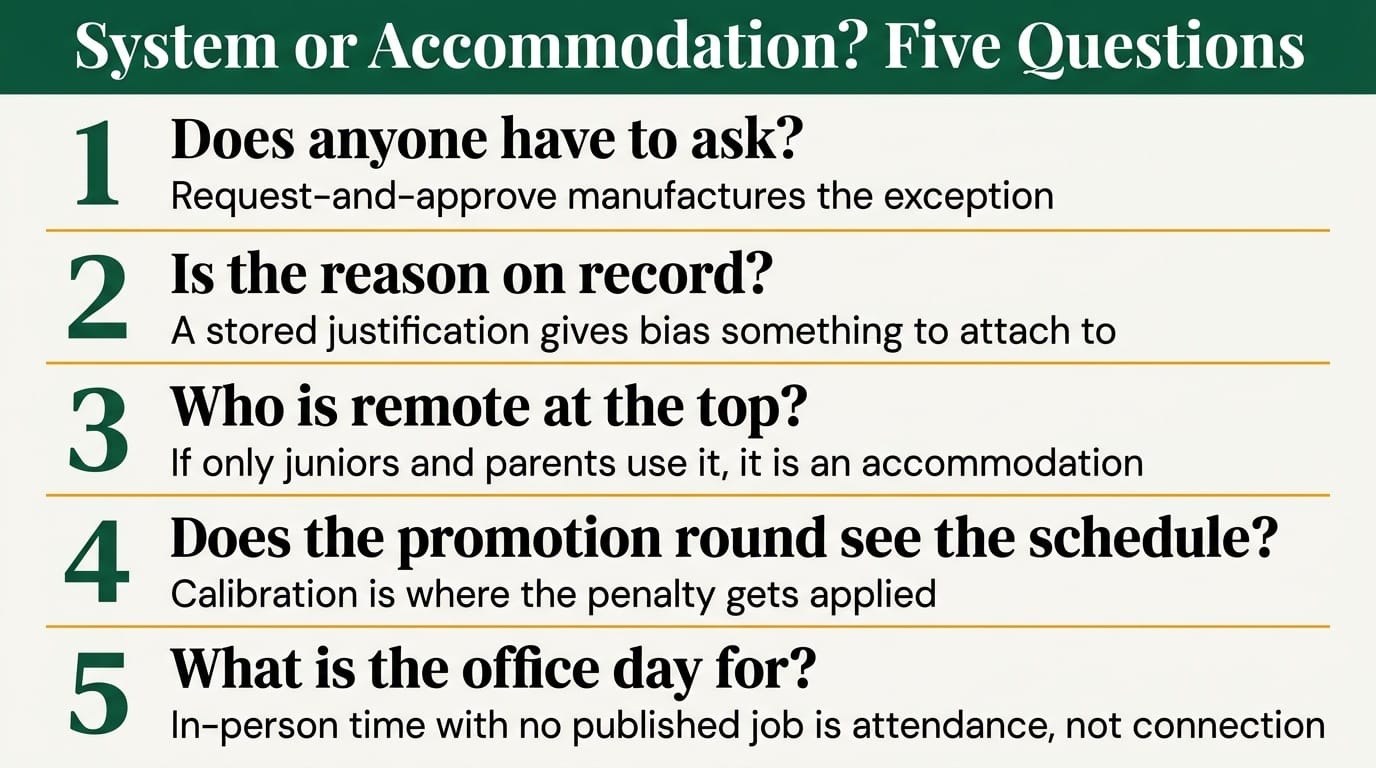
Five questions settle it. Does anyone have to ask permission? Is the reason recorded anywhere? Do senior leaders use the policy themselves, or only junior staff and parents? Does the promotion calibration conversation know who works which schedule? And can you say what a specific in-person day is for? A request step, a stored reason, or schedule visibility in calibration each mean you are running an accommodation, whatever the handbook calls it.
How do junior employees develop judgement on a distributed team?
By the same mechanism as always, made deliberate. Junior people learn from exposure to senior reasoning under uncertainty, fast correction on early work, and watching enough decisions to build a pattern library. The office delivered those incidentally. Distributed teams have to schedule them: decision narration on live calls, reviews where reasoning is the deliverable, and inclusion in meetings a junior person has no functional need to attend. Give each an owner, because none of it happens by default.
Should a leadership team ever mandate office attendance?
Yes, when a specific mechanism genuinely requires shared physical space and you can name it. Onboarding a cohort, a planning session that needs a wall and an argument, or work with a physical dependency all qualify. What does not qualify is a blanket day count justified by culture, collaboration or productivity in general terms. If you cannot say what the day is for and how you will know whether it worked, you are buying attendance and calling it connection.
Is Your Flexibility Policy Working Against You?
A 30-minute conversation can surface whether your hybrid policy is functioning as a system or an accommodation—and what to do about it.
Book a Free Consultation →