
AI and the Leadership Mindset: Who Is Actually Deciding?
How is AI changing what a leadership mindset has to include?
The shift is from consuming AI output to interrogating it. A Harvard field experiment found that experienced evaluators went along with AI recommendations that rejected strong work, and overrode the tool less often when it explained itself well. A leadership mindset now has to include the discipline of forming your own read before the machine offers one.
The Experiment Every Executive Should Read
Harvard researchers put 228 experienced evaluators in front of 48 submissions to an MIT global social impact innovation challenge, and gave some of them AI assistance. When the tool recommended rejecting submissions the expert panel had approved, the evaluators largely went along with it. High-potential work got filtered out by people who knew better.
The finding that should stop an executive cold is what happened in the condition where the model explained its reasoning. Evaluators who received a narrative rationale overrode the AI less often than the ones who got a bare recommendation. Better prose bought more compliance. Harvard Business Review published the results in August.
Sit with that for a second. These were experienced people, selected because they know the domain. The tool did not overwhelm them with data. It out-argued them, and being out-argued felt close enough to being informed that they stopped checking. Any executive who has approved a recommendation partly because the deck was tight already knows the feeling from the inside.
That is a decision-quality problem, which puts it in the same category as most of the benefits of executive coaching that companies already pay for. This one just arrives disguised as productivity.
Key Takeaways
- The AI risk to executives shows up as quiet deference to a confident recommendation, and the better the explanation, the less it gets challenged.
- Adoption is nearly universal and impact is not, because the gap is a judgment problem that more tool training does not touch.
- The entry-level work that used to build judgment is being automated at the same time management layers are being removed.
- Algorithmic trust is created by what a leader does when the tool is wrong, not by the governance document that says overrides are allowed.
- Coaching is one of the last structures that makes a leader produce their own view before an answer shows up.
The Adoption Gap Is a Leadership Gap
Companies are spending at scale and getting very little back. Enterprise generative AI spending has passed $30 billion worldwide, and 95% of organizations report no return on it, according to MIT’s Project NANDA as cited by SHRM. The tools are bought, the licenses are live, and the decisions have not improved.
McKinsey’s 2026 State of AI research, reported by Tony Gambill in Forbes, puts a second set of numbers on the same gap. Nearly nine in ten organizations report regular AI use in at least one business function. Only 37% attribute any positive effect on earnings to that use, and just 6% qualify as high performers. Near-universal adoption, very narrow impact.
The default response to a gap like this is more training. US businesses spent $102.8 billion on workplace training in 2025, and only 15% of learning and development leaders describe their own leadership programs as highly effective. Buying more of a thing that works 15% of the time is a budget decision pretending to be a strategy.
Gambill names the structural problem underneath, and it will sound familiar to anyone in a functional leadership seat. Leaders are held accountable for AI results without authority over the decisions that produce them. A leader inherits a platform selected somewhere else, on a timeline set somewhere else, changing workflows they did not design, and then owns the adoption numbers when the team resists. That distance between accountability and control is one of the most common presenting issues in C-suite coaching, and AI has widened it across an entire org chart in about eighteen months.
The Apprenticeship Layer Is Disappearing
Judgment has always been built by repetition. Junior people did the small, low-stakes work, got it wrong, got corrected, and slowly assembled the pattern library that senior judgment runs on. Generative AI is now good at precisely that work, and workforce researchers warn the leadership pipeline is eroding because of it.
Toby Walsh, chief scientist at UNSW.ai, asked the obvious question at a Mallesons summit: if these tools are good at the work entry-level people used to do, what happens to the entry-level people who used to do it. The follow-on question is the one nobody in the room owns. What happens to the leaders those people were going to become.
Benchmark data from the workplace researcher BoldHR points at the other half of the squeeze. Middle managers are retreating into operational execution at the same moment the roles beneath them are being automated. The layer that historically taught judgment by watching someone try and correcting them is now too busy shipping to teach anyone anything.
The org chart is getting shorter at the same time. Moritz Drerup, Managing Partner at Signium in Hamburg, told The HR Director that leaner organizations need more deliberate leadership, because flattening removes the buffers that used to absorb ambiguity. Wider spans of control, more direct reports, more decisions competing for the same attention, and fewer people standing between a leader and the mess.
Stack those three together and the arithmetic is unpleasant. Fewer reps, less teaching, more decisions per leader, and a very capable machine standing by with an answer. This is what turns leadership development and succession planning from an annual talent-review ritual into an operating problem with a clock on it.
Why Capable Leaders Defer
Deference is a rational response to pressure. A survey by ETS, reported in the Maryland Daily Record, found that 60% of workers feel pressure to adopt AI tools before they feel ready. Under that kind of pressure, going along with a confident recommendation costs nothing visible, and arguing with it costs time nobody has.
Is Deference Costing You Decisions?
A coaching conversation surfaces the quiet calculation between your instinct and the tool’s confidence—before it becomes a pattern.
Something happens in the moment a leader reads a recommendation that contradicts their own instinct. There is a small, quiet calculation. My read is a feeling. This thing has processed more cases than I will see in a career. Who am I to argue with it. That calculation takes about two seconds and almost never gets said out loud, which is exactly why it never gets examined.
What makes it so difficult to catch is that fluency reads as authority. A well-organized rationale activates the same trust a well-prepared colleague does, and it arrives without any of the social friction that makes us scrutinize a colleague. The Harvard result is that reflex measured under controlled conditions. The better the explanation, the less the human pushed back. A leader who spent a career learning to respect good reasoning is, by that measure, more exposed than a natural skeptic.
Then there is the adoption mandate sitting on top of everything. When an organization has publicly committed to AI, disagreeing with the tool starts to look like disagreeing with the strategy. Consider a leader whose team carries an adoption target on the quarterly scorecard. Overriding the model now has a political cost that overriding a colleague never had, and most people price that cost without ever naming it.
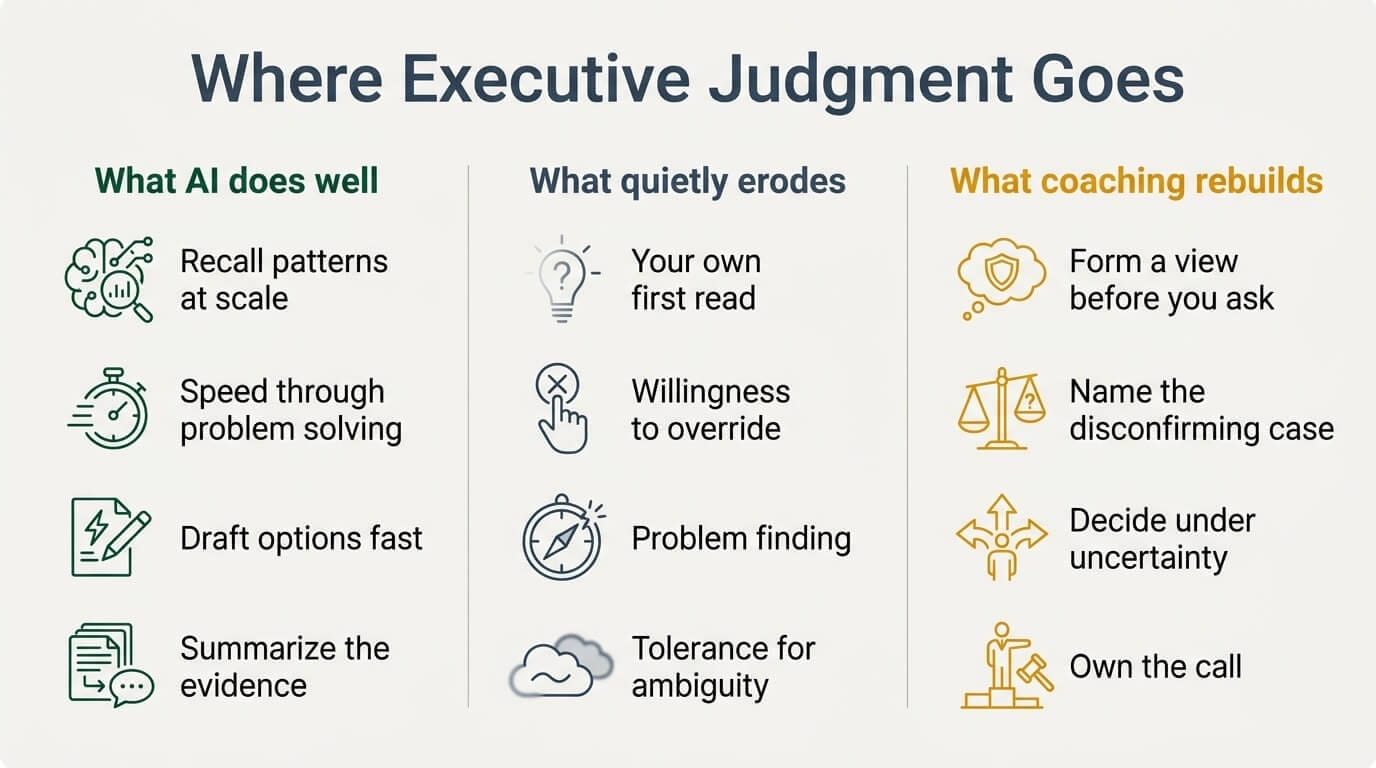
Set the three columns beside each other and the trade becomes visible. The middle column is the expensive one, because none of it fails loudly. No dashboard reports that a leadership team’s willingness to override dropped this quarter, and no post-mortem lists it as a cause.
This is why the work tends to surface in executive presence coaching rather than in any technical program. Presence, in this specific sense, is the capacity to hold your own read in the room long enough to test it against a very confident alternative. That capacity weakens without use and strengthens with practice, the same as every other executive skill.
The deference itself is understandable and often correct. The cost is what quietly stops happening around it. A leader stops consulting their own first read, and that read was the only thing in the room built from experience the model does not have.
Algorithmic Trust Is Built by Behavior
Trust in these systems cannot be assumed. A global KPMG study, cited by ETHRWorld, found that only 46% of people worldwide are willing to trust AI systems. Inside a company, that number sets the practical ceiling on how much of an AI rollout gets used rather than worked around.
ETHRWorld frames the mechanism well. Employees trust a system once they can see it is designed to be questioned, overridden, and held to account. Governance frameworks and accountability structures create those conditions on paper. Whether anyone believes the conditions are real depends entirely on what leaders do the first time the tool is wrong.
A leader who overrides a model in public, explains the reasoning, and then owns the outcome has taught their team that override is permitted. A leader who quietly defers has taught the opposite lesson, and no policy document reverses it. Behavior gets copied faster than governance gets read, and teams calibrate to what they watch happen rather than to what they were told in the rollout deck.
Usman Khan of ADP made a related point to Fast Company about values. His team keeps them in code rather than in prompts, so what gets blocked and what requires human sign-off runs as a deterministic check every time, and a person approves anything irreversible. An alignment strategy expressed only as a well-worded instruction is a suggestion. The same test applies to override: if a leader cannot name a specific decision the AI recommended and they refused, their override authority is a suggestion too.
No vendor ships this part of an AI rollout, and no governance template substitutes for it, which is why so many CEO coaching conversations this year end up on behavior rather than on the strategy document.
What Coaching Does That an AI Tool Cannot
Coaching requires a leader to produce their own thinking before an answer arrives. The coach withholds the recommendation on purpose, and the client has to build a position out of their own material. In an environment where every other tool on the desk volunteers an answer, that single constraint has become the practical case for executive coaching.
Build Your Override Rep
Coaching is the one structure that makes you produce your own read before an answer arrives. That discipline compounds.
Three practices carry most of the weight, and none of them need a budget line.
Commit before you consult. Write your own read of the decision in two sentences before you open the tool. Then query it. Then compare the two. The Harvard result depends on the human having no independent position at the moment the recommendation lands, and a written position taken thirty seconds earlier is remarkably hard to abandon quietly.
Build the override rep. After any recommendation, ask one question before acting: under what conditions would this be wrong. If the answer takes more than a few seconds to produce, the recommendation has not been evaluated, only received. Coaches already run this move on client assumptions every week. Only the target is new.
Treat fluency as a caution. The most thoroughly explained recommendation earned the least scrutiny in the Harvard study. A well-argued case deserves at least the same interrogation as a badly argued one, and usually more, because the polish may be doing work the underlying evidence cannot support.
There is a structural reason those practices pay off. Lav Varshney of Stony Brook University, speaking to the Maryland Daily Record, describes knowledge work in three phases: problem finding, problem solving, and externalization. AI is accelerating the middle phase, which raises the value of the two ends. Both ends belong to the leader. Problem finding is where deference does its quietest damage, because a leader who lets the tool frame the question has already conceded the decision before anyone evaluates an answer.
A model will answer any question you bring it. It will never tell you that you brought the wrong one.
Any leadership development plan written this year should carry a line about protecting judgment, sitting directly next to the line about AI fluency. Fluency without judgment produces fast, confident, well-explained decisions that nobody actually made.
The Decision Still Has Your Name On It
Accountability has not moved anywhere. When an AI-assisted decision goes badly, no board asks the model to explain itself. They ask the executive who approved it, and “the analysis supported it” has never worked as a defense in that room.
So the practice worth building is small and a little uncomfortable. Form your view first. Say it out loud, even if only to yourself. Then let the machine argue with it, and pay attention to how quickly you want to fold. That noticing is the entire discipline, and it is available in the next decision you make today.
Frequently Asked Questions
Three questions come up constantly when executives and coaches work through what AI is doing to decision-making: what the mindset shift actually is, whether using AI weakens judgment, and how to coach a leader carrying accountability for a rollout they never chose.
What is the AI leadership mindset shift?
Most AI leadership advice targets fluency, meaning the ability to use the tools well. The harder change is procedural. Form your own read of a decision before you query the model, ask under what conditions the recommendation would be wrong, and treat a fluent explanation as a reason for more scrutiny rather than less. Fluency gets you using the tools; this is what keeps your judgment in the decision.
Does using AI weaken executive judgment?
It can, and there is evidence for the mechanism. In a Harvard field experiment reported by Harvard Business Review, 228 experienced evaluators assessing 48 submissions to an MIT innovation challenge largely accepted AI recommendations to reject work the expert panel had approved. Evaluators overrode the tool less often when it supplied a narrative explanation. The erosion happens through deference and lack of practice at overriding, not through the technology itself.
How does coaching help a leader accountable for an AI rollout they did not choose?
Coaching addresses the accountability-without-authority position directly. The work usually covers three things: separating what the leader controls from what they only carry, building influence with the people who did make the decisions, and holding their own judgment steady when both the tool and the organizational mandate point the same direction. That is standard executive coaching territory, applied to a newer source of pressure.
Your Decisions Deserve Your Own Thinking First
Talk with a coach about building the judgment practices that keep you leading—not just approving what the machine recommends.
Book a Free Consultation →