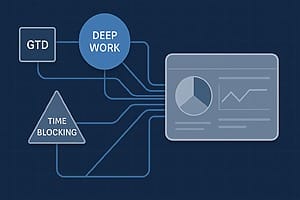
GTD for Executives: Adapting Getting Things Done for Leadership
How do I adapt GTD for leadership?
Keep the five steps of Getting Things Done (GTD): capture, clarify, organize, reflect, engage. Change three habits. Ask who owns an item before you decide its next action. Track what others owe you on Waiting For and Agendas lists. Use the Weekly Review and Horizons of Focus to manage the outcomes your team delivers.
Key Takeaways
- GTD’s clarify step already says to delegate when you can. At the executive level, ask who should own an item first.
- Sort next actions by cognitive context (the kind of thinking they need) and keep an Agendas list for each key person.
- Put everything you expect from other people on one Waiting For list, and review it every week.
- Treat your project list as a portfolio of outcomes, and use GTD’s Horizons of Focus to tie weekly projects to one- and two-year goals.
- Tell your team how your system works, so decisions, updates and escalations reach you in a form you can act on.
When Michael Porter and Nitin Nohria tracked 27 CEOs for 13 weeks, the CEOs worked an average of 62.5 hours a week, spent 72% of their work time in meetings and spent about 36% of their time reacting to issues as they came up. A to-do list built for one person’s work strains under a week like that.
David Allen’s Getting Things Done method still works at that level, with adjustments. What changes for an executive is where the work goes: most of it moves through other people. If you want to see where your week goes first, start with an executive productivity audit. If the same patterns break every system you try, the executive coaching guide covers the leadership habits underneath them.
Where standard GTD strains at executive scale
GTD was designed to get every commitment out of your head and into a system you trust. Five of its defaults need adjusting when your job is to lead other people’s work, because each one assumes a working life with fewer people in it.
Contexts. GTD suggests sorting next actions by context, such as Calls, Computer or Errands, so you see only what you can do where you are. The David Allen Company’s own setup guide calls context sorting optional, though it is the company’s most common suggestion. The real constraint is the kind of thinking a task needs and the people it involves. Knowing how you process information as a leader helps you choose better categories.
The two-minute rule. GTD’s clarify step says that if the next action takes less than two minutes, you do it now. If not, you delegate it if you can, or defer it. Allen meant the rule for clearing an inbox quickly. For a leader, the risk sits in the first branch: a two-minute task that belongs to someone else still lands on your desk, and doing it teaches people to send you the next one. Trust is part of this. Writing up Gallup’s study of 143 Inc. 500 CEOs, Sangeeta Bharadwaj Badal and Bryant Ott observed that leaders who do not delegate “do not trust others to do things as well as they themselves can.”
“GTD already tells you to delegate. At the executive level, ask that question first.”
Projects. GTD defines a project as an outcome that takes more than one action and can be finished within a year. By that definition an executive can carry dozens of projects, many of them delivered by other people. Your part in an outcome such as improving customer retention is to set direction, remove obstacles and check progress, so the list has to show who owns each outcome.
Review volume. Allen’s Weekly Review asks you to get every inbox to zero and walk through every list. The CEOs in Porter and Nohria’s study averaged 37 meetings a week and spent 24% of their work time on electronic communication. At that volume, a review that touches every input either shrinks to a skim or takes over Friday afternoon. Other people have to do some of the filtering and tracking before the review.
The single player. GTD started as a personal method. In a 2008 analysis of the method, Francis Heylighen and Clément Vidal suggested extending it to support collaborative work, and Allen later co-wrote Team: Getting Things Done with Others (2024) with Edward Lamont. For a leader, your system sets the pace for everyone who sends you work, so it needs to be visible to them.
Three changes that adapt GTD for executives
The three changes below keep Allen’s method intact and change its defaults: how you sort your next actions, what you let into the system, and the first question you ask when you clarify an item. Together they fit GTD into the rest of your executive productivity system.
Too Many Items Landing on Your Desk?
In a free consultation, we’ll look at which items should reach you, which belong with your team, and which decision rights would keep them there.
1. Sort actions by cognitive context and by person
Instead of @Computer or @Phone, group next actions by the kind of thinking they need. Call these cognitive contexts. A workable set might be deep thinking (strategy, writing, planning), decisions waiting on you, quick reviews and approvals, and conversations. Allen’s book gives four criteria for choosing what to do in the moment, in order: context, time available, energy available and priority. Cognitive contexts build energy into the list itself, so you can save demanding work for your best working hours.
Grouping similar work also cuts down on switching. Sophie Leroy’s research found that when you leave a task unfinished, part of your attention stays with it, and your work on the next task suffers. Our guide to what context switching costs covers the research and the fixes.
Then add GTD’s Agendas lists, which hold the items to discuss with specific people and in specific meetings. Keep one for each direct report, one for your board chair and one for each recurring leadership meeting. When you sit down with that person, the list is ready.
2. Filter what reaches you
Capturing everything works when the volume is yours to handle. At executive volume, add a filter before items reach you. Three tiers are enough:
- Items that need you: board matters, crises and decisions only you can make.
- Items someone on your team can handle with guidance.
- Information to read when you have time: updates, reports and FYIs.
An assistant or chief of staff can sort incoming items into these tiers, so you process them in order during time you have set aside. For what does reach you, capture still matters. In laboratory experiments by E. J. Masicampo and Roy Baumeister, an unfinished goal kept intruding on people’s thoughts and hurt their performance on unrelated tasks until they made a specific plan for it. In GTD terms, a captured item with a clear next action is that plan.
3. Ask who should own it before you ask what’s next
GTD’s clarify step already includes delegation: decide the next action, then do it, delegate it or defer it. At the executive level, change the order of the questions. When an item reaches you, ask:
- Why is this coming to me?
- Who could handle it with the right authority?
- What decision rule would stop it coming to me next time?
- If I have to be involved, what is the least involvement that works?
- What is the next action only I can take?

Anything you hand off goes on your Waiting For list, which GTD defines as actions other people are supposed to be doing that you care about. Review it weekly, and follow up from the list instead of from memory. A delegation framework helps you decide how much authority to hand over at each stage.
Capture across every input channel
Executive inputs arrive through email, chat, meetings, documents and requests in the hallway. In Porter and Nohria’s study, 61% of CEO work time was face-to-face and 24% went to electronic communication, so capture has to cover conversations as well as inboxes.
Email. Two habits help. First, an assistant can pre-sort by simple rules: the board and your own manager immediately, direct reports in a daily batch, everything else in a weekly summary. Second, check email at set times instead of keeping it open all day. In a study by Kostadin Kushlev and Elizabeth Dunn, 124 adults reported significantly lower daily stress in a week when they checked email three times a day than in a week of unlimited checking.
Chat. Messaging platforms carry an expectation of instant replies. Check them at set times too, and agree with your team on one route for real emergencies, such as a phone call, so urgent items still reach you.
Meetings. Meetings produce some of your most important inputs, and they are easy to lose between back-to-back sessions. In research by Leslie Perlow, Constance Noonan Hadley and Eunice Eun, executives spent nearly 23 hours a week in meetings. End each meeting with three things written down: decisions made, actions assigned with owners, and issues to escalate. Someone other than you can take and send the notes. Anything you need to raise with a person later goes on that person’s Agendas list.
Your project list as a portfolio of outcomes
At the executive level, the project list becomes a list of outcomes you are accountable for. GTD already has a structure for this. Allen’s Horizons of Focus describe six levels of work: next actions, projects you can finish within a year (reviewed weekly), areas of focus and accountability, goals for the next 12 to 24 months (set annually and recalibrated quarterly), vision, and purpose. In Allen’s words, “Priorities are determined from the top down.”
Group the outcomes you own into a few portfolios. One workable set: board accountabilities, strategic bets, operational improvements and leadership development. For each initiative, record who owns it (usually someone other than you), how you will know it is on track, and when you will review it. Porter and Nohria found that their CEOs spent 43% of their time on activities that advanced their own agenda, and they advise CEOs to keep a personal agenda, because without one the loudest demands set the priorities. A portfolio written against your goals is that agenda in a form you can check every week.
The executive weekly review
Allen calls the Weekly Review the one factor his method’s success hinges on. His Weekly Review checklist suggests early Friday afternoon, while you can still reach people at work, and walks through the same steps each time: gather loose notes, get every inbox to zero, empty your head, then review your action lists, your past and upcoming calendar, your Waiting For list, your project and larger-outcome lists, and your Someday/Maybe list.
For an executive, add five questions to that checklist:
- Portfolio: Which initiatives are on track, which are at risk, and where do you need to step in?
- Stakeholders: What do your board members, key customers and direct reports need from you this week? Their Agendas lists help here.
- Decisions: Which decisions are waiting on you, and what information do you still need?
- Energy: Does next week’s calendar put your hardest thinking where your energy is highest?
- System: What broke this week, and what one change would prevent it next time?
Keep the review short enough that you do it every week. If the calendar itself is the bottleneck, coaching for time management works on the habits the review keeps exposing.
Making GTD organizational: protocols for your team
Your system shapes how everyone around you works. Your direct reports need to know how you process information, when you make decisions and what gets your immediate attention. Think of it as designing the interface between your system and theirs. Agree on a few protocols:
- Decision requests include the context, the options and a recommendation.
- Status updates follow one consistent format.
- Escalations show what was already tried.
- Meeting requests explain why you specifically need to be there.
These protocols reduce the processing you do and teach the team to bring you work in a form you can act on. If your leadership team wants a shared method, Allen and Lamont’s book on teams applies the same GTD principles to groups.
From theory to practice: a four-week implementation path
You can phase these changes in over a month. The 30-day productivity challenge uses the same approach: one change at a time, with a review point before the next.
Week 1: Capture. Capture everything in one tool for a week without trying to organize it. By Friday you will see what actually reaches you and what should be going somewhere else.
Week 2: Structure. Set up your cognitive contexts, your Agendas lists and a Waiting For list. Process what you captured at a set time each day so a backlog does not build up.
Week 3: Delegation. Start asking who should own each item before you decide its next action. It will feel slower at first. Keep track of what you hand off and to whom.
Week 4: Integration. Run your first executive weekly review, share how your system works with your team, and agree on the protocols above.
“Start simple, stay consistent, and change one part of the system at a time.”
Frequently asked questions
How do I handle board members who expect immediate responses?
Set expectations during a calm period. Agree with your board chair on what counts as a board emergency and how it reaches you, such as a phone call, and handle everything else in batches. A short written update before each board meeting can answer routine questions before they arrive.
What if my organization’s culture resists structured communication protocols?
Start with your direct reports. If decision requests that arrive with context, options and a recommendation get faster answers, your team has a practical reason to use the format. Present it as a way to get them decisions sooner.
Should I use paper or digital tools for capture?
Use whatever has the least friction for you. A paper notebook for meetings and a digital list for processing can work together. Digital lists are easier to share with an assistant and make delegated items easier to track.
How do I keep GTD going during a crisis?
Switch to a reduced version. Keep capturing everything, keep the Waiting For list current, and shorten the weekly review to your calendar, your Waiting For list and your active projects. Go back to the full review when the crisis ends.
Can I run GTD as an executive if my assistant is new to productivity systems?
Yes. Have your assistant sit in on your weekly review, share your cognitive contexts and the three capture tiers, and hand over the sorting one step at a time. Working through one of the David Allen Company’s setup guides together gives you a shared vocabulary.
Is GTD coaching the same as executive coaching?
No. GTD coaching teaches the method itself. The David Allen Company works with Certified Trainers and GTD Coaches around the world who help people and organizations set it up and practice it. Executive coaching works on the leader who uses the system: the habits, decisions and relationships that send work your way, such as reluctance to delegate or unclear decision rights. Tandem’s executive coaches do that work in coaching sessions. They do not certify anyone in GTD.
Where to start
Pick one change for this week. Tomorrow morning, choose one capture tool and use it all day. Set up a Waiting For list and put on it everything you expect from someone else. On Friday afternoon, run your first weekly review with the five executive questions.
If one pattern keeps breaking your system, such as decisions that keep flowing up to you, Tandem’s executive coaching for senior leaders works on the habits behind it, in coaching sessions. To talk through your situation, book a consultation.
Rebuild Your System Around What Only You Can Do
Bring your project list and one week of inputs to a free consultation. We’ll look at what should reach you and what belongs with your team.
Book a Free Consultation →