Executive Work Rhythms: Optimize Your Chronotype
How can I optimize my work schedule for my chronotype?
To find your chronotype’s best hours, track your energy every hour for three workdays and note when your thinking is sharpest and when it dips. Block those peak hours on your calendar before anything else and give them strategic planning, complex problem-solving and high-stakes negotiations. Move email, administrative work and routine tasks into the dips.
Much of what you’ve been told about morning routines only works for some people. The 5 AM club, the miracle morning and the eat-the-frog-first advice all work well if your body clock runs early. If you’re naturally an evening performer, forcing yourself into a morning mold is like putting diesel in a gasoline engine. You might move forward, but you’re working against your own design the whole way.
The chronotype conversation has finally reached the C-suite, and it's about time. The same executives who would never ignore market cycles or seasonal business patterns routinely ignore their own biological cycles. They schedule board presentations during their cognitive valleys, make strategic decisions when their mental energy is depleted, and wonder why their judgment feels inconsistent despite their experience remaining constant.
What if you could predict, with reasonable accuracy, when you'll make your best decisions tomorrow? When your creative insights will flow? When you should absolutely avoid critical negotiations? This is chronobiology applied to executive performance, and once you understand it, you can’t unsee how much of your best thinking has been going to the wrong work.
The behavioral patterns that chronotype work reveals often connect to development priorities identified in coaching assessments. For context on that full engagement structure, what a full executive coaching engagement involves covers the ASPIRE process from intake through sustainability design.
Key Takeaways
- Chronotype runs on a continuum from early to late. The four executive patterns in this article are a coaching lens for planning your day, not a scientific classification.
- Timing matters: in a 2018 study of 56 adults, late chronotypes did significantly worse than early chronotypes on every test in the morning session.
- Sleep sets the baseline. Leaders’ poorer sleep quality predicted less self-control the next day, more hostile behavior toward their teams and lower team engagement.
- Short, quiet breaks after demanding work help it stick. There is no universal work-to-break interval, so test your own.
- Start with a three-day hourly energy log, then protect your peak block for your highest-stakes work.
The Four Executive Chronotypes: Beyond Morning and Evening
Chronotype describes when your body clock prefers to be awake and alert. Sleep researchers measure it on a continuum from early to late, often with the Munich ChronoType Questionnaire, and they do not sort people into executive types. Popular quizzes use animal labels instead, such as sleep specialist Michael Breus’s lion, bear, wolf and dolphin. Like those labels, the four patterns below are a coaching lens, a practical way to map that continuum onto a leader’s working day. Treat them as starting points to test against your own energy log, and drop any label that does not fit you.

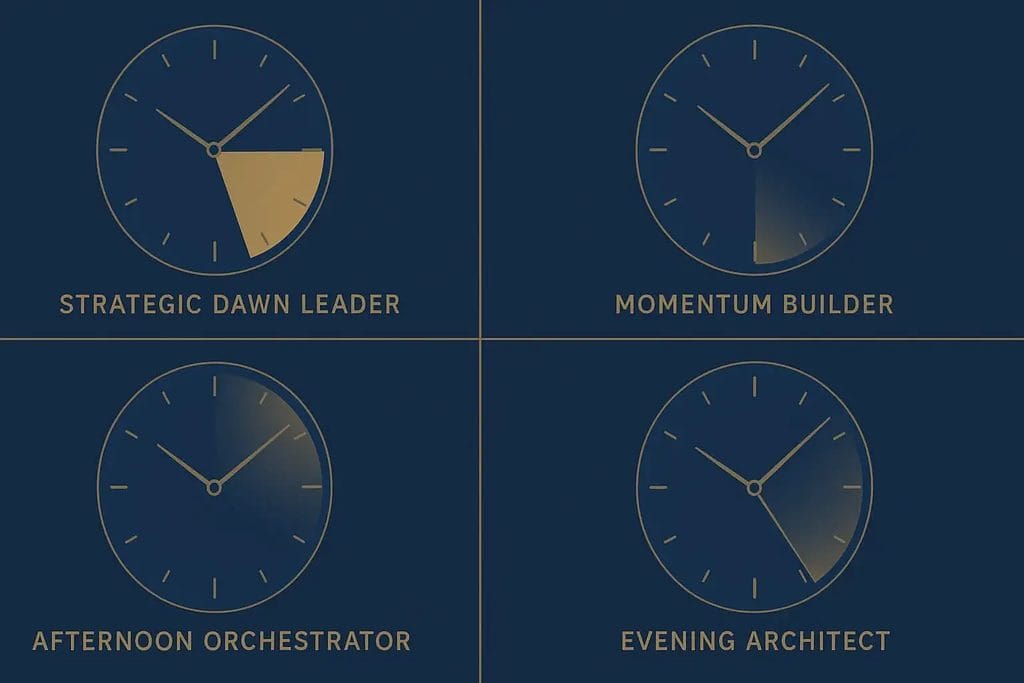
The Strategic Dawn Leader does their best thinking between about 5 and 8 AM, before the day’s complexity arrives. Leaders with this pattern describe their clearest strategic thinking as happening in those quiet hours. Their challenge is isolation: when your sharpest hours come before your team is awake, collaboration has to work asynchronously. A typical move for this pattern is to reserve one early, uninterrupted block for strategic planning instead of trying to think between afternoon meetings.
The Momentum Builder gains cognitive strength as the morning progresses, hitting peak performance between 9 AM and noon. These leaders thrive on the energy of the business day building around them. They’re naturals at leading meetings, making collaborative decisions and driving team energy. Their vulnerability is a morning meeting schedule that looks productive but breaks their peak window into pieces too short for deep work.
The Afternoon Orchestrator hits their stride between 2 and 5 PM, when many colleagues are reaching for another coffee. This pattern often goes unrecognized because it runs against the familiar advice to do the hardest work first. Leaders with this pattern protect their afternoons, scheduling routine tasks for the morning and complex problem-solving after lunch. Some also move negotiations and other high-stakes conversations into the afternoon once they notice that is when they think most clearly.
“Stop trying to become a morning person or an evening person. Learn your own rhythm, then build your day around it.”
The Evening Architect reaches peak clarity between 7 and 10 PM, after the workday’s noise dies down. Leaders with this pattern often feel guilty about it, as if they should be “off” at the hour they are most capable. The usual adjustment is to accept the evening peak and use it for strategic planning and complex document review, while handling routine communication during standard hours.
Understanding Your Biological Operating System
Chronotype shapes more than the hour you feel awake. It affects when you can do sustained, demanding thinking and when you are better suited to lighter work. For a leader, the useful question is which kind of work each part of the day can carry, and the answer differs from one person to the next.
Your circadian rhythm, a roughly 24-hour biological cycle, sets the broad peaks and dips of your day. Shorter cycles may sit on top of them. The sleep researcher Nathaniel Kleitman, who helped describe the roughly 90-minute cycle of sleep stages, argued in a 1982 paper in the journal Sleep that a similar rest-activity cycle continues through the waking day. The waking evidence is weaker than the sleep evidence. A 2024 analysis of continuous activity recordings in Scientific Reports found non-random patterns across the day, but at the scale of minutes to hours they looked more irregular than rhythmic. Treat 90 to 120 minutes as a sensible length for a focused block to test on yourself, rather than a fixed biological clock.
Timing matters more for some people than for others. In a 2018 study of 56 healthy adults, researchers tested early and late chronotypes at 2 PM, 8 PM and 8 AM the next morning. In the morning session, the late chronotypes did significantly worse than the early chronotypes on every measure, including reaction time and a test of executive function. If you are a natural night owl, an 8 AM strategy session may be landing in your weakest hours.
A few days of hourly energy notes will show you where your stronger and weaker windows fall. The weaker stretches still have uses, because they suit different work. The waste comes from spending your strongest hours on routine tasks while forcing strategic thinking into your weakest ones.
Sleep Sets the Baseline for Your Peak Hours
In a 2015 study in the Academy of Management Journal, Christopher Barnes and colleagues followed supervisors and their teams for 10 workdays. After nights of poorer sleep quality, leaders started the day with less self-control, which predicted more hostile behavior toward their teams and lower team engagement that day. How well the leaders slept mattered; how long they slept did not show the same effect. A chronotype schedule assumes a decent night’s sleep.
Christopher Neck and Todd Edwards make a broader case from family therapy in a 2026 paper in The American Journal of Family Therapy. Their Lifestyle Informed Systems Framework treats sleep, diet and exercise as inputs that shape emotion regulation and how people interact. It is a conceptual framework that proposes these links rather than testing them in leaders. Log how you slept next to each day’s energy ratings, so a slow morning after a bad night is not mistaken for your chronotype.
The Energy-Task Alignment Matrix
Now that you've identified your energy patterns from your productivity audit, let's optimize when you deploy them. Not all executive tasks require peak cognitive function. The skill lies in matching task demands to energy availability.
Stop Wasting Peaks on Routine Work
If your “10x work” keeps getting pushed into valleys, a coach can help you redesign the week so strategy, negotiations, and decisions land in your true peak windows.
Peak Energy Windows should be reserved for what I call “10x work”: activities where the quality of your thinking directly multiplies organizational value. Strategic planning, complex problem-solving, critical negotiations and high-stakes decision-making belong here. These are the hours where the difference between good and great thinking can decide a deal or save months of work.
Secondary Peak Windows are ideal for important but less cognitively demanding tasks. Performance reviews, project planning, team one-on-ones and creative brainstorming often work better in these windows than during primary peaks. You're still sharp, but you're not depleting your premium cognitive resources.
Valley Periods suit routine execution, email processing, administrative tasks and casual relationship building. The arithmetic adds up quickly: moving 90 minutes a week of email out of your morning peak and into a post-lunch dip returns 78 peak hours over a year.
The alignment matrix asks you to do the right work at the right time, with the same total workload. When you stop forcing strategic thinking into valleys and stop spending peaks on routine tasks, your best work gets your best hours.
Protecting Your Rhythm in an Arrhythmic World
The business world isn't designed for chronotype optimization. Standard meeting schedules, market hours, global time zones, and organizational culture all conspire against biological alignment. The answer is to work strategically within these constraints rather than fight them.
Start with defensive scheduling. Once you've identified your peak windows, block them on your calendar before anything else. Label them as you would any critical meeting. Some leaders give these blocks a working title such as “Board Prep” or “Strategy”, so colleagues read them as commitments rather than open time.
For global teams, the challenge multiplies. You are managing your own chronotype and also the overlap of several biological rhythms across time zones. The key is transparent communication about peak performance windows and creative scheduling that rotates meeting times so no one geography always bears the burden of off-peak participation.
“Book your peak window before anyone else can. It is the most valuable meeting on your calendar.”
Sometimes you will have to break your rhythm. Crisis doesn't care about your chronotype. The skill lies in knowing when to break your pattern and, crucially, how to recover afterward. If you must handle complex work during a valley, prepare differently. Over-prepare materials, simplify decision frameworks, and build in recovery time afterward.
The Recovery Protocol: Honoring Your Valleys
The dips between your peaks are where recovery happens, and recovery depends on what you do with a break. Treat a dip as an investment in the next peak and it stops looking like lost productivity. Short pauses between focused blocks also have some laboratory evidence behind them.
The best-known figures for how long to work and rest come from DeskTime, a time-tracking app. In 2014 it looked at the computer use of its most productive 10% of users and found they worked for about 52 minutes, then took a 17-minute break. When DeskTime repeated the analysis in 2021, the pattern had shifted to 112 minutes of work and 26 minutes of rest. Both results describe one app’s users, and they changed a lot in seven years, so treat them as prompts to test your own interval.
What a break does is better studied in the lab. In a Psychological Science study, Michaela Dewar and colleagues had people listen to a story and then spend 10 minutes either resting quietly or playing a spot-the-difference game. The resting group remembered more of the story shortly afterward and again a week later. A 2021 study in Cell Reports recorded brain activity while people learned a new motor sequence and found that during short rests, the brain rapidly replayed the practiced sequence; more replay went with more skill gained. Neither study looked at executives, but both point the same way: a short, quiet pause after demanding work helps it stick.
The comparison group in the Dewar study is the useful warning. A game, a news feed or an inbox keeps your mind busy, so a break spent scrolling looks more like the game than like rest. A short walk, a few quiet minutes away from a screen, or a conversation unrelated to work gives the pause a better chance to do its job.
Integration with Your Productivity Stack
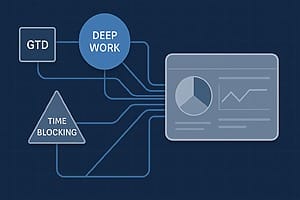
Your chronotype optimization doesn't replace the GTD system you've modified for executive scale – it amplifies it. Consider when you schedule your weekly reviews. Most GTD practitioners default to Friday afternoon, but if you're an Evening Architect, that's precisely when your strategic thinking peaks. Why waste that on review when Tuesday morning's valley would work perfectly?
The same logic applies to every element of your productivity system. Deep work blocks should align with peak windows. Administrative batch processing fits naturally into valleys. Delegation conversations often work better during secondary peaks when you have energy for interaction but don't need peak cognitive performance.
This integration extends to your 30-day productivity transformation. Week one focuses on discovering your rhythm. Week two experiments with alignment. Week three addresses team synchronization. Week four builds protection protocols. Each week builds on the previous, creating sustainable rhythm optimization rather than forced change.
Frequently Asked Questions
What if my chronotype doesn't match my industry's schedule?
Industries have rhythms: financial markets, retail seasons, tech sprints. When your biological rhythm conflicts with your industry’s, look for the one block of peak time you can protect each day, even if it is only an hour, and give it your most demanding work. A small alignment you can keep beats a perfect schedule you cannot.
How do I handle team members with different chronotypes?
Chronotype diversity is actually a strategic advantage if managed well. Map your team’s collective rhythms and you’ll find natural coverage patterns. Early birds handle morning crisis, evening types manage late stakeholder calls. The key is transparency and mutual respect for different peak windows.
Can I change my chronotype?
Partly. Genes play a role: a 2019 genetic study of nearly 700,000 people linked 351 regions of the genome to being a morning person, yet the 5% of people with the most “morning” variants slept only about 25 minutes earlier on average than the 5% with the fewest. Routine can move your timing further. In a three-week study of night owls published in 2019, a routine built around earlier fixed sleep and wake times, morning light and regular meal times moved participants’ schedules about two hours earlier. Within whatever range you have, the coaching question stays the same: which work belongs in which hours.
What about jet lag and travel?
Crossing several time zones leaves your body clock out of step with local time for a while, so plan your calendar around the trip. Where you can, keep the first days after a long flight for routine meetings and schedule the decisions that need your best judgment later in the trip.
How quickly will I see results?
No study gives a reliable timeline for this, so measure it yourself. After a few weeks of protecting your peak block, compare what you produced in it with your energy log and with your calendar from before you started. An early change can be relief: once you know why certain hours feel slow, the guilt about “unproductive” time tends to ease. Changes that involve your team take longer, because other people’s calendars have to move too.
What if my role requires constant availability?
Even 24/7 roles have degrees of freedom. You can’t control when crises occur, but you can influence when you do planning, analysis, and strategic thinking. Start by protecting just 60 minutes of peak time on each workday. Over a year of about 260 workdays, that adds up to 260 protected peak hours.
Should I share my chronotype with my board/stakeholders?
Frame it as performance optimization, not personal preference. Share that you’ve identified when you deliver maximum value and structured your schedule accordingly. Framed that way, it reads as a performance practice, which is language boards already use.
How does age affect chronotype?
It moves earlier as you get older. Large survey data show that chronotype gets later through the teenage years, reaches its latest point around age 20, and then moves gradually earlier through adulthood, according to a 2004 Current Biology paper by Till Roenneberg and colleagues. The pace varies from person to person, so repeat your energy log every year or two instead of assuming an old schedule still fits.
The patterns here connect across levels and functions: the real cost of context switching, Getting Things Done for executives, time management coaching, and choosing executive productivity tools.
Your Rhythm Revolution Starts Today
The executive who aligns with their biological rhythm doesn't work harder – they work synchronized. They stop the exhausting fight against their natural patterns and start surfing their energy waves. The result isn't just improved productivity – it's sustainable performance that compounds over time.
But knowing your chronotype is just information. Acting on it is transformation. This week, track your energy hourly for three days. Note when complex tasks feel effortless and when simple tasks feel overwhelming. Identify your peaks and valleys. Then protect one peak window completely – no meetings, no interruptions, no routine tasks. Use it for your highest-value work and measure the difference.
As you implement chronotype optimization alongside your existing productivity systems, remember that perfection isn't the goal – progression is. Every hour you align with your biology rather than against it is an hour of amplified impact. In a role where your cognitive performance directly influences organizational outcomes, can you afford not to optimize? If you want a thinking partner to turn these rhythms into a lasting leadership advantage, that is exactly the work of executive coaching for senior leaders.
Build a Calendar That Matches Your Biology
In a free consult, we’ll identify your peak windows, protect them with defensive scheduling, and align high-stakes decisions to your best thinking.
Book a Free Consultation →