
Team Performance Is a Decision Problem, Not a Culture Problem
What actually drives team performance?
Team performance is produced by the quality of the decisions a team makes between meetings. Four conditions determine that quality: agreed direction, shared understanding of how the business works, clear decision rights, and enough honest conflict that disagreement surfaces before the decision instead of after it. Culture is what those decisions look like in aggregate.
Five business publications ran the same story in three weeks, written for audiences that never read each other. A learning publication told chief learning officers their strategy did not stall for the reason they think. A consulting group put the failure rate for transformation past two-thirds. Gallup told chief human resources officers half of them do not trust their own managers with the technology they just bet the strategy on. A research body told HR the money is flowing into the people side of change and the capacity to deliver it is not. A Forbes columnist told everyone the quiet team is the expensive one.
Nobody in those organizations was short on strategy. They were short on decisions.
Strategy fails on an ordinary Tuesday, when a director chooses between the roadmap and the thing her biggest customer is shouting about, picks the customer, and never tells anyone she made a strategic choice. Multiply that by four hundred people and six months.
Key Takeaways
- Team performance is a decision output. Strategy converts into results through hundreds of unremarkable choices, and each one is a place the plan can leak.
- Calling it a culture problem reads the scoreboard back to the team as an explanation. Culture is the aggregate of the decisions, so it is a symptom with a diagnosis hiding behind it.
- The conflict-avoidant team costs more than the loud one. Its failures leave no incident to point at, only decisions that never got made.
- Coach training builds the coaching half well and the business half almost not at all, and at the execution layer that runs out fast.
- Managers are the only delivery mechanism that scales, and the research says they are the least equipped part of the system.
The culture diagnosis is where execution problems go to die
Almost every stalled strategy gets the same explanation, and the explanation is an aggregate wearing the costume of a cause. Culture describes the pattern in how people decided. It never tells you which decision went wrong, who made it, or what they were missing. Answer those three and you have something to work with.
Chief Learning Officer ran the sharpest version of this argument. The setup is familiar: sound strategy, clear goals, months of planning. Six months later departments are moving in different directions, meetings generate updates instead of decisions, and the leadership team is repeating the same message louder. Somebody says it is a culture problem and the conversation ends there. Their correction is exact. Culture does not execute strategy. People do, through hundreds of daily choices about what to prioritize, when to cross a boundary, and whether to raise a concern.
Consulting experts at Procapita Group put the failure rate for change initiatives at more than two-thirds, and their first strategy is no communication tactic. Senior leaders must agree on the message, the rationale and the expected outcomes before the change is announced, because leadership misalignment is one of the most cited causes of failed transformation worldwide. If the top team has not converged, everyone below receives a slightly different strategy and executes it faithfully. Nobody is resisting. The organization is doing exactly what it was told, four different ways.
So when a client hands you the word culture, refuse the abstraction and ask for the tape. Which decision went the wrong way last quarter. Who made it. What did they believe about the priority. Three questions in you find the diagnosis determines the outcome, and the diagnosis is rarely culture. It is a direction that was never converged, or a decision right nobody owns.
Team performance is a decision-quality problem
Four conditions sit between a written strategy and team performance: direction, shared understanding, decision rights, honest conflict. When a plan stalls one of them is missing, and each fails with a signature you can recognize from across the room.
Can Your Team Name Which Condition It Fails?
Most can’t. A coach who works at the decision layer can help you find the gap before the quarter closes short.
Direction means the leadership team agrees on the message, the rationale, and what success looks like. Missing, every team optimizes locally and calls the result priorities.
Shared understanding means people know why the strategy exists and how their work moves the number it depends on. Missing, they execute the plan they think they heard, which is usually the last plan with new vocabulary.
Decision rights means it is clear who decides what, at what level, without escalating. Missing, everything escalates and nothing closes. The executive calendar fills with decisions that belonged two layers down, and two layers down learns to wait.
Honest conflict means disagreement surfaces before the decision rather than in the hallway afterward. Missing, you get agreement in the room and drift outside it, the most expensive of the four because it stays invisible until the quarter closes.
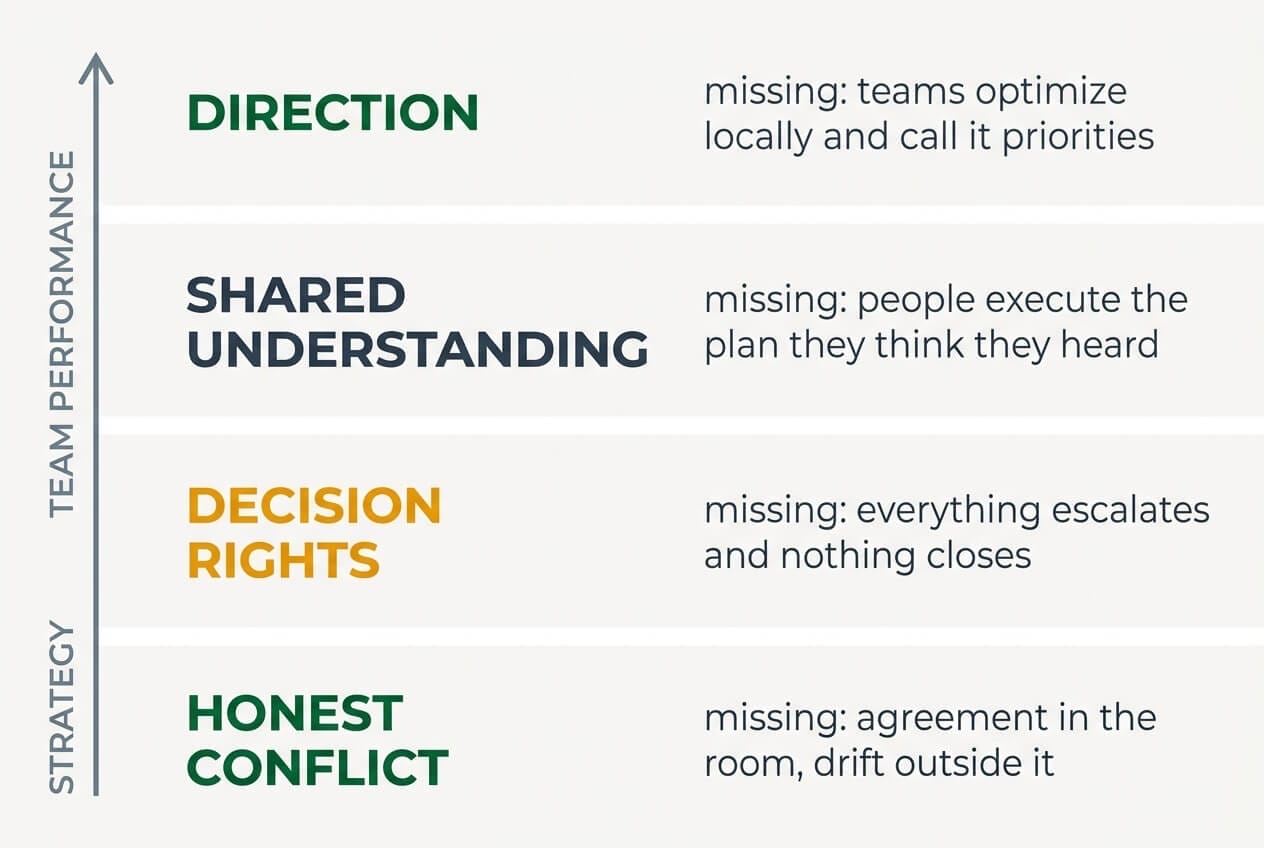
There is no order to work through. A team can be strong on three and collapse on the fourth, and the fourth is the one worth an engagement. Most coaches start with conflict, because conflict is what the sponsor described. Often the real gap is a decision right nobody wrote down, and once it is written the conflict evaporates. It was never about the disagreement. It was about who got to end it.
Working the gap between what a team agreed to and what it did is the whole discipline, and accountability is harder than it looks because most teams cannot say which of the four they are failing.
Conflict is where the decisions get made or quietly deferred
A team that never argues is deferring, and the deferrals are being paid for somewhere the sponsor cannot see. Writing in Forbes, Julie Kratz describes both ends of that range from inside them. Her first team argued constantly: name-calling, cursing, slammed doors, a punched wall. That is destructive conflict, a zero-sum contest over who is right that runs on defensiveness and escalating hostility, and she left. The second team was the correction she went looking for. More care, more stability, no surfaced conflict at all. Deadlines slid, quality dropped, and she calls it living in Care Bear land.
Both teams failed. One of them looked healthy while it did.
The Society for Human Resource Management puts the scale at 76% of employees experiencing conflict regularly, costing an estimated $2 billion a day in lost productivity and absenteeism. The avoidant end is the part nobody budgets for. Destructive conflict at least produces an incident somebody answers for. Avoidance produces no artifact, no complaint, and no meeting anyone would flag in a retrospective. Only a decision that never got made and a quarter that closed short.
The loud team costs you something you can name. The quiet team costs you the decisions nobody made, and there is nothing in the record to point at.
Generative conflict lives between those two, and it is a trained capability rather than a personality trait a team either has or does not. Which raises something uncomfortable about how coaches get made.
Coach training teaches presence, active listening, powerful questions, and how to hold silence. All necessary. Very little of it teaches you to stay in a room where four senior people disagree about a live trade-off and somebody has to decide by Friday. That room does not need a beautiful question. It needs someone who will name the disagreement out loud when everyone has agreed to pretend it is a scheduling issue, and who will not flinch when the temperature goes up.
That skill is teachable and mostly absent from curricula. Its prerequisite is psychological safety in team coaching, because a team without it surfaces nothing real however good your questions are. Past that it is repetition under supervision, the only way anybody learns to coach a team through a live disagreement without shutting it down or losing the room.
Business acumen is the half of coach training that gets skipped
A coach who cannot follow a margin conversation can still coach the leader’s feelings about the margin. Real work, real value. At the strategy-execution layer it runs out fast, because the client spends the session translating instead of thinking, and translation is not what they are paying for.
Chief Learning Officer profiled Andromeda Simulations International this month, and the durability of the business is the interesting part. Robin and Eliza Helweg-Larsen founded it in 1993-94, and for more than 30 years they have taught Fortune 500 companies, universities and business schools how business works through hands-on simulation rather than spreadsheets, using their Income|Outcome simulation and an approach they call visual finance. Robin Helweg-Larsen’s explanation for the persistent demand: people struggle with business finance because they have no way of seeing the big picture.
Thirty years of steady demand for one fix tells you the gap is structural. Every generation of managers arrives without a working model of how the enterprise makes money, and cannot see how their own decisions land on it. That is the shared-understanding condition, sold as a product.
Turn it on the profession. We ask coaches to work with executives on strategy execution and credential them on a framework that never checks whether they can read the client’s business. Three cumulative levels of fluency are worth naming.
- Read the statement. Revenue, gross margin, operating expense, cash. Enough to know what the client means by a good quarter, and to notice when their story and their numbers disagree.
- Follow the operating logic. How this business converts effort into money, what the constraint is, and which lever the client controls rather than influences.
- Hold the trade-off. Stay in a conversation where two defensible options compete on real numbers, without resolving it early to relieve the discomfort.
The third is where coaching and business fluency stop being separate skills. You cannot hold a trade-off you do not understand. You collapse it into a feelings conversation, the client lets you, and both of you leave pleased with an hour that changed nothing.
Ask your next executive client to walk you through their operating model on a whiteboard, as if you were a new hire. Twenty minutes, no coaching. You will learn more about where the strategy leaks than six sessions of clean questions, and the client often finds the gap while drawing it.
None of this makes you a consultant, and the boundary matters. You are not there to have an opinion about the pricing strategy. You are there so the client does not have to explain it before thinking about it, which is the difference between executive team coaching that reaches the work and a very pleasant hour.
The manager is the delivery mechanism, and nobody funded them
Every one of the four conditions is delivered by a manager or it is not delivered. Direction gets translated by a manager. Shared understanding gets built in a one-to-one. Decision rights get honored or hoarded at the manager’s desk. Conflict gets surfaced or smoothed in a meeting somebody runs. Two findings this month say the same thing about how that is going.
Equip the Delivery Mechanism
Your managers translate direction, build shared understanding, and surface conflict—or they don’t. Coaching builds the capability the training budget missed.
Gallup surveyed 102 chief human resources officers in its Global CHRO Roundtable. 99% say AI is somewhat or very important to their organization’s strategy. 50% are not very or not at all confident in their managers’ ability to guide employees on using it at work. 57% are providing AI training for people managers. Gallup’s Q1 2026 workforce study found AI adoption pushing organizational culture in equally positive and negative directions on average, with managers as the decisive variable: employees whose managers support their AI use are more likely to say the culture improved.
APQC found the structural version of the same gap. Across a global survey of more than 1,100 HR leaders, organizations at the median devote 40% of their change investment to people-focused activities, while only 44% say their function has change management capability and capacity to a substantial or very great extent. The money went to the people side. The capability to spend it well did not arrive with it.
What closes that gap is a manager who can run a conversation that produces a decision. That is a coaching skill, and the version of coaching that scales, because the manager is already in the room every week. The coaching skills that separate good leaders from great ones convert strategy into behavior on a Tuesday, and coaching skills for change management is where this stops being a soft investment and becomes how the transformation gets delivered. A two-day workshop will not do it. Reps on live problems with someone watching cost more, and they are the only thing that has ever worked.
Design coach training backward from the decision
Chief Learning Officer made one more argument this month, aimed at learning leaders, that lands harder on coach training than on the audience it was written for. Learning should begin with the business outcome rather than the curriculum. Organizations deliver thousands of courses, count certifications earned, watch learning hours climb, then cannot answer a leader who asks what business problem any of it solved.
Apply that to how coaches get made and it stings, because coach training programs are designed from a competency list. Not out of laziness. The competency list is what gets assessed, so it is what gets taught, and the result is graduates who pass a recorded-session evaluation and go quiet in a strategy room. That evaluation is real and worth passing. It also never asks whether the coach can hold a trade-off, read an operating model, or stay in a room where the disagreement is about money.
Backward design asks a different first question: what decisions does this coach need to be able to hold. Answer honestly for anyone working above the individual-contributor layer and you get a list a competency framework does not generate. Conflict a coach can stay inside without resolving it early. A financial conversation they can follow without translation. A team session where the trade-off gets named and the decision right assigned before anyone leaves.
The delivery format already exists, and it is supervised repetition on real work rather than a module. That is what mentor coaching and supervision have always been. A coach observed holding a hard room ten times has something no curriculum transfers, and a coach training program worth the money builds that on purpose rather than hoping it accumulates.
Which puts the profession in the same position as the organizations it serves. The plan is sound, the competencies are articulated, and the gap sits between the framework and what a coach can do on a Tuesday afternoon when a leadership team disagrees about the number.
Frequently Asked Questions
What actually drives team performance?
The quality of the decisions a team makes between meetings. Four conditions govern it: agreed direction, shared understanding of how the business works, clear decision rights, and enough honest conflict that disagreement arrives before the decision rather than after. Team-building activities move none of these.
Is a stalled strategy a culture problem or a strategy problem?
Usually neither. Culture names the pattern in how people decided, so calling it the cause stops the inquiry one question early. Ask which decision went the wrong way, who made it, and what they believed about the priority. The answer is normally a direction that was never converged or a decision right nobody owns.
How much business acumen does a coach actually need?
Enough to follow the client without translation. Read a financial statement, understand how the business converts effort into money, and stay in a trade-off between two defensible options with real numbers on both sides. Your job is to let the client think about the strategy instead of explaining it to you.
How does a manager learn to coach without leaving the job?
Reps on live problems with someone watching. A two-day workshop produces enthusiasm and no behavior change, which is why many organizations ran one and concluded coaching does not work for managers. Observed practice on their own conversations, over months, is the only format with a record.
Which of the Four Conditions Is Missing?
Direction, shared understanding, decision rights, honest conflict—a 30-minute conversation can narrow it to the one worth an engagement.
Book a Free Consultation →