Letters to Myself
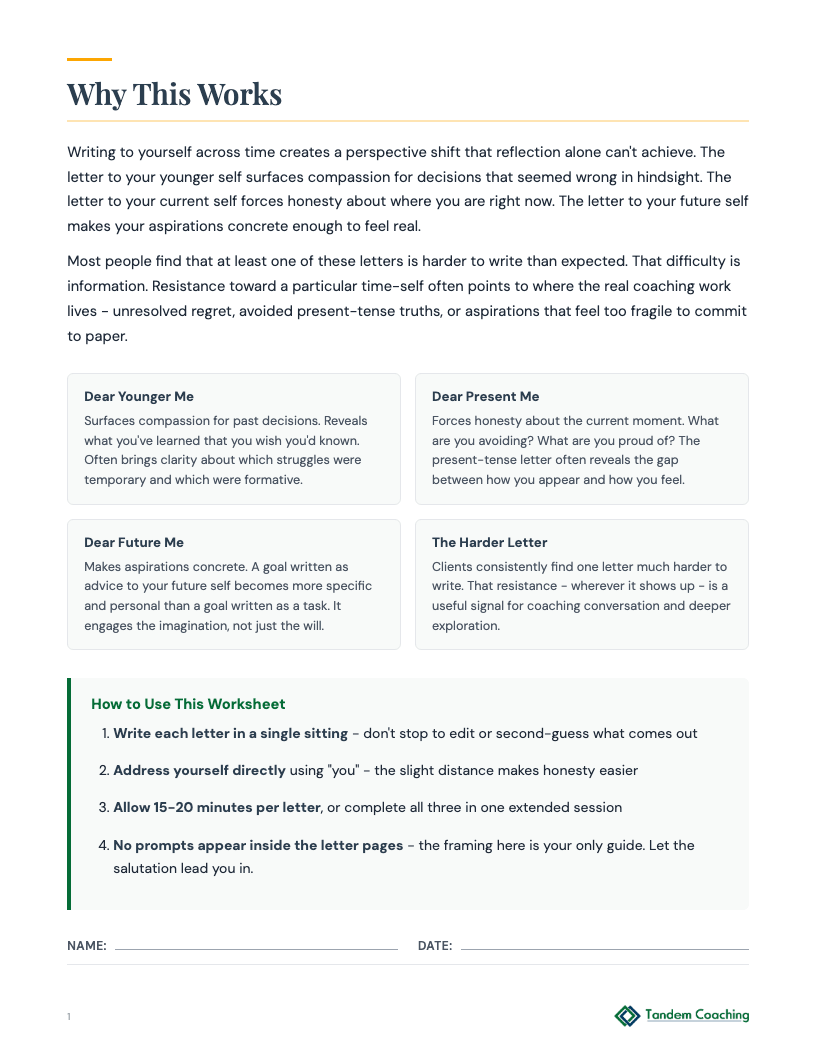
Write a compassionate letter to your past self to ease regret and self-criticism, using guided prompts grounded in evidence-based self-compassion.
Get This Tool
Free, print-ready PDF.
When to Use This Tool
I'm hard on myself for past mistakes and I want to find some compassion for who I was then
I feel disconnected from my future self and where I'm actually heading
I want to understand how my past shaped me without being stuck there
How to Introduce This Tool Plus
Some clients find it powerful to write letters to their younger, present, and future selves as a way of accessing perspective they can't easily get through conversation alone - would that be an approach worth trying?
Browse All Pages
Tool Classification
Domain
Life Coaching
Type
Worksheet
Phase
Discovery
Reflection
Details
45+ min
Between sessions
Topics
Identity
Resilience
Values
For the Coaching Practitioner
Plus
Coaching Scenarios
Plus
1 Mid-career professional reentering workforce after a health crisis ▶
Context
A marketing director took fourteen months away from work following a serious illness. She is now re-entering the workforce and is fielding job offers, but she finds herself unable to evaluate them clearly. She says the person who left her last job and the person now reading these offers do not feel like the same person. She wants to understand who she has become before she commits to what she does next.
How to Introduce
Frame all three letters as a single conversation across time. 'The letter to your younger self tends to surface what you've learned. The letter to your present self is usually the hardest - people rarely speak to themselves with the same directness they'd use with a friend. The letter to your future self is where you find out what you actually want, because you have to imagine it into existence.' For her specifically: 'The illness is going to show up in these letters - that's expected. We're not avoiding it; we're finding out what it changed.'
What to Watch For
Watch the tone of the letter to the present self. If it is critical or demanding (you need to figure this out, you're falling behind), she is applying the pre-illness standard to a post-illness person. If it is gentle to the point of avoidance (you've been through so much, just rest), she may not yet be ready to claim an identity for what comes next. The letter to the future self is diagnostic for this scenario: if it describes a career resumption that looks identical to what she left, the illness has not yet changed the blueprint. If it describes something substantively different, that is the conversation.
Debrief
Start with the letter to the present self. 'Read me the part you found hardest to write.' That section holds the most honest content. Then move to the future letter: 'What does this person want that the person who left her last job didn't yet know she wanted?' Look for anything that appears in all three letters - a value, a theme, a recurring image - and name it: 'This word shows up in all three. What does that tell you?' The connecting thread across all three letters is usually the most stable part of her identity, and the most useful thing to anchor next steps to.
Flags
If the letter to the present self is short, clinical, or written in third person (she would be wise to...) rather than second person directed at herself, she may not yet be able to make contact with where she is. Severity: low. Do not push for more intimacy in the writing; instead explore what is making it hard to address herself directly. If the future letter contains no images of work at all - only rest, relationship, or recovery - that is worth naming: 'Your future self doesn't have a job. What do we make of that?'
2 Senior leader preparing for retirement who has no identity outside his title ▶
Context
A senior director at a government agency is eighteen months from a planned retirement. He has been in this role or adjacent ones for twenty-six years. His wife has been asking him to engage more with planning what comes next. He brings this to coaching as 'figuring out what to do with my time,' but his coach has noticed that the question underneath is who he will be when he is no longer the person his title has made him.
How to Introduce
Introduce the three letters as a structured way to separate the role from the person. 'We're going to write three letters - to yourself at the beginning of your career, to the person you are now, and to the person you'll be in retirement. The letter to the future self tends to be the most revealing for people in your situation, because it has to describe you without the title.' Name the resistance: 'Some people find the future letter the hardest to write because there's nothing there yet. That blank page is what we're here to work with.'
What to Watch For
Watch what the letter to the future self contains. If it is mostly logistical (travel plans, grandchildren, golf), he has described activities but not an identity. If the future self has no role, no contribution, no sense of mattering to anything, he may be anticipating retirement as an ending rather than a transition. Watch the letter to his younger self for what he was before the career shaped him - that often contains seeds of what retirement could claim. If the letter to the present self is written in the voice of his professional role (strategic, measured, output-focused), the tool has not yet broken through the professional frame.
Debrief
Start with the letter to his younger self. 'What does the person in this letter care about that the person you are now hasn't had much time for?' Look for anything that predates the career identity. Then move to the future letter: 'Does the person here have a way of mattering that isn't about the role?' If not, that is the coaching conversation: what does contribution look like outside of formal authority? The question that often opens this: 'Who will notice the difference between you being in the room and not being in the room - and for what reason?'
Flags
If the letter to the future self is very short, or if he declines to write it and says he doesn't know what to write, this may be early-stage anticipatory grief about the end of a professional identity that has been his primary self-concept for decades. Severity: moderate. Do not push through the blank page quickly. Explore what makes the future self hard to imagine - is it the absence of the role, or the absence of something the role was providing that he hasn't named yet? Consider whether additional support alongside coaching (therapy, peer community for retirees) would be useful.
3 Young professional who achieved the goals she was told to want and feels nothing ▶
Context
A twenty-nine-year-old finance associate has completed her MBA, joined a top-tier firm, and earned a promotion ahead of schedule. She describes her career as objectively successful. She also describes feeling hollow in a way she cannot explain and has not told anyone about. She came to coaching because she does not know what she is trying to build now that she has built what she was supposed to. She frames this as a goal-setting problem.
How to Introduce
Frame this as a way to locate what she actually wanted before the script was written for her. 'The letter to your younger self is going to be interesting for you - because I'm going to ask you to write to yourself before you knew what success was supposed to look like. Before the MBA track, before the recruiting cycle, before you knew what 'making it' meant.' The resistance to name: 'Some people find the future letter produces anxiety - because you have to choose what to want, and there's no one left to tell you what to choose. That discomfort is what we're here to explore.'
What to Watch For
Watch what the letter to the younger self grieves, if anything. If there is an earlier version of herself - a version who wanted something specific that the career track interrupted - it will appear here. Watch the present-self letter for the tone of self-regard: is she proud of herself or exhausted by the person she has been working to become? The future letter is the most diagnostic: if she cannot fill it in, the hollowness is about not yet having authored her own goals. If she fills it with professional achievements, the script is still running.
Debrief
Start with the letter to her younger self. 'What did she want that didn't make the final plan?' Name anything that appears in that letter but not in the future letter - those are the dropped threads. Then go to the present self: 'What does this person need that the career track hasn't provided?' Follow with the future letter: 'Read me the part that surprised you - something you wrote that you didn't plan to write.' If there is no surprise, the future self is still performing. Ask: 'If no one you respect would ever see this letter, what would you write differently?'
Flags
If all three letters are written with the same competent, achievement-focused tone and contain no moment of genuine personal desire or vulnerability, the tool has not yet reached the person underneath the performance. Severity: low. This is not a reason to push harder - it means the access point is not yet found. Consider whether a values-focused tool or a direct conversation about what she was like before the career script got written is a better entry point. If the hollowness she describes has been present for more than a year and includes loss of interest in most activities outside of achievement, assess whether what she is describing goes beyond coaching scope.
Tool Flow
Plus
Requires
- None - standalone tool
→
Produces
- three written letters to self across time
- named resistance points toward time-selves
- compassion map for past decisions
Pairs Well With
Life
Wins and Learning Evidence Log
Use this tracker to notice patterns in resilience and accountability over time before drawing conclusions.
Why it pairsUse this after the letters to give the client evidence that counters the self-criticism surfaced in their resistance points.
WellnessOptional Wellbeing Intentions
Use this worksheet to explore self care and values and turn the client’s observations into one optional next step.
Why it pairsOnce you've mapped compassion for past decisions, this assessment shows where current depletion is still driving the same self-neglect patterns.
LifeBelief and Practice Options Map
Use this planner to organize mindset and habits into a client-owned sequence of possible next steps.
Why it pairsUse this to map which domains still carry fixed framing around the exact mistakes the client just named compassionately.
Related Articles


Demystifying the ICF Certification Process: A Competency-Based Approach
Read article →
What Got You Here Won't Get You There — The Currency Version
Read article →
Is Hiring an Executive Coach Worth It? Let's Find Out!
Read article →
When Your Client Is Already Using AI: Coaching Through the Disruption
Read article →