Identify the self-care gaps draining your energy and stalling goals, using a structured, evidence-informed assessment to guide next steps.
Free, print-ready PDF.
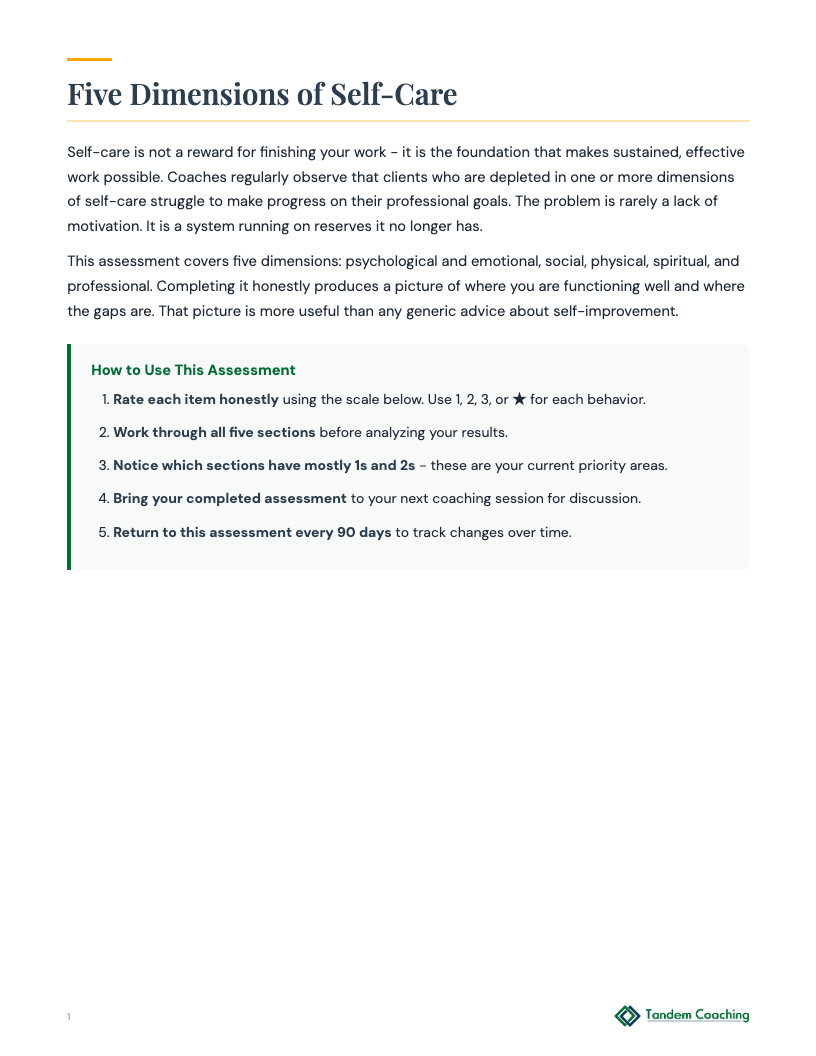
There's a five-section self-care assessment covering psychological, social, physical, spiritual, and professional dimensions — it produces a picture of where you're functioning well and where the reserves are actually running low. Would that be a useful starting point?
C-suite executive at a manufacturing company, working 70+ hour weeks through a major acquisition. Came to coaching for 'leadership effectiveness' but shows signs of decision fatigue and irritability with direct reports. Views any non-work activity as time stolen from responsibilities.
Frame this as a performance audit, not self-care. 'We're going to assess the sustainability of your current operating system. High performers track the inputs that maintain peak output.' Expect resistance to the word 'self-care' - they'll want to rename sections as 'recovery protocols' or 'performance maintenance.'
Speed through the assessment in under 5 minutes signals they're not engaging genuinely. Watch for consistent 2s and 3s across all sections - this suggests they're rating what they think they should do, not what they actually do. Physical and Professional sections often get inflated ratings.
Start with Professional Self-Care since they rated it highest. Ask: 'Walk me through what taking breaks during the workday actually looks like for you.' The specificity of their answer reveals whether the rating reflects reality. Then move to their lowest section with: 'What would need to change for this area to not be a performance liability?'
If Physical section shows all 1s but they insist they're 'fine' - especially sleep and medical appointments - this suggests they're running on adrenaline and may be heading toward burnout. Severity: moderate. Continue coaching but name the pattern directly and assess whether they're willing to treat this as a business risk.
Nurse manager at urban hospital, 18 months into staffing shortages. Came to coaching because she's 'losing patience with her team' and considering leaving healthcare entirely. Works mandatory overtime, covers shifts, and feels guilty about any time spent on herself while colleagues are struggling.
Position this as a resource allocation assessment. 'Before we talk about your team dynamics, let's map where your personal resources are actually going versus where they need to go.' Normalize that healthcare workers often score low across multiple sections - the system demands it, but that doesn't make it sustainable.
Look for scores of 1 across Social, Psychological, and Spiritual sections, but inflated scores in Professional (they're still showing up to work, so they think they're doing fine professionally). If they rate 'Ask others for help when needed' as 1 but 'Ask for support when overwhelmed at work' as 3, they're compartmentalizing.
Start with Social Self-Care, which is often devastated in healthcare workers. Ask: 'When was the last time you spent time with someone who doesn't work in healthcare?' Then explore the guilt pattern: 'What story do you tell yourself about taking time for relationships while your unit is short-staffed?' This usually opens up the martyrdom dynamic.
If they score 1s in three or more sections and express guilt about 'being selfish' when discussing any self-care activity, this suggests identity fusion with caregiver role. Severity: high. The guilt response indicates they may need support beyond coaching to separate personal worth from professional sacrifice.
Founder of a successful tech startup, company just hit Series B funding. Externally everything looks great - revenue growing, team expanding, media coverage. Internally, they feel disconnected from friends, haven't taken a real vacation in three years, and their relationship is strained. Came to coaching for 'scaling leadership skills.'
Frame this as a sustainability audit for high-growth phases. 'Success can mask resource depletion until it becomes a performance issue. Let's see what's actually fueling your current pace.' Entrepreneurs often resist this because they fear slowing down will kill momentum. Address that directly: 'This isn't about slowing down - it's about not burning out the engine.'
Entrepreneurs typically score themselves higher than reality, especially in Professional Self-Care. They confuse 'loving their work' with 'taking care of themselves professionally.' Watch for 1s in Social and Psychological sections but 3s or stars in Professional - this suggests work has consumed other life areas.
Start with the section they rated highest and drill down. If Professional got stars, ask: 'What does celebrating professional achievements actually look like for you?' Often they realize they don't celebrate - they just move to the next milestone. Then ask: 'What would need to be true for you to invest in [lowest section] the way you invest in your business?'
If Social Self-Care shows all 1s and they mention relationship strain or lost friendships, but they minimize this as 'temporary sacrifice for the business,' this suggests they're using success to avoid intimacy. Severity: moderate. Continue coaching but explore whether business focus is serving growth or avoiding personal connection.
Marketing director with ADHD, recently diagnosed at age 38. Has tried multiple self-care approaches but can't maintain consistency. Either goes all-in on elaborate wellness routines that collapse after two weeks, or abandons self-care entirely during busy periods. Came to coaching to 'get better at follow-through.'
Frame this as a pattern recognition tool, not a performance measure. 'ADHD brains often have all-or-nothing relationships with self-care. This assessment will show us which areas you naturally maintain versus which ones require different strategies.' Normalize that consistency looks different with ADHD - it's about sustainable minimums, not perfect routines.
ADHD clients often show extreme variation within sections - some items rated as stars, others as 1s, with few 2s or 3s. This reflects the all-or-nothing pattern. Physical Self-Care typically shows this most clearly - they either exercise intensely or not at all. Look for self-judgment in their body language when rating low items.
Start with items they rated as stars and ask: 'What makes this one sustainable when others aren't?' Look for environmental factors, not willpower explanations. Then move to 1s: 'Which of these low-rated items actually matters to you versus which ones you think should matter?' This separates authentic priorities from should-based expectations.
If they rate most items as 1s and express shame about 'failing at basic self-care,' this suggests they're measuring themselves against neurotypical standards. Severity: low to moderate. Continue coaching but focus on ADHD-compatible approaches rather than traditional self-care advice. Consider referral to ADHD-informed therapist if shame is pervasive.
I swing between feeling flat and feeling overwhelmed and I don't know how to regulate in between
WellnessWhen I'm overwhelmed I blank on what actually helps me - I need a list I can reach for
WellnessA client is running at full capacity and starting to show signs of burnout
Step 1 of 6 in Client is depleted and struggling to make progress on professional goals despite high motivation
Next: 28-Day Dopamine Reset Challenge → Explore all pathways →