Build confidence for your next challenge by reviewing evidence of your past follow-through and turning it into a clear, credible plan.
Free, print-ready PDF.
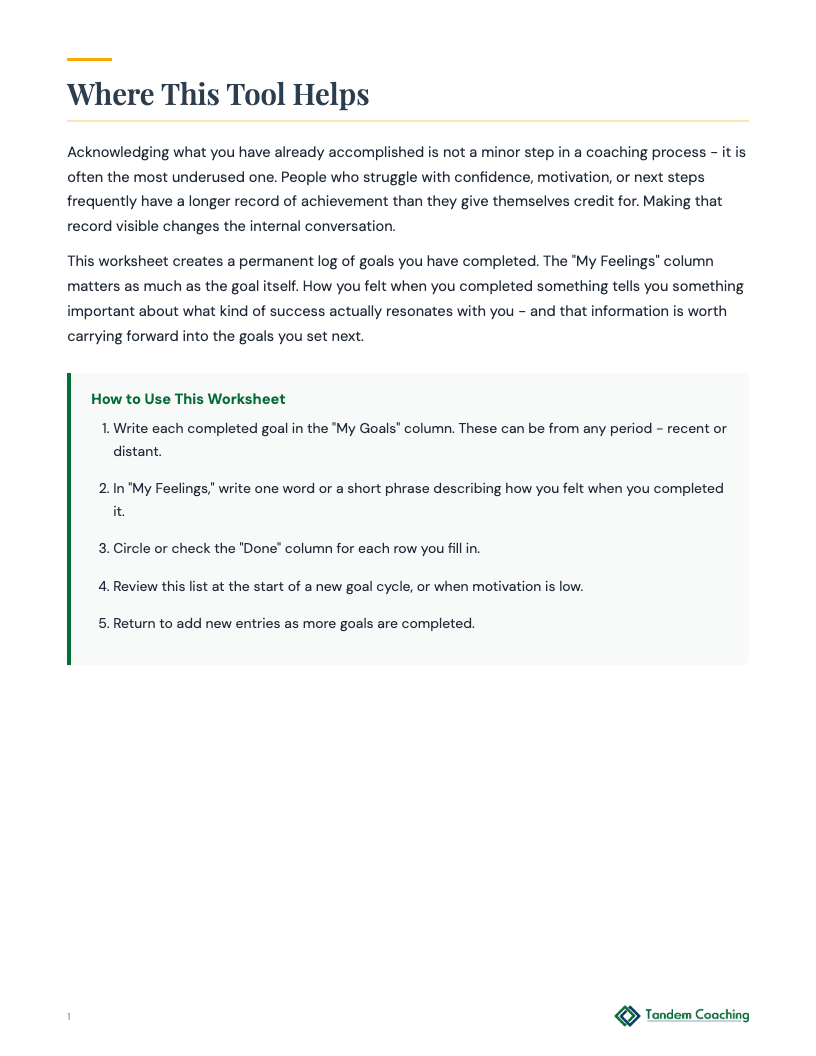
There's a log for goals you've already completed — with a column for how each one felt when you finished it, because that tells you what kind of success actually resonates with you. Would it be useful to build that out before we set what's next?
A professional who is working on building confidence or setting ambitious next goals has a pattern of discounting what they've already completed. When they describe prior achievements, qualifiers appear immediately: 'that wasn't that hard,' 'anyone could have done it,' 'the timing helped.' The log creates a written record that the inner critic has a harder time revising than a verbal account during a session.
Frame as evidence-building rather than celebration. 'We're going to create a file. Not impressions — a record. Completed goals, written down, marked done. The feelings column is important: how you felt when you finished each one. Over time this log becomes a counter-record to the story that you don't follow through, or that your accomplishments don't add up to much.' The evidence framing works for clients who reject positive reframing but accept documentation.
Watch the feelings column for this client in particular. Clients who discount their follow-through often write feelings like 'relief,' 'fine,' or 'ready for the next thing' — not pride or satisfaction. That's information: they completed the goal and didn't register it as meaningful. The coaching work is in the gap: 'You wrote 'fine' here. What would have had to be true for you to write 'proud'?' That question surfaces what the client's standard for registrable achievement actually is.
Ask the client to read the completed list aloud — all seven entries. Then: 'Looking at this list as a whole — whose record does this look like? How would you describe this person if someone asked you about their track record?' The third-person reframe is useful for clients who minimize their own achievements; they often describe the same record more accurately when asked to characterize it as if it belonged to someone else.
If the client cannot populate seven entries — cannot identify seven completed goals from any period in their professional or personal life — the difficulty accessing achievements is more significant than a habits issue. Severity: low to moderate. Explore whether the standard for 'goal' is set so high that nothing qualifies, or whether the client genuinely cannot recall accomplishments. Both are informative but point to different coaching work.
A professional in a demanding period — high workload, organizational uncertainty, a role that's been consuming — has progressively lost access to their own record of accomplishment. In session they describe feeling ineffective or behind, despite objective evidence that they've been delivering. The log is used as a mid-cycle intervention: not a year-end review but a real-time accounting to counter the distortion that sustained pressure produces.
Position as a mid-course correction to the narrative. 'Before we talk about what's not working, I want to build a list of what you've actually completed. Not how it felt to complete it — what happened. Goals finished, marked done. Start with the last six months.' The instruction to start with a specific recent period prevents the list from becoming abstract. The 'marked done' frame is deliberately concrete: these are things that are actually over.
Watch for whether the feelings column shifts between earlier and more recent entries. For a client in a difficult stretch, older completions may show 'satisfied' or 'proud' while recent ones show 'relieved' or blank. That shift tells you something about when the difficulty started to affect how achievement registers. It's also a basis for a useful question: 'What was different about this period compared to the earlier ones?'
After completing the log, step back with the client. 'You described the last several months as a period when you've been struggling. Look at this list. How does this record match that description?' For clients whose internal narrative is running ahead of the actual evidence, the disconnect between the self-described experience and the documented record is often visible and useful. Don't resolve the tension for the client — let them observe it.
If a client in a genuinely difficult period completes the log and reports that reading it back doesn't produce any shift in how they feel about their effectiveness — the record is accurate but doesn't register — this disconnection between evidence and self-perception is worth noting. Severity: moderate. It may indicate burnout (the work is happening but doesn't feel meaningful), or a self-perception that isn't responsive to evidence. Neither is a minor issue; explore whether other forms of support alongside coaching might be appropriate.
A competent professional experiences a cycle: when approaching familiar territory, they feel confident and effective. When facing genuinely new challenges — a stretch assignment, a level change, an unfamiliar domain — their confidence drops sharply and doesn't recover until they've demonstrated success in the new area. The log, built over time and returned to at the start of new challenges, provides a portable record of demonstrated capability that the client can carry into unfamiliar territory.
Introduce the log as a resource for those moments, not just a reflection exercise. 'We're building this list now, and we're going to add to it over time. But the moment this list is most useful is when you're facing something genuinely new and your confidence is low. At that point, pull this out. Read it. That list is what kind of person is about to take on this new challenge.' The future use case matters for clients who would otherwise see the exercise as retrospective rather than functional.
Watch the feelings column for patterns that reveal what kind of achievement the client finds most motivating. Some clients' feelings column is warmest for goals with clear impact on others; some for goals requiring persistence over a long arc; some for goals where they overcame genuine doubt. The pattern in the feelings column reveals the type of achievement that most consistently produces the positive registration the client is looking for — which is useful information for how to frame the next challenge.
After completing the initial log, ask the client to identify one entry where they had significant doubt before completing it. 'Pick one where you weren't sure you'd get there.' Then: 'What did you write in the feelings column for that one?' The connection between doubt, persistence, and completion is often the most confidence-building narrative for clients who face wavering confidence on new challenges. A client who has navigated doubt before and succeeded has evidence they can do it again.
If the client's feelings column is consistently flat — 'done,' 'fine,' 'finished' — without any entry that reflects genuine satisfaction, the achievement record may be real but the motivational connection to it isn't. Severity: low. This doesn't change what the record shows, but it suggests that the goals being completed aren't connecting to what the client actually cares about. That's worth exploring: which entry, if any, produced something other than completion satisfaction?
I'm hard on myself for past mistakes and I want to find some compassion for who I was then
WellnessClient is depleted and struggling to make progress on professional goals despite high motivation
LifeClient talks about wanting to grow but responds to setbacks with fixed patterns of self-protection