Shift from self-protective reactions to a growth response when setbacks hit, using evidence-based mindset coaching grounded in behavioral science.
Free, print-ready PDF.
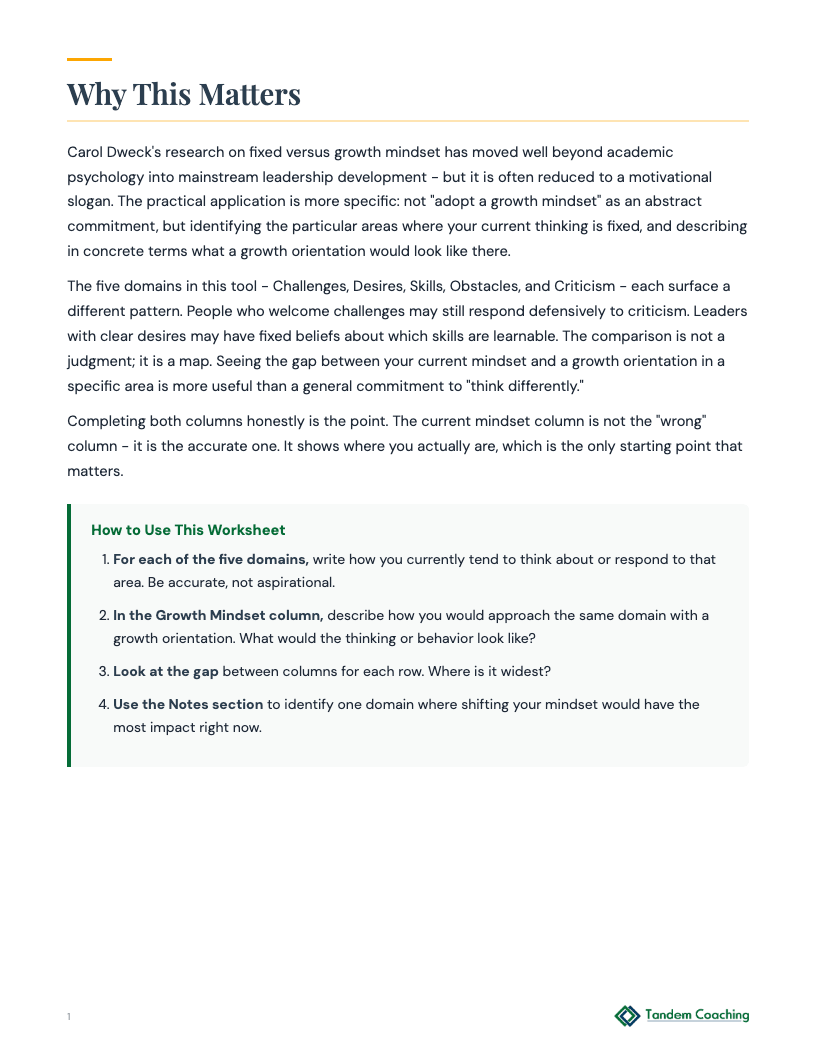
This comparison maps your current response patterns in five domains against growth mindset patterns - it's less about scoring and more about seeing exactly where the contrast shows up - would that be a useful starting point?
A director at a technology company uses growth mindset vocabulary fluently — he talks about learning, iteration, and embracing failure in team meetings and performance conversations. In coaching, his behavior tells a different story: he avoids stretch assignments he might not excel in immediately, prepares exhaustively to avoid any appearance of not knowing, and consistently attributes his setbacks to external factors rather than examining his own approach. He has never completed a domain-by-domain assessment of where his actual mindset patterns are fixed versus growth-oriented.
The framing needs to separate vocabulary from operating reality. 'You use growth mindset language accurately and you believe in the framework. What we haven't yet mapped is where your actual daily patterns land in each domain. There's a difference between endorsing the framework and operating from it — and the gap is almost always domain-specific, not universal. This worksheet asks you to describe how you actually tend to respond in five domains — challenges, desires, skills, obstacles, and criticism — not how you'd like to respond. The current mindset column is the honest one. That's the starting point.' Position the honest assessment as more useful than the aspirational one.
Watch whether the 'Current Mindset' column contains behavioral descriptions ('I defer to others' ideas in areas I haven't mastered') or endorsements of the growth orientation ('I embrace challenges and try to learn from them'). The latter means the client is not completing the exercise honestly — he is writing the aspirational column twice. Also watch for the domain where there is the widest discrepancy between what he writes in the current column and his actual behavior as you have observed it in sessions. The Criticism domain is often where the discrepancy is largest for clients who publicly endorse growth mindset.
Start with the domain where he rated the widest gap between his current and growth mindset descriptions. 'Tell me about a specific example in the last month where your current mindset in this domain showed up — not the growth orientation version, the current one.' A concrete example tests whether the self-assessment is accurate. Then: 'In the Notes section, you identified one domain where shifting would have the most impact right now. What specifically would shifting look like in behavior terms — what would you actually do differently in that domain next week?' Convert the conceptual into the behavioral before the session ends.
If the 'Current Mindset' column is generally positive across all five domains — close to the growth orientation in each — and this does not match his behavioral patterns as observed in sessions, the self-assessment gap is the coaching issue. Severity: low. Name the discrepancy directly: 'What you've written in the current mindset column looks close to the growth orientation in all five areas. And yet the preparation pattern you described this morning — spending four hours before a 30-minute conversation to make sure you knew everything — fits more closely in the fixed column for skills. What's going on between the assessment and the behavior?' The gap is the work.
A VP of customer success coaches her team on growth mindset regularly and is widely respected for how she develops her direct reports — she is patient with their learning curves, frames failure as information, and creates genuine psychological safety for them to try things and stumble. In coaching, when the focus turns to her own development, a different pattern emerges: she is reluctant to attempt things she hasn't mastered, rarely names specific development areas, and describes her own professional struggles as 'just who I am.' She applies the framework to others with sophistication and to herself almost not at all.
Name the asymmetry before introducing the tool. 'You are genuinely skilled at creating growth conditions for your team. What I've noticed is that the framework you apply to them doesn't seem to travel to your own development in the same way. This worksheet applies the same map to you that you apply to others — five domains, current orientation versus growth orientation. The discipline is completing the current column for yourself with the same honesty you'd bring to a developmental conversation with one of your direct reports.' The team-leader framing activates her existing competence rather than positioning this as a new skill.
Watch the Criticism domain specifically — this is often where the asymmetry is sharpest. Clients who are genuinely growth-oriented with others' failures often have a fixed response to feedback or criticism about themselves. Also watch whether she fills the 'Growth Mindset' column for herself with descriptions she has used in conversations with her team — her growth orientation descriptions for others may be more developed than her growth orientation descriptions for herself. If the two columns look very similar in language, she may be importing her team-facing framework rather than examining her own.
After completing the worksheet, compare her description of growth mindset for herself to what she has described in team development conversations. 'You wrote in the Criticism domain: [read her growth orientation]. Is that the same framing you use when you debrief your director after a difficult stakeholder meeting?' If the answer is yes, the gap is not in understanding — it is in application to self. Then: 'What would make you extend yourself the same kind of patience you extend your team? Not across all five domains — just the one where the gap is widest.' Make the behavioral target specific and small.
If the fixed-mindset language she uses about herself is global and resistant to any domain-specific reframe — if she describes herself as 'not a learner' or 'not capable of changing how I operate' in multiple domains — and this coexists with strong developmental behavior toward her team, the self-directed fixed belief may run deeper than mindset mapping alone can address. Severity: low to moderate. Continue the worksheet work, but the source of the self-exception — why she applies the framework generously to others and not to herself — is worth exploring directly.
A senior individual contributor is transitioning into a team lead role in four months. Her manager wants her to begin development work now on the areas where she will face the most adjustment. Her coach wants to establish a baseline — where her current mindset patterns are genuinely growth-oriented and where they are more fixed — before the role demands begin. She has no prior formal assessment of her mindset. Her coach suspects her orientation toward challenges and obstacles is strong, but her response to criticism and her beliefs about leadership skills may be less examined.
Frame this as preparation infrastructure, not assessment. 'Four months before the role changes is the right time to do this — not because something is wrong, but because leadership puts you in five specific situations repeatedly: challenges you haven't faced, skills you haven't fully developed, obstacles you didn't plan for, desires that get complicated by the organizational context, and criticism of your decisions. This worksheet maps where your current patterns land in each of those five domains. What we're building is a starting point so we know what to work on before the role demands it.' The proactive framing reduces defensiveness.
Because she is completing this before the leadership role begins, some domains will be genuinely harder to assess from direct experience. Watch whether she uses hypothetical framing ('I would probably...') or draws on previous direct experience. The domains with the least experiential basis — leadership-specific situations she hasn't encountered yet — are the ones where the self-assessment is least reliable. Note those explicitly and treat them as hypotheses rather than baselines to be confirmed against early leadership experience in the first quarter of the new role.
After completing the worksheet, identify the two domains where her current mindset is most growth-oriented and the one domain where it is most fixed. 'In the domains where you're already operating with a growth orientation, what do you want to make sure the new role doesn't disrupt? The transition to management can make previously strong patterns fragile if the demands are high enough.' Then, for the fixed domain: 'What is one concrete situation in the first month of the new role where you're likely to encounter your current mindset in this domain? What would you want to do differently there?' Make the development target time-specific and role-grounded.
If the Criticism domain produces a significantly fixed orientation — particularly if she describes needing decisions and direction to be validated before she can fully commit to them — this may become a significant challenge in the leadership role where she will be critiqued publicly and frequently. Severity: low. Flag it for targeted preparation: what specifically will she do when she receives her first critical public feedback as a leader? Having a pre-made response to that moment is worth building before the role begins.
A client doubts themselves in ways that are holding them back from what they want
LifeClient feels stuck and is not accessing their own sense of agency or capability
LifeClient says their confidence varies widely depending on context and can't explain the pattern




![Best Leadership Development Tools [Top 5 Ranked and Compared]](https://cdn.tandemcoach.co/wp-content/uploads/2024/08/TC-113-1.jpg)