
Emotional Intelligence Became the Hard Skill
What is emotional intelligence in leadership?
Emotional intelligence in leadership is the ability to recognize what you are feeling, understand what is driving it, and choose a response that serves the situation instead of the impulse. It covers self-awareness, emotional regulation, and empathy accurate enough to change what you decide. It is learnable, and it depletes under sustained pressure.
The chief executive of Microsoft was asked about soft skills recently and refused the category outright. Empathy, Satya Nadella said, is the hardest skill we learn. That sentence lands differently coming from the person running one of the largest engineering organizations on earth, and he was making a business argument rather than a moral one.
The hiring data has been saying something similar in a far less quotable way, and it says it about entry-level jobs as loudly as about corner offices. Something in the structure of work shifted while everyone was arguing about which tasks AI would eat.
For a long stretch the career rule was easy to state. Technical expertise opened the door, and emotional intelligence decided how far you traveled once inside. That order has reversed, and the reversal carries a cost nobody has priced yet, because the demand for emotional capability rose at precisely the moment leaders had the least of it left to spend.
Key Takeaways
- Emotional intelligence moved from the promotion criteria to the entry requirement. Automate the technical layer of a job and judgment is what remains to hire for.
- Empathy is expensive to use, which is what makes it hard rather than soft. It costs attention you do not have and occasionally reopens a decision you already defended.
- Emotional regulation is the trainable unit. The gap between the trigger and your response is where the skill lives, and that gap can be widened deliberately.
- Demand went up while supply went down. Leaders are asked for more emotional capability at the point where 71% of them report more stress than when they started.
- This gets built before the crisis or not at all. Practice, reflection, and one person willing to tell you the truth beat any workshop scheduled after the announcement goes out.
What changed about emotional intelligence
Emotional intelligence stopped being the tiebreaker and became the threshold. Once AI absorbs the routine technical layer of a job, what remains is judgment under uncertainty, reading a room accurately, and holding a group steady through a decision people dislike. Those capabilities moved out of the promotion conversation and into the job description.
The evidence arrived in an unglamorous place. Forbes covered PwC’s 2026 Global AI Jobs Barometer, which analyzed more than a billion job advertisements across six continents. Entry-level roles most exposed to AI are now seven times more likely to require traditionally senior-level skills such as judgment and leadership.
Seven times, for work that used to be where people learned the basics before anyone trusted them with a hard call.
Sit with what that does to a career. The bottom rungs were where you built pattern recognition slowly and safely, doing the routine version of the work until the exceptions started making sense. Automate the routine version and the first rung now sits at the height of the third. The World Economic Forum reached a similar conclusion in its 2025 report on the future of jobs, ranking emotional intelligence and empathy among the core skills for the AI transition.
The practical consequence is a development problem you may not have named yet. Your organization is recruiting for judgment where it used to recruit for competence, and judgment does not come off a resume. It shows up in how someone handles being wrong in front of other people. Leadership emotional intelligence was treated for two decades as the polish applied to people who had already proved themselves technically. It now sits closer to the foundation, and foundations get poured early.
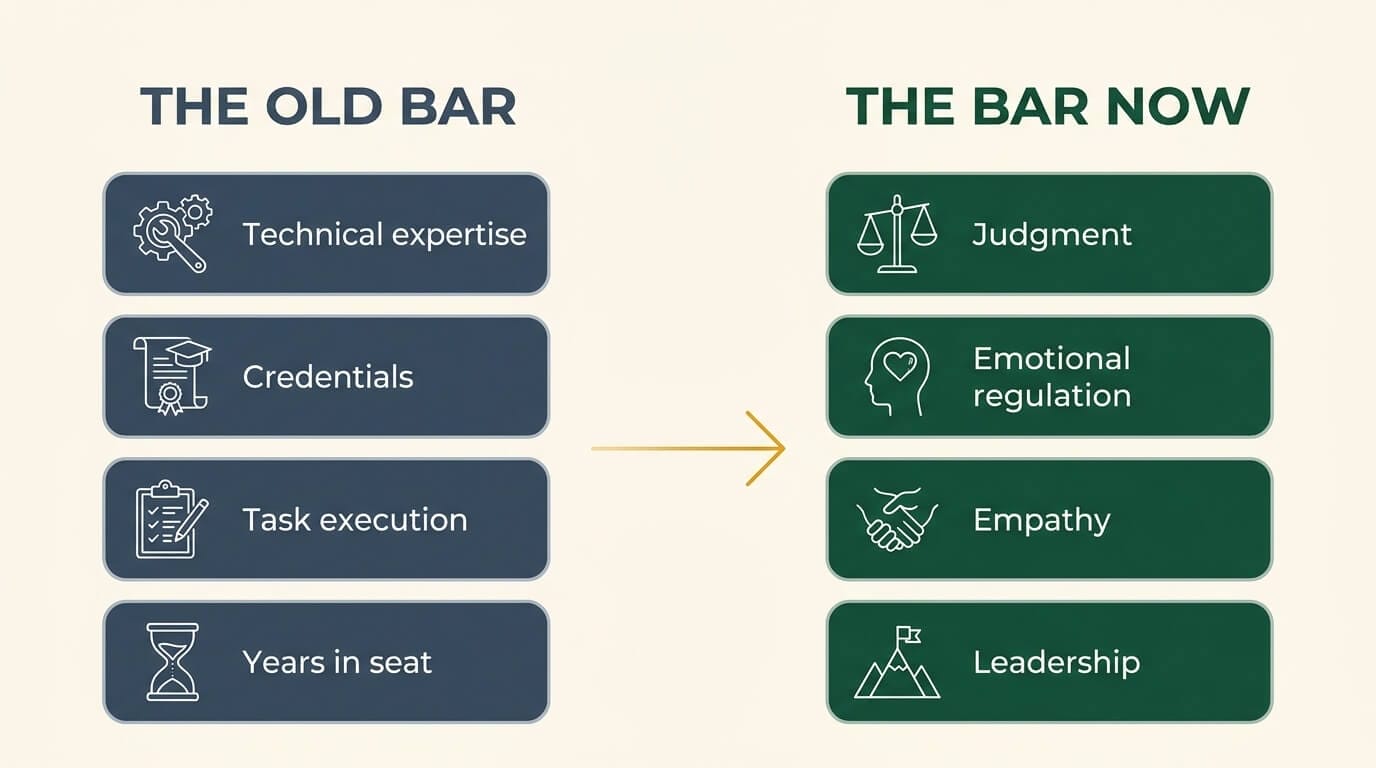
Notice the awkward part of that picture. Everything in the right column is harder to assess, slower to develop, and easier to fake in an interview than anything in the left. Which is why organizations keep hiring for the left column and then wonder why the bench looks thin the moment something goes sideways.
Why empathy is the hardest skill on the list
Empathy earns the label hard because using it costs something every time. It requires attention you have already committed elsewhere, it slows a decision you wanted closed, and it occasionally tells you something that makes the plan you defended last week look wrong.
Sentiment is free. Empathy has a price.
Nadella’s argument, reported by Inc. magazine from his conversation with Fortune, is commercial before it is human. Understanding a need the customer has never put into words is the origin of anything genuinely new, and design thinking is a corporate label for applied empathy. Somebody has to hear what sits underneath the request.
The same muscle reads your team. A leader who can hear the unspoken need in a customer conversation can hear it in a direct report’s status update, and how much a leader actually hears determines how much of the truth ever reaches them. The information that would change your mind rarely arrives as a clean escalation. It arrives as a hesitation, an overqualified answer, a project slipping by one week at a time.
Picture a leader who has just heard from a strong engineer that the timeline is not achievable. The empathic response is taking that objection seriously enough to reopen a commitment already made to a customer, which is expensive and personally uncomfortable. Leaders who do that build teams that keep telling them things. The ones who nod warmly and change nothing train their people to stop bothering.
Emotional regulation is the part nobody trains
Emotional regulation is the ability to recognize what you are feeling, understand what may be driving it, and choose a response that serves the situation. Forbes Australia framed it plainly: regulation means using emotion as information without letting it take the wheel. Suppressing anger and avoiding conflict are different behaviors entirely, and both get mistaken for the skill.
Marc Brackett, who directs the Yale Center for Emotional Intelligence, describes regulation as intentional, learnable skills that help people respond in ways aligned with their goals and values. Learnable is the operative word. Regulation gets discussed as a temperament issued at birth, which conveniently excuses everyone who has decided they simply run hot.
What makes this the capability with the widest reach at senior level is exactly that: reach. Your frustration does not stay in your office. It travels through the next four conversations, gets interpreted by people who never saw what caused it, and arrives at the edge of the organization as a rumor about strategy. One difficult email at nine in the morning can reset the emotional weather for a whole floor by noon.
The gap between what you feel and what you do is where leadership actually happens. Everything on either side of that gap is technique.
The gap is trainable, which is the encouraging part. You widen it by knowing your triggers well enough to see one coming, and by having somewhere to put the reaction other than the next person who walks in. Naming the feeling accurately does a surprising amount of the work, because a feeling you can name is one you can hold at arm’s length long enough to think.
Regulation sits underneath most of the other development areas leaders keep running into. Delegation fails when a leader cannot tolerate watching someone do it worse than they would. Difficult feedback goes unsaid because the conversation is more uncomfortable than the status quo. Three separate lines on a development plan, one root.
The capacity problem underneath all of it
Emotional intelligence behaves like capacity rather than character. It draws on attention, patience, and enough internal quiet to notice what you are feeling before you act on it. All three run down over a long week, and none refill because a calendar invitation says leadership offsite. This is the part the training market has no product for.
Running on Empty Isn’t a Development Gap
When 71% of leaders report more stress than when they started, capacity is the constraint, not skill. A coaching conversation can help you protect what you decide with.
The numbers on supply are worth sitting with. Forbes Australia cited DDI’s January 2025 Global Leadership Forecast, built on responses from 10,796 leaders in more than 50 countries. Seventy-one percent reported significantly greater stress since stepping into their current roles. Among those stressed leaders, 40% had considered leaving leadership altogether to protect their well-being.
Put that beside the hiring data and the shape of the problem becomes clear. We are asking for more emotional labor from a population already running at the edge, then treating the shortfall as a development gap.
A leader who has nothing left is out of the raw material the competency runs on, and no curriculum replaces it.
Executive burnout is where this ends when nobody intervenes, and it rarely announces itself as exhaustion. It shows up as a shortening fuse, then a flattening of curiosity, then a quiet preference for the people who agree with you. Each reads as an emotional intelligence symptom with a capacity cause.
Protecting the capacity is unglamorous work with a real payoff. Unscheduled thinking time that survives contact with your calendar. Somewhere to be uncertain out loud without it becoming a signal to the organization. Coaching for resilience gets sold as a wellness benefit, and it works better understood as maintenance on the instrument you make every decision with.
The test arrives without warning
Emotional intelligence gets tested on the day you have no time to prepare. Something breaks over a weekend, and by Monday morning the people who report to you need direction, honesty, and some evidence that the person in charge has not come apart. Whatever you built before that morning is what you have to work with.
Latoya Sahadeo, who directs leadership development programs at the Association of State and Territorial Health Officials, works with leaders living exactly that scenario. Forbes opened with one of them: a public health leader learns over a weekend that funding has been halved, and by Monday she has to balance thoughtfulness against urgency, empathy against practicality, vulnerability against confidence. Sahadeo’s conclusion was blunt. These are precisely the situations that make it impossible to treat emotional intelligence as a soft leadership extra, because the foundation has to be built before the crisis arrives.
Anyone who has run a restructure, a failed launch, or a bad quarter recognizes the shape of it. The change management skills that count in those moments come down to whether you can stand in front of people, tell them something they do not want to hear, absorb the reaction without defending yourself, and still be trusted the following week.
Before you announce a hard change, answer one question in writing: what will the three people most affected be feeling ninety seconds after they hear this? If you cannot answer specifically, you are not ready to announce it.
The AI rollouts happening across your industry are the same test in slower motion. The HR Digest reported on Businessolver’s 2026 State of Workplace Empathy, which found that employees who see their leadership as empathetic and invested in their future are more likely to feel positive about AI and its role in their careers. People are evaluating whether the person introducing the technology has their interests in mind, and they answer that question long before they read the implementation plan.
How the capability actually gets built
Emotional intelligence gets built the way any judgment gets built: through repetition, honest reflection on how it went, and feedback from someone with nothing to gain by flattering you. There is no shortcut, and the two-day workshop persists mainly because it is easy to buy and easy to report on.
Repetition, Reflection, Honest Feedback
Emotional intelligence builds through practice with someone who has nothing to gain by flattering you. That’s what MCC-level coaching provides.
Fast Company named the first observable habit, and it is the smallest one. Emotionally intelligent leaders pause before they react. They know what sets them off, so they can step back, get some perspective, and choose a response rather than firing off the first thing that arrives. That pause is the whole discipline in miniature, trainable the way a golf swing is trainable, through repetition rather than insight.
Three moves are worth making this quarter, and none needs a budget line.
The first is to name your two reliable triggers. Not a personality profile. Two specific recurring situations that produce a reaction you later regret, described concretely enough that you would recognize one starting. Being contradicted in front of your peers. A missed deadline nobody warned you about. Once a trigger has a name, you get a few seconds of warning you did not have before, and a few seconds is the entire margin.
The second is to put twenty minutes of genuine reflection where the pressure is highest and defend it the way you defend a board meeting. One recurring block after your hardest standing commitment, spent on a single question: what happened in the room, and what did I do with it? Capability compounds in the reviewing, which is precisely why the reviewing gets cut first.
The third is the uncomfortable one. Ask one person for the leadership feedback nobody volunteers, and make it safe enough that they actually answer. Self-assessment is the weakest available instrument for a capability defined by blind spots, and the higher you sit, the less unsolicited truth reaches you. This is why serious leadership development eventually involves a thinking partner rather than a curriculum, and why executive coaching spends its first months on what a leader cannot yet see about their own reactions. If you are carrying more than your capacity can hold, that is worth taking seriously rather than scheduling around.
Frequently asked questions
Four questions come up almost every time this subject reaches a leadership team. The answers below describe how the capability behaves inside a working organization rather than how it is defined in an assessment manual.
What does emotional intelligence mean in a leadership context?
It means reading your own emotional state accurately, understanding what is driving it, and choosing a response that serves the situation. In practice it covers self-awareness, emotional regulation, and empathy precise enough to change a decision. The leadership version is distinguished by reach: a senior leader’s unregulated reaction travels through the organization and gets interpreted by people who never saw what caused it.
Can emotional intelligence be learned as an adult?
Yes. Marc Brackett of the Yale Center for Emotional Intelligence describes emotional regulation as a set of intentional, learnable skills, and the mechanism is ordinary: repetition, reflection, and feedback from someone willing to be honest. What fails is a single workshop with no practice attached, which is why development budgets often show activity and no behavior change.
How is emotional intelligence different from being nice?
Agreeableness avoids friction. Emotional intelligence tolerates it. A leader with high emotional intelligence can deliver news that lands badly, hold the discomfort in the room without rushing to smooth it over, and stay trusted afterward. Warmth that never produces a hard conversation usually indicates conflict avoidance, and teams read the difference quickly.
How does a leader develop emotional regulation under pressure?
Start by naming two recurring triggers concretely enough to recognize one starting, which buys a few seconds of warning. Then protect a short, regular reflection block after your hardest standing commitment. Then find one person whose feedback you cannot dismiss. Regulation also depends on capacity, so a depleted leader develops it slowly no matter how good the practice is.
Your Next Crisis Will Test What You Built
Emotional regulation, empathy under pressure, leading through change—these don’t build themselves. Talk to a coach about where your capacity stands today.
Book a Free Consultation →