
Organizational Development Is Now a Leadership Job
What is organizational development?
Organizational development is the work of building what a company can do: the capability its people hold, the leadership bench ready to carry it, the way change gets absorbed, and the conditions that let people grow into bigger work. It belongs to senior leadership, and it is judged on business results rather than training hours.
Three senior learning and development people described their work in public over the past two weeks. Two sat for career profiles in the Chief Learning Officer series that asks learning executives how they got here and what they have figured out along the way. The third had an appointment announced: National Head of Learning and Organizational Development for a pharmacy retail business expanding across India. Read the three side by side and one thing jumps out. Not one of them describes the job as running courses.
One of them talks about deep listening as the first real skill he picked up. One describes moving from delivering training to shaping the environments people grow inside. The third’s mandate reads like something you would hand a chief operating officer: capability building, leadership development, change management, workforce readiness, competency frameworks across an entire country. Somewhere in the last few years, organizational development stopped being a support function and turned into a leadership one.
If you sign off on the development budget, or if your growth plan is stuck for want of people ready to step up, that shift is yours to work with. It changes where your attention goes, and what you should expect for the money.
Key Takeaways
- Organizational development has moved from running training to owning capability: who can do what, who is ready to lead, and how fast the organization absorbs change.
- Listening is the first move, and it is not the soft one. Ten unstructured conversations will name the real gap more accurately than any needs-analysis survey.
- Conditions beat curricula. Who gets seen, who gets the stretch assignment, and whether it is safe to be visibly new decide how much of any program survives.
- Completion rates measure the activity you bought. Decisions made lower down, roles filled from inside, and manager ramp time measure the capability you wanted.
- Your manager layer is the delivery system. Development that managers are not held to will not happen, whatever the budget says.
What organizational development actually covers now
Organizational development now covers the whole capability system: what your people can do, who is ready to lead, how quickly change gets absorbed, and whether the company learns anything from what it just went through. The training calendar is one instrument inside that system. The mandate itself belongs to senior leadership and gets judged on business outcomes.
The clearest evidence of that came in an ordinary press announcement. Emami Frank Ross, a pharmacy retail business expanding across India, named a National Head of Learning and Organizational Development. Look at what they handed him. Build the national learning roadmap. Align development to business objectives. Design competency frameworks across the enterprise. Run onboarding and continuous learning for the sales organization. Lead regional learning teams so execution holds up in every market. Then deliver measurable business impact.
Read that list with an operator’s eye. Almost none of it is course delivery. It is architecture, alignment, and change management. The person in that seat has to know where the business is going, what the organization will need to be good at when it arrives, and how far the bench sits from that today. Those are strategy questions wearing a learning and development badge.
Now compare it with the version of the function most companies still run. Someone books the vendor, fills the room, tracks attendance, and reports a completion rate at quarter end. Nothing in that loop asks whether anybody leads differently on Tuesday. A serious leadership development strategy starts from the business constraint and works backward to the capability, which is a different job and usually a different person.
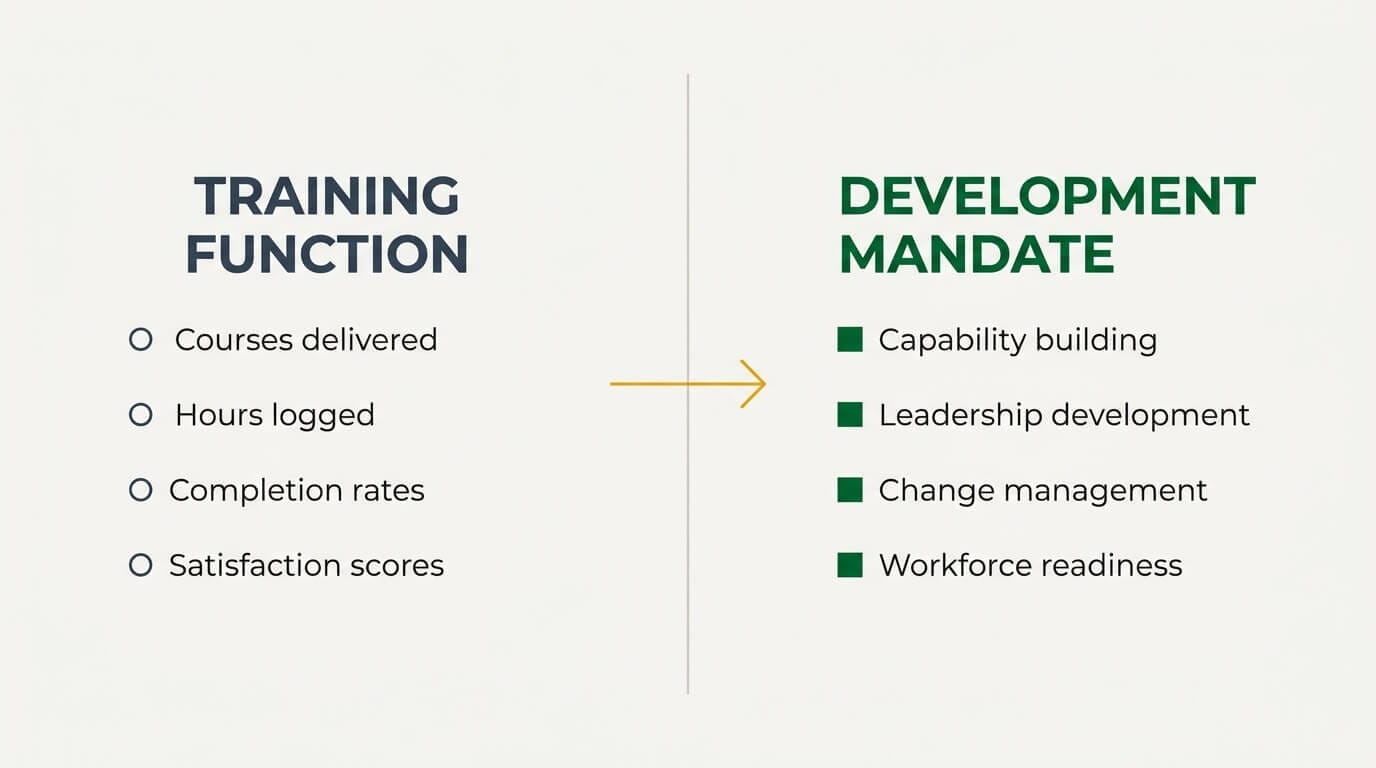
Notice what the reframe does to your budget conversation. “How much training did we buy?” is a procurement question. “What can this organization do now that it could not do a year ago?” is a leadership question, and only one of the two produces an answer worth taking to a board.
The skill underneath all of it is listening
Every piece of that mandate rests on one unglamorous capability: hearing accurately what is going on. Before anyone builds a framework or designs a program, somebody has to find out what people are struggling with, what stands in their way, and what they already know how to do. Skip that step and you fund a solution to a problem nobody diagnosed.
Need a Thinking Partner for the Hard Questions?
The ten-conversation diagnostic works better with someone who asks what your team won’t. Let’s start there.
Aaron Haefele, in his Chief Learning Officer profile, was asked what pulled him into this work and what he learned early. His answer was deep listening. He started out teaching at a massage therapy school and later trained employees in a call center, and both settings taught him the same thing: the trainers who make a difference are the ones who take time to understand what people need, what they are up against, and how they learn. Delivery skill comes second.
Sit with that for a moment, because it lands on you and not only on whoever runs your training. A pattern I keep noticing is that capability spending starts at the solution. We need a manager program. We need communication skills. We need an offsite. The question that belongs first is much less comfortable: what are people actually running into, in the work, this month?
You already hold the raw material. Skip-level conversations. Exit interviews. The meetings where a decision floats up two levels because nobody below felt authorized to make it. All of that is diagnostic data, and it usually goes unread, because reading it is slow and buying a program is fast.
I invite you to try the slow version once. Ten conversations, one question, no agenda: what makes your job harder than it needs to be? You will hear the capability gap named out loud, in the words of the people living inside it, and it will rarely be the thing you were about to buy.
From delivering programs to building the conditions
People grow in conditions, and conditions are set by leaders rather than by curricula. Who gets seen, who gets the assignment with real stakes attached, whether it is safe to be visibly new at something: those three things decide how much of any program survives contact with the actual job. Most leaders set them without noticing they are doing it.
Shaleenah Marie described that arc in her own profile. She began by delivering training and moved toward building something wider: cultures of inclusion, visibility, and leadership readiness. Those words repay slowing down on. Inclusion decides who is in the room. Visibility decides whose work becomes known. Readiness decides who is prepared when the seat opens up. No course produces any of the three. A leadership team produces them every week, through what it rewards and who it trusts with the hard thing.
This is why an employee development plan that lives only inside the HR system tends to go quiet by March. The plan describes what somebody should learn. The conditions decide whether that person ever gets to practice it anywhere consequential. If your strongest people are parked in work that never stretches them, no plan closes that gap, and a learning culture stays a phrase in the values deck.
The same logic scales past the company walls. In New Jersey, a group of business, civic, and investment leaders launched Trenton Forward, a nonprofit platform built to connect people, organizations, and capital in a city where all three had been operating apart from one another. Strip off the civic framing and the move is identical: the capability was scattered, so somebody built the conditions for it to find itself. Development work at every scale looks like that.
The trap: measuring the program instead of the capability
Completion rates, satisfaction scores, and hours delivered all measure the activity you purchased. None of them tells you whether a single person leads differently than they did last spring. That gap is why development budgets get cut first: the function reports numbers no operator recognizes as results.
The Emami Frank Ross mandate names the harder standard in its own announcement, right there in the language about measurable business impact across the country. That phrase is easy to write into a job description and difficult to honor, because it forces the question most learning reporting steps around. Impact on what, exactly?
There are answers, and they are less comfortable than a folder of satisfaction scores. How many decisions now get made one level below where they used to be? How many roles could you fill from inside today that you could not fill a year ago? Are the people you cannot afford to lose still here, and can they tell you why? Those numbers move slowly, and each one describes a capability rather than an activity. If you want a structured way to measure leadership development, start with questions shaped like those and let the surveys come second.
A completion rate tells you people showed up. It never tells you whether anything they learned survived the walk back to their desk.
None of this makes training worthless. It makes training a means. When the means gets measured as though it were the end, the whole function drifts toward looking busy, and the people who fund it eventually notice.
How the capability actually gets built
Leadership capability gets built the way every hard skill does: real practice with real stakes, honest reflection afterward, and feedback from somebody who is not impressed by your title. Content can inform that loop. Content cannot replace it. Everything else in a development program is scaffolding around those three ingredients.
Put a Thinking Partner Beside the Weight
The higher someone sits, the fewer people say the difficult thing out loud. Our MCC coaches are the ones who will.
Start with where learning already happens. Almost nobody develops because of a workshop. People develop because of the person they report to, the project that scared them a little, and the conversation somebody was brave enough to have afterward. Your manager layer is your delivery system, whether you designed it that way or not.
Which means the highest-return move available to an executive has nothing to do with the training budget. It is making development part of what managers are held to, alongside the forecast and the headcount plan. A manager who is never asked about the growth of their people will treat it as optional, and they will be right to, because in that company it is.
Three things do most of the remaining work. Hand people work with genuine stakes and let them own the outcome, including the parts that go badly. Build reflection into the calendar, so experience turns into judgment instead of just being survived. And put a thinking partner beside the people carrying the most weight, because the higher somebody sits, the fewer people around them say the difficult thing out loud. That third one is the work of a good executive coach or organizational coach, and it is the piece organizations skip most often.
Ask your managers one question in the next round of one-on-ones: what is the last thing you changed about how you lead, and what made you change it? Silence across the whole layer tells you more about your development spend than any completion report will.
None of the three requires a new vendor. All three require sustained attention from people who have too little of it, which is exactly why they get skipped, and exactly why they work for the leaders who refuse to skip them.
Where to start this quarter
Three moves fit inside a single quarter and none of them needs a new budget line. Listen before you design anything. Name the two capabilities your strategy genuinely depends on. Then put your managers on the hook for growing the people underneath them, in a form they cannot quietly hand off to a portal.
The first is the ten conversations. One question, no agenda, nothing written down while the person is talking. You are listening for what keeps recurring across all ten, not for what any one person happens to say.
The second is harder than it sounds. Look at your plan for the next eighteen months and name the two things this organization will have to be good at that it is not good at today. Two. If your list reaches nine, you have written a wish rather than a leadership development plan, and nine priorities will buy you nine shallow efforts.
The third is the one that shifts behavior. Put a development conversation into every manager’s regular rhythm and hold them to it the way you hold them to a forecast. Not a form. A conversation, with a person’s name on it, about what they are building toward and what they need next in order to get there.
None of this is fast, and I would not pretend otherwise. Capability compounds on a slower clock than revenue, which is why the organizations that start early keep pulling away from the ones still buying courses. If you want a thinking partner while you work it through, that is what our leadership development and executive coaching work is for. Bring the constraint you are genuinely stuck on.
Frequently asked questions
Four questions come up almost every time this subject reaches a leadership team. The answers below describe what the work looks like inside a company, rather than how the function gets drawn on an org chart.
How is organizational development different from learning and development?
Learning and development builds individual skill. Organizational development builds the system that skill sits inside: leadership bench strength, competency frameworks, change management, and the conditions that decide whether new skill ever gets used. In practice the two share a leader and a budget, which is why the wider mandate gets reported as a training number.
What does a head of learning and organizational development do?
The mandate covers the learning roadmap, alignment between development work and business objectives, enterprise competency frameworks, onboarding and continuous learning, and regional learning teams. Increasingly it also carries accountability for measurable business impact, which pulls the role toward strategy and away from program delivery.
Who owns organizational development in a company?
A head of learning and organizational development owns the architecture. The executive team owns the conditions. Managers own the day-to-day development of their own people. When only the first of those three shows up in someone’s objectives, capability stalls no matter how good the design work is.
Is coaching part of organizational development?
Yes, and it is usually the mechanism rather than the perk. Coaching supplies the practice, reflection, and candid feedback loop that turns experience into judgment, which is the part a course cannot deliver. It works best beside the people carrying the most weight, inside a learning culture that makes it safe to develop in public.
Name Your Two Critical Capabilities
A 30-minute conversation to identify the capabilities your strategy depends on, and where your bench actually sits today.
Book a Free Consultation →