Relationship Boundaries Worksheet
Clarify and communicate healthy boundaries to reduce resentment and burnout, with a structured, coach-tested worksheet you can use in one session.
Get This Tool
Free, print-ready PDF.
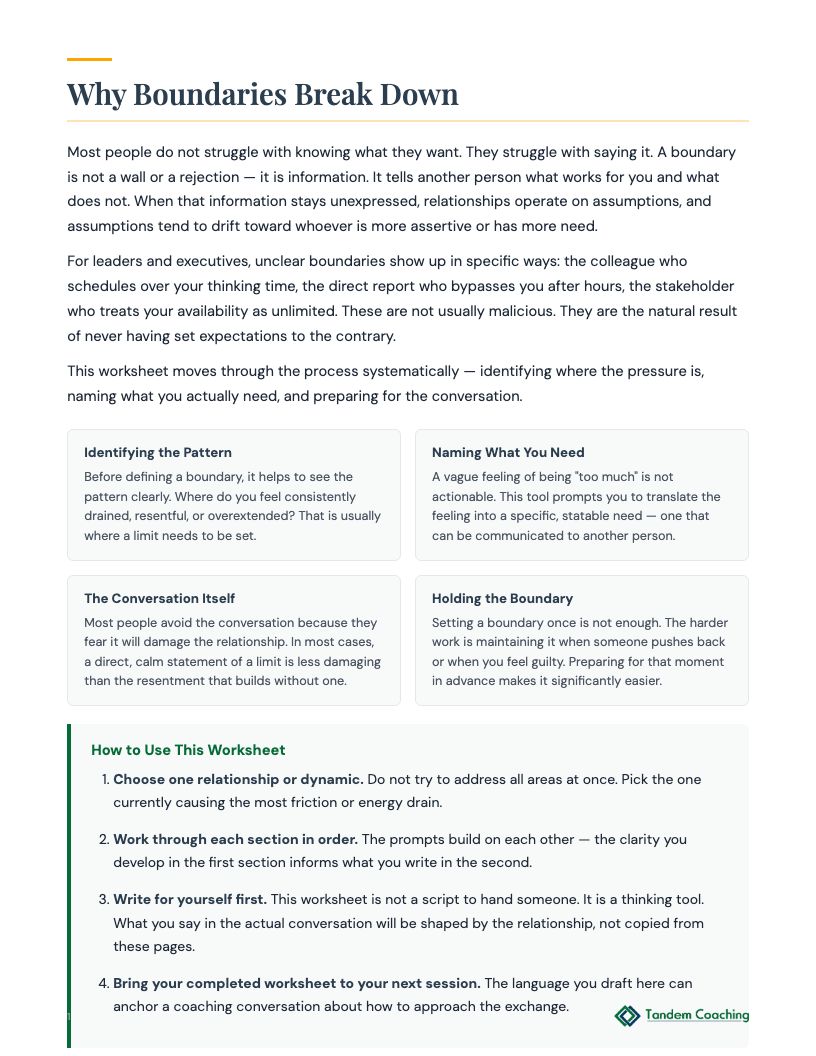
When to Use This Tool
A client feeling resentful or depleted in a specific relationship
Getting clear on what's being crossed and what they actually need before a conversation
Moving from vague discomfort in a relationship to a specific, sayable boundary
How to Introduce This Tool Plus
In the relationship you're thinking about, what keeps happening that you're not okay with — and have you said that out loud to them yet?
Browse All Pages
Tool Classification
Domain
Relationships
Type
Worksheet
Phase
Discovery
Action
Details
15 min
Between sessions
As-needed
Topics
Communication
Values
For the Coaching Practitioner
Plus
Coaching Scenarios
Plus
1 Senior professional consistently absorbing work that belongs to peers ▶
Context
A senior manager has noticed that her peers regularly hand off tasks and last-minute requests that fall outside her role, and she consistently accepts them. She's resentful but unsure how to say no without appearing uncooperative.
How to Introduce
Frame this as a diagnostic tool before it's an action tool. 'Before we talk about what to say, let's get specific about what's actually happening.' The boundary section (what is being crossed) often reveals the client doesn't have a clear name for it yet - they feel the resentment before they can articulate the specific behavior. Getting precise is more than half the work. The resistance to name will come from the client's belief that clarity is aggression.
What to Watch For
If the 'what I need' section is vague - 'I need more respect' - the client is still operating at the level of feeling rather than request. A boundary that can't be stated as a specific behavioral ask cannot be communicated. Also watch whether the consequence section gets left blank or filled with something the client would never actually enforce - that signals the boundary is aspirational, not real.
Debrief
Start with the gap between the described behavior (what is being crossed) and the drafted request. Read both aloud: does the request address the behavior or the feeling it produces? Then move to the consequence: ask the client what they would actually do if the behavior continued after the conversation. Their answer will tell you more than what they wrote.
Flags
If the client cannot articulate any consequence they would enforce - every option they generate feels too costly - the boundary may be real but the client's current leverage or risk tolerance doesn't support it. Severity: low. Continue coaching around what options exist and what constraints are actually fixed versus assumed. Do not push the client toward a conversation they are not positioned to sustain.
2 Client repeatedly giving more than they receive in a close friendship ▶
Context
A client describes a long friendship where they consistently show up, support, and prioritize the other person, but doesn't feel that reciprocated. The friendship matters to them but they leave most interactions feeling drained rather than replenished.
How to Introduce
Personal relationships invite a different kind of resistance than professional ones - guilt, loyalty, and fear of loss rather than political calculation. Name that upfront: 'What you write here doesn't commit you to anything. We're just getting clear about what's actually happening.' The 'my contribution' section is often where clients get stuck - they over-attribute the imbalance to themselves rather than naming what the other person is actually doing.
What to Watch For
If every section circles back to the client's own fault - 'I let this happen,' 'I should have said something earlier' - watch whether this is genuine self-awareness or a pattern of self-responsibility that avoids holding the other person accountable at all. The two look similar on paper but drive very different conversations. Also notice if the drafted request is so softened that it no longer communicates the actual need.
Debrief
Start with whether the specific behavior named in the boundary section is one the other person can actually change - or whether what's being described is a fundamental aspect of who they are. That distinction changes everything about what kind of conversation is possible. Then explore the consequence: in close friendships, the implicit consequence is often distance, and clients often haven't admitted that to themselves yet.
Flags
If the relationship the client describes shows consistent patterns of the friend creating crises, requiring rescue, or becoming hostile when limits are set, the dynamic may be more entrenched than a boundary conversation will address. Severity: moderate. Name the pattern without diagnosing it and explore whether the client has support for whatever outcome this conversation produces - including the possibility that it ends the friendship.
3 Leader whose team has normalized after-hours availability expectations ▶
Context
A director has gradually become available around the clock and now finds the team expects responses to messages and decisions in the evenings and on weekends. The client wants to reset this without damaging team relationships or signaling disengagement.
How to Introduce
This is a boundary conversation that is also a leadership communication. The worksheet helps clarify what specifically needs to change before the client tries to announce a new policy. Many leaders in this situation have never named the specific behaviors clearly - they know they want to stop responding at 10pm but haven't defined what the new expectation actually is. Work through the 'what I need' and 'conversation request' sections carefully before any announcement.
What to Watch For
If the consequence section applies only to the client's behavior ('I'll stop responding') but doesn't address what the team should do with urgent needs, the boundary will create anxiety rather than clarity. The client is setting a limit on themselves while leaving the team without guidance. Watch also whether the drafted request is framed as a personal change ('I need to') versus a structural change ('here's how we'll handle X going forward').
Debrief
Start with the distinction between the personal boundary and the team norm: those are two different conversations requiring different language and possibly different sequencing. Then explore what 'urgent' actually means in the client's context - if they have never defined it, the team will default to their own definitions, and the boundary will be tested constantly at the edges.
Flags
If the after-hours availability was established or encouraged by the client's own behavior during a high-stakes period (product launch, restructuring), and the team built their work patterns around it, the reset may generate confusion or pushback that goes beyond a boundary conversation. Severity: low. The coaching issue is about managing the transition expectation-by-expectation, not just communicating a personal limit.
Tool Flow
Plus
Requires
- one relationship causing resentment or depletion
- vague sense of what is being crossed
→
Produces
- specific boundary statement for one relationship
- drafted conversation request with non-negotiables named
- identified consequence if limit is not respected
Pairs Well With
Executive
Message Review Checklist
Use this checklist to review communication and leadership without assuming every item applies.
Why it pairsOnce the worksheet produces a drafted conversation request, the checklist audits it against seven criteria before the client sends it.
ExecutiveTeam Engagement Planner
A client is concerned about low morale or disengagement on their team
Why it pairsUse this when the depleting relationship is with the client's team - it checks whether engagement methods are generating the resentment.
ExecutiveShared Information and Feedback Map
Use this framework to structure a conversation about identity and communication while keeping interpretation with the client.
Why it pairsAfter naming the boundary, this reveals whether the client's blind spots are inadvertently signaling permission for others to cross it.
This tool is part of a coaching pathway
Step 6 of 6 in A client acts on digital impulses before they've had a chance to notice and choose
Use after Check the Facts Worksheet.
Explore all pathways →Related Articles


ICF Team Coaching Competencies: What They Look Like in Practice
Read article →
Improving Your Relationships: The Role of a Relationship Coach
Read article →
How to Vet an AI Tool Before It Goes Near a Client
Read article →How to Structure a Coaching Conversation That Actually Moves
Read article →