Team Engagement Planner
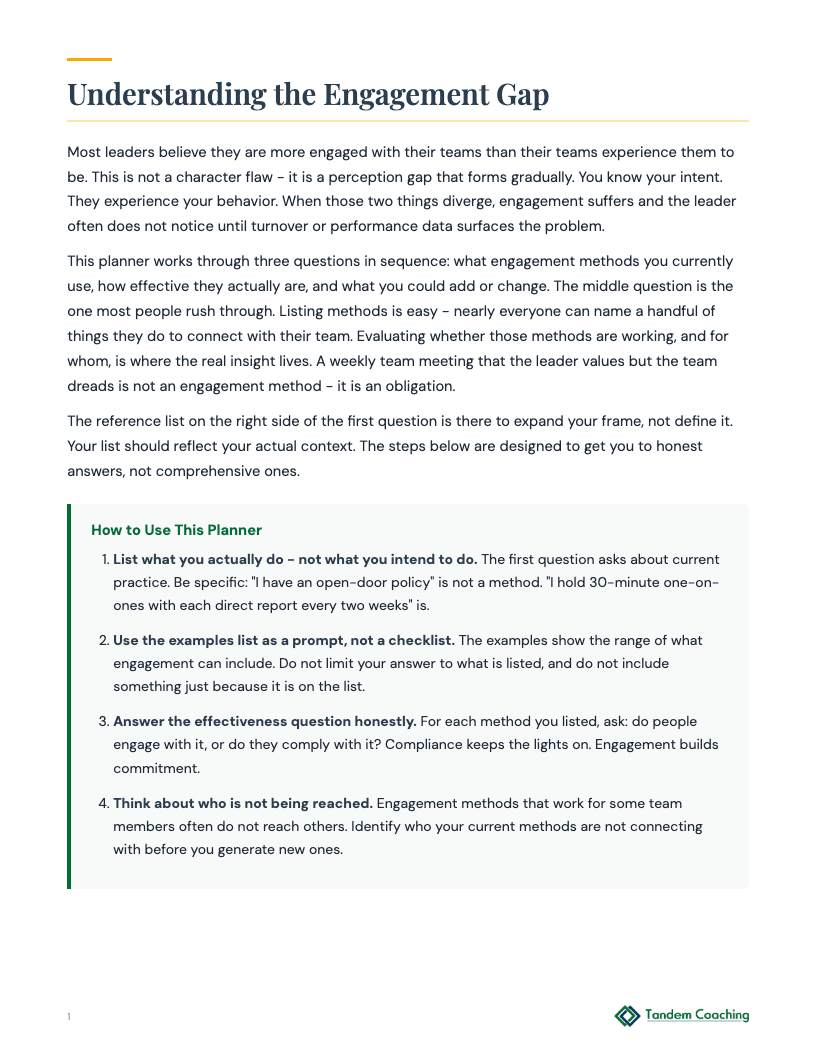
Diagnose morale and engagement gaps and map targeted actions, using an executive coaching framework grounded in proven team drivers.
Get This Tool
Free, print-ready PDF.
When to Use This Tool
A client is concerned about low morale or disengagement on their team
A client wants to evaluate which engagement practices are actually working
A client is building out a people strategy for the year ahead
How to Introduce This Tool Plus
When you reviewed your current engagement methods, which ones felt like genuine connection and which ones felt like going through the motions?
Browse All Pages
Tool Classification
Domain
Executive
Type
Planner
Phase
Action
Reflection
Details
30 min
Between sessions
Monthly
Topics
Leadership
Communication
For the Coaching Practitioner
Plus
Coaching Scenarios
Plus
1 Manager whose team engagement practices are uniform and not working for everyone ▶
Context
Your client runs a team of seven. They hold weekly one-on-ones, run a team standup, and do a monthly social event. They believe they are engaging the team because they are doing the things that are supposed to work. What they have not examined is who these practices are actually landing with. Two team members are highly engaged. Three are functionally compliant. Two are quietly disengaged and looking for other roles. The practices were built once and have not been revisited. The worksheet's Effectiveness Review section is the specific part that surfaces this.
How to Introduce
Frame this as a calibration exercise, not a verdict on their management. 'The practices you have in place are not the problem. The question is whether they are working for the specific people you have, or whether they were designed for a different team.' The resistance pattern: managers who have invested in building engagement practices sometimes experience an effectiveness review as criticism of the investment they made. Name that the practices can be fundamentally sound and still need adjustment for specific individuals - that is not a failure, it is normal team management.
What to Watch For
Watch the Effectiveness Review section closely. If your client fills in 'who is it working for' with the same one or two names across multiple practices, they have identified their engaged subset. Ask directly: 'Who is conspicuously absent from that column?' The names that never appear are the disengaged members, and that absence is the data point the session should work from. Also watch whether the Opportunities to Improve section stays at the practice level ('do more team meetings') rather than the individual level ('figure out what actually matters to person X').
Debrief
Start with the person or persons most absent from the Effectiveness Review column. Ask: 'What do you actually know about what engages this person - not what you assume, but what they have told you directly?' That question often reveals that the engagement practices were designed without direct input from the people they are supposed to reach. Then ask: 'What is one thing you could change in the next two weeks that might change the picture for this person?' That question moves from diagnosis to a specific, testable experiment.
Flags
If the Effectiveness Review surfaces that one or more team members are consistently not reached by any current practice, and if this has been true for a significant period, the engagement issue may have crossed into retention territory. Severity: moderate. Response: note whether any of the disengaged team members are in conversations with your client about their future on the team - and whether the engagement work needs to run parallel to a more direct conversation.
2 New manager taking over a team with low morale and no established engagement practices ▶
Context
Your client took over a team four months ago that had been through a difficult year - a previous manager who left abruptly, a reorganization, two departures. The team is functional but flat. People do their work and go home. Your client has been trying things: more one-on-ones, a team lunch, a few shoutouts in the team chat. Nothing has created visible movement. They are frustrated because they are doing the things they were told to do and the team is not responding. The worksheet is the right tool here not to produce a new list of practices but to examine what has actually been tried and why it is not landing.
How to Introduce
Frame this as building an evidence base rather than adding more interventions. 'You have been trying things for four months. Before adding more, the useful move is to get everything on paper - what you've done, who it's reached, and what you notice about the pattern. That tells you whether you need more practices or different ones.' The resistance pattern: new managers who feel the pressure of a disengaged team sometimes want to add more engagement activity as a way of showing effort. Name that adding without examining is how managers end up with a full calendar of engagement activities that reach the same two people.
What to Watch For
Watch the Current Engagement Methods section for whether the list includes practices that build trust over time versus practices that create momentary good feeling. Lunches and shoutouts create momentary good feeling. One-on-ones that are genuinely two-way and where concerns are heard build trust. If the list is heavy on the former and light on the latter, the engagement problem is likely a trust problem, not an activity problem. Also watch whether the Effectiveness Review includes any honest assessment of what is not working - new managers sometimes avoid writing that something is not working because it feels like criticism of themselves.
Debrief
Ask your client to read the Effectiveness Review column aloud and then ask: 'What does the pattern tell you about what this team actually needs right now?' That question shifts from tactics to diagnosis. A team coming out of a difficult year typically needs to see that problems will be acknowledged and acted on - that is a trust signal, not an engagement activity. Then ask: 'What is one thing you could do in the next month that would signal that you are different from what they experienced before?' That question often produces a more targeted action than another entry in the engagement methods list.
Flags
If the team's low morale has roots in unresolved organizational problems - a structural issue from the reorganization, unaddressed workload, a performance issue that was not handled by the previous manager - the engagement planner addresses the manager's practices but does not address the underlying conditions. Severity: moderate. Response: note whether there are systemic issues that your client needs to surface to their own manager alongside the team-level engagement work.
3 Senior manager whose team engagement has been delegated and is now effectively absent ▶
Context
Your client leads a team of fourteen through three team leads. They meet with the team leads regularly. They rarely interact directly with the broader team except in all-hands meetings. Their engagement strategy is the team leads' engagement strategy, which varies widely. Two of the three team leads are strong; one is inconsistent. Your client has not reviewed their own engagement practices because they believe they are managing through their leads, which is appropriate at their level. What they have not examined is whether that approach is actually producing engagement - or whether it has produced a situation where their own presence and practices are essentially invisible to half the team.
How to Introduce
Frame the planner as a review of both what they do directly and what they enable through their leads. 'At your level, engagement happens through two channels - what you do directly with the broader team and what you enable your leads to do. The planner maps both. The question is whether both channels are actually working or whether you are relying entirely on one of them.' The resistance pattern: senior managers who have been told to delegate often interpret any direct engagement with the broader team as undercutting their leads. Name that direct visibility is different from undermining - and that absence can be as visible as presence.
What to Watch For
Watch whether the Current Engagement Methods section includes any direct-to-team practices at all. If the only methods listed are team leads' practices, your client has identified their absence. Also watch the Effectiveness Review: if your client cannot complete that section for the broader team members because they do not know whether the practices are working for specific individuals, that is itself data. Inability to assess effectiveness is a sign that the distance from the team is too large.
Debrief
Start with a direct question: 'How would the broader team members - the ones who report to your leads - describe the quality of their connection to you?' That question often produces a pause. Then ask: 'What is one direct practice you could add that would not undermine your leads but would increase your own visibility to the team?' That question frames a solution rather than a criticism. The planner should end with both a direct-practice addition and an assessment of what the inconsistent team lead needs to improve their practices.
Flags
If the inconsistent team lead is producing measurable engagement problems for their portion of the team - higher turnover, lower output, visible morale issues - the engagement planner identifies the problem but your client needs to address the team lead's performance directly. Severity: moderate. Response: note whether the team lead situation requires a performance conversation alongside the engagement planning work.
Tool Flow
Plus
Requires
- knowledge of current team practices and context
→
Produces
- current engagement method inventory with specifics
- effectiveness evaluation per method and by team member
- improved engagement opportunities identified
Pairs Well With
Executive
Message Review Checklist
Use this checklist to review communication and leadership without assuming every item applies.
Why it pairsAfter flagging which of your client's engagement methods are underperforming, this isolates whether poor message quality is the actual cause.
ExecutiveShared Information and Feedback Map
Use this framework to structure a conversation about identity and communication while keeping interpretation with the client.
Why it pairsAfter mapping your client's engagement effectiveness, this surfaces the blind spots explaining why certain methods land differently across the team.
ExecutiveFeedback Observations, Requests, and Safety Notes
Use this worksheet to explore communication and leadership and turn the client’s observations into one optional next step.
Why it pairsWhen the effectiveness review flags disengaged individuals, this structures the direct conversations your client now needs to have with each person.
Related Articles


8 Executive Coaching Books MCC Coaches Actually Recommend
Read article →
CEO Coaching: What Happens When the Person at the Top Gets a Coach
Read article →
5 Strategic Steps to Establish an Effective Engagement Plan for Agile Leadership Teams
Read article →
Leadership Development Tools: What Works and How to Choose
Read article →