Conflict Resolution Planner
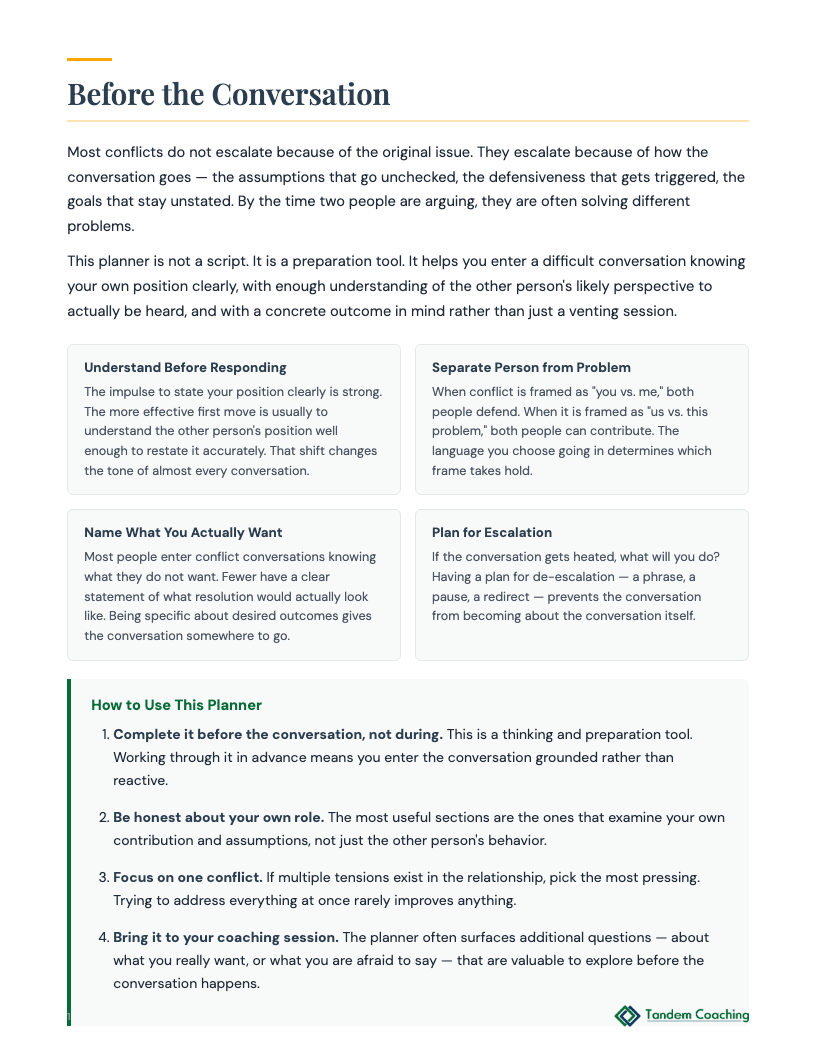
Plan a calm, clear hard conversation with prompts grounded in proven conflict-resolution frameworks, so you can reduce tension and reach agreement.
Get This Tool
Free, print-ready PDF.
When to Use This Tool
A client needs to have a hard conversation and wants to prepare before going in
Getting clear on their own position and what they actually want to achieve first
Turning conflict avoidance into a planned, intentional conversation
How to Introduce This Tool Plus
What's the conversation you've been putting off — and what would need to be true for you to feel ready to have it?
Browse All Pages
Tool Classification
Domain
Relationships
Type
Planner
Phase
Action
Details
15 min
Between sessions
As-needed
Topics
Communication
Resilience
For the Coaching Practitioner
Plus
Coaching Scenarios
Plus
1 Manager preparing for a direct report performance conversation ▶
Context
A mid-level manager has been avoiding a difficult conversation with a direct report whose work has declined. The client knows the conversation is overdue and is anxious about how the employee will react.
How to Introduce
Frame this as preparation for a specific conversation, not a general conflict exercise. 'Before you walk into that meeting, let's get your thinking organized so you're not winging it.' Have the client work through steps 1-4 before even touching the opening statement. The quality of step 2 - their own contribution - determines whether the conversation will be honest or performative.
What to Watch For
If the client writes nothing in step 2 (their own role) or fills it with deflections like 'I waited too long,' the self-reflection isn't landing. The contribution section should name something specific about their behavior, not just timing. Also watch whether step 4 (desired outcome) describes a behavior change or just resolution of their own discomfort.
Debrief
Start with what they wrote in step 3 - the other person's perspective. Ask them to read it aloud. If it is thin or uncharitable, that's the first thing to work on. Then move to the gap between steps 4 and 5: does the opening statement actually signal the outcome they want? The bridge between the two is often where the conversation goes wrong.
Flags
If the client cannot articulate the other person's perspective at all - writes 'I don't know' or attributes only bad faith - the conversation is likely to escalate regardless of preparation. Severity: moderate. The absence of perspective-taking isn't a communication skill gap; it may indicate the relationship is more damaged than the client is acknowledging. Consider exploring that before coaching the conversation mechanics.
2 Peer conflict that has been silently building for months ▶
Context
A professional has a long-standing tension with a peer - another team member or colleague at the same level. The tension has never been named directly and both parties have been working around each other. The client is unclear whether raising it will make things worse.
How to Introduce
The resistance here is the client's belief that naming the tension is riskier than continuing to avoid it. Before introducing the tool, surface that assumption: 'What's the cost of this continuing as-is for another six months?' Then position the planner as a way to think through whether the conversation is worth having - not just how to have it. Some clients realize through step 1 that the conflict is smaller than the avoidance has made it feel.
What to Watch For
If step 4 (desired outcome) is vague - 'I just want things to be better' - the client hasn't decided what they actually want. A resolution without a specific picture tends to leave both parties unsatisfied. Also notice whether the de-escalation plan in step 6 is specific or generic. 'Stay calm' is not a plan.
Debrief
Start with the gap between how the client describes the conflict (step 1) and what they want from it (step 4). If those two are misaligned - the conflict is about behavior but the desired outcome is about feelings - that misalignment is worth naming before the conversation happens. Then explore the opening statement: does it invite a response or close one down?
Flags
If the conflict involves an ongoing pattern of exclusion, credit-taking, or undermining - not a single incident - the planner may surface dynamics that coaching alone cannot resolve. Severity: low to moderate. The issue may be structural (role overlap, unclear ownership) rather than interpersonal. Note the pattern and explore whether a conversation is the right intervention or whether the system needs to change.
3 Adult child navigating a tense dynamic with a parent ▶
Context
A client is dealing with recurring friction with a parent - typically around life choices, autonomy, or long-standing family patterns. They want to have a direct conversation but are unsure how to do it without triggering escalation or damaging the relationship.
How to Introduce
Family dynamics carry history that professional conflicts do not. Frame the planner explicitly as a way to separate the current issue from the accumulated history: 'We're going to focus on one specific thing that happened, not the whole pattern.' Step 2 will be the hardest section - family members often genuinely struggle to see their own contribution when the relationship feels asymmetric in power.
What to Watch For
Clients often write step 3 (other person's perspective) from a place of resigned understanding rather than genuine empathy: 'I know why they do it.' That's different from actually holding the other person's perspective. If the tone of step 3 is condescending or dismissive, the conversation will likely confirm what the client already believes rather than open anything new.
Debrief
Ask the client to read their opening sentence (step 5) aloud. Family conversations often trigger a regression in how people speak - the client who is articulate at work reverts to adolescent phrasing with their parent. The opening sentence is diagnostic. Then explore step 6: in family conversations, the de-escalation plan often needs to include permission to pause and return rather than push through.
Flags
If the client describes a pattern that includes emotional manipulation, financial control, or persistent boundary violations across decades, the conversation they are preparing for is not a conflict resolution conversation - it is a limit-setting conversation. The two require different preparation and different expected outcomes. Severity: moderate. Name the distinction and ensure the client's expectations are calibrated to what a single conversation can actually accomplish.
Tool Flow
Plus
Requires
- named conflict or interpersonal tension
- basic sense of own role in the situation
→
Produces
- written conflict description and own contribution
- specific desired resolution outcome
- planned opening statement and de-escalation strategy
Pairs Well With
Relationships
Conflict Context, Perspectives, and Safety Notes
Use this worksheet to explore communication and resilience and turn the client’s observations into one optional next step.
Why it pairsRun the worksheet next so the client's opening statement gets tested against a realistic read of the other side's position.
RelationshipsRelationship Context and Options Review
Use this assessment to take stock of communication and resilience before the client chooses what deserves attention.
Why it pairsUse the assessment to check whether the dynamic behind this conflict is also degrading relationships the client hasn't mentioned yet.
RelationshipsSupport Network Planning Map
A client wants to use Support Network Planning Map as an optional reflection
Why it pairsAfter the planner, use the map to name a real contact for each tier before the client walks in.
This tool is part of a coaching pathway
Step 6 of 6 in A client acts on digital impulses before they've had a chance to notice and choose
Use after Check the Facts Worksheet.
Explore all pathways →Related Articles

Executive Team Coaching: What It Is, How It Works, and When Your Team Needs It
Read article →
Leadership Team Coaching: Why It’s Different and When Your Team Needs It
Read article →
Need a Career Transition Coach? Read This Guide First
Read article →