

Personal Power Prompts
Guided prompts to help you move from feeling stuck to taking clear, self-directed action, using evidence-based coaching questions.
Get This Tool
Free, print-ready PDF.
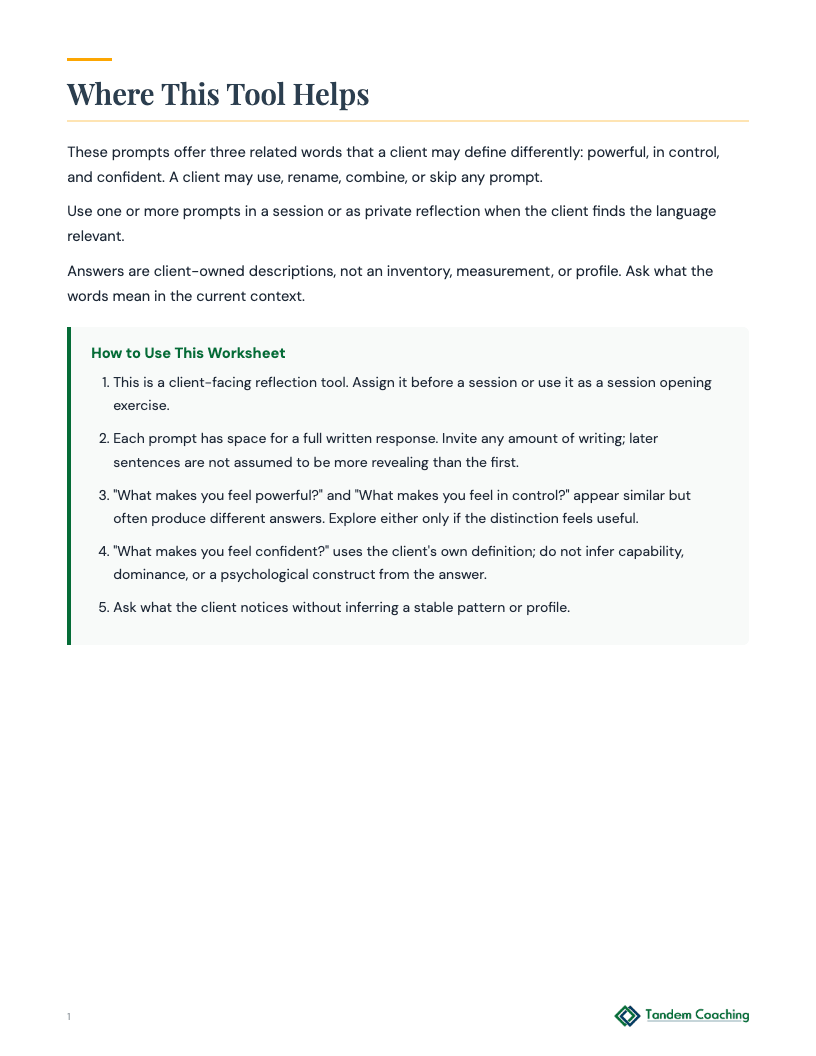
When to Use This Tool
A client wants to use Personal Power Prompts as an optional reflection
A client wants to record context without inferring a cause, identity, or diagnosis
A client wants to prepare one question or optional next step
How to Introduce This Tool Plus
What did you notice, what remains uncertain, and which question or optional next step feels useful?
Browse All Pages
Tool Classification
Domain
Life Coaching
Type
Worksheet
Phase
Discovery
Reflection
Details
15 min
Opener
As-needed
Topics
Mindset
Identity
Resilience
For the Coaching Practitioner
Plus
Coaching Scenarios
Plus
1 Client in a recurring negative self-narrative about capability ▶
Context
A client brings a situation related to Personal Power Prompts and wants an optional, practical coaching reflection. Confirm the client's own words, context, goal, privacy needs, and preferred scope before using the tool.
How to Introduce
Offer the tool as optional. Explain what it does, distinguish it from nearby tools, and confirm the client's language, access needs, and consent.
What to Watch For
Keep observations client-owned. Do not infer a diagnosis, hidden motive, fixed identity, cause, treatment, measurement, or correct decision from an answer, selection, blank, or rating.
Debrief
Ask what the client noticed, what remains uncertain, and whether one small experiment, additional question, or qualified referral would be useful.
Flags
Not therapy, diagnosis, medical, legal, financial, or employment advice. Adapt or stop for distress or risk; use qualified or emergency support when appropriate.
2 Leader who has deprioritized personal agency during organizational restructuring ▶
Context
A client brings a situation related to Personal Power Prompts and wants an optional, practical coaching reflection. Confirm the client's own words, context, goal, privacy needs, and preferred scope before using the tool.
How to Introduce
Offer the tool as optional. Explain what it does, distinguish it from nearby tools, and confirm the client's language, access needs, and consent.
What to Watch For
Keep observations client-owned. Do not infer a diagnosis, hidden motive, fixed identity, cause, treatment, measurement, or correct decision from an answer, selection, blank, or rating.
Debrief
Ask what the client noticed, what remains uncertain, and whether one small experiment, additional question, or qualified referral would be useful.
Flags
Not therapy, diagnosis, medical, legal, financial, or employment advice. Adapt or stop for distress or risk; use qualified or emergency support when appropriate.
3 Coaching client recovering from a significant professional setback ▶
Context
A client brings a situation related to Personal Power Prompts and wants an optional, practical coaching reflection. Confirm the client's own words, context, goal, privacy needs, and preferred scope before using the tool.
How to Introduce
Offer the tool as optional. Explain what it does, distinguish it from nearby tools, and confirm the client's language, access needs, and consent.
What to Watch For
Keep observations client-owned. Do not infer a diagnosis, hidden motive, fixed identity, cause, treatment, measurement, or correct decision from an answer, selection, blank, or rating.
Debrief
Ask what the client noticed, what remains uncertain, and whether one small experiment, additional question, or qualified referral would be useful.
Flags
Not therapy, diagnosis, medical, legal, financial, or employment advice. Adapt or stop for distress or risk; use qualified or emergency support when appropriate.
Tool Flow
Plus
Requires
- None - standalone tool
→
Produces
- client-owned observations
- context and uncertainty notes
- an optional question or next step
Pairs Well With
Life
Belief and Practice Options Map
Use this planner to organize mindset and habits into a client-owned sequence of possible next steps.
Why it pairsChoose this planner for a different angle on mindset; use it only if that separate job fits the client.
ExecutiveGrowth Zones Reflection
A client is avoiding something important and keeps finding reasons not to move forward
Why it pairsChoose this assessment for a different angle on mindset and identity; use it only if that separate job fits the client.
ADHDShame and Inner Critic Guide
A client consistently moves from mistakes to global self-condemnation rather than specific accountability
Why it pairsChoose this framework for a different angle on mindset and identity; use it only if that separate job fits the client.
Related Articles


Building Resilience Amid Change: The Power of Coaching
Read article →
The Formation Coaching Preparation Protocol: Six Prompts Before Every Session
Read article →
Agile Manifesto - What it means to me
Read article →
Maximizing Leadership Potential: 4 Key Strategies for Personal Growth
Read article →