Shame and Inner Critic Guide
Reduce ADHD-driven shame spirals by shifting mistakes into specific, actionable accountability using evidence-based self-compassion and CBT tools.
Get This Tool
Free, print-ready PDF.
When to Use This Tool
A client consistently moves from mistakes to global self-condemnation rather than specific accountability
A client has a persistent inner critic voice that interferes with performance and relationships
A client needs to understand the shame cycle before they can begin working with it
How to Introduce This Tool Plus
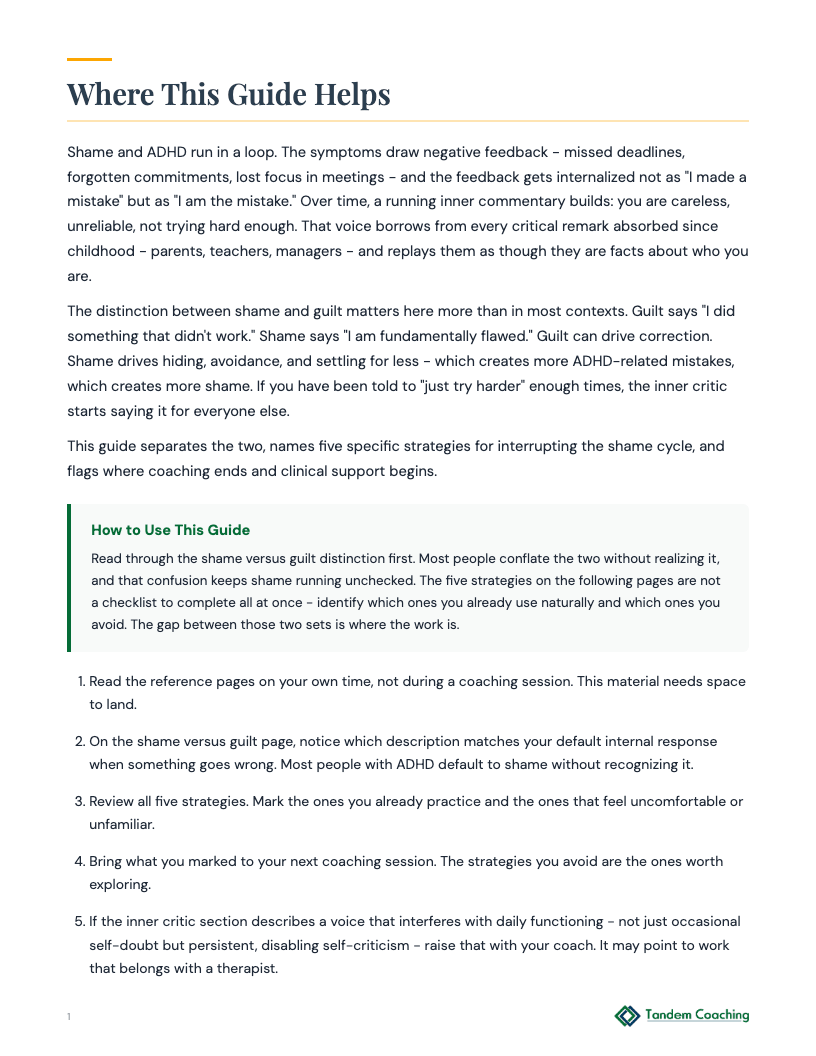
There's a difference between 'I did something that didn't work' and 'I am fundamentally flawed.' That distinction matters for how you respond. This guide maps the shame cycle and five ways to interrupt it.
Browse All Pages
Tool Classification
Domain
ADHD
Type
Framework
Phase
Discovery
Reflection
Details
15 min
Between sessions
Topics
Identity
Mindset
Resilience
For the Coaching Practitioner
Plus
Coaching Scenarios
Plus
1 Global Self-Condemnation After a Single Mistake ▶
Context
A client with ADHD who is a VP of engineering sent a miscalculated cost projection to the executive team, triggering a board-level correction. His response in the coaching session is not 'how do I fix this' but 'I'm not the right person for this role.' He has been VP for eight months and this is his first significant error. The self-assessment has leapt from one mistake to total identity indictment. He cannot currently separate what happened from what it means about him. The coaching focus is on the shame cycle running the interpretation, not the error itself.
How to Introduce
Do not rush to reframe the mistake or list evidence of competence - that addresses guilt (I did something wrong) when the client is in shame (I am wrong). Read back what he said: 'You said you're not the right person for this role. That's a big conclusion from one cost error. Can we look at how we got from that mistake to that verdict?' The guide's shame-versus-guilt distinction gives the coaching conversation a map. Work through it with him: what would guilt look like here? (I made a calculation error, I need to correct it, I need to understand how it happened.) What is shame doing instead? Once he can see the cognitive leap, the guide's five strategies become tools rather than advice.
What to Watch For
Watch for the client intellectually accepting the shame/guilt distinction while his language stays in shame: he says 'I know it's just one mistake' but continues describing his role in absolute terms. The distinction has been understood but not metabolized. Also watch for the client using the challenge strategy (Strategy 3) prematurely - demanding proof from himself before he has named and expressed the shame. Challenge does not work as a first move; recognition and expression come before the evidence review.
Debrief
Start with the five strategies he read: 'Which of these do you already do naturally? Which ones did you skip or feel resistance toward?' The avoided strategies locate where the shame is most protected. For this client, Expression (Strategy 2) is likely the one skipped - admitting the shame out loud to someone feels like confirming the verdict. The gap between which strategies he practices and which he avoids is the coaching contract for the next several sessions.
Flags
- Moderate
Client's shame response extends beyond the work context - he describes not telling his partner about the error, withdrawing from family dinners, difficulty sleeping for more than a week - and the self-condemnation language is intensifying rather than moderating across sessions
Response: Shame that persists and intensifies across multiple weeks while spreading into home and family functioning warrants a referral conversation. Name the scope: 'The pattern you're describing has moved well beyond the work situation and it's been going on for a while. I want to be direct - this level of self-condemnation is worth exploring with a therapist, not just a coach. Are you currently working with anyone clinically?' Continue coaching on the professional situation while being clear about the limits of coaching scope here.
2 The Inner Critic Borrowed from a Specific Manager ▶
Context
A client with ADHD who is a team lead at a software company can identify exactly where her inner critic voice comes from: a manager she worked under for three years who used contempt as a management strategy. She describes hearing that manager's specific phrases in her head when she makes mistakes - word for word, same tone. She has been out of that role for two years but the voice has become her own. She is not aware this is happening as a shame pattern; she experiences it as accurate self-assessment.
How to Introduce
The guide's inner critic section names this precisely - the voice 'borrows their phrasing and tone because it formed when you were young enough to take external judgment at face value.' For this client, that history is recent and named. Frame the guide as a way to externalize what she has internalized: 'The critical voice you're describing is not your assessment of yourself - it's his assessment of you, running on a loop after he's gone. That's a different thing.' Ask her to read Strategy 2 (Express) and the inner critic section during the session, then name what she notices. The act of writing the voice down word-for-word often surfaces how extreme and unexamined the statements are.
What to Watch For
Watch for the client defending the inner critic's accuracy - 'but some of what it says is true.' This is the most common resistance to Strategy 3 (Challenge). Acknowledge the mixed accuracy without accepting the framing: 'Some criticism is useful. The question is whether this voice is doing useful performance feedback or something else.' Also watch for her describing the inner critic as motivating - 'it keeps me from getting complacent.' For some clients, the fear of losing the critic feels like the fear of losing their standards. Distinguish between internal standards and contempt-based self-monitoring.
Debrief
Ask which of the five strategies she already uses: most clients with a specific, identifiable inner critic source have tried Challenge (arguing back) and found it exhausting. The strategy that tends to work better in this case is Expression - getting the critic's statements out of her head and onto paper, where they look like what they are rather than what they feel like. Build one specific practice: 'This week, when you hear that voice, write down exactly what it says. Not a summary - the actual words. We'll look at the list together next session.'
Flags
- Moderate
Client describes the manager's behavior in detail that suggests sustained psychological abuse - targeting, isolation, public humiliation over an extended period - and the impact on her functioning has been significant and lasting
Response: Sustained workplace contempt from a manager can cause trauma responses that look like shame but require trauma-informed clinical support to address fully. Coaching can work with the current behavioral patterns, but the roots of the inner critic in this case may need therapeutic processing. Ask directly: 'Have you had a chance to talk through what happened in that role with a therapist? The impact you're describing goes deep enough that it might be worth doing alongside this work.'
3 EF-Interaction: When the Shame Cycle Drives Avoidance Behavior ▶
Context
A client with ADHD who is a project director has a pattern the team has noticed and her manager has named: after making a visible error, she disappears. She reduces her presence in meetings, delays responses to emails, and becomes vague about project status. She does not experience this as avoidance - she experiences it as 'needing time to recover.' The pattern is creating compounding problems: her disappearance after errors is being read as lack of ownership, which generates more critical feedback, which deepens the shame and extends the disappearance. The guide's ADHD shame cycle maps exactly to what is happening.
How to Introduce
Frame the guide as a diagnosis of the loop, not a judgment about her response: 'There is a specific cycle that ADHD and shame create together. I want to walk through it with you and see if you recognize your situation in it.' Read the shame cycle section together: ADHD symptoms produce visible mistakes, visible mistakes draw negative feedback, negative feedback gets internalized as shame, shame drives avoidance, avoidance produces more visible mistakes. Ask her where she is currently in the cycle. The guide's power for this client is that it names the avoidance not as weakness but as a predictable output of a specific loop. That reframe is the entry point for building a different response.
What to Watch For
Watch for the client accepting the cycle map intellectually while still planning to wait out the current situation before engaging. The ADHD executive function dimension here is task initiation after shame: the avoidance is not just emotional but neurological. The shame creates aversion that ADHD's initiation difficulty amplifies. Recovery behavior - reaching out to the manager, being present in meetings - requires initiating action when the internal state is most aversive to action. The behavioral strategy needs to be concrete and timed, not intention-based.
Debrief
Ask which of the five coping strategies applies most directly to the avoidance pattern. Strategy 1 (Recognize) is where you start - can she identify the moment the disappearance begins? Then Strategy 2 (Express) - has she named the shame to anyone, including herself, out loud? Finally, Strategy 5 (Know When to Refer Out) is worth reviewing together if the cycle has been running for longer than this role - if the pattern predates this job, it may have roots that benefit from clinical exploration alongside coaching.
Flags
- Moderate
Client's avoidance pattern after mistakes has resulted in formal performance consequences - a PIP, a written warning, a role change - and she describes feeling unable to change the pattern even with full awareness of the professional cost
Response: Awareness without behavioral change despite significant professional consequences suggests the shame-avoidance loop may be running at a level that exceeds what coaching alone can interrupt. Be direct: 'You've described understanding the pattern clearly and still not being able to stop it. That quality - knowing and still not being able to act differently - is worth exploring with a therapist who works with ADHD and shame. Coaching can work alongside that, but I want to be honest about what we're dealing with here.'
Tool Flow
Plus
Requires
- None - standalone tool
→
Produces
- shame vs guilt distinction map
- inner critic trigger pattern log
- identified coping strategies to avoid or practice
- coaching-vs-therapy scope boundary flag
Pairs Well With
ADHD
ADHD Letter to Myself
ADHD adult who loses motivation mid-goal and needs something to reconnect with their why
Why it pairsUse this after naming specific critic triggers so the client writes their own counter-voice before shame takes over.
LifeConfidence Evidence and Learning Notes
Use this worksheet to explore identity and mindset and turn the client’s observations into one optional next step.
Why it pairsOnce the client can spot global self-condemnation, building a concrete evidence inventory gives them specific facts to counter that pattern.
LifeBelief and Practice Options Map
Use this planner to organize mindset and habits into a client-owned sequence of possible next steps.
Why it pairsOnce you've logged which domains trigger the inner critic, the mindset map shows exactly where fixed thinking is amplifying shame.
Related Articles


Adaptive ADHD Leadership: 7 Strategies That Work
Read article →
Measuring Progress in ADHD Executive Coaching: Complete Guide
Read article →
Disclosure and Accommodation: A Practical Guide for ADHD Executives
Read article →
ADHD Mentorship: Support Networks That Work
Read article →